Last updated: October 24, 2026
Every Kia EV you can actually buy in America in late 2026 fits on a short list, and every one of them is a money question before it is a car question. Three models are genuinely on sale: the EV3 from $29,890, the EV6 from $37,900 and the EV9 from $54,900. Three more wear the same badges and star in the same adverts, yet you cannot buy them here at any price. This guide separates the two groups, runs the value math Kia leaves off the window sticker, and scores each model on the only three things that decide whether an EV is worth its loan payment: range, charging and value. All prices in this guide were checked on October 24, 2026, and are MSRP before destination charges unless a figure says otherwise.
One piece of housekeeping first, because it changes every calculation below. The $7,500 federal EV tax credit ended on September 30, 2025. Gone. Whatever a Kia EV costs now, it costs in full, which is exactly why the per-mile math in this guide matters more than it did two years ago. If you want the wider market picture before narrowing to one brand, our guide to electric cars, their range, charging and running costs covers the full field; this page is for readers who have already landed on Kia and want to know where the money is well spent and where it leaks away.
The Kia EV lineup you can actually buy in America
Kia’s global electric range runs from the little EV2 up to the EV9, and Kia’s own global EV lineup page shows the lot. America’s slice is smaller. The EV3, EV6 and EV9 are the buyable three. The Niro EV is in its final model year, with production ended and dealers clearing remaining stock. The EV4 sedan was shown in New York in April 2025 with a planned early-2026 launch, then delayed indefinitely once tariffs and the end of the federal credit rewrote its business case. The EV5 is sold in Canada and nowhere else in North America. The PV5 electric van is headed to Canada in late 2026, and Kia has confirmed it has no plans to sell the van in the United States.
So the real showroom looks like this.
| Model | Starting price (MSRP) | Battery | Best EPA range | DC fast charging | US status |
|---|---|---|---|---|---|
| Kia EV3 | $29,890 | 58.3 / 81.4 kWh | 321 miles | 400V, 10–80% in about 29–31 min | On sale (2027 model year) |
| Kia EV6 | $37,900 | 63.0 / 84.0 kWh | 319 miles | 800V, 10–80% in about 18 min | On sale |
| Kia EV9 | $54,900 | 76.1 / 99.8 kWh | 305 miles | 800V, 10–80% in about 24 min | On sale |
| Kia Niro EV | $39,700 | 64.8 kWh | 253 miles | 10–80% in about 45 min (est.) | Final year; remaining stock only |
| Kia EV4 | Was expected from about $39,000 (est.) | 58.3 / 81.4 kWh | Up to 330 miles (est.) | 400V | Delayed indefinitely |
| Kia EV5 | From CAD $43,495 in Canada | 60.3 / 81.4 kWh | About 285 miles (est., from Canadian ratings) | 400V, 10–80% in about 30 min | Canada only |
Notice the pattern a budget shopper should spot straight away. The two cheapest routes into a Kia EV, the EV3 Light at $29,890 and the Niro EV at $39,700, carry the two smallest batteries in the table. Cheap sticker, short legs. The value in this range hides one step up the ladder, and the next section proves it with arithmetic.
Dollars per mile of range: the Kia EV math nobody prints
Here is the computation we run on every EV lineup and no manufacturer will ever publish: divide the sticker price by the EPA range and you get the cost of each mile of range you are buying. It punishes small batteries and exposes fake bargains ruthlessly.
Start with the EV3. The Light trim at $29,890 with its 58.3 kWh battery and 221 miles of EPA-estimated range works out to $135.25 per mile of range. The Wind trim at $34,990 carries the 81.4 kWh battery and 321 miles of range, which lands at $109.00 per mile. Read those two numbers again. The trim that costs $5,100 more is roughly 19% cheaper for the thing you are actually purchasing, which is distance between charges. Put differently, the step from Light to Wind buys 100 extra miles at $51 per mile, the cheapest range upgrade anywhere in Kia’s catalogue.
The EV6 tells the same story one rung up. The base Light at $37,900 and 237 miles costs $159.92 per mile of range. The Light Long Range at $41,200 and 319 miles costs $129.15 per mile. That $3,300 step buys 82 extra miles at $40.24 each, again far better value than the headline trim. The EV9 is where the arithmetic turns hostile: the Light RWD at $54,900 with the small 76.1 kWh battery and 230 miles costs $238.70 per mile of range, the worst figure in this entire guide. The Wind AWD at $63,900 with the big battery and 283 miles improves it to $225.80 per mile, still more than double the EV3 Wind’s figure. Big cars carry big batteries and big prices; the EV9’s numbers simply refuse to flatter it.
And the Niro EV? At $39,700 and 253 miles it sits at $156.92 per mile of range, within a few dollars of the base EV6, a car built on a dedicated EV platform with far faster charging. That single number explains why Kia killed it.
Filling the battery is the second half of the ledger. At an average US residential electricity price of about 17 cents per kWh (est.), a full home charge costs roughly $9.91 for the EV3’s small battery, $13.84 for the big one, $14.28 for the EV6’s 84.0 kWh pack and $16.97 for the EV9’s 99.8 kWh pack. Per 100 miles of driving, the EV6 used 31 kWh in Edmunds’ independent testing, which is $5.27 of home electricity; the EV9’s EPA figure of 38 kWh per 100 miles works out to $6.46. A comparable gas SUV at 30 mpg and $3.40 a gallon (est.) burns $11.33 of fuel over the same 100 miles. Run your own household version of this comparison in our EV total cost of ownership calculator, because your electricity tariff moves these numbers more than any trim choice does.
EV3: the $29,890 headline and the $5,100 catch
The EV3 is the car this whole guide secretly revolves around, because it is the first Kia EV with a sticker under $30,000. American sales started in mid-August 2026 as a 2027 model, built in Mexico, and it arrived with a 2025 World Car of the Year trophy already on the shelf. Light trim: $29,890, 58.3 kWh battery, 221 miles of EPA-estimated range, front-wheel drive. Add the $1,495 destination charge and the real starting figure is $31,385. Still cheap. Still not the one to buy.
My first opinion in this guide, stated plainly: skip the Light. The Wind at $34,990 is the actual base model for anyone who drives beyond their own postcode. You get the 81.4 kWh battery, 321 miles of range, the same cabin, the same standard vehicle-to-load power export, the same native Tesla Supercharger port. The Light exists so Kia can advertise a number starting with 29. The Wind exists so you can drive to another city.
The trim ladder after that deserves suspicion, which is my job here. Wind AWD at $38,690 drops range to 280 miles; you are paying $3,700 for driven rear wheels and losing 41 miles for the privilege. Land FWD at $38,490 keeps the 321 miles and adds equipment. GT-Line AWD is $43,490 and the 288 hp GT AWD tops the range at $45,890, with an EPA-estimated 280 miles. A $45,890 EV3 is a strange object: the same money buys an EV6 Long Range with faster charging and a bigger cabin. Discipline, shoppers. The EV3 makes sense between $31,385 and about $36,500 all-in, and dealers are already helping: within weeks of launch the EV3 was carrying up to $1,500 of customer cash on Light and Wind trims plus 0.9% finance offers, according to Autoblog’s September 2026 reporting. Never pay sticker for a freshly launched Kia. The deals arrive before the brochures fade.
Charging is the EV3’s honest compromise. It runs a 400-volt system rather than the 800-volt hardware in the EV6 and EV9, so a 10–80% DC fast charge takes about 29 to 31 minutes depending on battery. At a home wallbox it simply charges overnight like everything else. For a car bought to save money, that compromise is correctly chosen: the 800-volt kit costs money the EV3’s buyers would rather keep.
Our score: Kia EV3 (Wind FWD) — 8.7/10. Range: 9/10. Charging: 6/10. Value: 10/10. The Light trim on its own scores 7.4/10 (Range 6/10, Charging 6/10, Value 8/10), which is the whole argument of this section in three numbers.
EV6: the road-tripper’s sweet spot, priced like it knows
The EV6 is the oldest car in this guide and still the hardest to argue against. For 2026 it starts at $37,900 for the Light with a 63.0 kWh battery, 167 hp and 237 miles of range; with destination, Cars.com listings put the starting figure at $39,445. The Light Long Range at $41,200 MSRP swaps in the 84.0 kWh battery and stretches range to 319 miles. Wind RWD is $46,345 including destination, GT-Line AWD tops the mainstream range at $54,545 including destination, and the 641 hp GT that used to headline the range has been dropped from US order books for 2026, one more casualty of the tariff reshuffle. Good riddance, frankly. The GT was a party trick; the Long Range cars are the product.
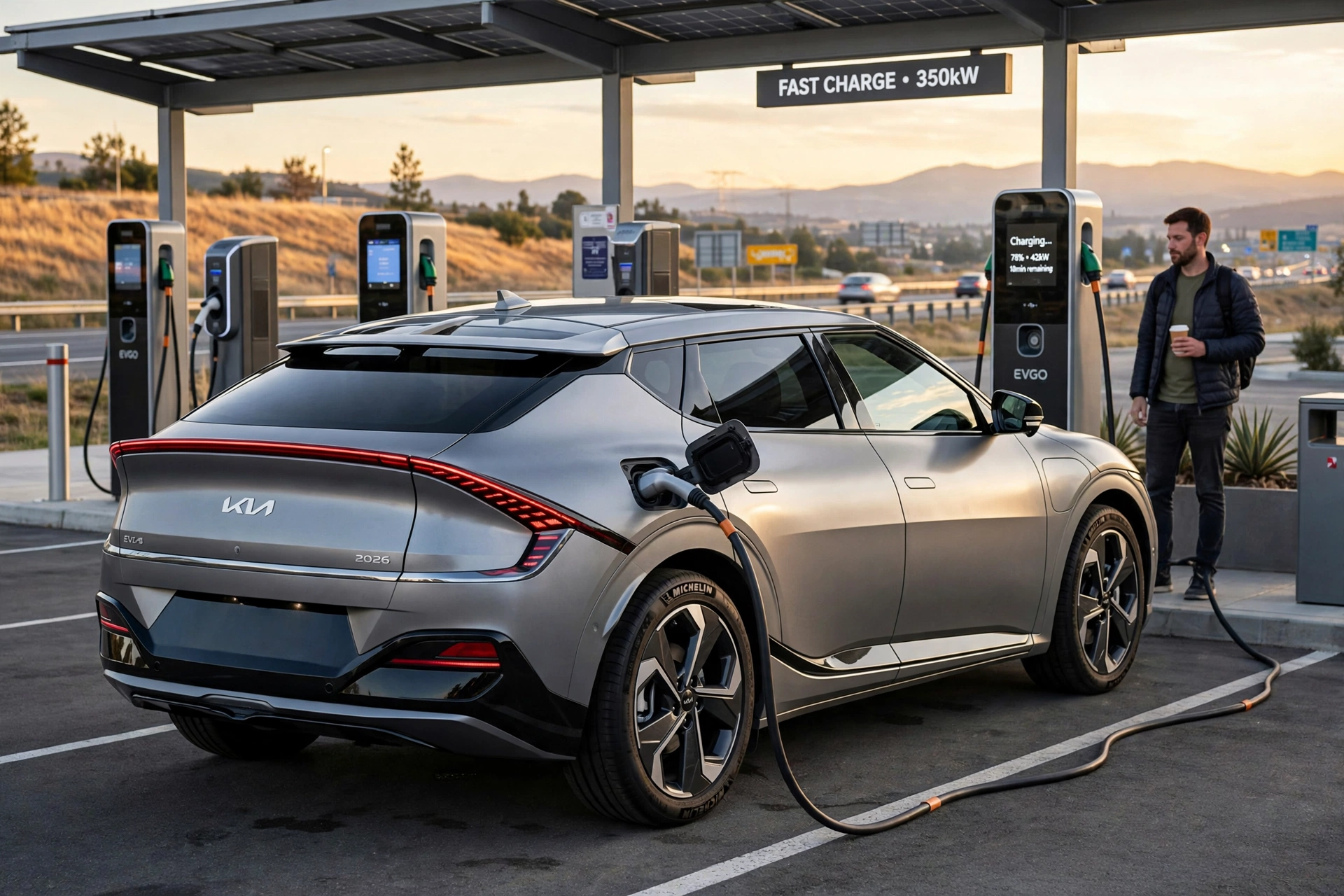
Charging is where the EV6 humiliates cars costing twice as much. Its 800-volt architecture peaks at around 240–258 kW depending on the source you read, and Kia quotes 10–80% in about 18 minutes. Independent testing backs the claim with interest: in the Edmunds EV Charging Test, an EV6 GT-Line added range at 592 miles per charging hour, roughly 100 miles in 10 minutes, second only to its Hyundai Ioniq 5 cousin. In the Edmunds EV Range Test the same all-wheel-drive GT-Line covered 296 miles against a 270-mile EPA rating, and a rear-drive EV6 Wind managed 310 real-world miles in Edmunds testing. Check the official figures for each configuration at fueleconomy.gov before you sign anything; the spread between wheel sizes alone is worth 25 miles.
Cross-shopping note, because this is where Kia money gets spent twice. The EV6 shares its platform with the Hyundai Ioniq 5, and the two trade blows on price month by month. Before committing to an EV6 deal, scan the current Hyundai Ioniq 5 lease deals; more than one buyer has used a Hyundai quote to knock four figures off a Kia. The EV6 fights back with standard kit the options list cannot touch: the full Drive Wise safety suite is standard on the base Light, both 12.3-inch screens are standard, and Kia’s EV powertrain warranty runs 10 years or 100,000 miles.
Our score: Kia EV6 (Light Long Range) — 8.8/10. Range: 8/10. Charging: 10/10. Value: 8/10. The base Light scores 7.9/10 (Range 6/10, Charging 10/10, Value 7/10). Nothing else under $45,000 charges this fast; that is not an opinion, it is a stopwatch result.
EV9: three rows, seven seats, one very large bill
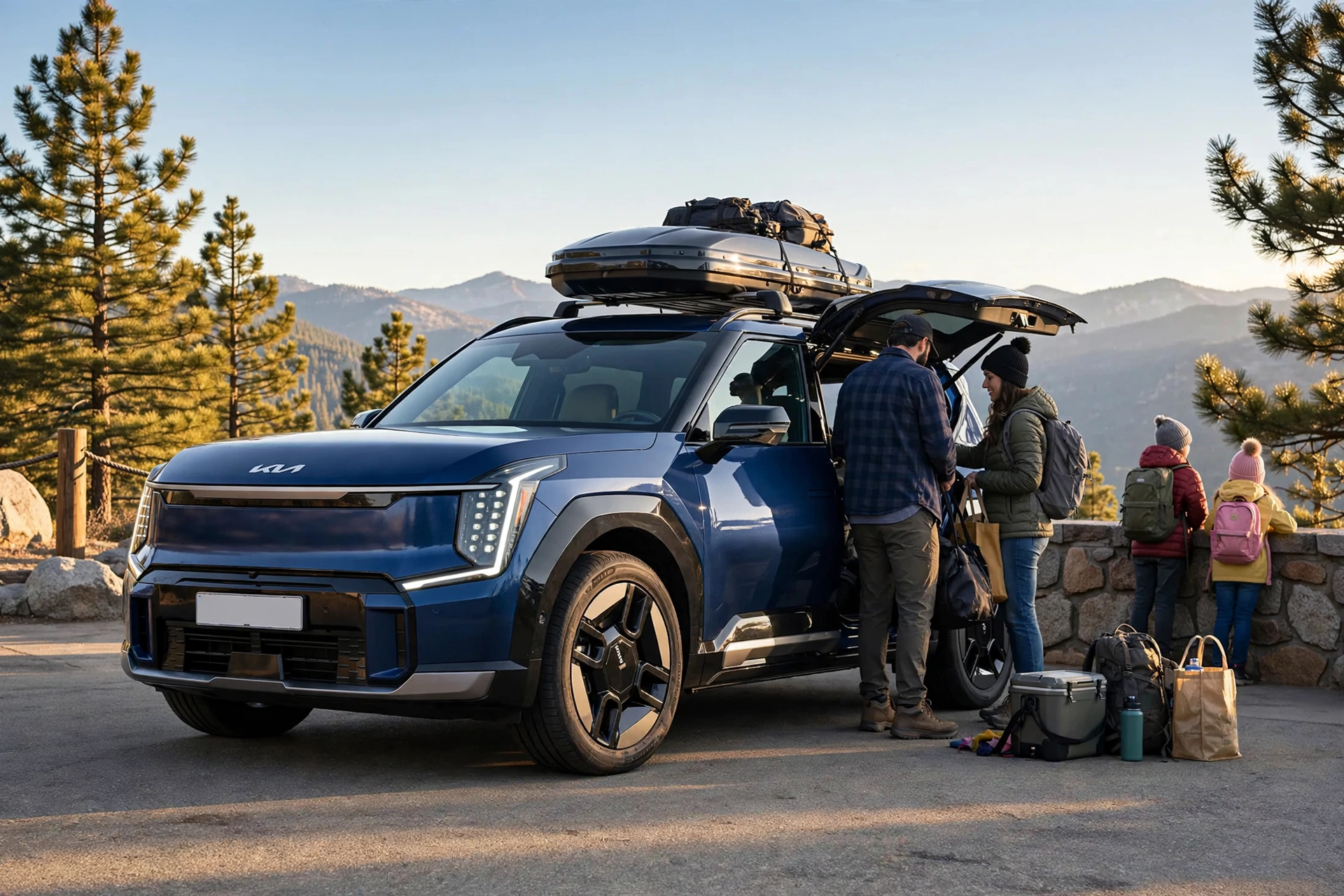
The EV9 is the only electric Kia that can carry seven people, and it charges family-hauler prices for the privilege: $54,900 to start, $71,900 at the GT-Line summit, all before destination. The range story splits cleanly by battery. The Light RWD’s 76.1 kWh pack gives 230 miles. The Light Long Range’s 99.8 kWh pack gives 305 miles. Wind and Land AWD give 283 miles, GT-Line AWD 280 miles, and every version tows up to 5,000 lb when properly equipped.
Second opinion, and I will not soften it: the base EV9 is the worst-value car in this entire guide. A $54,900 family SUV with 230 miles of range asks its owners to plan every holiday around a charger, and its $238.70-per-mile-of-range figure, from our own math above, is the evidence. The honest entry point is the Light Long Range, or the Wind AWD at $63,900, which Autoblog’s pricing guide also flags as the range’s best-value trim: 379 hp, captain’s chairs, 283 miles. The GT-Line’s extra $8,000 over the Wind buys styling and equipment, not a single extra mile. Spend it if you love it, but know that is what you are doing.
Charging partially redeems the bill. The EV9 shares the 800-volt architecture, filling the big battery from 10–80% in about 24 minutes, and it offers vehicle-to-load export powerful enough to run home appliances in an outage. Real-world range needs one honest note: Car and Driver’s 75 mph highway test of an EV9 GT-Line returned 240 miles against a 270-mile EPA figure for that configuration, a typical highway haircut for a tall, blunt SUV, and a reason to budget the big battery if your life involves freeways. The 1,000 kWh of free Electrify America charging Kia bundles with the EV9 is a genuine sweetener; at public-charging prices that credit is worth several hundred dollars (est.).
Our score: Kia EV9 (Wind AWD) — 8.4/10. Range: 7/10. Charging: 9/10. Value: 7/10. The base Light RWD scores 6.8/10 (Range 5/10, Charging 9/10, Value 6/10). Families who need the seats have few alternatives at this price; families who merely like the look should price an EV6 and a roof box.
The ones America doesn’t get: EV4, EV5, PV5 and the Niro EV’s last lap
A word for the ghosts, because their absence shapes US prices. The EV4 was supposed to be Kia’s electric sedan, 201 hp, 400-volt, up to about 330 miles from its big battery, priced from roughly $39,000 (est.). Kia unveiled the US version in New York in April 2025, then delayed the launch indefinitely as tariffs on Korean-built cars and the loss of the federal credit destroyed its price point. Edmunds drove the car overseas and rated it highly, which only sharpens the sting. Canadians can buy one. Detroit cannot. Cross-border envy is not a purchasing strategy, so treat the EV4 as a 2027-or-later story.
The EV5, a Sportage-sized SUV on the 400-volt platform with up to about 285 miles of range (est. from Canadian ratings), is exclusive to Canada in North America, from CAD $43,495. The PV5 van follows the same pattern: Canada in late 2026, no US plans, despite fleet buyers here paying far more for electric vans from rival brands. Both decisions are tariff arithmetic, not product judgement, and both could reverse if trade rules change.
The Niro EV deserves a respectful paragraph on its way out. The 2026 model, $39,700 for the Wind and $44,700 for the Wave per CarBuzz’s pricing report, offers 253 miles from a 64.8 kWh battery and a perfectly pleasant drive. Its problem is pure arithmetic: at $156.92 per mile of range it costs EV6 money while charging at roughly half the speed (10–80% in about 45 minutes, est.). Production has ended, so what remains is a clearance negotiation. A Niro EV at a heavy discount is a sensible commuter. A Niro EV at sticker is a donation to the dealership.
Our score: Kia Niro EV — 5.9/10. Range: 6/10. Charging: 4/10. Value: 5/10 at sticker, rising a full point for every $3,000 negotiated off (est., our rule of thumb for a discontinued model).
Which Kia EV for whom
The commuter on a budget: EV3 Wind. $34,990, 321 miles, $109.00 per mile of range, about $13.84 to fill at home. Nothing else in this guide is close, and nothing else at this price is close either.
The road-tripper: EV6 Light Long Range. 319 miles, 18-minute fast charges, 310 real-world miles in Edmunds testing of the Wind. Your stops will be shorter than your coffee queue.
The family of six or seven: EV9 Wind AWD, with the Light Long Range as the thinking alternative if you can live without all-wheel drive. Budget the big battery or do not buy the car.
The negotiator: Niro EV, but only against a written discount. The model is discontinued, the replacement is on the lot beside it, and the dealer knows both facts.
The patient: wait. The EV4’s delay is officially indefinite rather than permanent, the EV5 could follow the EV3’s path from Canada-only to US sale, and every quarter of soft EV demand improves the deals on the cars already here.
Frequently asked questions
Which Kia EV is the cheapest to buy and run?
The EV3. The Light starts at $29,890 ($31,385 with destination) and the Wind at $34,990, and our price-per-mile-of-range math puts the Wind at $109.00, the best value figure in the Kia EV range. It is also the cheapest to fill, at roughly $9.91 to $13.84 per full home charge depending on battery (est. at 17 cents per kWh).
Is the Kia EV3 really under $30,000?
The sticker is: $29,890 before the $1,495 destination charge, so $31,385 is the true floor before tax and fees. Within weeks of its August 2026 US launch, dealers were already advertising up to $1,500 of customer cash on the Light and Wind, so transaction prices under the headline are realistic.
Why can’t I buy a Kia EV4 or EV5 in the United States?
Tariffs and the end of the $7,500 federal credit. Kia delayed the EV4 indefinitely before its planned early-2026 US launch and made the EV5 a Canada-exclusive model for North America. Both decisions are economic rather than technical, and both could change if trade or incentive rules change.
How fast does a Kia EV charge?
It depends on the badge. The 800-volt EV6 and EV9 are among the fastest-charging EVs at any price: about 18 minutes and 24 minutes respectively for a 10–80% DC fast charge, with the EV6 adding roughly 100 miles in 10 minutes in Edmunds’ independent charging test. The 400-volt EV3 and EV5 need about 29–31 minutes, and the Niro EV about 45 minutes (est.).
Does any Kia EV still qualify for the $7,500 federal tax credit?
No. The federal clean vehicle credit ended on September 30, 2025, for every brand. Any dealer advertising a Kia EV price that quietly assumes the credit is doing arithmetic you should walk away from; negotiate on the real number instead.
Is the Niro EV a good buy now that it has been discontinued?
Only at a discount. At its $39,700 sticker it costs as much per mile of range as an EV6 while charging far more slowly. With production ended and dealers clearing stock, the negotiating power sits with you: a Niro EV bought several thousand dollars under sticker is a solid 253-mile commuter, and Kia’s 10-year/100,000-mile powertrain warranty still applies.