Last updated: October 24, 2026
A tesla model s 70d battery swap is the decision almost every 70D owner eventually has to think through, because the maths changed in 2024. That is when the last of these cars — built for the 2015 and 2016 model years — aged out of Tesla’s eight-year battery warranty. The car itself is still solid. The motors still pull. But the pack underneath is now entirely your financial problem, and the first quote most owners receive from a Tesla Service Center lands somewhere between $13,000 and $22,000 (prices checked October 24, 2026). This guide walks through what each route really costs per usable kilowatt-hour — and how to tell whether your car needs a whole pack at all. Read it slowly. The cheapest correct answer is rarely the first one quoted.
First, Read Your Degradation Curve — Not Just the Warning Light
Battery packs almost never die the way people imagine. There is no cliff edge. A healthy lithium pack follows a curve: a noticeable drop in the first two or three years, then a long, shallow slope that can stretch for a decade. The 70D left the factory with a 70 kWh pack, roughly 65.9 kWh of it usable, and an EPA rating of 240 miles — fueleconomy.gov still lists the car at 101 MPGe and 33 kWh per 100 miles. A decade on, a well-kept 70D at 130,000 to 180,000 miles typically shows 190 to 215 miles at a full charge (est., based on the 85 to 90 percent capacity retention that fleet tracking of early Model S cars consistently reports). That is degradation. It is normal — and not, on its own, a reason to swap anything.
Failure is a different animal. Failure looks like a car that will not charge past 40 percent. A “high voltage battery fault” message that arrives overnight, on a car that drove fine yesterday. Range that falls off a ledge in six weeks rather than six years. Those symptoms usually trace back to one weak module among the fourteen inside the 70 kWh pack, a battery management fault, a contactor, or coolant where coolant should never be. Tesla’s service model does not open packs. Tesla replaces the whole unit, which is why their quote is always the big number. Independent specialists can open the pack, and that single difference is worth thousands of dollars.
So before you price a swap, get a diagnosis. A proper one. That means a capacity test and a module-level voltage report, not a dashboard screenshot. If your car has lost range gradually and evenly, you almost certainly have degradation, and the honest advice is to keep driving it. If one module is dragging the pack down or the car has thrown isolation faults, you have a repair-or-replace decision, and the rest of this guide applies to you.
What a Tesla Model S 70D Battery Swap Actually Involves
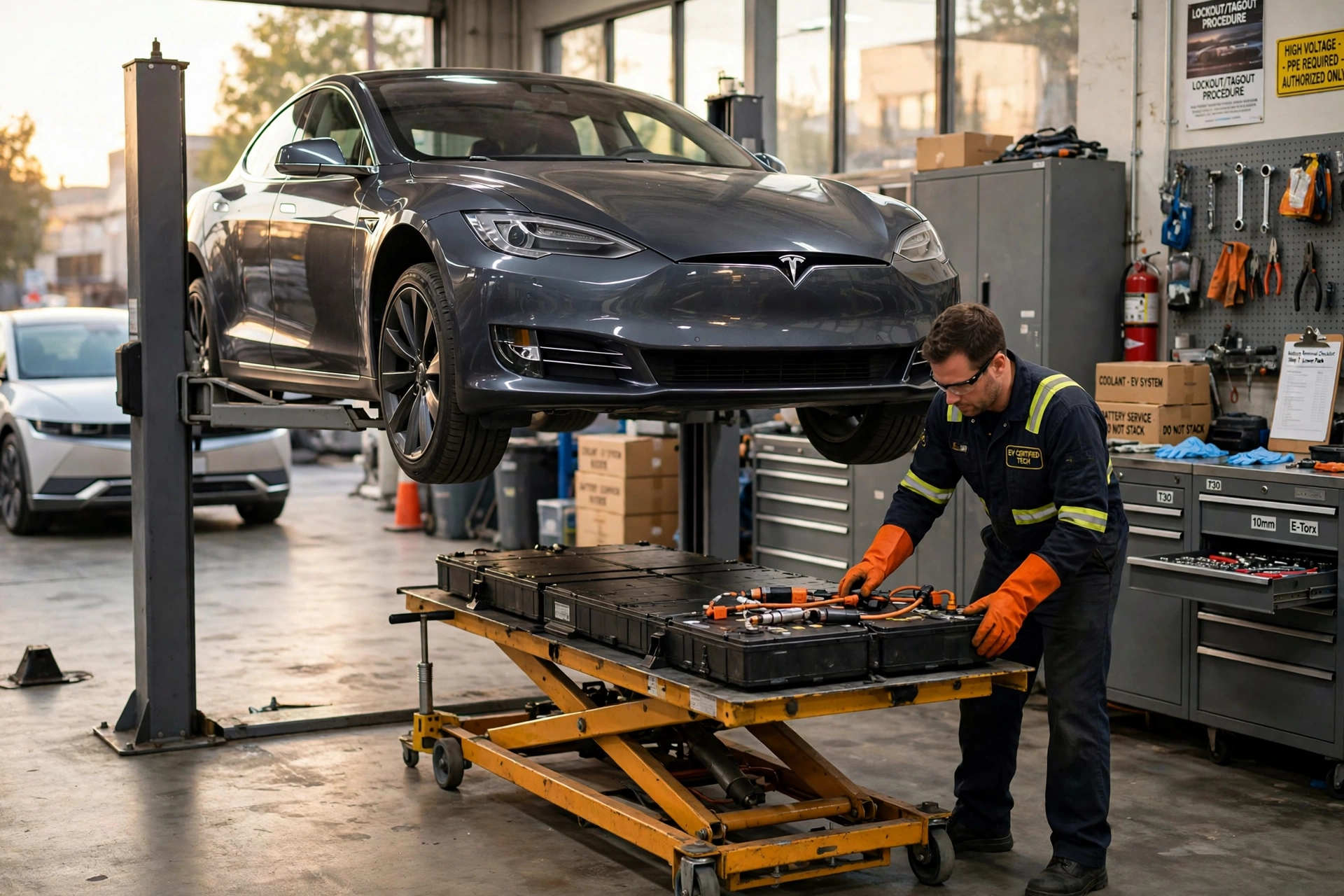
The physical job is more elegant than people expect. Pre-2021 Model S cars were built around Tesla’s Rapid Mate connector system, designed back when the company seriously intended battery-swap stations. The pack is a flat slab forming the floor of the car. On a lift, a technician disconnects the high-voltage and coolant lines, unbolts the pack, and lowers roughly 1,200 pounds of battery (est.) onto a lift table. The replacement goes up the same way. In a clean car, the mechanical work is a few hours.
The catch lives in two places. The first is corrosion: road salt attacks the fasteners and fittings on a ten-year-old underbody, and published shop data puts total swap times anywhere from 3 to 13 hours depending on the state of the car underneath. At Tesla’s reported labour rates of $175 to $200-plus per hour, that spread alone is $525 to $2,600 of labour. The second catch is software. The car must be told what pack it now carries. Configuration changes, firmware matching, and error clearing are part of every swap, and a mismatched configuration can leave a mechanically perfect installation throwing faults. This is routine work for an experienced Tesla specialist. It is not a Saturday-afternoon project, and the safety section below explains why.
Tesla Model S 70D Battery Swap Costs: The Three Routes Compared
There are three realistic routes for a 70D in 2026, plus one tempting shortcut we will deal with honestly. Prices below are US figures gathered from service quote roundups and specialist listings, checked October 24, 2026; every range is wide because pack supply and regional labour rates genuinely move these numbers.
| Route | Typical all-in cost (est.) | What you get | Warranty |
|---|---|---|---|
| Tesla Service Center — remanufactured pack | $13,000–$18,000 | Factory remanufactured pack, often a software-limited 75 or 90 kWh unit because original 70 kWh packs are largely discontinued; whole-pack replacement only | Tesla parts warranty; capacity guaranteed at least equal to your pack before failure |
| Tesla Service Center — new 90 kWh upgrade | $20,000–$22,000 | Brand-new larger pack fitted by Tesla with factory configuration | Tesla parts warranty |
| Independent specialist — remanufactured/refurbished pack | $7,000–$12,000 | Rebuilt pack from tested, balanced modules, fitted by shops such as Recell, Greentec Auto or Electrified Garage | Typically 1–4 years from the specialist (est.); service may be restricted to their own centers |
| Independent specialist — 100 kWh upgrade (used pack) | $11,000–$14,000 | Good used 100 kWh pack from a wrecked newer car, fitted and configured by a specialist | Specialist warranty, commonly 1–2 years (est.) |
A few notes on that table. The independent figures reflect a deep salvage market: the Model S has been on the road since 2012, so tested used packs and the shops that rebuild them are easier to find than for any other EV. One documented pattern worth knowing — an owner quoted around $20,000 by Tesla resolved the same fault for under $9,000 through an independent specialist. That gap is the whole reason this guide exists. For a broader picture of how pack prices vary by model, our guide to Tesla battery replacement costs covers the rest of the range, and if you want a figure tailored to your own car, the site’s battery replacement cost estimator will build one from your mileage and symptoms.
Route One: Tesla Service — Simple, Supported, Expensive
Tesla’s process is deliberately boring: diagnose, quote a remanufactured pack, swap the whole unit, hand the car back with factory software and a parts warranty behind the work. Tesla’s own warranty language promises that a replacement battery will have capacity at least equal to what your pack had before it failed — a detail in Tesla’s Model S warranty document that matters, because it means Tesla is not obliged to hand you a healthier pack than the one you lost, only an equivalent one. In practice, because the original 70 kWh pack is largely discontinued, owners frequently receive a 75 or 90 kWh pack that Tesla has software-limited. You may get the extra capacity released. You may not. Ask before you sign, in writing.
Our score: Tesla remanufactured swap — 7.3/10. Cost 5/10 — the highest price of the three routes for the least capacity gained. Longevity 8/10 — a factory reman pack with balanced modules should give years of shallow-curve service. Risk 9/10 — factory configuration, factory warranty, no software surprises. If money were no object, this is the route. Money is an object for nearly everyone reading this.
Route Two: A Remanufactured Pack From an Independent Specialist
Specialists such as Recell, Greentec Auto, Gruber Motor Company and Electrified Garage have built a real industry around the early Model S. The good ones test every module, replace weak ones, balance the pack, and sell you the result with a written warranty — Recell, for example, advertises multi-year coverage on its remanufactured packs, with round-trip vehicle shipping from $395, though warranty work must be done at their own service centers. That last condition is the trade you are making. The price is dramatically lower. The safety net is narrower and further away.
Ask any specialist three questions. What is the tested capacity of the exact pack going into my car, in kilowatt-hours, measured how? What does the warranty cover — capacity floor, labour, shipping? And what happens if the car throws faults after a Tesla software update? A shop that answers all three precisely is a shop that has done this hundreds of times. A shop that waves at them is selling you someone else’s core charge.
Our score: independent remanufactured swap — 6.7/10. Cost 8/10 — routinely $4,000 to $7,000 less than Tesla for equivalent range. Longevity 6/10 — the modules are used, however well tested, and the curve resumes from wherever those modules left off. Risk 6/10 — quality varies by shop, and warranty logistics can mean shipping your car across the country. For a sound car with a single failed pack, this is where most owners should start their quotes. Our explainer on how EV battery packs are built and why they age is worth ten minutes before you talk to any of them.
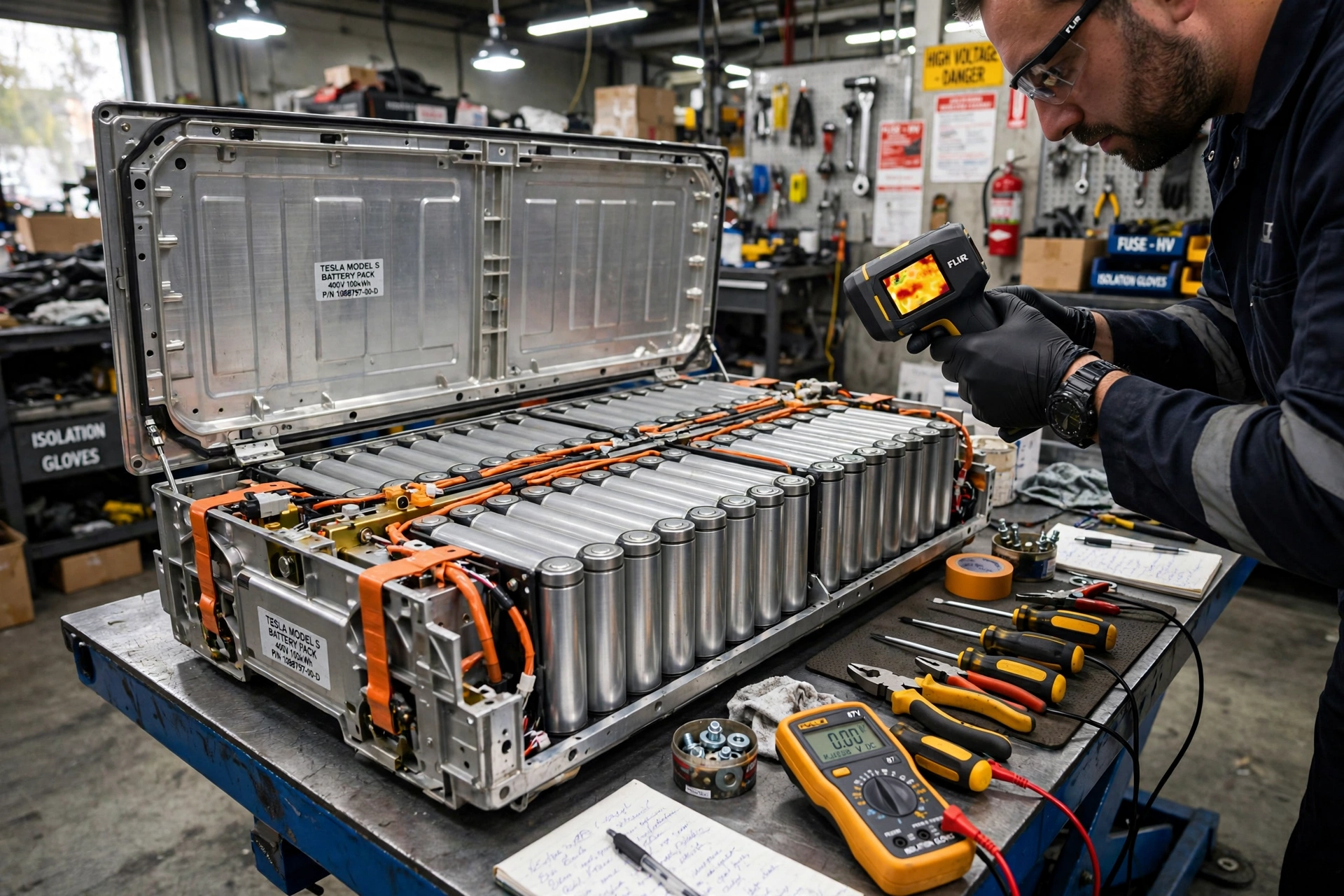
The Shortcut We Do Not Recommend: Module-Level Repair
Here is a clear opinion, stated plainly. Replacing one failed module in a ten-year-old 70 kWh pack is usually money spent postponing this same conversation. The repair itself is real — specialists like Gruber will open a pack and replace a failed module, and quotes in the $3,000 to $6,000 range (est.) look wonderful next to $14,000. The problem is the curve. If one module has aged to failure, its thirteen siblings have lived the same life, at the same temperatures, through the same cycles. The pack is only as strong as its weakest module, and you have just installed a strong module into a weak field. Owners do sometimes get years from a module repair. Owners also come back in eight months with the neighbouring module down. Unless diagnostics prove a genuinely isolated early failure — a manufacturing defect, a single coolant-damaged module in an otherwise healthy pack — treat module repair as a way to sell the car honestly, not as a way to keep it.
Route Three: The 100 kWh Upgrade — Can You Fit a Bigger Pack?
Yes, with conditions, and this is where the 70D gets interesting. The 75 and 90 kWh packs are straightforward upgrades; Tesla itself will fit a new 90 kWh pack for around $20,000 to $22,000. The 100 kWh pack is the one everyone asks about, because it turns a 240-mile car into a roughly 300-mile car (est.). Tesla will not fit it to a 70D. Their stated reasons are mechanical: the 100 kWh pack uses different connectors and fluid fittings, it weighs substantially more — around 1,375 pounds against roughly 1,200 for the 70 (est.) — and the suspension and airbag calibrations on 100 kWh cars were set for that weight.
Independent specialists fit them anyway, carefully. The documented example everyone cites is a 2015 Model S 70D with more than 470,000 miles, upgraded by its owner — an EV mechanic — with a used 100 kWh pack sourced from a wrecked car for $8,500 plus $1,000 freight; his estimate for the same job done for a paying customer was about $12,000, and range rose by roughly 50 percent. Expect error codes and at least one anxious software update along the way; that job produced both. The larger pack also brings a charging bonus nobody advertises: the 70 kWh pack is a roughly 350-volt design that Supercharges modestly, while the 85/90/100 packs are 400-volt-class units that hold higher charging speeds for longer. Same car. Noticeably shorter stops.
Two honest limits. First, the weight is real — a 100 kWh swap in a coil-sprung car deserves a suspension conversation with your installer, not a shrug. Second, a bigger used pack is still a used pack; its curve depends on the donor car’s history, so the tested-capacity paperwork matters even more here.
Our score: 100 kWh upgrade via a specialist — 7.0/10. Cost 8/10 — the cheapest capacity money can buy, as the next section proves. Longevity 8/10 — a healthy 100 kWh pack in a 70D lives an easy life, rarely asked for its full output. Risk 5/10 — software configuration, weight, and donor-pack history all sit on your side of the ledger. Our second clear opinion: if you intend to keep the car three years or more, this is the smartest of the three routes. Not the safest. The smartest.
Our Own Maths: Cost Per Usable kWh, and the Swap-or-Sell Break-Even
Comparing quotes by headline price is how owners overpay. Compare them by what you actually receive: usable kilowatt-hours, and miles of range. Using mid-range all-in figures from the table above and the tested usable capacities a buyer should demand in writing (all est., calculated October 24, 2026):
| Route | All-in cost used | Usable capacity restored (est.) | Cost per usable kWh | Range after swap (est.) | Cost per mile of range |
|---|---|---|---|---|---|
| Tesla remanufactured | $14,500 | 62 kWh | $234 | 225 miles | $64 |
| Independent remanufactured | $9,500 | 60 kWh | $158 | 215 miles | $44 |
| 100 kWh upgrade (specialist) | $12,000 | 93 kWh | $129 | 300 miles | $40 |
Read that middle column again. The biggest pack is the cheapest electricity you can buy for this car — $129 per usable kWh against $234 through Tesla — because a used 100 kWh pack costs barely more than a used 70-class pack while carrying half as much capacity again. Nobody else publishes this comparison for the 70D, and it flips the usual assumption that the upgrade is the extravagant option.
Now the break-even. Say your 70D’s pack has failed outright. As it sits, the car is worth roughly $5,500 to a specialist buyer (est.). Running and healthy, a tidy 70D is worth about $14,000 (est.). Fit the $9,500 independent remanufactured pack and you hold a $14,000 car for $9,500 spent — and if you keep it four years at 12,000 miles a year, the pack money works out to about 20 cents per mile before any other running costs. Sell the dead car instead and you have $5,500 toward a replacement; a comparable used EV at $16,000 leaves you $10,500 out of pocket for a car whose battery history you know less well than your own. The swap wins on these numbers — unless the rest of your car is tired. If it also needs $4,000 of suspension, brake and interior work, the honest total is $13,500 into a $14,000 car, and selling wins. Rule of thumb (est.): a swap makes financial sense when the quote lands under roughly two-thirds of the car’s healthy market value, and the car underneath the pack is genuinely sound.
Safety: The Section to Read Twice
Everything above sits on top of one non-negotiable fact. A Model S pack stores enough energy, at 350 to 400 volts DC, to kill a careless person quickly and without drama. There is no warning buzz. DC arcs do not let go. The pack also weighs more than half a ton, contains a glycol coolant loop plumbed through it, and its cells can enter thermal runaway if a damaged pack is handled, charged or stored wrongly.
So the rules are simple and absolute. Nobody without high-voltage training, insulated Class 0 gloves, rated tools and a proper lift table opens or drops one of these packs — not as a favour, not to save money, not because a video made it look easy. A reputable shop will show you its lockout procedure, its insulated-tool cabinet, and how it verifies zero voltage before a hand goes near a busbar. If a shop cannot show you those things, leave, however good the quote was. This applies to buyers too: a bargain pack of unknown history, crash-damaged or flood-exposed, is not a bargain. It is a stored fire with a delivery date.
Warranty, Supercharging and Resale: What Changes After a Swap
Three practical consequences follow any swap. First, the pack’s warranty now belongs to whoever fitted it. Tesla will not warranty a third-party pack, and can reasonably decline related claims on systems the swap touched; your drive units and the rest of the car are a separate matter, but expect any grey area to be argued from their side. Get the specialist’s warranty in writing, with its capacity floor and its service-location conditions, before the car goes on the lift.
Second, charging entitlements. Many 2015–2016 cars carry free unlimited Supercharging, and that entitlement is attached to the car rather than the pack — owners who have upgraded packs report keeping it, which is one more reason the upgrade maths works so well on these particular cars. Confirm your car’s status before the swap, not after.
Third, resale. A documented swap with a tested-capacity report and a transferable warranty adds value to a 70D; an undocumented one subtracts it, because the next buyer prices in the unknown. Keep every invoice, every test sheet, every before-and-after range log. Paperwork is part of the repair.
Making the Next Pack Last Longer Than the First
However you replace it, the replacement pack’s curve is partly in your hands. Live between 20 and 80 percent charge for daily driving and save full charges for trip days. Favour home charging over DC fast charging when you have the choice — heat and high charge rates are the two accelerants every degradation study finds. Keep the car plugged in during hard freezes and heatwaves so the pack can condition itself from the wall rather than from its own cells. Degradation is a slope. These habits are how you make yours the shallow one.
Frequently Asked Questions
How much does a Tesla Model S 70D battery swap cost in 2026?
Expect $13,000 to $18,000 all-in at a Tesla Service Center for a remanufactured pack, $20,000 to $22,000 for Tesla’s new 90 kWh upgrade, or $7,000 to $12,000 at an independent specialist for a remanufactured pack (est., prices checked October 24, 2026). A specialist-fitted used 100 kWh upgrade typically lands between $11,000 and $14,000.
Can I put a 100 kWh battery in my 70D?
Yes — independent specialists do it, and documented conversions show range rising by roughly 50 percent, to around 300 miles (est.). Tesla itself will not fit one, citing different connectors, coolant fittings, the pack’s extra weight, and suspension and airbag calibration. It also needs software configuration work — use a shop that has done it before.
Is my 70D still under battery warranty?
No. The 70D was sold for 2015 and 2016, and its eight-year battery warranty expired during 2023–2024 regardless of mileage. Every 70D battery decision in 2026 is an out-of-warranty decision, which is exactly why comparing routes matters.
How long does a battery swap take?
The mechanical swap can be done in a day on pre-2021 cars thanks to the Rapid Mate connector design, but published shop labour runs 3 to 13 hours depending on underbody corrosion, and configuration, testing and charging checks usually stretch the job across two to five days at a specialist, longer if the car is shipped to them.
Will I lose free unlimited Supercharging if I swap the pack?
Owners report that free unlimited Supercharging survives a pack swap, because the entitlement is tied to the car rather than the battery. Verify your car’s charging status in your Tesla account before the work and again at handover.
Should I repair the failed module instead of swapping the pack?
Only if diagnostics prove a single isolated failure in an otherwise healthy pack. On a ten-year-old pack, the remaining modules have aged alongside the failed one, and module repairs in the $3,000 to $6,000 range (est.) often buy months rather than years. For a car you plan to keep, a full remanufactured pack or a 100 kWh upgrade is the sounder spend.