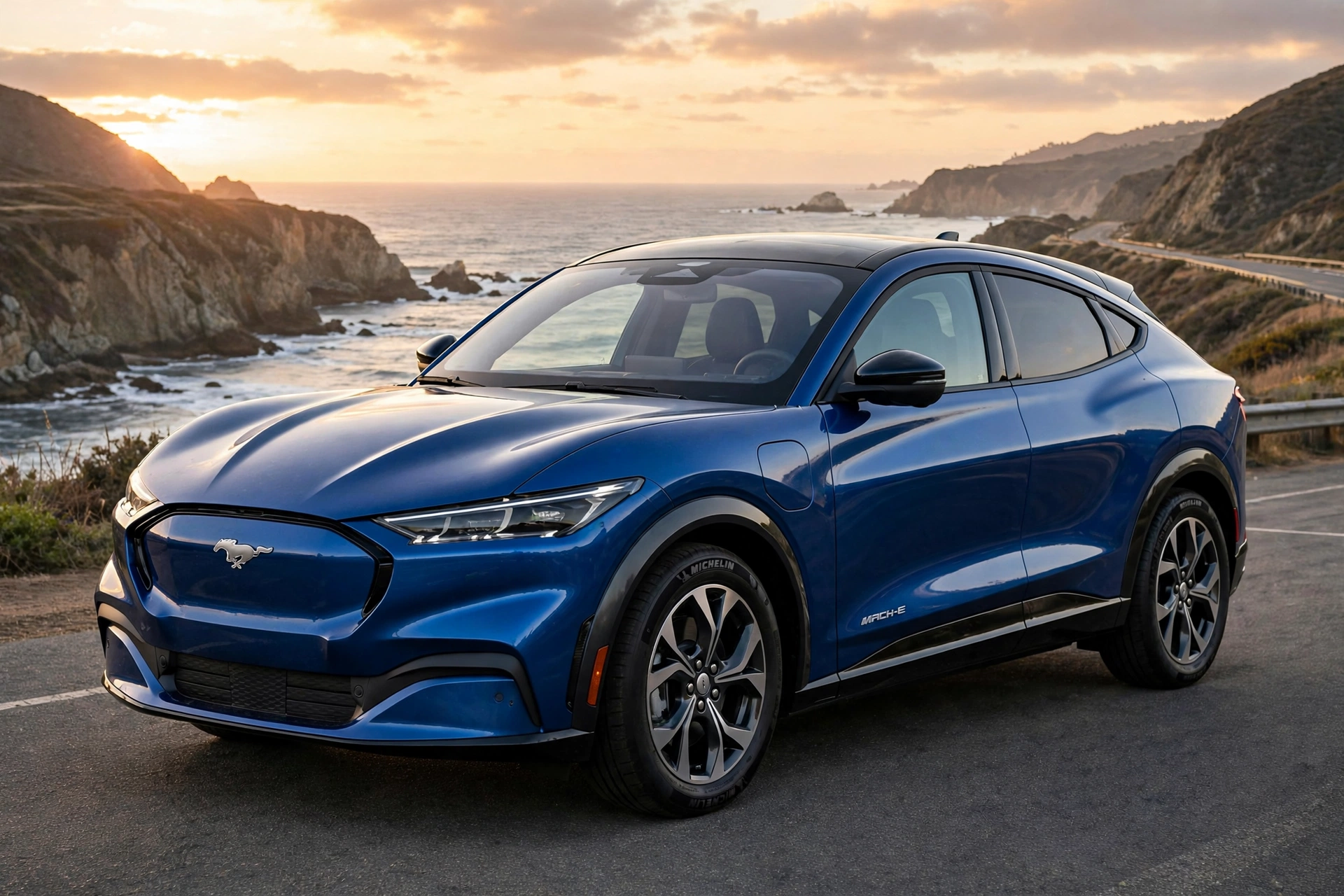

Search for an electric Mustang and you will meet one of the most argued-about names in the car world. Purists still insist a Mustang must have a V8 and two doors. Ford disagrees — and since 2021, the only Mustang you can buy with a battery is the Mustang Mach-E, an all-electric five-door crossover. It carries the pony badge, the tri-bar taillights and a surprising amount of genuine Mustang attitude, but it plays by completely different rules than the gas coupe. Here are the seven things you should know before you buy one.
Table of Contents
1. The Only Electric Mustang Is an SUV — Not a Coupe
Let’s clear up the biggest point of confusion first. There is no electric version of the classic two-door Mustang coupe. The electric Mustang people talk about is the Ford Mustang Mach-E, a midsize electric crossover that Ford deliberately launched under the Mustang name in 2021.
Why does this matter? Because if you walked into a dealership expecting a silent electric sports car with two doors and a back seat suitable only for emergencies, you will find something very different: five doors, five seats, a tall ride height, and a frunk (front trunk) with 4.7 cubic feet of drainable storage space. It is a family vehicle wearing a sports car badge.
That branding choice annoyed plenty of Mustang fans at launch. Five years on, the market has mostly made peace with it — the Mach-E has become one of the best-selling electric SUVs in the United States, regularly trailing only the Tesla Model Y and a handful of others. The badge brought attention; the product earned the sales.
2. Trims and Prices: Select, Premium, GT and Rally
The 2026 Mustang Mach-E lineup has four trims, and picking the right one is the single most important buying decision you will make.
Select — from about $37,995
The entry point. Rear-wheel drive, standard-range battery, 264 horsepower and 260 miles of EPA-estimated range. You still get the 15.5-inch touchscreen, wireless Apple CarPlay and Android Auto, and the full Co-Pilot360 safety suite. For a commuter who charges at home, this is the value play — it undercuts a comparable Tesla Model Y by a couple thousand dollars.
Premium — around $44,000
The sweet spot for most buyers. Available with rear-wheel or dual-motor all-wheel drive and the larger battery, giving up to 320 miles of range on the RWD extended-range setup. Adds heated and ventilated front seats, a B&O sound system, and a hands-free power liftgate. If you want maximum range without GT money, this is your trim.
GT — from roughly $56,000
The performance flagship: 480 horsepower, 600 lb-ft of torque, standard all-wheel drive, and MagneRide adaptive suspension. Ford quotes a 3.3-second 0–60 mph sprint; independent testing has recorded as little as 3.1 seconds, officially quicker than a V8 Mustang Dark Horse in a straight line. Range drops to about 270 miles — the price of speed.
Rally — around $60,000
A rally-inspired special edition with raised suspension, underbody shielding, rallycross drive mode and unique styling. Think of it as the Mach-E for gravel roads and buyers who want something nobody else has. It shares the GT’s 480-hp powertrain.
One honest note: EV prices move with incentives and model-year changes, so treat these figures as a solid 2026 baseline and confirm with a local dealer before you negotiate. Tax credit eligibility also shifts year to year — check the current rules before counting on it.
3. Real-World Range: 240 to 320 Miles, and AWD Costs You
Range is where trims and batteries really separate. The electric Mustang offers two battery packs — a standard-range pack around 73 kWh and an extended-range pack near 88 kWh — and EPA estimates span a wide band:
- Select RWD (standard battery): about 260 miles
- Premium RWD (extended battery): up to 320 miles — the range champion
- Premium AWD (extended battery): around 300 miles
- GT AWD: roughly 270 miles
- Select AWD (standard battery): as low as 211–240 miles
Two patterns worth noticing. First, all-wheel drive costs you 20 to 50 miles of range depending on the battery — you are feeding a second motor. Second, cold weather bites hard. Like every EV, the Mach-E can lose 20 to 30 percent of its range in deep winter; we have a full breakdown of why electric cars lose range in winter and how to fight back. If you live somewhere with real winters and do long highway runs, the extended-range RWD Premium is the sensible pick.
For daily driving, though, even the shortest-range Mach-E covers the average American commute (around 40 miles) several times over on a single charge.
4. Charging Is Solid but Not Class-Leading
Here is the Mach-E’s weakest spec-sheet line, and I would rather you hear it from me than discover it at a rest stop. Peak DC fast-charging speed is 150 kW, with a 10–80% charge taking roughly 32 minutes on the standard battery. That is perfectly usable — about the time of a coffee and a restroom break — but rivals on 800-volt architectures charge noticeably faster.
Where Ford claws back ground:
- Tesla Supercharger access. Ford includes a NACS adapter, so every Mach-E can plug into the Tesla Supercharger network — the largest and most reliable fast-charging network in North America. That single move erased most of the real-world charging anxiety owners used to feel.
- Home charging is effortless. An 11 kW onboard charger means a 240-volt home setup refills the car overnight. The included Ford mobile charger adds roughly 20+ miles of range per hour on a 240V outlet.
- Route planning that works. The navigation system factors in chargers along your route and preconditions the battery so it charges faster when you arrive.
If you are new to EV charging, our ultimate guide to EV charging stations in the USA explains the plug types, networks and etiquette in plain language.
5. The GT Is Genuinely Fast — Faster Than a V8 Mustang
Numbers first: the Mach-E GT makes 480 horsepower and 600 lb-ft of torque, and independent instrumented tests have run it to 60 mph in about 3.1 seconds. Ford’s own Performance package quotes 3.3 seconds. Either way, it outruns a V8 Mustang Dark Horse to 60 mph, and it does it in near silence with all-wheel-drive traction off the line.
But straight-line speed is only half the story. The GT gets MagneRide adaptive dampers — the same magnetic suspension technology from the Corvette — which read the road a thousand times per second and keep this 4,900-pound crossover surprisingly composed when you push it. Three drive modes (Whisper, Engage, Unbridle) genuinely change the car’s character, from quiet commuter to something that feels, well, like a Mustang.
The trade-offs: the GT’s 20-inch wheels make the ride firm on rough pavement, and you will feel that weight in tight switchbacks no matter what the suspension does. If performance is your priority, the GT justifies its price. If it isn’t, the Premium is quicker than 95% of traffic anyway.
6. Tech, Interior Space and Safety Are All Strong
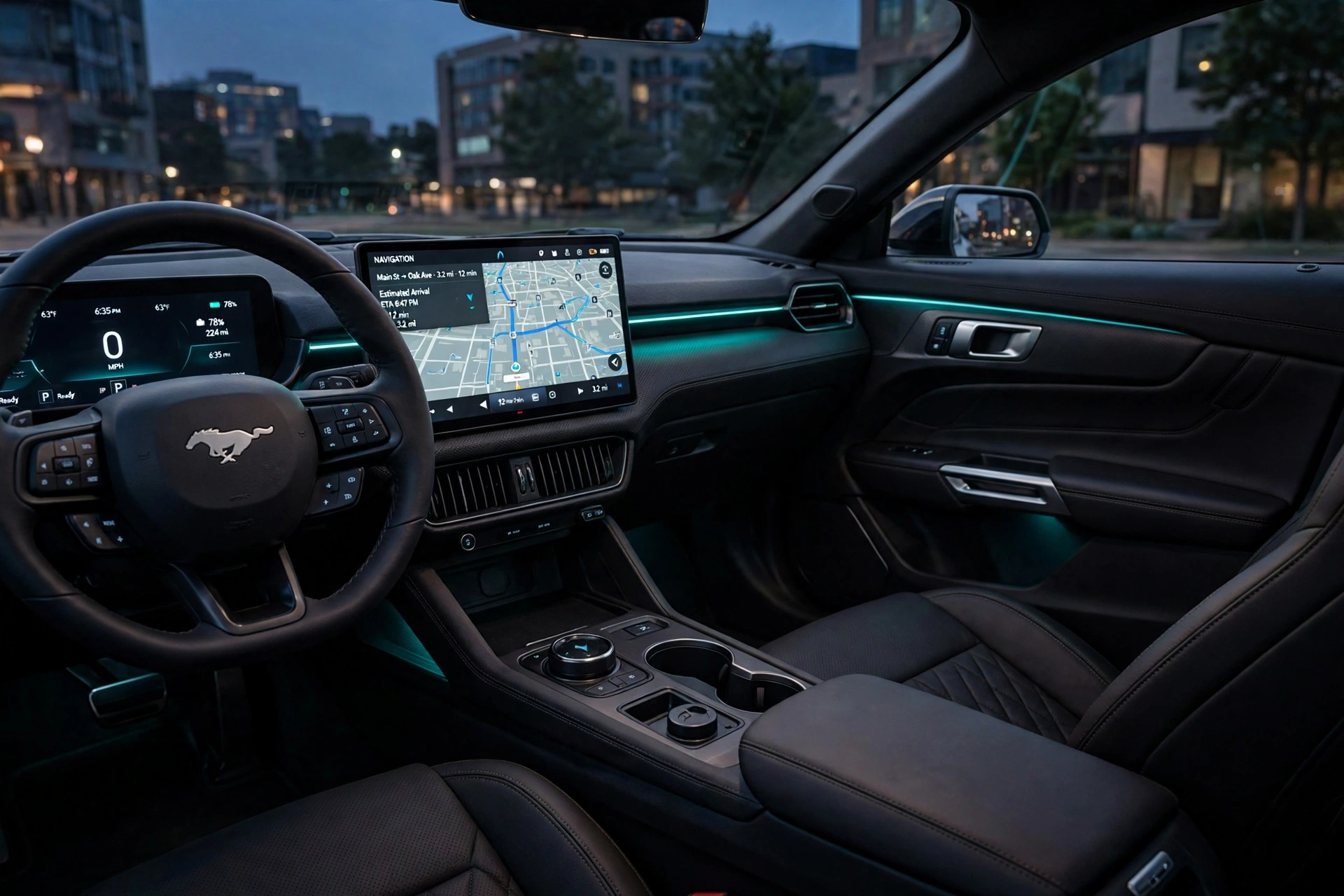
The cabin is one of the Mach-E’s best arguments. A 15.5-inch vertical touchscreen runs SYNC 4A with wireless Apple CarPlay and Android Auto standard on every trim — something Tesla still doesn’t offer. A slim 10.2-inch digital cluster sits behind the wheel, and a large rotary dial on the screen gives you a physical volume knob, a small mercy Ford deserves credit for.
Practical numbers: 34.4 cubic feet of cargo behind the rear seats, 59.7 cubic feet with the seats folded, plus the 4.7-cubic-foot frunk. Rear legroom of 38.1 inches fits real adults. Materials won’t fool anyone into thinking it’s a luxury car at Premium prices — hard plastics appear lower in the cabin — but the design and ergonomics are genuinely good.
On the safety front, the 2026 model earned an IIHS Top Safety Pick award, and NHTSA rates it five stars overall. BlueCruise, Ford’s hands-free highway driving system, is among the best in the business — it handles lane changes hands-free on mapped highways, and owners consistently rate it above most competitors’ systems. Ford’s dealer network also means service is a short drive away for most buyers, unlike some EV-only brands.
7. Ownership Costs, Warranty and the Honest Verdict
Let’s talk money beyond the sticker. Electricity is dramatically cheaper than gasoline per mile — most owners report “fuel” costs roughly a third of a comparable gas SUV. Maintenance is lighter too: no oil changes, no spark plugs, no transmission fluid, and regenerative braking means brake pads last far longer than on a gas car.
Warranty coverage is solid: 3 years/36,000 miles basic, 5 years/60,000 miles powertrain, and 8 years/100,000 miles on the battery and drive unit. Battery degradation is covered, and modern liquid-cooled packs degrade slowly — our guide on what happens to expired EV batteries covers the long-term picture.
One cost to watch: insurance. EVs generally cost more to insure than equivalent gas cars, and the Mach-E is no exception. Get quotes before you buy.
So, should you buy the electric Mustang?
Buy it if: you want a comfortable, quick, well-equipped electric crossover with real personality; you value CarPlay, BlueCruise and a dealer down the road; or you want GT-level speed without German-car money.
Think twice if: you road-trip constantly and want the absolute fastest charging; you need a third row; or you simply can’t forgive Ford for putting a pony badge on an SUV.
My honest take: the electric Mustang works because it’s a good EV first and a Mustang second. The badge got it noticed; the 320-mile range, the genuinely fast GT, Supercharger access and BlueCruise are what make it worth your money. Shop the Premium extended-range RWD for the best balance, the GT if you want the speed, and skip the base Select AWD unless your daily driving is short — its range is the weakest link in the lineup.
Electric Mustang FAQ
Is there an all-electric Mustang coupe?
No. As of 2026, the only electric Mustang is the Mustang Mach-E crossover. Ford has shown no production plans for an electric two-door Mustang coupe.
How far does the electric Mustang go on a charge?
EPA estimates range from about 211 miles (Select AWD with the standard battery) up to 320 miles (Premium RWD with the extended battery). Most buyers land between 260 and 300 miles. You can cross-check any EV’s official numbers on FuelEconomy.gov.
How long does it take to charge a Mustang Mach-E?
At a DC fast charger, 10–80% takes roughly 30–35 minutes. At home on a 240V outlet, a full charge happens overnight.
Can the Mustang Mach-E use Tesla Superchargers?
Yes. Ford provides a NACS adapter, and the Mach-E can charge at Tesla Supercharger stations, giving it access to North America’s largest fast-charging network.
How much does the 2026 electric Mustang cost?
The 2026 Mustang Mach-E starts near $37,995 for the Select trim. Premium models run in the mid-$40,000s, the GT starts around $56,000, and the Rally special edition approaches $60,000. Incentives and tax-credit eligibility change frequently, so confirm current pricing with a dealer.
Is the Mustang Mach-E reliable?
The Mach-E has earned an IIHS Top Safety Pick and five-star NHTSA ratings. Early model years had some recalls and software growing pains, but the platform is now mature, and Ford’s 8-year/100,000-mile battery warranty provides long-term cover.