Last updated: October 27, 2026
Fire Prevention Week landed earlier this month — October 4 to 10 — and this year the NFPA built the whole campaign around lithium-ion charging safety. So the safety aisle is freshly stocked, the adverts are loud, and a new product category is doing the rounds: the “EV fire extinguisher.” Here is the short version before the long one. Yes, your garage should have a proper electrical fire extinguisher within reach of the door. No, it will not save your car if the battery goes. Both things are true, and the gap between them is where the marketing lives.
What changed this year is the packaging. Small aerosol cans and designer canisters now carry labels like “for EV battery fires” and “lithium fire spray.” They photograph well. They trend well. They are, in tested terms, close to useless — and the full-size units that actually carry a UL rating barely get a look-in, because a steel cylinder with a gauge does not make exciting content.
So, the blunt bit first, because everything else hangs off it. A traction battery in thermal runaway is a chemical reaction, not a campfire. Cells heat themselves, vent flammable gas, and pass the failure to the next cell. No handheld extinguisher — powder, CO2, or anything in a spray can — reaches inside a sealed pack and stops that. Firefighters do not try. They cool the pack with very large amounts of water, or they protect everything around the car and let the reaction burn itself out under watch.
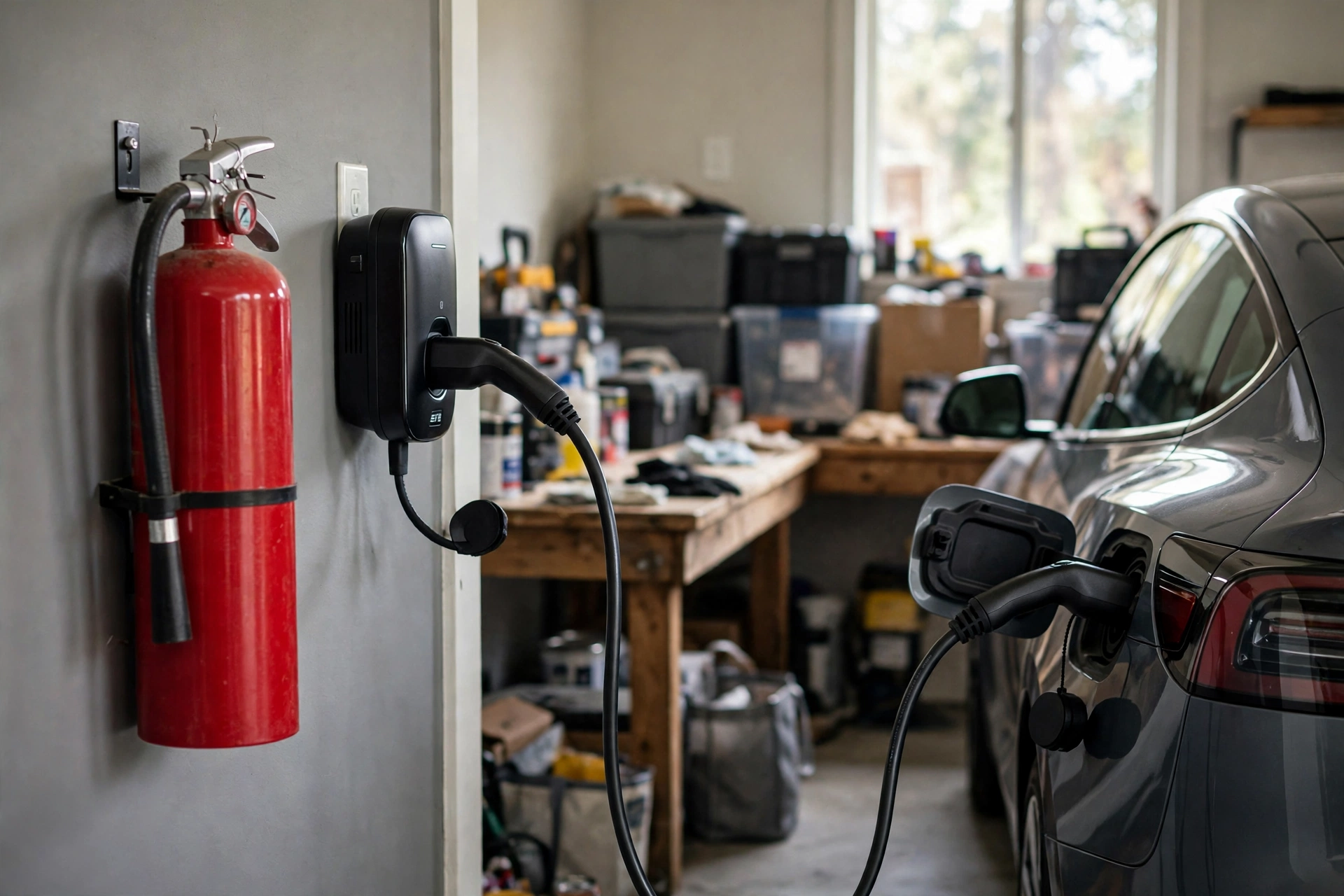
What the extinguisher on your wall is for is the other 95% of garage fires. The wallbox fault that starts smoking at the terminals. The 12-volt battery fire. The workbench rag, the wiring fault, the charger cable that chafed through and arced. Those fires start small, and a small fire is exactly what a rated extinguisher handles — if you reach it in its first minute, and if you bought the right one.
Thing 1: No electrical fire extinguisher puts out an EV battery fire
Let us put numbers on the honesty. Documented EV battery incidents have taken anywhere from 3,000 to over 30,000 gallons of water to control, because the water’s job is cooling, not smothering. A petrol car fire, by comparison, typically takes 500 to 1,000 gallons. Your garage extinguisher holds five pounds of powder and empties in about 14 seconds. The maths is not close, and it was never going to be.
The second problem is time. The NFPA’s EV safety page explains “stranded energy”: nobody can tell how much energy is still trapped in a damaged pack, so a battery that looks finished can reignite days or even weeks after the first fire. Crews plan around that. A homeowner with a red cylinder cannot.
Which gives you the rule that outranks every other line in this article. Smoke or flame from the battery pack itself — hissing, popping, a sweet chemical smell, vapour jetting from under the car — means one job only. Get everyone out. Get at least 100 feet away. Call 911 or your local emergency number. Do not go back in for the car, the charger, or anything else. An extinguisher is for a fire that has just started and is not growing. A pack fire is neither.
Any product sold as the thing that fixes that scenario is selling you a story. Hold that thought; it comes back when we reach fire blankets.
Thing 2: An electrical fire extinguisher is a rating, not a product
There is no separate shelf in the standards world labelled “electrical extinguishers.” In the US, what makes an extinguisher safe around live equipment is one letter on its label: C. Class C means the agent does not conduct electricity back to the person holding the hose. The full US set is A (wood, paper, ordinary combustibles), B (flammable liquids), C (energised electrical equipment), D (burning metals) and K (cooking oils). A multi-purpose ABC dry-chemical unit — the standard garage buy — already carries the C. You do not need a special “electrical” model. You need the letter.
Read the label of anything marketed as an electrical fire extinguisher and look for that C in the rating, plus a UL listing. If a can shows neither, it is not an extinguisher in the tested sense, whatever the advert calls it.
Reading this in the UK or Europe? The markings change, and this trips people up. Europe dropped its old electrical class years ago; under BS EN 3 there is no electrical fire class at all, and Class C there means flammable gas. Instead, an extinguisher passed for live equipment carries a lightning-bolt symbol and the words “suitable for use on live electrical equipment up to 1000V at a distance of 1m,” earned through a 35 kV dielectric test. CO2 is the usual recommendation around electrical gear. Same physics, different label. Buy to the label where you live.
One more consequence of the definition: an electrical fire stops being electrical the moment the power is off. Kill the supply safely and a burning wallbox becomes an ordinary Class A fire — which is why the breaker earns its own section below.
Thing 3: The rating numbers are a stopwatch
Take the garage unit we recommend later, the Amerex B402. Its label reads 3A:40B:C. Decoded: the 40B roughly matches the square footage of flammable-liquid fire the unit can handle in untrained hands — call it a 40-square-foot petrol spill, fully alight. The 3A compares to water, at about 1.25 gallons per A, so roughly 3.75 gallons’ worth of firefighting on wood and paper. Solid numbers for a five-pound cylinder.
Now the arithmetic nobody prints on the box. A two-car garage is about 20 by 20 feet: 400 square feet of floor. Forty square feet is one tenth of it. The B402 discharges its 5 lb of powder in 14 seconds — 5 ÷ 14 ≈ 0.36 lb of agent per second — so a five-second fumble with the pin burns over a third of your total firepower before you have aimed at anything.
Fire growth runs against you on a curve, not a line. Fire engineers model growing fires with t-squared curves: on the “fast” curve used for clutter and upholstered furniture, heat output reaches about 170 kW at one minute (0.0469 × 60²) and about 675 kW at two minutes (0.0469 × 120²). One extra minute of delay, four times the fire. Your extinguisher’s entire working life is inside that first minute.
That is why the little cans lose. A 2.5 lb unit like Amerex’s own B417T is rated 1A:10B:C — a quarter of the B coverage — and empties in about 9 seconds. Aerosol “extinguishing sprays” are weaker still: they carry no UL A:B:C rating at all. Small is fine as a second unit in a car boot. As your only garage protection, small is a gamble dressed as a saving.
Thing 4: Match the agent to the room
Three agent families matter for a home with an EV, and they are not interchangeable.
Dry chemical (ABC powder). The cheap all-rounder, and the correct garage default: it handles combustibles, liquids and live electrical gear in one cylinder. The catch arrives after the fire. Mono-ammonium phosphate residue is corrosive. It works into circuit boards, switchgear and the inside of the wallbox you just saved, and the cleanup is miserable. Powder also drops visibility to near zero in a closed garage while it hangs in the air. Use it where the mess is acceptable: garage, workshop, driveway.
CO2. The clean agent for people. It leaves zero residue, which is why it owns server rooms and electronics benches. Its limits are physical: a 5 lb unit reaches only 3 to 8 feet, discharges in about 9 seconds, carries no A rating — it can knock down surface flame on wood or paper and watch it reflash — and it does no cooling. Outdoors, wind steals it. By the electronics corner: excellent. As a garage’s only unit: no.
Clean agents (Halotron class). CO2‘s cleanliness with better reach and a friendlier discharge, at several times the price (est., based on current maker and supplier listings). Justifiable over a server rack or studio gear. Hard to justify over a lawnmower.
So the placements write themselves. Garage: 5 lb ABC powder. Kitchen: a small ABC by the exit, and a lid for the pan — never water on burning oil; Class K is the commercial-kitchen answer, not a home requirement. Car: a secured 2.5 lb ABC. Electronics corner: CO2. That is the whole system, and it costs less than most people expect — numbers in the buying section.
Thing 5: If the wallbox is the thing burning
A charger fault is the scenario your extinguisher genuinely exists for, and the order of jobs matters more than the brand in your hand.
First: people out, and 911 dialled — by you on the way out, or by someone already outside. Second: the breaker. If the panel is on your exit route and flipping it costs you seconds, kill the charger circuit. That one move protects the firefighters, stops the fault feeding itself, and turns an electrical fire into an ordinary one. If reaching the panel means walking toward the fire, skip it. Third — and only if the fire is still small, contained, and your exit is at your back — use the extinguisher: pull the pin, aim at the base, squeeze, sweep. The moment the room starts filling with smoke, the decision makes itself: leave, and close the door behind you.
Prevention is cheaper than any of this. The NFPA’s home-charging advice is boring and correct: use listed equipment, have a qualified electrician check the circuit can handle charging, inspect cords for damage, and never run a charger through an extension cord. A proper fixed installation matters here — our breakdown of what a home charger installation should cost shows where the money goes, and it is mostly the safety parts. If you are still deciding whether you even need one, charging from a regular outlet is a legitimate way to start, provided the outlet and circuit pass the same inspection logic. And before any of it, check the charger actually matches your car — mismatched, bargain-bin gear is where fault fires begin.
Thing 6: The fire blanket in your feed is a crew tool, not a gadget
The other product riding the same algorithm is the EV fire blanket: a car-sized sheet of high-temperature fabric, marketed as the thing you drape over a burning EV. Here is its real job description. A car blanket weighs around 25 kg, takes two firefighters in breathing apparatus to deploy, and contains flames and smoke so a crew can work around the vehicle. It does not stop thermal runaway — the pack keeps reacting underneath it, generating its own heat and gas.
Fire-safety researchers add a sharper warning for enclosed spaces: flammable gases build up under a deployed blanket, and lifting it can release a vapour cloud. Guidance aimed at private sites is plainer still — ordinary homes that park and charge EVs do not need one. A blanket is also single-incident equipment costing several hundred dollars (est., from current supplier pricing). Our position is not complicated: for a homeowner, a car fire blanket is money spent on the wrong problem. Spend it on the rated extinguisher, the smoke alarms, and the electrician.
Do not confuse it with the small kitchen fire blanket that lives in a drawer and smothers a pan fire. That one is cheap, legitimate, and worth owning. Different product, different job.
Thing 7: Where it hangs, and the 30-second monthly check
Placement beats brand. Mount the garage unit by the exit you would actually run to — the door into the house, or the side door — never in the far corner behind the car, where a fire gets to stand between you and it. NFPA 10’s mounting rule puts the top of a unit under 40 lb no more than about five feet off the floor: reachable, visible, grabbable in the dark. When you use it, your back stays to that exit. If you cannot reach the fire without turning your back on the way out, you do not fight it.
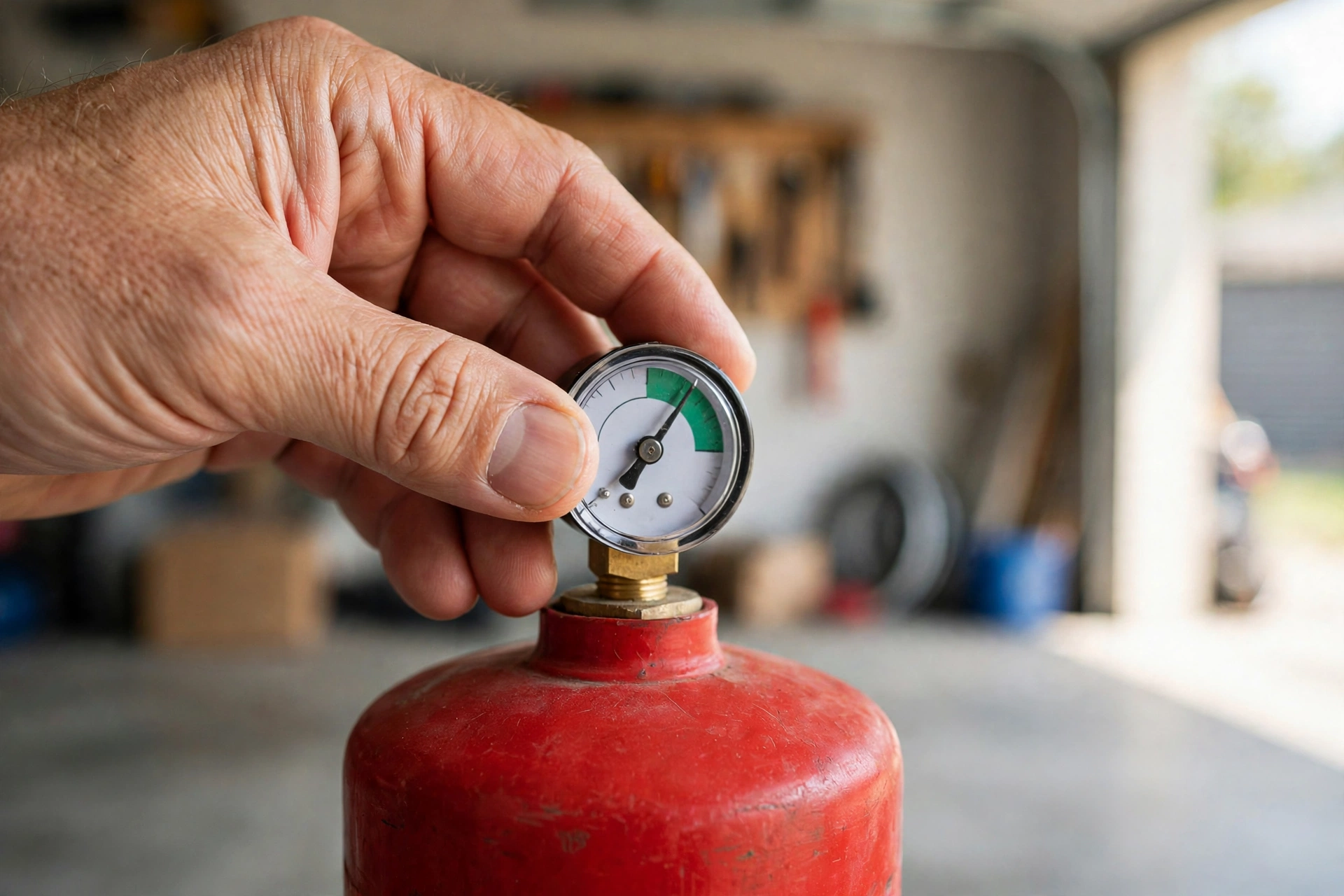
Then the maintenance rhythm, straight from the NFPA 10 framework. Monthly, a 30-second visual check: unit in place, gauge needle in the green, pin and tamper seal intact, hose uncracked, nothing stacked in front of it. Every six years, a rechargeable dry-chemical unit goes to a service shop for an internal examination and recharge. At twelve years it faces a hydrostatic pressure test of the cylinder — CO2 cylinders run on a five-year hydrostatic cycle instead, and a CO2 unit has no gauge at all, so its check is a weighing. Disposable, non-rechargeable units skip the servicing and simply retire twelve years after their manufacture date. Check the date stamped on anything already hanging in your garage; plenty of inherited units are already past it.
And after any discharge at all — even a two-second squirt to “test” it — the unit gets professionally recharged or replaced. A half-empty extinguisher is a decoration.
The shortlist: three electrical fire extinguisher buys that check out
Every specification below comes from the maker’s own published data, checked the same way we check everything — our research method is public for a reason. Prices checked October 27, 2026.
Amerex B402 — the garage unit. Five pounds of ABC dry chemical, UL rated 3A:40B:C, 14-second discharge, 12 to 18 feet of range, all-metal valve, wall bracket in the box, rechargeable, six-year maker warranty. Amerex’s own spec sheet confirms the rating and discharge figures. Amerex lists it at $129.35; safety suppliers had it between $80 and $110 — call it $90 (est.). This is the electrical fire extinguisher a garage with a wallbox should start with.
Our score: 9/10 — Fire class fit: 9/10 · Ease of use: 8/10 · Value: 9/10
Kidde Pro 210 — the inside-the-house second unit. UL rated 2-A:10-B:C, a lighter body at about 7 lb, roughly 13 to 15 seconds of discharge, up to 15 feet of range, rechargeable. Home Depot pricing sat at $45 to $60 — call it $50 (est.). Less A and B muscle than the B402, easier for every adult in the house to handle, and the right size for a hallway or kitchen exit.
Our score: 8/10 — Fire class fit: 7/10 · Ease of use: 9/10 · Value: 9/10
Amerex 322 — the CO2 for the electronics corner. Five pounds of CO2, rated 5B:C, 9-second discharge, 3 to 8 feet of reach, zero residue on whatever it saves. Priced between $185 and $250 at safety suppliers — call it $215 (est.). It earns its place next to a home server, a solar inverter or a workbench of electronics, and nowhere else in the house.
Our score: 8/10 — Fire class fit: 8/10 · Ease of use: 7/10 · Value: 6/10
Now the total damage, because this is where the category stops looking expensive. B402 at $90 (est.) plus a Pro 210 at $50 (est.) is $140 of hardware. Add one professional service at year six, about $50 (est.). Total: roughly $190 spread over the twelve-year hydrostatic horizon — $190 ÷ 12 ≈ $16 a year for a protected garage and a protected hallway. There is no sale season worth waiting for on numbers like that. The right buying time was the week the wallbox went in; the second-best time is this one.
Electrical fire extinguisher questions, answered straight
Can an electrical fire extinguisher put out an EV battery fire?
No. Nothing handheld can. A pack in thermal runaway heats itself from inside a sealed case; crews answer with thousands of gallons of cooling water or a controlled burn, and even they watch for reignition for days afterwards. If the fire is in the pack, your job is evacuation and a 911 call.
What size do I actually need for a garage with a charger?
A 5 lb rechargeable ABC unit, rated at least 3A:40B:C, mounted by the door. That combination covers the charger fault, the 12-volt fire and the workbench accident — the fires that start in garages — with about 14 seconds of working time.
CO2 or powder next to the wallbox?
Powder. A garage fire is rarely only electrical: it reaches tyres, boxes and fuel cans fast, and CO2 has no A rating and a 3-to-8-foot reach. CO2 is the specialist for the electronics corner, where its zero residue pays.
How long does one last?
A rechargeable unit, serviced on the NFPA 10 rhythm — monthly glance, six-year internal service, twelve-year hydrostatic test — stays in service for decades. A disposable unit retires twelve years after its manufacture date, serviced or not.
The wallbox fire is out. Can I charge again tonight?
No. The breaker stays off, an electrician inspects the circuit and the charger, and your insurer hears about it before anything is replaced. A charger that caught fire once has given you information. Listen to it.
Should the car itself carry one?
Optional, and only a proper one: a 2.5 lb ABC, hard-mounted in the boot, never loose — an unsecured cylinder is a projectile in a crash. Understand its limits before you buy it: it serves the small fires around a car, not the car’s battery.
One-line version, then. Buy the rated cylinder, hang it by the door, glance at the gauge every month, and keep the battery truth in front of every purchasing decision. The extinguisher’s job is the fire that started thirty seconds ago. Everything bigger belongs to the fire service — and the fastest way to help them is to already be outside.