Last updated: October 27, 2026
Nobody actually shops for an electric bike motor. You shop for getting up the hill by the grocery store with two bags of shopping swinging off the bars. You shop for a bike that fits in the hallway, survives being locked outside the office in the rain, and doesn’t leave you doing an unplanned workout when the battery dies two miles from home. The motor decides all of that. Not the paint, not the app, not the suspension fork. The motor.
So let’s skip the spec-sheet lecture. There are three layouts you’ll meet in every shop: a geared hub motor in the rear wheel, a direct-drive hub motor in the rear wheel, and a mid-drive motor sitting between the pedals. Each one has a personality. Each one has a price. Pick the wrong personality and you’ll resent the bike within a month, even if it was a bargain.
Here’s my bias up front, because I have one: for flat city riding, the mid-drive is jewellery. Lovely, beautifully made jewellery. A good geared hub does the same commute for roughly half the money, weighs the same on the stairs, and any mechanic in town can fix it. Where hills, cargo or bad knees enter the picture, my answer flips completely. Context is everything with motors.
One warning before the seven things. The watt number on the sticker is close to meaningless, and I’ll show you why with Bosch’s own figures in a moment. Torque, sensor type and wheel size tell you far more about how a bike will feel at the lights with a bag of potatoes on the rack. Also, every price in this guide was checked on October 27, 2026, against maker and retailer listings, and anything we couldn’t verify is marked (est.) with the basis stated.
Seven decisions, then. Where the motor sits, how hard it pushes, how it knows you’re pedalling, whether it’s legal, what it sounds like, who can repair it, and which one matches your actual streets. Scores for each motor type sit in the last section, next to the bikes that use them.
1. Where the electric bike motor sits decides your puncture day
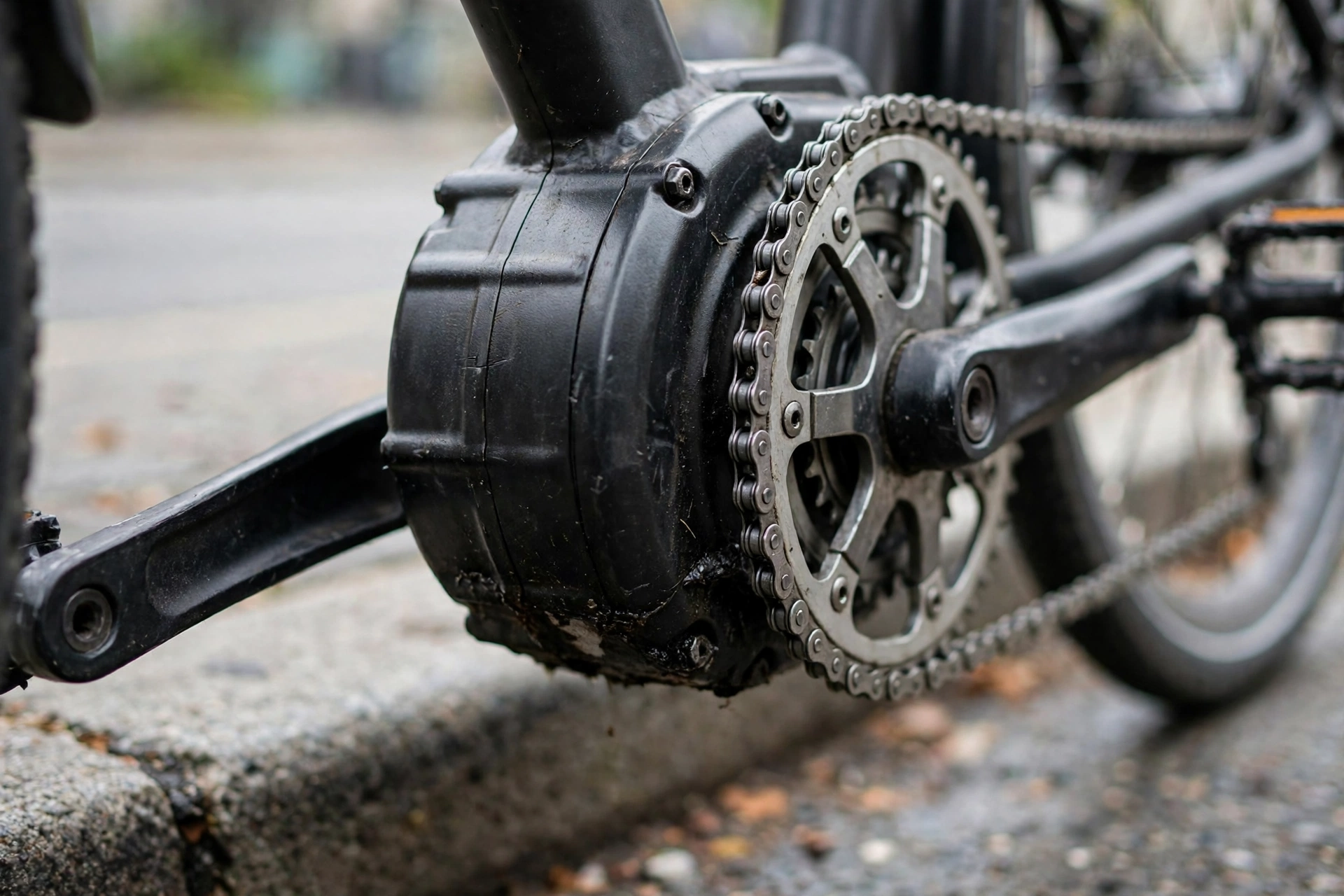
A hub motor lives inside the wheel. A mid-drive lives at the bottom bracket, between your feet, and pushes through the chain. That one placement choice changes your weight balance, your repair bills and your relationship with your local bike shop.
Balance first. A mid-drive carries its weight low and central, so the bike steers like a normal bicycle and doesn’t try to wheelie off the line or wash out on wet corners. A rear hub puts 3–5 kg (est., typical for 500–750 W units) in the back wheel. On a city bike you mostly notice it when you lift the rear end up a kerb or carry the bike up two flights of stairs, where the back end swings like a pendulum. Front hubs exist too, mostly on cheap conversions. They pull rather than push, which feels odd on wet leaves. Rear hub over front hub, every time.
Punctures are the real test. A rear tyre flat on a hub-motor bike means disconnecting a motor cable, undoing axle nuts (often with a wrench, not a quick release), and wrestling a heavy wheel out while the bike leans against a wall in the rain. Doable. Not fun. On a mid-drive, both wheels pop out like a normal bike’s, and a tube swap takes five minutes with cold fingers. If your commute includes glass-strewn bike lanes, file that away.
Price is the hub’s counterpunch. An electric bike motor in hub form is a mature, mass-produced part, and hub-motor city bikes start hundreds of dollars below comparable mid-drives. The Lectric XP 3.0 folder, 500 W hub and all, lists at $999 (checked October 27, 2026). A Bosch or Shimano mid-drive system rarely appears on a complete bike under $2,000. You’re paying for gears multiplication and refinement, which brings us to the number that actually matters.
2. Torque is the number you feel from an electric bike motor
Watts are the legal label. Torque, measured in newton-metres (Nm), is the twist that gets you and the shopping moving. A motor can wear a modest watt rating and still shove hard, because the watt figure is a continuous rating the maker declares, while torque is what your legs feel at walking pace on a ramp.
The rating game, exposed by the makers themselves: Bosch’s Performance Line CX is a “250 W” motor on paper, the figure European law wants to see, yet Bosch’s own drive-unit pages publish 85 Nm of torque and 600 W of maximum power for it, with a software path to 100 Nm on the current generation. Shimano’s EP801 plays the same game: 250 W nominal, 85 Nm, 600 W peak. The Brose-built Specialized 2.0 motor in the Turbo Vado 4.0 is also labelled 250 W nominal and delivers 70 Nm. Meanwhile a US hub motor shouts “750 W!” on the box and may only produce 40 Nm of actual push. Same neighbourhood of real power, wildly different stickers.
Hub motors generally quote 40–85 Nm. Budget geared hubs sit near 40–55 Nm, strong ones higher, and there are outliers: Rad Power Bikes quotes a full 90 Nm for the geared hub in the RadWagon 5 cargo bike (maker figure, checked October 27, 2026). Mid-drives cluster at 85 Nm and reach 90–120 Nm in cargo and performance versions. But Nm alone still isn’t the whole story, because wheel size and gears multiply it. Here’s the arithmetic for a real hill: you, the bike and the shopping total 100 kg, the street is a 10% grade, and you want to hold 12 mph (5.36 m/s).
Gravity alone demands mass × g × speed × sin(grade) = 100 × 9.81 × 5.36 × 0.0995 ≈ 520 W. Rolling resistance on city tyres adds roughly 100 × 9.81 × 0.008 × 5.36 ≈ 42 W (Crr 0.008, est. for treaded city tyres), and air drag at that speed adds maybe 30–40 W (est.). Call it 600 W at the wheel just to hold speed. Your legs might supply 75–100 W of that. The motor owes about 500 W, continuously, or you slow down.
Now the force version, which is where torque earns its keep. Holding that hill needs about 106 N of push at the tyre. A 40 Nm hub in a big 700c wheel (radius 0.35 m) delivers 40 ÷ 0.35 ≈ 114 N. That’s an 8 N margin. Nothing left to accelerate, and the motor crawls at its least efficient speed, heating up. The Lectric XP’s 55 Nm hub sits in a small 20-inch wheel (radius about 0.25 m), so 55 ÷ 0.25 ≈ 220 N, roughly double the requirement, which is why small-wheel folders climb better than their spec sheets suggest. An 85 Nm mid-drive in its lowest gear (44-tooth chainring driving a 51-tooth cog multiplies torque by about 1.16) puts roughly 99 Nm at the wheel, or 99 ÷ 0.35 ≈ 281 N of push. Nearly three times the requirement. It doesn’t climb that hill. It strolls up it.
3. The sensor decides how the electric bike motor behaves
Two bikes with identical motors can feel completely unrelated, because the sensor tells the motor when and how hard to work. A cadence sensor is a simple switch: it notices the pedals turning and delivers power after a short delay, at whatever level you selected. A torque sensor measures how hard you’re pressing and matches it, instantly and proportionally.
The test-ride difference is obvious within fifty metres. Cadence feels like being pushed by an invisible hand that sometimes arrives late, then keeps pushing for a beat after you stop pedalling. At low assist it’s gentle and fine. At high assist in a tight turn it can surge when you’d rather it didn’t. Torque sensing feels like your legs got a software upgrade. Press harder, get more. Ease off, get less. Independent group tests of the big mid-drives, like E-MOUNTAINBIKE’s motor group test, consistently praise exactly this natural delivery on torque-sensed systems such as Shimano’s EP801 and Bosch’s CX.
Ghost pedalling is the cadence sensor’s tell. At 20 mph on a cheap hub bike the gearing runs out, your legs spin contributing nothing, and the motor does all the work. Some riders love that; it’s a throttle with extra steps. Fine on flat ground, silly on a hill.
Now the accessibility note, and it matters. If your knees are unreliable, you’re recovering from surgery, or you simply cannot push hard on pedals, a torque sensor can punish you: ride gently and it assists gently. A cadence system with a throttle asks nothing of your legs at all. For that rider, the “cruder” system is the correct one, and any review that sneers at cadence sensors without asking who the bike is for is reviewing for itself. My one hard line: cadence sensing on a bike costing over $2,000 (est., as a value judgement on typical 2026 pricing) is a swindle. At that money, torque sensing is the single upgrade most worth paying for.
4. The legal label: 750 watts in the US, 250 in Europe
Law, briefly, because it decides what you can insure and where you can ride. In most US states the three-class system caps an e-bike at 750 W, with Class 1 and 2 assisting to 20 mph and Class 3 to 28 mph, pedal-assist only for Class 3 in many states. Our complete guide to Class 1 e-bikes walks through the class rules in detail. Buy a motor kit or bike beyond those limits and you may own a perfectly fun machine that is legally a moped: no bike-lane access, possible registration and insurance duties, and a helmet law with your name on it.
Europe plays a different sport: 250 W continuous, assistance cutting out at 25 km/h (15.5 mph), pedalling required, no throttle beyond a walk-assist crawl. That is why European motors wear 250 W stickers while making 85 Nm and 600 W peaks. The law regulates the continuous rating, so makers compete on torque instead. It works: a 250 W European mid-drive will out-climb most 750 W American hub bikes.
The practical risk isn’t a ticket, though those exist. It’s the trail ban and the insurance shrug. Land managers increasingly restrict paths to Class 1 only, and an overpowered bike forfeits access. Worse, if you’re knocked off a bike that’s legally a motor vehicle and unregistered, your claim gets complicated fast. Buy inside the classes unless you genuinely want a moped. Some riders do. Just buy it with your eyes open.
5. Noise, drag, and the dead-battery ride home
Every motor makes a sound. Geared hubs whir, a purposeful little gear whine. Direct-drive hubs are nearly silent, no gears inside, just magnets passing coils. Mid-drives vary: Bosch’s current CX was re-engineered for quietness, and Shimano markets the EP801 on being light and quiet. Cheap mid-drives can buzz like an annoyed wasp. If you ride at dawn through sleeping streets, put noise on your test-ride checklist, right after the hill.
Drag is the flip side. A geared hub has a clutch that freewheels when the power’s off, so pedalling an unpowered geared-hub bike feels almost normal. A direct-drive hub never disconnects. Its magnets resist you slightly with every pedal stroke, a phenomenon riders call cogging, and on a dead battery it turns a 25 kg bike into a stubborn one. Mid-drives add a little drivetrain drag of their own but generally pedal cleanly once you’re above walking pace.
The dead-battery ride home is where city practicality bites. A 20 kg hub-motor folder with a freewheeling clutch? You’ll manage, slowly. A 30 kg direct-drive cargo bike with a flat battery and a headwind? You’ll walk it, and remember it. Weight you carry up the stairs nightly is also weight you push home exactly once, memorably.
One cost nobody mentions at the shop: mid-drives spend your chain. All that torque flows through a standard bicycle chain and cassette, and strong riders on strong motors can eat a chain in 1,000–2,000 miles (est., based on typical shop service intervals for high-torque mid-drives). Chains run $20–$40 (est.), cassettes more, and the fix is a $15 chain checker and honesty. Hub motors leave the drivetrain almost unstressed, which is a genuine, unglamorous running-cost win. Our total cost of ownership calculator is built for cars, yet the habit transfers: price the consumables, not just the sticker. The electricity itself is the cheap part, as our breakdown of what it costs to charge an e-bike shows.
6. Theft, rain and repairs: the electric bike motor in real life
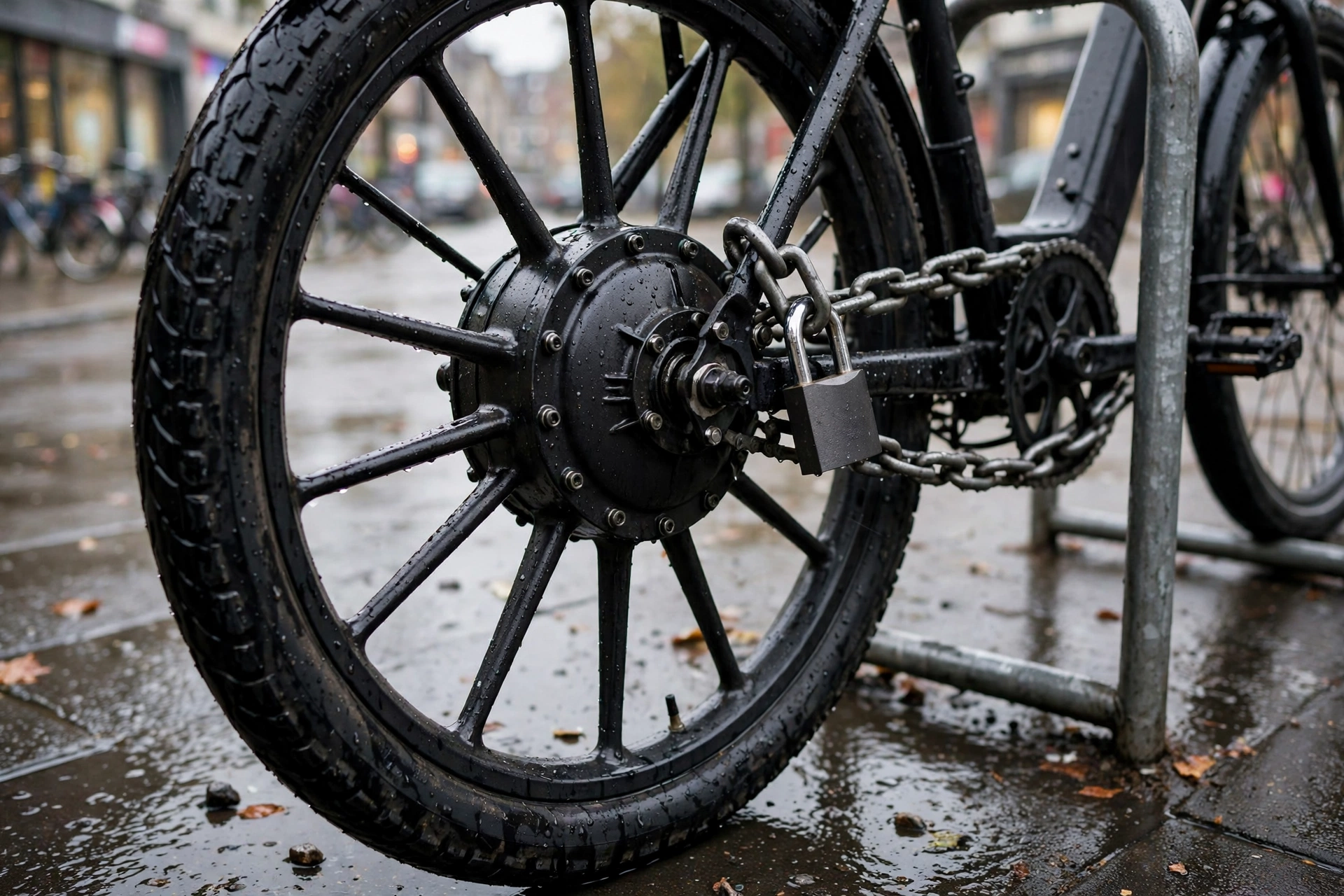
Repeat after me: a motor is not a lock. A pricier motor makes your bike more attractive to steal, not less. Specialized’s Turbo System Lock, which disables the motor through the app, is a genuinely useful deterrent and Bosch sells alarm and tracking add-ons for its smart system, but neither stops an angle grinder. The heavy chain in the photo above is the actual security system. Budget for a serious lock (10% of the bike’s price is a sane rule of thumb), lock the frame and a wheel to something immovable, and take the battery with you: on many bikes the battery is a third of the value and it unclips in seconds.
Repair reality splits the field cleanly. A generic hub motor is a commodity part: if it dies in five years, a shop can swap the wheel, and independent mechanics actually will. A proprietary mid-drive is a sealed unit, serviced through dealer networks, not opened on a bench. Fine while the network is healthy and the model current; awkward at year eight on a discontinued system. Ask the shop, before purchase, who services that motor locally. Our research method page explains why we weight local serviceability in every score below.
Rain deserves one sentence of its own. Rated systems (Bosch quotes IP55 on the CX drive unit) shrug off commutes in proper rain; bargain hub kits with exposed connectors are the ones that sulk. If your bike lives outside, that rating is worth more than 10 extra Nm.
7. Matching the electric bike motor to your actual job
Four jobs, four answers, all prices checked October 27, 2026.
Flat city, dry-ish, budget first. Geared hub, cadence sensor, done. The Lectric XP 3.0 ($999) pairs a 500 W nominal hub (1,000 W peak, maker figures) with 55 Nm, and its small 20-inch wheels multiply that torque exactly as the maths above shows. It also folds, which solves the apartment problem and most of the theft problem in one motion. Hills or a fast, natural ride feel. Mid-drive with a torque sensor. The Specialized Turbo Vado 4.0 (US list $4,000; retailer listings checked October 27, 2026) runs the Brose-built Specialized 2.0 motor, 250 W nominal and 70 Nm, with a 710 Wh battery, and BikeRide’s testers noted it out-riding 750 W fat bikes on climbs despite the modest sticker. That’s the rating game, proven.
Cargo and kids. Torque first, layout second. The RadWagon 5 ($2,399) proves a hub can do it: 750 W geared hub, 90 Nm, and a torque sensor this generation, hauling a rated 375 lb payload. A Bosch Cargo Line mid-drive (85 Nm standard) remains the premium alternative. Either way, don’t buy a 40 Nm anything and expect it to move two children and a week’s groceries uphill. Folders and trains. The XP 3.0 again, or any light geared-hub folder. Mid-drive folders exist, but you pay mid-drive money for a bike whose whole purpose is to be carried, and the hub version rides fine on city gradients.
One last computation, because it exposes the whole market: whole-bike dollars per newton-metre of torque. Lectric XP 3.0: $999 ÷ 55 Nm = $18 per Nm. RadWagon 5: $2,399 ÷ 90 Nm = $27 per Nm. Turbo Vado 4.0: $4,000 ÷ 70 Nm = $57 per Nm. The Vado’s torque costs three times the Lectric’s per unit, and the Vado is still worth it to the rider who values how the power arrives. You’re never buying Nm. You’re buying manners.
So, the verdicts. We score every electric bike motor type on hill ability, city manners and value, the same way we research everything here.
Geared hub motor — Our score: 8.3/10. Hill ability: 7/10 · City manners: 9/10 · Value: 10/10. The default answer for most city riders, and the value champion by a mile.
Direct-drive hub motor — Our score: 6.1/10. Hill ability: 5/10 · City manners: 6/10 · Value: 7/10. Silent and nearly indestructible, but heavy, draggy when dead, and gutless on ramps unless it’s huge. A niche choice in 2026, whatever the conversion-kit adverts say.
Mid-drive motor — Our score: 8.8/10. Hill ability: 10/10 · City manners: 9/10 · Value: 6/10. The best riding experience money can buy, the best climber, the priciest to buy and feed chains to. Worth every cent on hills, wasted on a pancake-flat grid.
Electric bike motor FAQ
How many watts do I need from an electric bike motor for city hills?
Look at torque and wheel size first, watts second. For a 100 kg rider-bike-load on a 10% grade, you need roughly 500 W of motor output on top of your legs, plus about 106 N of push at the tyre. In practice: 55 Nm or more in a small wheel, 85 Nm in a mid-drive, or accept walking pace on the steepest ramps.
Is a 250 W motor weaker than a 750 W motor?
Often not. The 250 W figure on Bosch and Shimano mid-drives is a continuous legal rating; those motors peak around 600 W and make 85 Nm. Many “750 W” hub bikes peak briefly and make far less torque. Compare Nm and peak watts, and test-ride the hill by your house.
Cadence or torque sensor: which should I choose?
Torque, if you pedal happily and want the bike to feel like a bike. Cadence with a throttle, if your knees or health mean the motor must do nearly all the work. Neither is a character flaw. They’re tools for different legs.
Do hub motors wear out faster than mid-drives?
The motors themselves are all durable; the wear moves around. Hub systems spare your chain and cassette but put stress in the wheel, and a rear flat is a bigger job. Mid-drives wear chains and cassettes faster, especially at high torque. Budget $20–$40 (est.) a chain on a mid-drive and check it every few months.
Can I upgrade my motor later if I buy the wrong one?
Realistically, no. Motors, batteries, controllers and displays are matched systems. The cheap upgrade path is buying the right motor first, even if it means waiting a month and stretching the budget one step.
Final word. Ride the hill by your house on your test ride, with a bag on the rack, in the rain if the sky cooperates. The right motor will introduce itself in about thirty seconds. The wrong one will too.