Last updated: October 27, 2026
Every e-bike hub, every electric scooter and a good share of the world’s drones run on the same idea: the brushless DC electric motor. It is the default motor of small electric transport, and the most misused term in large electric transport. Car brochures use “brushless” as if it were a feature. It is not. It is a construction method, and on a car it describes every traction motor on sale. This guide separates the engineering from the label: what the motor is, where the term stops being accurate, which specifications survive scrutiny, what the hardware costs in October 2026, and what actually wears out.
The short version, for readers who stop here. Magnets sit on the rotor. Windings sit still on the stator. Electronics perform the switching that carbon brushes used to perform, and that single change removes the main wear item of the classic DC motor. Everything else — the efficiency claims, the range claims, the “PMSM” arguments — is detail. Useful detail, and we will go through it with numbers, but detail nonetheless.
What a brushless DC electric motor actually is
In a brushed DC motor, the windings rotate and a mechanical commutator — brushes sliding on a copper drum — reverses the current in each coil at the right moment.
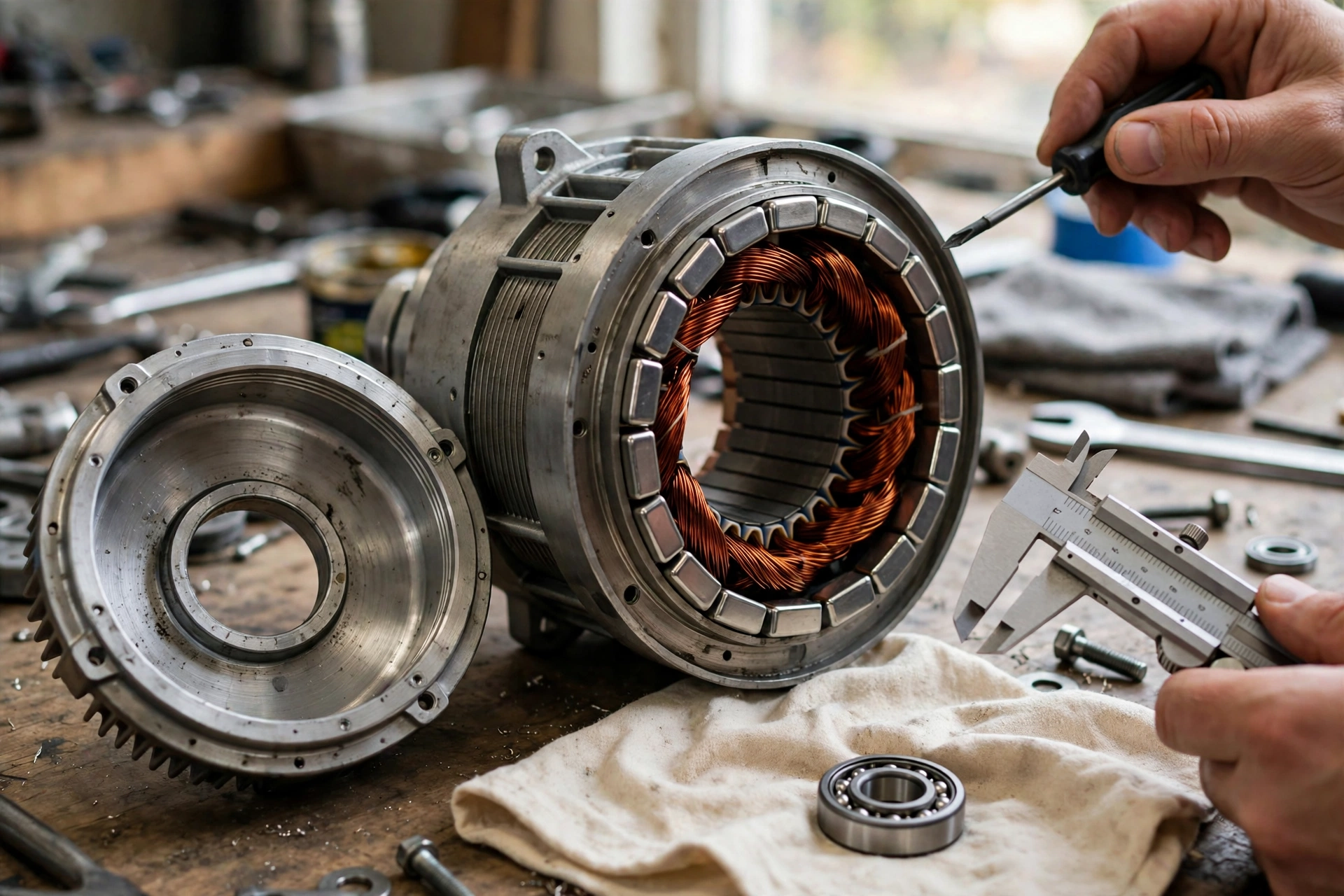
In a brushless DC electric motor the layout is turned inside out. The permanent magnets rotate with the output shaft (or, in a hub motor, with the wheel), the three-phase windings are fixed to the stator, and a controller does the reversing electronically. The controller is, strictly, a small inverter: it takes DC from the battery and synthesises timed three-phase pulses. The “DC” in the name is a historical courtesy. The motor itself runs on switched AC, a point the more honest textbooks state plainly.
The controller must know where the rotor is. Two methods dominate. Sensored motors carry three Hall sensors that report rotor position in 60-degree electrical steps — coarse, cheap, and sufficient for clean starts under load. Sensorless motors infer position from back-EMF, the voltage a spinning motor generates in its unpowered phase. Back-EMF is proportional to speed, which means it is exactly zero at standstill.
A sensorless system therefore starts open-loop, guessing, and only synchronises once the shaft turns. On a drone propeller that hardly matters. On a loaded cargo bike pointing uphill, it produces the familiar stutter and rollback. Our position is firm: sensorless drive on a working bicycle is a false economy.
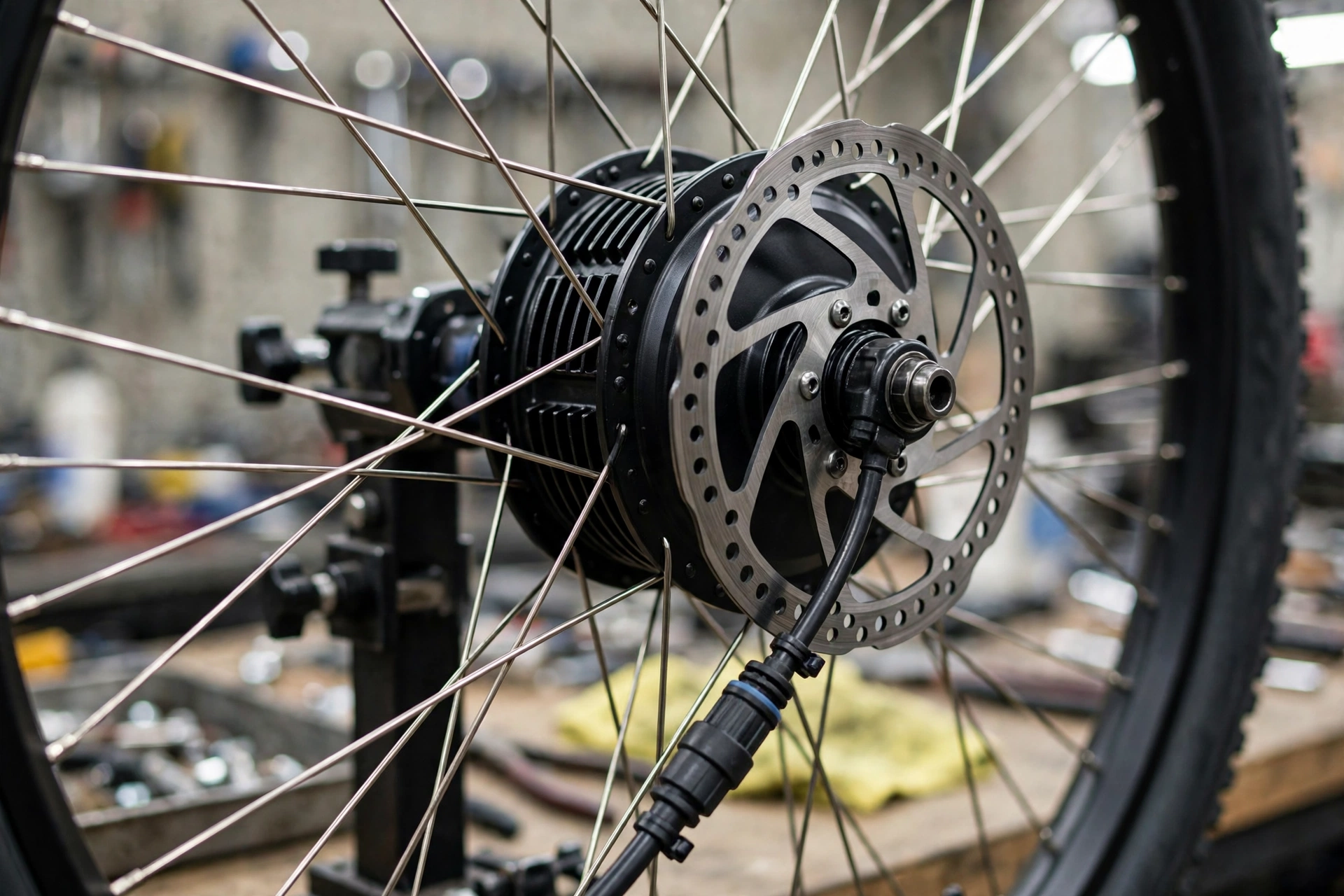
Remove the brushes and you remove brush wear, commutator arcing and carbon dust in one step. A comparable brushed motor typically needs brush service within a few thousand operating hours (est., strongly dependent on load and duty). What remains mechanical inside a brushless motor is a pair of bearings. That is the honest core of the “maintenance-free” claim: it is nearly true of the motor, and not true at all of the system around it, as the failure section below sets out.
Brushless DC electric motor or PMSM? The terminology trap
Here the spec-sheet discipline matters. A brushless DC electric motor and a PMSM (permanent magnet synchronous motor) are the same family: three-phase, permanent-magnet, synchronously rotating machines. The textbook distinction is the shape of the back-EMF and the drive waveform matched to it. A true BLDC design has a trapezoidal back-EMF and is driven with six-step commutation — two phases energised at a time, current in rectangular blocks.
A PMSM has a sinusoidal back-EMF, distributed windings to match, and is driven with sinusoidal currents under field-oriented control (FOC). The Swiss drive manufacturer maxon states the practical consequence in its engineering notes on EC motors: sinusoidal commutation delivers roughly 5% more torque at identical power losses, with no theoretical torque ripple.
| Property | BLDC (strict sense) | PMSM |
|---|---|---|
| Back-EMF waveform | Trapezoidal | Sinusoidal |
| Drive method | Six-step, rectangular current | FOC, sinusoidal current |
| Position feedback | Hall sensors, 60° steps | Resolver or encoder, fine resolution |
| Torque delivery | Noticeable ripple, some cogging feel | Smooth from zero speed |
| Peak efficiency (manufacturer datasheet class) | ~85–90% | ~93–96% |
| Typical home | E-bike and scooter hubs, fans, drones | Electric car traction drives |
In practice the boundary is porous. Premium e-bike controllers now drive hub motors with FOC, and the result behaves like a small PMSM whatever the carton says. Marketing departments, meanwhile, apply “BLDC” to almost anything small, round and brushless. Judge the behaviour — smoothness at walking pace, noise, heat on a long climb — and let the acronym go.
Which vehicles use which motor
Two-wheelers are the brushless DC electric motor’s home ground. Nearly every e-bike hub motor and every scooter hub motor is a true BLDC machine: Hall-sensored, three-phase, increasingly paired with sine-wave or FOC controllers at the premium end. Mid-drive e-bike motors from Bosch, Shimano and Yamaha are permanent-magnet machines under sinusoidal control — PMSM behaviour in all but name.
Cars are different. The Nissan Leaf, Chevrolet Bolt and Hyundai Ioniq 5 use PMSM traction motors; the rear motor of a Tesla Model 3 is an interior-permanent-magnet synchronous design; Tesla’s earlier cars, and the front axle of dual-motor Model 3 and Model Y variants, use induction motors, which have no magnets at all. No car maker sells a six-step BLDC traction drive. When a car advertisement says “brushless”, it is telling you the motor has no brushes — which is true of every electric car ever offered for sale.
The term does have one legitimate automotive address: the auxiliary drives. Electric power-steering motors, air-conditioning compressors, coolant pumps and blower fans in a modern car are small brushless DC electric motor units of exactly the textbook kind, chosen for the same reason they dominate bicycles — no brushes, no service schedule.
The brushless DC electric motor specifications that matter
Efficiency is a map, not a number. A motor reaches peak efficiency at one combination of speed and load and is worse everywhere else. Datasheet minimums tell the sober story: Bafang’s published manuals rate its hub motors at ≥75% and ≥80% efficiency at the rated point, and six-step BLDC machines generally peak around 85–90% (figures from manufacturer datasheets and motor-vendor engineering literature). Automotive PMSM drives peak at roughly 93–96% on the same basis. A motor advertised as “90% efficient” that spends its life crawling at high torque will not deliver 90% in service.
The rating is a thermal promise, not a power ceiling. A continuous rating — 250 W under the European EN 15194 pedelec rules, up to 750 W for a US Class 3 e-bike — states what the motor can sustain without overheating. Short peaks of roughly twice the continuous figure for a few minutes are normal (est., based on published controller and motor pairings). This is why near-identical Bafang hardware wears a 250 W label in Europe and a larger one in the United States: the label is regulatory, the copper is the same.
Torque, meanwhile, follows current. Bafang’s small G310 hub is rated 250 W and 35 Nm in the maker’s manual; feed a motor more current through a stronger controller and it makes more torque, until heat collects the debt.
kV selects the operating point; it is not a power figure. On hobby and RC units, kV means no-load rpm per volt: a 2,300 kV drone motor on an 11.1 V pack spins near 25,500 rpm unloaded. Hub motors are wound far slower, around 8–12 rpm/V at common voltages (est.). A higher kV winding reaches a higher top speed on the same battery and gives up low-speed torque and efficiency to do it. Choose the winding for the wheel size and the riding, a trade-off familiar to anyone who has compared the machines in our fastest e-bike guide.
The controller is half the system. It sets the current limit, and current is torque. A “1,000 W” motor behind a 25 A controller on a 48 V battery can draw at most 48 × 25 = 1,200 W of electrical input, and rather less at the wheel after losses. FOC controllers add smoothness, quiet and a few points of real-world efficiency over six-step units. It is also, not coincidentally, the part of a brushless DC electric motor system that ages fastest in the field.
Our advice, stated plainly: on any build or purchase, spend on the controller and the battery before spending on the motor. The motor is the most durable component in the chain; it deserves the smallest share of the budget.
What motor efficiency does to range: the arithmetic
Take a 500 Wh e-bike battery and a rider whose speed, tyres and terrain demand 20 Wh of mechanical energy per mile at the wheel (a mid-range figure for mixed riding at moderate pace). Run the numbers for two drive systems. System A, motor and controller together at 80% efficiency: the battery must supply 20 ÷ 0.80 = 25.0 Wh per mile, so range = 500 ÷ 25.0 = 20.0 miles. System B at 88%: the battery supplies 20 ÷ 0.88 = 22.7 Wh per mile, so range = 500 ÷ 22.7 = 22.0 miles.
An eight-point efficiency gap — larger than the real gap between a decent hub motor and an excellent one — buys two miles, exactly 10%, because 0.88 ÷ 0.80 = 1.10.
Now change the speed instead. Aerodynamic drag rises with the square of velocity: riding at 25 mph instead of 20 mph multiplies drag by 25² ÷ 20² = 1.56. If aerodynamic drag is half the total load at 20 mph (est.), total demand per mile rises to 0.5 × 1.56 + 0.5 = 1.28, a 28% increase — nearly three times the effect of the motor swap, in the wrong direction.
Tyre choice and pressure routinely swing consumption by a similar order. This is also why car figures behave as they do: EPA and WLTP ratings measure the whole vehicle, losses included, so a marginally better motor moves a car’s official range by a few percent while its tyres and frontal area move it by far more. How those ratings are built is covered in our EV battery and range explainer. Motor efficiency is worth having. It is the third or fourth thing that decides your range, not the first.
A European footnote, because the two rating systems are so often compared carelessly: a car’s WLTP range figure and its EPA figure are produced by different test cycles, and the WLTP number typically reads 15–20% higher for the same vehicle (est., based on published dual-rated models). Neither system rewards a motor type. Both measure the finished car, which is precisely why a drivetrain detail worth 3% cannot rescue a thirsty shape — and why we report EPA figures on this site when both exist.
Prices: what the hardware costs in October 2026
Prices below were checked on October 27, 2026, at Grin Technologies’ store and US retailer listings; our research method applies as usual. Grin’s hub motor catalogue lists the small Bafang G311 from $120 and the 250 W G310 from $125 as bare motors. The G62 fat-bike hub is $260. An eZee hub starts at $390, the clutch-locked GMAC geared hub is $472.50, and Grin’s own All-Axle front hub starts at $622.
Complete kits change the picture: US listings show a Bafang 500 W front-hub kit — motor, controller and display, battery extra — at $169.99, a Bafang BBS02B 750 W mid-drive kit at $415.99, and the 1,000 W BBSHD kit at $647.88.
Dividing price by rated power exposes the structure of the market. The G310: $125 ÷ 0.25 kW = $500 per kW for a bare motor. The 500 W kit: $169.99 ÷ 0.5 kW ≈ $340 per kW, controller and display included. The BBS02B: $415.99 ÷ 0.75 kW ≈ $555 per kW. The BBSHD: $647.88 ÷ 1.0 kW ≈ $648 per kW. The GMAC: $472.50 ÷ 0.5 kW = $945 per kW, the premium bare-motor outlier, bought for its locked clutch and climbing manners rather than its watts.
Replacement scooter hub motors cluster around $90–$300 (est., based on current marketplace and parts-store listings). Two conclusions follow. Mass production, not magnet content, sets the price of a brushless DC electric motor at bicycle scale. And in any complete build the battery, at roughly $300–$500 for a 500 Wh pack (est.), costs more than the motor it feeds.
What actually fails, and what almost never does
Field failures follow a consistent order. Bearings wear first among the mechanical parts; they are standard industrial sizes and replaceable. Hall sensors fail from water ingress and heat, and a dead Hall produces exactly the stutter that sensorless systems show at start-up — which is why some riders misdiagnose a drowned sensor as controller trouble. Phase wires chafe where they exit the axle. Geared hub motors add one genuine wear item: nylon reduction gears, which can strip under sustained high torque. The controller, exposed to weather and full battery current, fails more often than the motor it drives — capacitors age, MOSFETs die, connectors corrode.
The magnets deserve a precise word, because “demagnetisation” is often invoked and rarely quantified. Neodymium-iron-boron magnet grades carry maximum operating temperatures of roughly 80 °C for standard N grades, rising through M (~100 °C) and H (~120 °C) to SH (~150 °C) (textbook grade data). Exceed the grade limit under load and flux loss becomes partly irreversible: the motor survives, permanently weaker.
Stator temperatures in a hard-worked hub motor on a long, slow climb can pass 120 °C (est., consistent with published hub-motor thermal testing), which is why sustained low-speed, high-torque work — not top speed — is the thermal worst case. The windings themselves, enamelled copper on steel laminations, almost never fail outside of water damage and abuse. A brushless motor’s realistic service story is a bearing change and dry connectors, not a funeral.
Our verdict, by application
For e-bikes: Our score: 9/10. Efficiency 8/10 · Maintenance 10/10 · Value 9/10. The hub motor is the correct answer for most riders: cheap, sealed, silent enough, and effectively wear-free at bicycle power levels. Mid-drives earn their premium on steep terrain and natural pedal feel, not on reliability.
For electric scooters: Our score: 8.5/10. Efficiency 8/10 · Maintenance 9/10 · Value 9/10. Nothing else fits the format — a brushless hub is the scooter. The half point goes to small wheels running hot and to sealed units that resist bearing service.
“Brushless” as a car-buying criterion: Our score: 1/10. Efficiency signal 1/10 · Maintenance signal 2/10 · Value 1/10. Every electric car is brushless. The word distinguishes nothing, predicts nothing and should be ignored in the showroom entirely. Compare EPA range, charging curves and price; the motor’s commutation method is not on the list of things that will affect your ownership.
Frequently asked questions
Is a brushless DC electric motor the same thing as a PMSM?
Nearly. Both are three-phase permanent-magnet synchronous machines. The strict distinction is back-EMF shape and control: trapezoidal with six-step drive for BLDC, sinusoidal with field-oriented control for PMSM. Many products sit between the definitions, and a good FOC controller makes a hub motor behave like a small PMSM.
Do brushless motors need maintenance?
Almost none. There are no brushes or commutator to service. Keep the connectors dry, listen for bearing roughness, and expect the controller, battery and tyres to demand attention long before the motor does.
Why does my e-bike stutter when pulling away?
Usually one of two causes: a sensorless controller, which cannot sense rotor position at standstill because back-EMF is zero at zero speed, or a failed Hall sensor in a sensored motor, which produces the same symptom. The first is a design limitation; the second is a repair.
What does kV mean on a motor rating?
No-load speed per volt applied, in rpm per volt. It locates the motor’s efficient operating band and its top speed on a given battery voltage. It is not a power rating, and a higher kV does not mean a stronger motor.
Will a more efficient motor give me much more range?
No. On the worked example above, an eight-point system-efficiency gain returned 10% more range — two miles from a 500 Wh pack. Speed, tyres and terrain each move consumption by more than any realistic motor upgrade. Buy efficiency when it comes with the motor you already want.
Are car traction motors brushless DC motors?
Not in the strict sense. Cars use PMSM and induction traction motors under field-oriented control. They are brushless, certainly, but calling them BLDC confuses a bicycle-hub term with automotive practice — and tells you nothing useful when comparing cars.
In short, a brushless DC electric motor is the right choice for bikes and scooters, and the brushless DC electric motor remains simple, durable and affordable at that scale. Ignore the label on cars, and judge any brushless DC electric motor by its controller, thermal rating and price per kilowatt.