Last updated: October 27, 2026
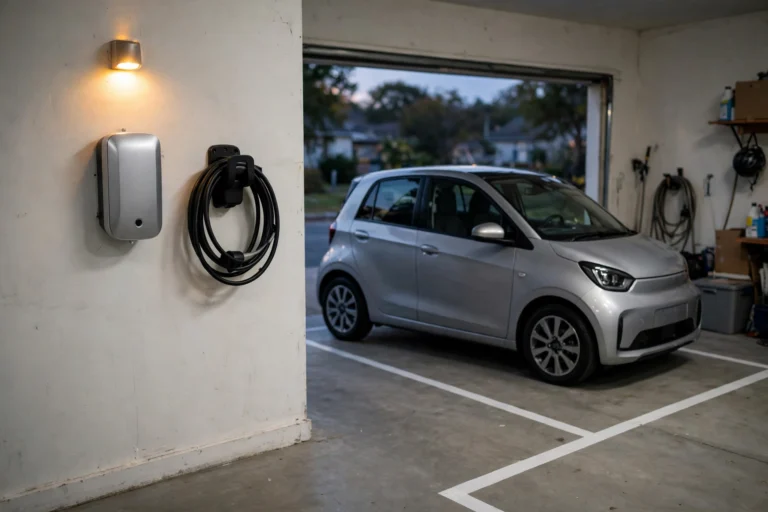
A first installation starts from a blank wall. A remodel starts from a decision somebody else made years ago — a charger chosen when the car was smaller, the panel was emptier, and 16 amps sounded like plenty. That is why how to remodel EV charger installation is a different question from how to install one. The wiring in your wall is either an asset to build on or a limit to design around, and the whole job turns on knowing which, in writing, before money moves.
The honest triggers are few, and specific. The old unit is too slow for the car you own now: a 16-amp, 3.8 kW charger returns about 12 miles of range an hour, which a 300-mile EV feels as a shortfall every week. A second EV arrives, and one charger stops being a rota and starts being an argument. The unit itself is worn — cracked housing, a cable jacket split near the handle, a connector that runs hot. You are selling the house and the install looks dated. Or the panel arithmetic changed — a hot tub, a heat pump, a workshop — and the charger that was legal headroom in 2021 is crowding the load calculation now.
Remodels come in three sizes, and confusing them is where the money leaks. A swap replaces the box on the same circuit at the same rating. An upsize raises the charging current, which almost always means a new circuit as well as a new box. A relocation moves the charging point — really a new install wearing the old one’s permit history. Each size has its own permit position, labour shape and honest price; the sections below take them in that order.
One piece of framing governs everything after it. Home charging in the United States is regulated work under Article 625 of the National Electrical Code, and a remodel is judged against the code edition your state has adopted at the time of the remodel — not the edition in force when the original charger went up. A 2016 install that was fully compliant then can stand as it is, yet still need upgrading the moment you modify it. That is not a trap; it is how electrical safety improves one alteration at a time.
And the safety line, stated once and plainly: circuit work — breakers, wiring, panel changes, new receptacles — is licensed-electrician work, done under permit, in nearly every US jurisdiction. Homeowners can plan, measure, photograph, compare quotes and choose equipment. The moment a conductor is cut or a breaker changes size, the job belongs to a professional whose licence stands behind it.
How to remodel EV charger installation without wasting the wiring you already own
Start with the single most misunderstood fact in this whole subject: the charger does not set the circuit size — the circuit is sized from the charger’s draw, with a margin the code insists on. NEC 625.41 requires overcurrent protection for EV charging to be rated at no less than 125 percent of the equipment’s maximum load, because charging is a continuous load — it runs for hours, not minutes. A 32-amp charger therefore lives on a 40-amp circuit. A 40-amp charger lives on a 50-amp circuit. A 48-amp charger needs a 60-amp circuit. The breaker, the wire gauge and the charger’s setting move together, as one system.
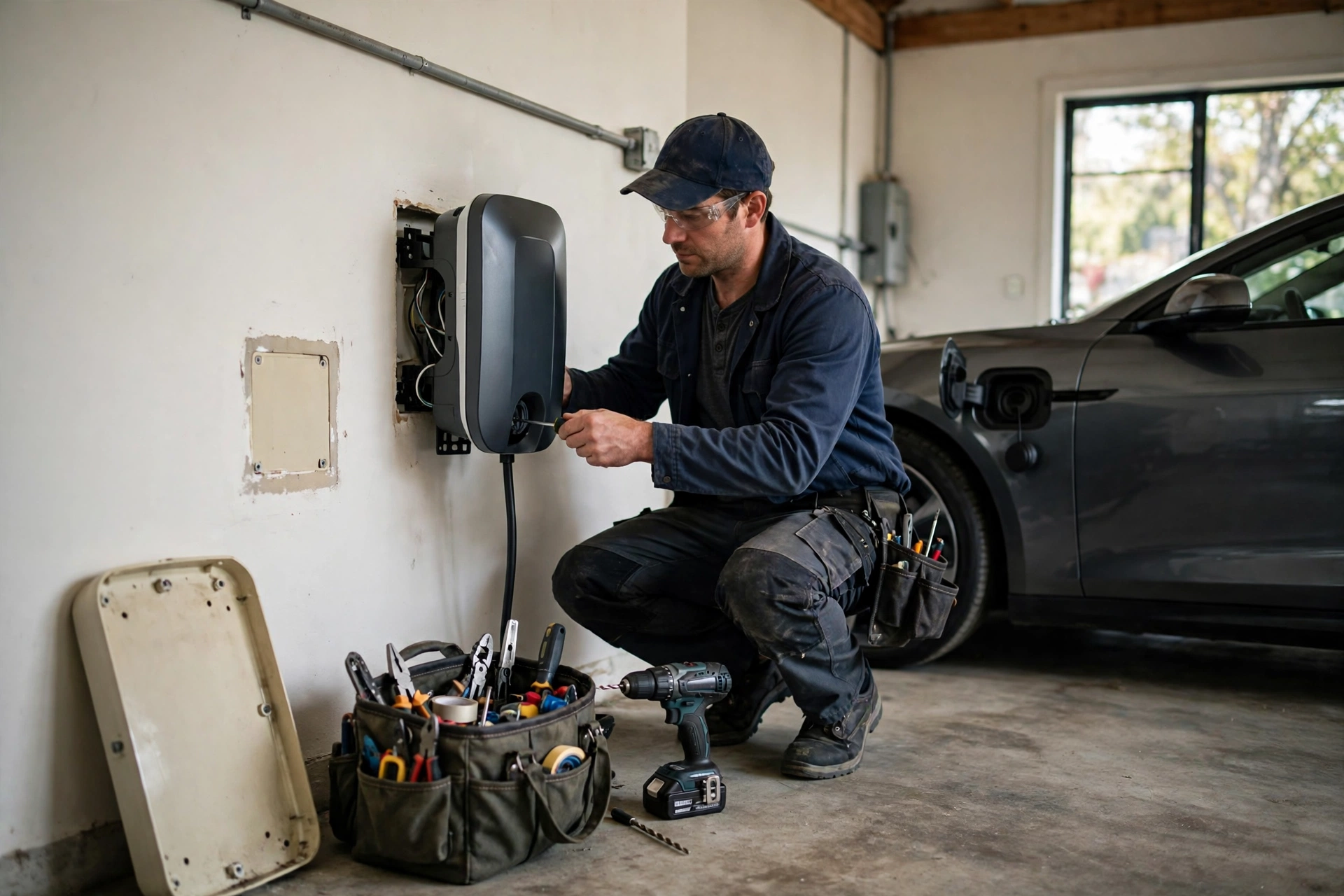
Now the consequence that surprises people. Upsizing from a 32-amp charger to a 48-amp charger is not a box swap. The existing 40-amp circuit — breaker, and usually wire — cannot legally carry the new unit at full output. You are buying a new circuit that happens to end where the old one did. Owners who budget for a charger and receive a quote for a charger plus a circuit run feel overcharged; they are not. They are reading the correct quote for the job they asked for. Our EV charger sizing calculator shows the pairing plainly — enter the amps you want and it returns the circuit the code requires, which is the number to take into quote conversations.
What can be reused is real, and worth claiming. The conduit run, if intact and correctly sized for the new conductors, usually stays. The panel position and breaker space stay. The mounting location and its weather protection stay. On a like-for-like swap, reuse is nearly total — circuit, breaker, wiring and location all carry over, and the visit is measured in an hour or two, not a day. What can never be reused is headroom that does not exist: a 40-amp circuit will not become a 60-amp circuit because the new charger is more efficient. Efficiency lives in the car. The circuit is copper and arithmetic.
The load-management shortcut: NEC 625.42 against the service upgrade
Here is the standards point that decides more remodel budgets than any other. NEC 625.42 covers the rating of services and feeders feeding EV charging, and it contains the sentence that saves homeowners thousands: where an automatic load management system is used, the maximum load counted on the service is the maximum the system permits — not the charger’s nameplate. In plain terms, a listed device that watches the house’s total draw and throttles the charger when the oven, dryer and air conditioner peak together lets the code count the charger at its managed ceiling. A 100-amp service that fails the load calculation for a 48-amp charger can pass it, legally and safely, with management fitted.
Our own published install analysis priced this fork for a 100-amp panel, and the pattern holds for remodels. The service-upgrade route — new 200-amp panel, meter work, utility disconnect and reconnect — totalled $4,701 all in. The managed route — same panel, a listed energy-management device fitted, charger and circuit at managed ratings — totalled $2,381 all in. Same overnight speed for almost every real household routine; $2,320 apart. The managed charger’s throttle events happen on cooking-and-cooling evenings at 7 p.m.; by 2 a.m. the car has everything it asked for.
My position, without hedging: do not sign a service-upgrade quote for a charger remodel until a load-management quote exists beside it on paper. The upgrade is genuinely necessary in some houses — a panel that is full or deteriorated deserves replacing on its own merits. But for a sound 100-amp panel whose only problem is one hungry new load, management is the engineering answer and the upgrade is the expensive habit. The Mike Holt Enterprises commentary on Article 625 walks through the 625.41 sizing rule and the 625.42 management provision in the code’s own terms — worth reading before arguing with either quote.
Reliability is the fair objection: a managed setup adds a device and a sensor to the chain. But listed systems fail safe — a lost signal defaults the charger to its lowest rate or pauses it, never to unrestricted draw — and the failure owners actually report is one slow night’s charging, not a tripped main. Compare the upgrade’s own disruption: a full day without power and a utility appointment. The managed route’s consequences are smaller and cheaper; that is the whole argument.
Three remodels, itemised: what each size of job actually costs
Ranges hide decisions, so here are three complete remodels with the arithmetic shown — the worked answer to how to remodel EV charger installation on a real budget. Prices checked October 27, 2026; lines marked (est.) are typical-market estimates, since charger street prices and electrician rates move by city and by month.
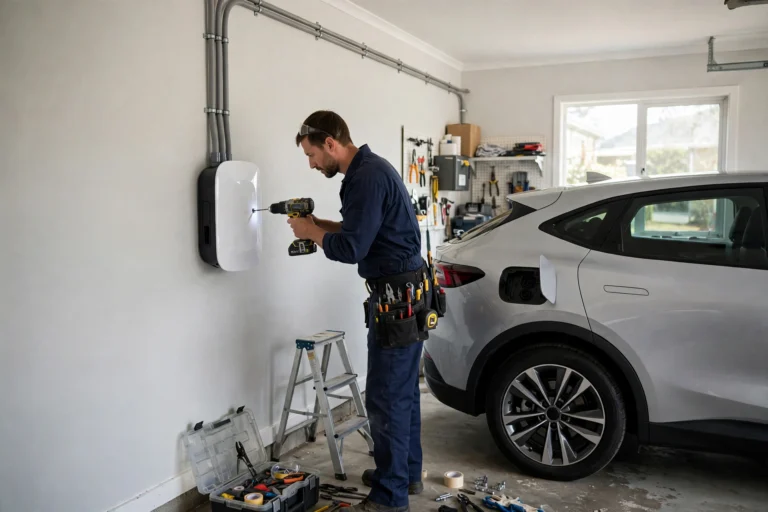
Remodel 1 — the like-for-like swap. The worn 40-amp unit comes off; a current 40-amp smart charger goes on the same circuit, same breaker, same location. Charger $499 (est.) + electrician’s swap visit, about ninety minutes including testing under load, $225 (est.) + permit and inspection where your jurisdiction requires one for equipment replacement, $150 (est.) + sundries and disposal $25 (est.) = $899 all in. The best-value job in home charging: modern app control, a fresh warranty and an undamaged cable, for one short visit.
Remodel 2 — the upsize with management. The 32-amp charger becomes a 48-amp unit on a sound 100-amp panel. Charger $549 (est.) + new 60-amp circuit materials — breaker and roughly 25 feet of conductor and conduit, reusing the existing route where it passes inspection — $310 (est.) + listed load-management device $650 (est.) + labour, about five hours, $750 (est.) + permit and inspection $265 (est.) = $2,524 all in. The same upsize by the upgrade route — a $3,150 (est.) service upgrade in place of the $650 device, permits at $310 (est.) — totals $4,919. Management saves $2,395 on this one job: more than the charger, circuit and labour combined.
Remodel 3 — the relocation. The charger moves 35 feet, from the panel wall to the wall the cars actually park against, upsized on the way. Charger $549 (est.) + 35 feet of 6 AWG copper in conduit at $9.50 a foot = $333 (est.) + 60-amp breaker $118 (est.) + labour, about six and a half hours including the wall work, $975 (est.) + making good the old location — patch, paint, blank plate — $210 (est.) + permit and inspection $265 (est.) = $2,450 all in. The lesson is in the lines: the charger is a fifth of the bill. Distance is the price — copper by the foot, labour by the obstacle — so make relocation decisions with a tape measure in hand, not a catalogue.
Run your own version of these sums with our EV home charger installation cost estimator — it uses the same line items, so its total and the quote on your table compare line by line. Where a line differs wildly, that line is the conversation to have with the electrician.
The connector remodel: J1772, NACS and the adapter question
The second most common remodel trigger in 2026 is not electrical at all: the household’s cars changed plugs. A J1772 charger installed for an older EV now serves a car with a NACS inlet, or the reverse is coming with the next purchase, and the owner asks the reasonable question — swap the charger, or adapt?
The adapter answer first, with its limits stated. A quality listed adapter — supplied by the carmaker or sold by the charger manufacturer — is a legitimate bridge for a season: it converts the connector mechanically, carries the same pilot signalling, and works fine for overnight AC charging. Its limits are three. It adds a junction that ages in the weather on outdoor installs. It caps you at the adapter’s own rating, which on cheap unbranded units is a number printed on a box, not a tested figure.
And if the old charger is also slow, small or orphaned by its maker’s app shutdown, the adapter spends money preserving the wrong unit. An adapter is a bridge, not a remodel. When the car change is permanent, replace the charger with the connector the household now uses; the swap is Remodel 1 money, and it ends the subject.
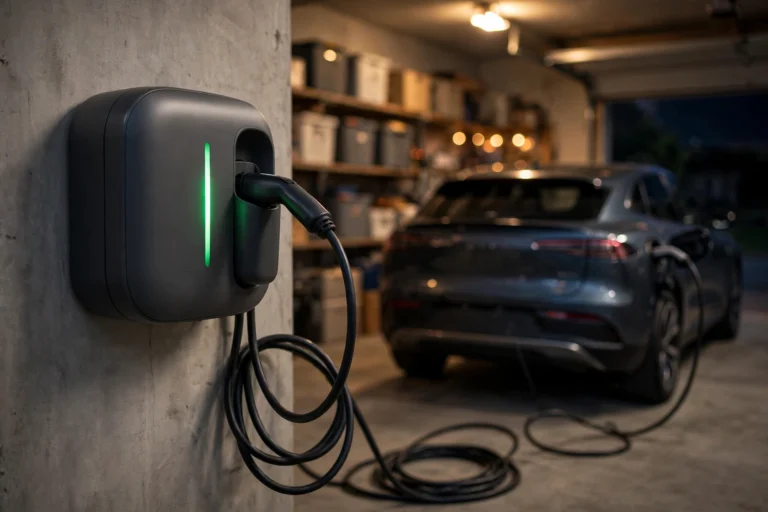
The dual-standard answer is better where it fits. Universal units — chargers sold with both connectors, or a swappable cable — exist for two-standard households, and a remodel is the natural moment to buy one: one circuit, one wall position, both cars served. The power-sharing versions go further, splitting one feed between two connectors under management — the 625.42 principle inside a single box. For a two-EV household remodelling anyway, that is the specification to ask for by name.
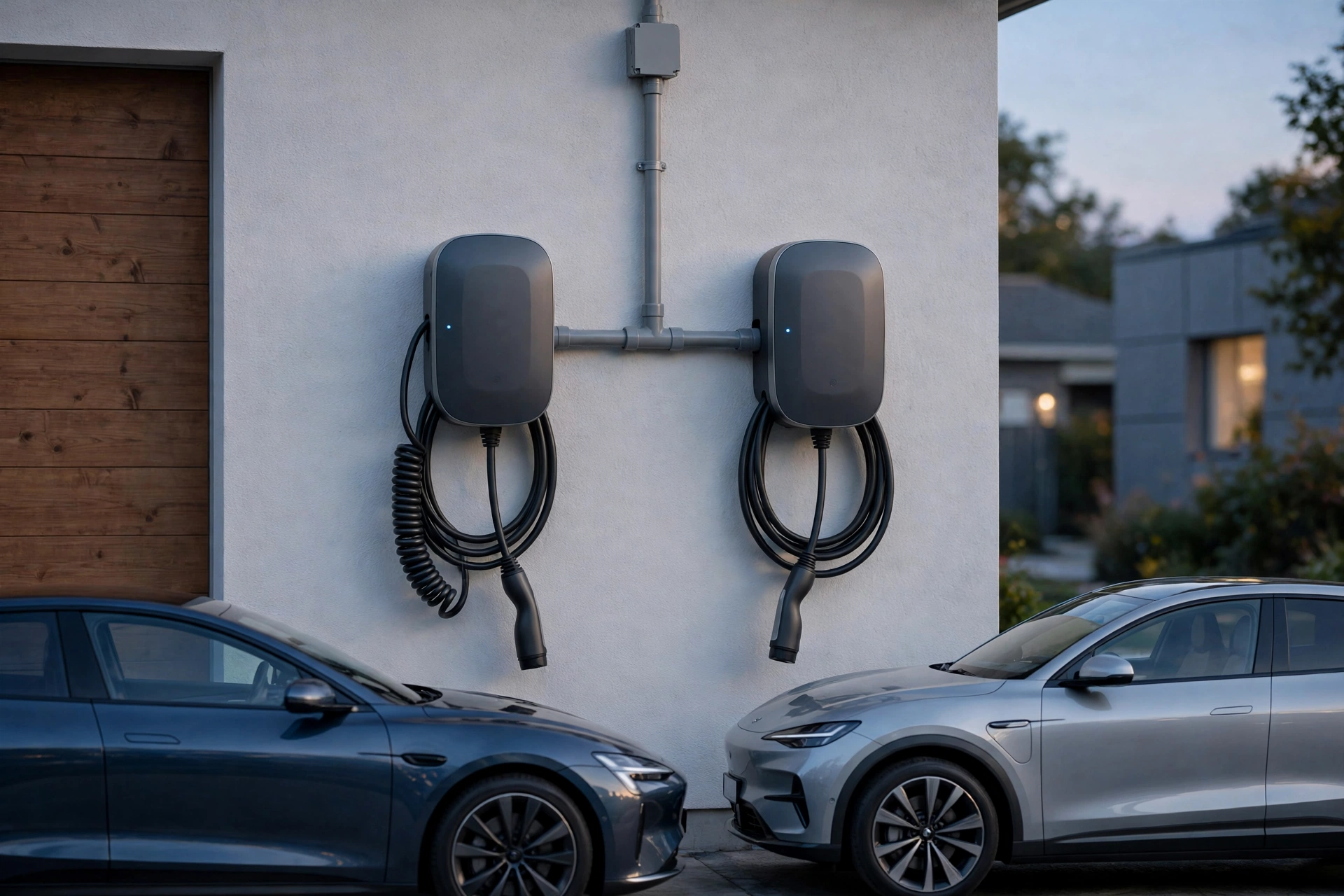
Adding the second charger: one feed, two cars, no drama
Because it deserves its own section: the second-EV remodel frightens people out of proportion to its difficulty. The fear is the panel — two 48-amp chargers read as 96 amps of new load, and a naive load calculation agrees. The standards answer is the one from the earlier section: load management is not limited to a single charger. NEC 625.42’s provision covers the managed total, so two chargers on a listed power-sharing arrangement count at their configured combined ceiling. Two cars wanting 30 kWh each overnight need about eight hours at a shared 40 amps between them — which a managed pair delivers while the house sleeps, on a panel that could never host two unrestricted circuits.
The practical shape of the job: second charger $499–$649 (est.) depending on the standard and features, a shared-feeder or paired-circuit arrangement engineered by the electrician, labour of half a day (est.), one permit covering the modification. Total typically lands between the swap and the relocation above. The alternative households improvise — one car on a household outlet — is covered honestly in our guide to charging an electric car with a regular outlet: 3 to 5 miles of range an hour is a ration, not a solution, though for a low-mileage second car it is sometimes the right ration. When both cars commute, do the managed pair once and stop thinking about it.
Code drift: what changed while your charger was on the wall
A remodel is inspected against today’s adopted code, so it is worth knowing what “today” added since many existing installs went in. Three changes account for most surprise line items.
First, receptacle protection. The 2020 NEC added 625.54, requiring GFCI protection for personnel on receptacles installed for EV charging. An older plug-in install on a plain breaker, legal when fitted, will commonly be quoted a GFCI breaker in any permitted modification touching that circuit — a real cost, typically $100–$250 for the breaker itself (est.), and a genuine improvement for a socket that lives in a damp garage and is handled nightly. Hardwired units carry their own internal protection and are untouched by this one.
Second, the management provisions themselves. Load management for EV charging entered the code in recognisable form in 2017 and was refined in 2020 and 2023; an electrician quoting from an older mental edition may not offer the managed route at all. That is a knowledge gap, not a character flaw, and the fix is simple: ask for the managed quote by its article number.
Third, adoption lag. The NEC publishes on a three-year cycle — 2017, 2020, 2023, with the 2026 edition arriving — but states and cities adopt on their own calendars, and some jurisdictions still enforce editions two cycles old. Your remodel is governed by your authority’s adopted edition plus local amendments, which is one more reason the electrician’s local licence matters more than any national guide, this one included. The Department of Energy’s Alternative Fuels Data Center keeps a plain-language guide to charging an electric car at home that tracks the national picture; treat it as the cross-check, and your local inspector as the verdict.
Permits, paperwork and keeping the money valid
Permit rules follow the size of the job. A like-for-like swap is exempt in some jurisdictions and permitted in others; a new circuit, a changed breaker size or a relocation is permitted work essentially everywhere.
The paperwork has a second job: money. Utility rebate programmes routinely require a permitted install and an invoice naming the equipment; a remodel done off-permit can void the new unit’s rebate eligibility and raise questions nobody wants at resale. Keep the permit card, the invoices and the old unit’s paperwork together. Note also the federal position, because old guides still get it wrong: the Section 30C home-charging credit ended for equipment placed in service after June 30, 2026, so budget a remodel done now without it — any quote that quietly assumes the credit is out of date. Our research method page sets out where every figure in this guide came from and when it was checked.
Our verdict on the remodel itself
Our score: 7.5/10 — Remodel value: 8/10. Disruption: 6/10. Future-proofing: 8/10.
Value scores highest because the reuse is real: the swap at $899 and the managed upsize at $2,524 both buy a modern charging life out of infrastructure already in the wall. Disruption scores lowest, honestly — even small jobs involve a permit timeline the homeowner does not control. Future-proofing earns its 8 on one condition: the remodel is specified for the household’s next car, not its last one. Choose the dual-connector or power-sharing unit now, and how to remodel EV charger installation becomes a question you answered once, properly, instead of one that returns in 2029.
Frequently asked questions
How to remodel EV charger installation if I only want a faster charger?
Expect a new circuit, not just a new box. NEC 625.41 sizes the circuit at 125 percent of the charger’s draw, so a move from 32 to 48 amps means a 60-amp circuit — breaker and usually wire. If your panel is tight, the same upsize with a load-management device under 625.42 is the cheaper route: $2,524 against $4,919 by the upgrade path in the worked examples above, prices checked October 27, 2026.
Can I reuse the old wiring when the new charger has the same amp rating?
Usually, yes — that is what makes the like-for-like swap the best-value remodel. The electrician verifies the conductor gauge, the breaker and the condition of the run; if all three match the new unit’s requirements, the circuit carries over unchanged and the visit is short. Reuse is decided by inspection, not by the age of the install.
Do I need a permit to replace a charger with an identical model?
It depends on the jurisdiction, and the honest answer is to ask the building department or your electrician before the work, not after. Circuit changes, breaker changes and relocations need permits essentially everywhere; equipment-only swaps are exempt in some places and permitted in others. The permit also protects rebate eligibility, which is reason enough to make the phone call.
Is a J1772-to-NACS adapter acceptable for daily home charging?
A listed adapter from the carmaker or charger manufacturer is an acceptable bridge: overnight AC charging through one works and is widely done. Treat unbranded adapters as the false economy they are — their ratings are unverified — and treat any adapter as temporary. When the household’s cars have settled on one standard, the connector-matched charger swap ends the question for Remodel 1 money.
Will a remodel affect my existing rebate or the charger’s warranty?
A permitted remodel with itemised invoices keeps utility rebate paperwork clean; unpermitted circuit work is what creates problems, both with programmes and with a future buyer’s inspector. The new charger carries its own manufacturer’s warranty from its install date. The old unit’s warranty dies with its removal — one more reason to photograph its labels and keep its paperwork before it leaves the wall.
How long does a charger remodel take compared with a first install?
The physical work is shorter — a swap is roughly ninety minutes, an upsize or second charger about half a day (est.) — because the route planning and panel knowledge already exist. The calendar time is similar to a first install, since quotes, permit issue and inspection scheduling run on the jurisdiction’s clock either way. Start the permit conversation first and the remodel finishes when you expect it to.