Last updated: October 27, 2026
Start with the fact that changes everything else in this guide. Electric Bike Co — the Newport Beach, California brand that sold custom-painted beach cruisers under the full name Electric Bike Company — no longer exists. The company filed for Chapter 7 bankruptcy liquidation on October 3, 2025. The factory is closed, the famous 10-year warranty has nobody left to honour it, and the brand’s own web address now opens a generic e-bike buyer’s guide.
What follows is still worth your time, because thousands of electric bike co bikes are out there: on boardwalks, in garages, and increasingly on the used market at steep discounts. This guide covers what the bikes are, what the specs really mean, what the range claims were worth, and what one should cost you now.
One disclosure before the hardware. Most of my riding is on dirt, on mid-drive machines with proper suspension. An electric bike co cruiser is the opposite of that: rigid fork, balloon tyres, a hub motor, and geometry built for flat bike paths and coffee runs. I am not the target customer. But a bike does not have to be my kind of bike to be a good bike, and it does not escape scrutiny just because it is pretty. The paint on these was genuinely excellent. The range chart was not. Both things get covered below, with the receipts.
Electric Bike Co in 2026: the company is gone
The court record for electric bike co is short and brutal. Electric Bike Company LLC filed under Chapter 7 in the US Bankruptcy Court for the Central District of California (case SA-25-12810-SC), listing roughly $6.1 million in liabilities against about $953,000 in assets, as reported by Bicycle Retailer and Industry News.
Chapter 7 is not a restructure. It is a liquidation: no plan to keep trading, no buyer lined up to save it. The trustee offered what was left — the brand, the website, the intellectual property, remaining inventory, and the factory equipment, down to the paint gear and wheel-building jigs — with bids due in January 2026 and any auction set for early February, per Electric Bike Report’s industry coverage.
Nothing suggests a rescue happened. Upway, the large refurbished e-bike marketplace, states plainly in its brand guide that the company “was not acquired by any other business,” and that it occasionally takes in EBC models to recondition and sell under its own 1-year warranty.
Type in the old address today — the brand’s former official site — and you land on an affiliate buyer’s guide wearing a similar name. The store is gone. That is the first thing any October 2026 price list still floating around the internet will not tell you, and it is why every “price” in this article is labelled a last published list price, checked October 27, 2026, rather than a live offer.

Why electric bike co died matters if you are shopping the leftovers. Founder Sean Lupton-Smith told BRAIN that tariffs on his imported components climbed from 25% to 55% and beyond; Inc. magazine’s post-mortem put the company’s final-year revenue at $9.5 million with a net loss near $2 million, after a crowdfunding raise brought in only about $171,000.
The cruel detail: as of 2020 only about 22% of each bike’s value came from China. The rest came from Taiwan, Japan, the Netherlands and the US. This was one of the most American e-bikes ever sold at scale — assembled, painted, wheel-built and battery-packed in Orange County — and American assembly is precisely what the cost spiral punished. The bikes were not the problem. The spreadsheet was.
What an Electric Bike Co bike actually is
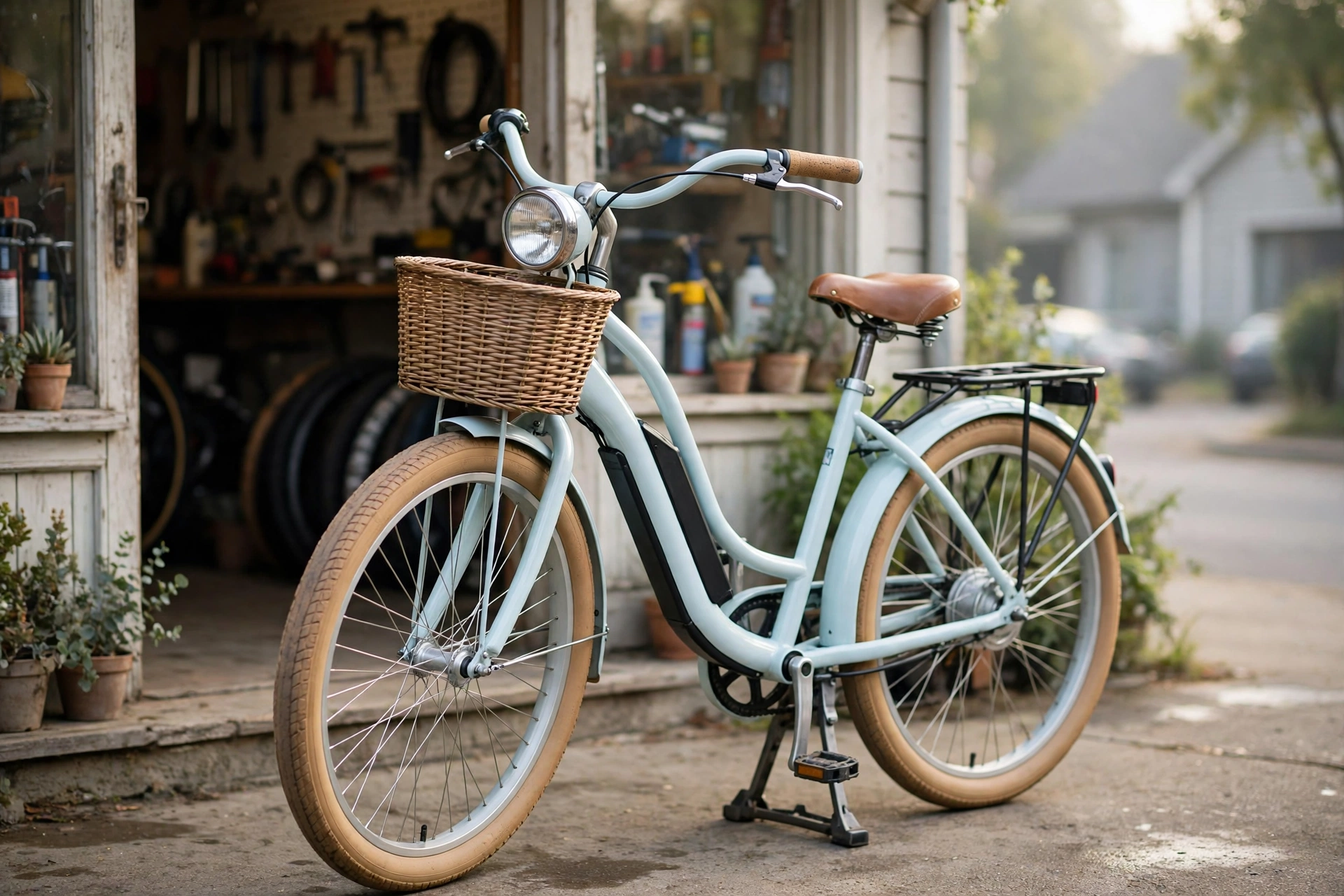
Strip away the custom paint and every electric bike co model in the range was the same machine wearing different frames. Aluminium cruiser frame, pedal-forward geometry so you can put a foot down at stops, 24-inch or 26-inch wheels, and a geared rear hub motor. Spec sheets listed it at 500W nominal with a 1,250W peak on the Model C and Model R; later bikes were listed at 750W nominal.
Call it roughly 60 Nm of torque at the hub (est., based on published listings). A hub motor is the right choice here, whatever my trail instincts say. It is simple, sealed, quiet, and it does not chew through chains. On flat ground at legal speeds, it is all the motor this job needs.
Control is by cadence sensor with five speed-based assist levels and a thumb throttle. Cadence sensing is the cheap way to do it — the motor responds to the cranks turning, not to how hard you push — and testers noticed the consequences. BikeRide’s Model R coverage flagged a lunge when pulling away at assist level five, and weak climbing on throttle alone.
The base drivetrain was a single-speed with a big 58T chainring, which makes the motor do all the work on any real gradient; the 7-speed Shimano Altus was a $149 option that should have been standard. Gears are not an accessory on a 57 lb bicycle. They are how it moves when the battery is flat.
The parts bin, though, was serious. Tektro Dorado hydraulic disc brakes with four-piston calipers on 180mm rotors — that is downhill-grade stopping hardware on a beach cruiser, and it is the single best component decision the brand made. Schwalbe Fat Frank balloon tyres, a full-colour LCD, integrated lights, stainless hardware against sea air, and a payload rating of 420 lb that embarrassed most rivals. Weight ran 53 to 58 lb depending on model and battery. Not light. Honest heft, at least.
Then there was the customisation, which was the real product. Dozens of colours at no extra cost, real wood fenders, colour-matched racks, baskets, chainguards, rim and spoke colours, your choice of throttle, bars, tyres and battery size — well over a million combinations, by the brand’s own count. Every bike was built to order in California and shipped fully assembled. As a manufacturing model it was lovely. As a business model, it was carrying costs that a $1,799 price tag could not feed.
The final line-up, model by model
Five models made up the range at the end. Prices below are the last published list prices before the shutdown, checked October 27, 2026; street prices bounced around in the final year, with the Model J seen as low as $1,299–$1,499 in 2025 sales and the Model C advertised between $1,799 and $1,899. Treat every figure as history, not as a quote.
Model C — from $1,799. The classic. High-step cruiser frame, 24- or 26-inch wheels, the 12Ah battery in the frame with upgrades to 14Ah and dual-battery setups. Electric Bike Report’s Model C review ran a test bike with the dual-battery 21Ah (1,008Wh) configuration and praised the frame quality and finish while listing an “up to 110 miles” claim we will deal with in the next section. As a used buy this is the one to hunt: the most common, the best documented, and the easiest to keep alive with standard parts.
Our score: 6.0/10 — Range honesty 4/10 · Build & parts 8/10 · Value 6/10
Model E — from $1,699. The cheapest way into the electric bike co range when new, with the same 48V system (12Ah base, 14Ah a $399 upgrade) and a slightly softer spec. Ebike Escape called it the most polished bike at its price, and the fundamentals — brakes, frame, assembly quality — matched the pricier models. If a used Model E and a used Model C sit at the same money, take the C. If the E is cheaper, it is the smarter buy of the two.
Our score: 6.7/10 — Range honesty 5/10 · Build & parts 8/10 · Value 7/10
Model R — from $1,799. The “Rugged” one, with knobbier tyres and marketing that reached for the word Enduro. Stop there. A long, slack, 57 lb cruiser with a rigid or basic suspension fork and slick-geometry steering is not an enduro bike, and BikeRide’s experts said the same in politer language: capable on light gravel and hardpack paths, out of its depth beyond that. On pavement and beach paths, where it belongs, it is a comfortable and stable machine. Judge it as a cruiser and it scores well. Judge it by its own label and it does not.
Our score: 6.0/10 — Range honesty 4/10 · Build & parts 8/10 · Value 6/10
Model S — from $2,499. The style flagship: step-through frame, the prettiest lines in the range, and a smaller base range claim — around 40 miles — for more money than the Model C. The premium bought looks and finish, not hardware; the motor, brakes and battery options were the family parts. Nothing wrong with paying for design. Plenty wrong with paying flagship money for it in 2026, when the same money buys a supported bike from a living brand with a dealer network.
Our score: 5.7/10 — Range honesty 4/10 · Build & parts 8/10 · Value 5/10
Model J — from $1,749. The odd one out: a moped-style machine with a bench seat, a 750W motor, shipped as a Class 2 at 20 mph with an unlockable off-road mode reaching about 26 mph. It is not a trail bike either, whatever the silhouette suggests — it is a neighbourhood runabout. Fine at that job. But an unlockable bike ridden derestricted on shared paths is exactly how cities end up banning all e-bikes from those paths, and my position on that is not flexible.
Our score: 6.3/10 — Range honesty 5/10 · Build & parts 7/10 · Value 7/10
Electric Bike Co range claims, checked against physics
Now the part of the brochure that never survived contact with a watt-hour. The base battery was 48V × 12Ah = 576Wh, and the claimed range was 60 miles. Divide: 576 ÷ 60 = 9.6 Wh per mile. The biggest setup — a 14Ah frame battery plus a basket battery for 30Ah total — held 48 × 30 = 1,440Wh, and the claim was 150 miles. Divide again: 1,440 ÷ 150 = 9.6 Wh per mile. The whole chart, from a $1,699 Model E to the flagship builds, was one constant: 9.6 Wh/mi.
An older electric bike co comparison chart pushed a 36Ah build to a claimed 190 miles on the same arithmetic. That is not a measurement. That is a marketing department dividing by the same optimistic number at every size.
Real cruisers do not sip 9.6 Wh/mi. BikeRide’s instrumented range test of the Ride1Up Cafe Cruiser — a direct rival, 65 lb, 750W hub motor — recorded 27.9 miles on throttle alone from its 720Wh battery: 720 ÷ 27.9 = 25.8 Wh/mi, on a hilly course. Pedalling properly at moderate assist, a heavy cruiser on balloon tyres lands around 20–25 Wh/mi. Ebike Escape’s reviewers, who liked these bikes, put the stock 12Ah pack at “about 20–30 miles” for most riders.
Run the honest maths at 22 Wh/mi (est., our planning figure between gentle pedalling and throttle use): 576 ÷ 22 ≈ 26 miles from the base pack, 672 ÷ 22 ≈ 31 miles from the 14Ah, 1,008 ÷ 22 ≈ 46 miles dual-battery, and 1,440 ÷ 22 ≈ 65 miles from the full 30Ah stack. Good numbers, all of them. Roughly 40% of the claims.
Price per realistic mile settles the value argument. A Model C at $1,799 over 26 honest miles costs about $69 per mile of real range. The Cafe Cruiser, at $1,595 over 720 ÷ 22 ≈ 33 honest miles (est., using the same planning figure), cost about $48 per mile while it was on sale — and it carried a tested 27.9-mile throttle-only result to back its paperwork. None of this makes an electric bike co bike a bad bike. It makes the range chart a bad document, and it means any used example should be priced on its battery size in watt-hours, never on the miles printed in an old advert.
Owning an Electric Bike Co bike now: parts, batteries, and a warranty with nobody home
The advertised electric bike co warranty was the best in the business on paper: 10 years on the motor and the frame, up to 5 years on the battery in the brand’s own marketing (some later listings trimmed battery cover to 2 years, and electronics such as the display and controller were covered for as little as 30 days).
Read your own paperwork if you own one — then accept what Chapter 7 means. A warranty is a promise from a company. The company has been liquidated, the claims deadline in the case passed on January 23, 2026, and there is no successor honouring EBC coverage. Any seller — dealer, marketplace, or private — offering you an “EBC warranty” in 2026 is selling you a story. The only real cover available is a third party’s, such as the 1-year warranty Upway puts on its own reconditioned stock.
The good news is mechanical. Almost everything that wears out is a standard part from a living supplier: Tektro brake pads and rotors, the Shimano Altus derailleur, Schwalbe tyres, chains, spokes, headsets. Any competent bike shop can keep the bicycle side of an electric bike co cruiser alive for a decade, and none of it costs exotic money — electricity to run one is pennies a charge, as our breakdown of how much it costs to charge an electric bike shows.
The proprietary risks are the electrical organs. The battery packs were assembled in-house in shapes specific to these frames — the slim in-frame pack, the basket battery — and the displays and controllers were EBC-specific. When a pack dies, the realistic route is a specialist battery rebuild with fresh cells, typically $400–$700 (est., based on current US rebuild pricing for packs of this size). Budget for that possibility in what you pay, not after.
One legal point, because it decides where these bikes may be ridden. They shipped as Class 2 machines — throttle and assist to 20 mph — with an unlockable mode taking them to 28 mph. EBC itself warned that using off-road mode voided the warranty; the deeper problem is that a derestricted bike stops being an e-bike in the eyes of most path and trail rules, which is the whole subject of our Class 1 e-bike guide.
Keep it at its shipped setting on shared paths. A 57 lb cruiser at 28 mph among dog walkers and kids is how access gets removed for every rider, including the careful ones. On dirt singletrack these bikes have no business at all — rigid fork, slick tyres, hub motor. Pavement, boardwalks, gravel paths: that is the habitat, and inside it they are genuinely pleasant machines.
Should you buy one in 2026?
Used, at the right price, yes — with your eyes open. These were well-built, well-finished cruisers with the best brakes in their class, and the used market now prices them like orphans. A clean, late-model C, E or R with a healthy battery should trade around $700–$1,100 (est., based on reconditioned listings and typical used-cruiser depreciation); pay at the top of that band only with proof the pack still holds a charge, and treat any example needing a battery rebuild as a $400 bike whatever the paint looks like.
Before paying, run the full electric bike co ownership picture — purchase, a likely pack rebuild inside five years, standard consumables — the way our total cost of ownership calculator structures it, and check how we verify figures like these on our how we research page.
New old stock is the trap to avoid. Any “new” EBC still sitting in a warehouse or dealer corner in 2026 has an ageing, unsupported battery, no warranty behind it, and a seller hoping you have not read the news. At list price it is the worst purchase in this entire guide. The bike deserved a better ending than the company got — but you shop with the market that exists, not the one that should.
FAQ
Is Electric Bike Co still in business? No. Electric Bike Company LLC filed for Chapter 7 liquidation on October 3, 2025, its remaining assets were offered for sale in early 2026, and no buyer relaunched the brand. The old website address now hosts a third-party buyer’s guide.
Is my 10-year EBC warranty worth anything now? Practically, no. It was a promise from a company that has been liquidated, and the bankruptcy claims deadline passed in January 2026. Some reconditioned bikes are sold by marketplaces like Upway with their own separate 1-year warranty — that cover comes from the seller, not from EBC.
How far does a Model C really go on one charge? Plan on roughly 25–30 miles from the stock 12Ah (576Wh) battery with normal pedalling, and around 45 miles (est.) from the dual-battery 21Ah setup. The 60-mile and 110-mile figures in old listings assumed about 9.6 Wh per mile, which a heavy balloon-tyre cruiser does not achieve outside the gentlest riding.
Can I still get parts for one? The wearing parts, yes — brakes, drivetrain, tyres and spokes are standard items from Tektro, Shimano and Schwalbe that any shop can order. The difficult parts are the EBC-specific batteries, displays and controllers; a dead battery usually means paying a specialist for a cell rebuild, at roughly $400–$700 (est.).
What is a fair price for a used one in 2026? Around $700–$1,100 (est.) for a clean late-model electric bike co cruiser with a strong battery. Less — much less — if the pack is weak, because the rebuild cost lands on you and there is no factory to fall back on.
Can I ride one on mountain bike trails? You should not, and on many trail systems you may not. These are heavy, rigid-forked cruisers with slick tyres and a hub motor, built for pavement and boardwalks; trail rules in most places limit e-bike access to specific classes on specific trails. Ride it where it belongs and it will outlast most of the bikes it shares the path with.
For shoppers weighing a used purchase, the key takeaway on electric bike co models is simple: judge the battery, not the brochure. An electric bike co cruiser can still be a pleasant, well-built ride, but only at a price that leaves room for a possible battery rebuild. That is the honest verdict on electric bike co ownership in 2026.