Last updated: October 27, 2026
Short answer first, because nobody buys a bike to read statutes. Do you need a license for an electric bike? In most of the United States, no. No license, no registration, no insurance, no plate. You buy the bike, charge the battery, and ride it the same morning, exactly like a regular bicycle. That answer holds for the big majority of riders on the big majority of e-bikes, and it is the single best reason these machines have taken over city commuting.
One state recently broke ranks in a loud way, and a handful of others add fine print, so the full answer takes a few minutes. The fine print matters. Get it wrong and you are not a cyclist with a ticket. You are an unlicensed driver on an unregistered motor vehicle.
Everything hangs on one thing: whether your bike counts as a bicycle in law, or as something with a motor that the state wants paperwork for. A legal e-bike has working pedals you can actually propel it with, a motor rated at 750 watts or under, and a motor that stops helping at its class speed. Since 2017-ish, honest manufacturers have stuck a little label on the frame stating the class, the top assisted speed and the wattage. Find that label before you pay. It is the closest thing your bike has to a passport, and it takes four seconds to read.
While you are crouched down there, note the weight on the spec sheet too. A 38 lb bike rides up three flights of stairs with you. A 74 lb bike lives in the garage, gets ridden less, and gets locked outside more, which is exactly how bikes get stolen.
Most states sort e-bikes using the three-class system drawn up by PeopleForBikes, and the industry’s state-law tracker counts more than 40 states running some version of it. In those states, the deal is beautifully simple: a bike inside the classes is a bicycle, full stop. That is why the question “do you need a license for an electric bike” gets the same answer at almost every bike shop counter in the country. No DMV visit. No forms. The classes exist so that a rider, a retailer and a police officer are all looking at the same three boxes.
Class 1 is pedal-assist only. The motor helps while you pedal and bows out at 20 mph. No throttle. Class 1 bikes go almost everywhere a normal bike goes, including most trails that allow bicycles at all, which makes them the default choice for riders who mix streets and paths. If you want the quietest legal life, this is it.
Class 2 keeps the 20 mph ceiling and adds a throttle, so the bike can move without pedaling. Same legal treatment as Class 1 in three-class states: no license, no registration, no insurance. This is the city class. Throttle starts off the line at a wet intersection, throttle up the last steep block with groceries in the panniers, then pedal like a normal human the rest of the way. My strong view: for stop-start urban riding, Class 2 is the sweet spot of the entire system, and the class most non-riders imagine when they picture an e-bike.
Class 3 is the fast commuter class: pedal-assist up to 28 mph, with a speedometer, and in the standard model law no throttle above walking pace. States treat Class 3 riders a little more like adults in traffic. Many set a minimum age of 16 — California does — and helmet rules bite here: California requires a helmet for every Class 3 rider at any age. Access narrows too, because plenty of shared-use paths are closed to Class 3 even in states that welcome Classes 1 and 2. None of that involves a license. It is conditions, not paperwork.
If you are weighing the fast class against the gentle one, our complete Class 1 e-bike guide walks through what the 20 mph life actually feels like day to day.
Do you need a license for an electric bike in New Jersey? Since July 2026, yes
New Jersey used to give the standard answer. Then, in January 2026, the governor signed a new law (S4834, now P.L.2025, c.285) that scrapped the three-class system entirely, and the requirements took effect in July 2026. Ask “do you need a license for an electric bike” in New Jersey today and the answer is genuinely yes. The New Jersey Motor Vehicle Commission’s e-bike page lays out the new world: every e-bike must be registered with the MVC, and every rider must be at least 15 and hold either a regular driver’s license or a new e-bike license, earned with a permit, knowledge and vision tests, a practice period of 20 to 45 days, and a road test.
The $5 examination fee is waived until January 2027, and first-year fees were waived under the statute. An $8 annual registration fee is scheduled to begin in 2027, and registered bikes wear plate stickers on both sides of the front fork.
The categories changed too. New Jersey now splits e-bikes into “low-speed electric bicycles” — pedal-assist only, motor done at 20 mph, roughly the old Class 1 — and “motorized bicycles,” which swallows the old Class 2 and Class 3: anything with a throttle, or pedal-assist reaching 21 to 28 mph. Low-speed bikes must be registered, and skip insurance. Motorized bicycles must be registered and insured. One carve-out: riders of rented low-speed bikes from share systems need no license, though the minimum age there is 16 and the operator handles registration. PeopleForBikes called the law the most restrictive e-bike law in the country, and on the facts, that is simply accurate.
My opinion, plainly: New Jersey regulated the wrong machine. A 20 mph pedal-assist bike ridden by a teenager to school is not the problem vehicle on anyone’s road. The problem vehicle is the 40 mph, pedal-free e-moto weaving through traffic with no plate and no insurance, and this law spends its energy on the school-run bike instead.
Worse, it exports confusion: a rider visiting from Pennsylvania or New York with a perfectly legal Class 2 is, on paper, unregistered and unlicensed the moment the front wheel crosses the state line. If you live in New Jersey, comply — the appointments exist, the first year is free, and riding dirty helps nobody. Just know the rest of the country looked at the same facts and chose differently.
Do you need a license for an electric bike in New York? No — and its Class 3 is not a Class 3
New York keeps the no-paperwork answer — no license, no registration, no insurance for a qualifying e-bike, and the DMV will not register one even if you ask — and then writes its own definitions. Classes 1 and 2 work statewide with assistance capped at 20 mph, riders must be at least 16, and New York’s Class 3 is a different animal from the national one: it allows a throttle, tops out at 25 mph instead of 28, and is legal only in cities of a million or more people, which in practice means New York City and nowhere else.
Class 3 riders must wear a helmet at any age. Take a New York Class 3 upstate and it has no legal class to stand in. Labels matter in New York for another reason too: the state requires the manufacturer’s class label on the bike, so a no-name import with no label starts every traffic stop on the back foot.
Then the city adds its own layer, which is the part visiting riders miss. Since October 24, 2025, New York City has capped all e-bikes at 15 mph on city streets, whatever the class sticker says. Commercial riders — the delivery fleet — work under extra city rules, including helmet requirements tied to their employers, and the city also requires the e-bikes and batteries sold there to carry accredited safety certification such as UL listings.
None of this is a license. It is a speed limit, an equipment rule and a sales rule stacked on top of the state’s no-paperwork answer. Cities elsewhere can and do write smaller versions of the same stack, which is why “legal in my state” should always be followed by “and on my actual street?”
The paperwork ledger: $0 against real moped money
Here is the comparison nobody at the dealership prints out. Take a Class 3 e-bike in Michigan, a clean three-class state. License fee: $0, because none is required. Registration: $0, because none exists. Insurance premium required by law: $0. First-year paperwork total: $0 + $0 + $0 = $0. Ride it five years and the paperwork total is still $0, because there is nothing to renew.
Now put a 49cc moped next to it in the same state. Michigan law (MCL 257.801e) requires every moped on public roads to be registered with the Secretary of State: the decal costs $15 and lasts three years. The rider must hold a valid driver’s license or, from age 15, pass vision, knowledge and traffic-sign tests for a restricted moped license.
Michigan does not force insurance on mopeds, so that line stays $0. First-year paperwork total: $15. Five-year total: $15 at the start, plus a second $15 decal in year four, equals $30. Thirty dollars is not much money. It is, however, thirty dollars more than zero, plus two trips to a Secretary of State office, plus tests if you are unlicensed — and Michigan is the gentle version.
Cross to New York with the same 49cc moped and the ledger grows teeth. The state’s DMV table for limited-use motorcycles requires a driver license, registration and insurance for a Class B moped (the 20–30 mph bracket most 49cc machines land in). Minimum-liability insurance alone typically runs around $200 a year for a small moped (est., based on typical minimum-coverage quotes checked October 27, 2026), before any registration fee reaches the till.
So the honest five-year comparison is: Class 3 e-bike, $0 of paperwork, against $30 and some queuing in the friendliest moped state, or $1,000-plus of insurance alone (est.) where mopeds are treated as full motor vehicles. Run your own ownership numbers, fuel and maintenance included, in our EV total cost of ownership calculator. The paperwork gap is the part of that math riders forget to price.
When do you need a license for an electric bike? The moment it stops being one
Three tripwires push a machine out of bicycle law and into motor vehicle law. Power: a motor rated over 750 watts. Speed: assistance that keeps pushing past 28 mph. Pedals: no working pedals at all. Cross any one of them and you no longer own an e-bike in the eyes of the law. You own a moped or a motorcycle, and mopeds and motorcycles need licenses, registration and, in most states, insurance.
This is also why the little “off-road mode” unlock buried in so many display menus is a trap. The day you switch a Class 2 into its unlocked 32 mph setting for the street, you have converted a legal bicycle into an unregistered motorcycle using a button. My rule is absolute: ride it in the class it was sold in, on the street, every time. Save the unlocked modes for private land, or do not buy a bike whose party trick is breaking its own classification.
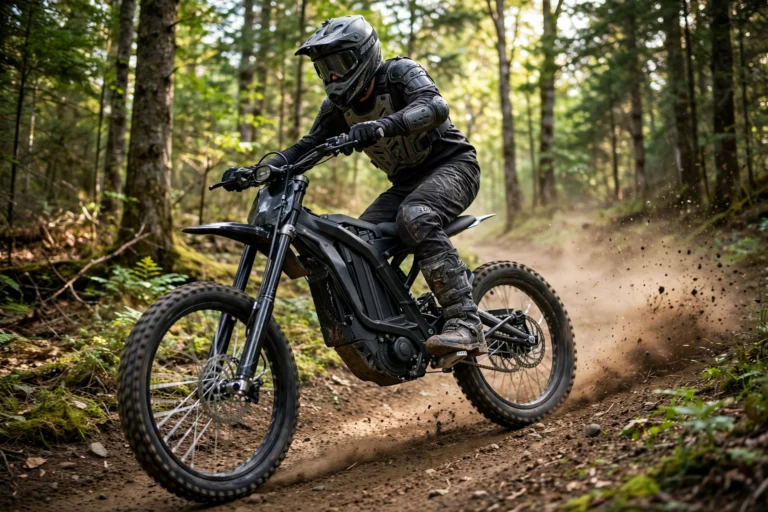
The poster child is the Sur-Ron Light Bee and its many cousins. It wears bicycle-ish clothes — slim frame, bicycle saddle, bicycle-sized wheels — and it fools buyers constantly. Look closer: no pedals, and a motor several times the 750-watt ceiling. It is an electric dirt bike, full stop, and on a public road most states will treat it as an unregistered, uninsured motorcycle, because that is what it is.
Bolt-on pedal kits do not rescue it; the power and speed numbers still break every class definition, and several states now say so explicitly. Ride one on trails where dirt bikes are welcome and it is a fine machine. Our guide to e-bike dirt riding covers where that kind of bike belongs. Just do not commute on it and expect bicycle law to protect you.
Mopeds proper sit on the far side of the same line, alongside the mini-bike end of the market. A 49cc moped needs the full stack in most states — in New York, a Class A limited-use motorcycle (30–40 mph) even demands a motorcycle license, and since January 2025 every moped sold by a New York dealer must be registered at the point of sale.
Small displacement does not mean small paperwork. This is the territory where the answer to “do you need a license for an electric bike” flips to yes, with tests and fees attached. If a machine you are eyeing blurs into that territory, our electric mini bike and motorcycle guide maps out where the licensing lines actually fall.
Trails, paths and the city fine print
Out on a trail, do you need a license for an electric bike? Wrong question — access is the question. Land managers write their own guest lists. The National Park Service lets e-bikes where traditional bikes are allowed, and each park’s superintendent decides which classes get in, park by park. State and city paths run the same way, with Class 3 the usual first exclusion because 28 mph sits badly next to joggers and dog leads. Read the trailhead sign, not the brochure.
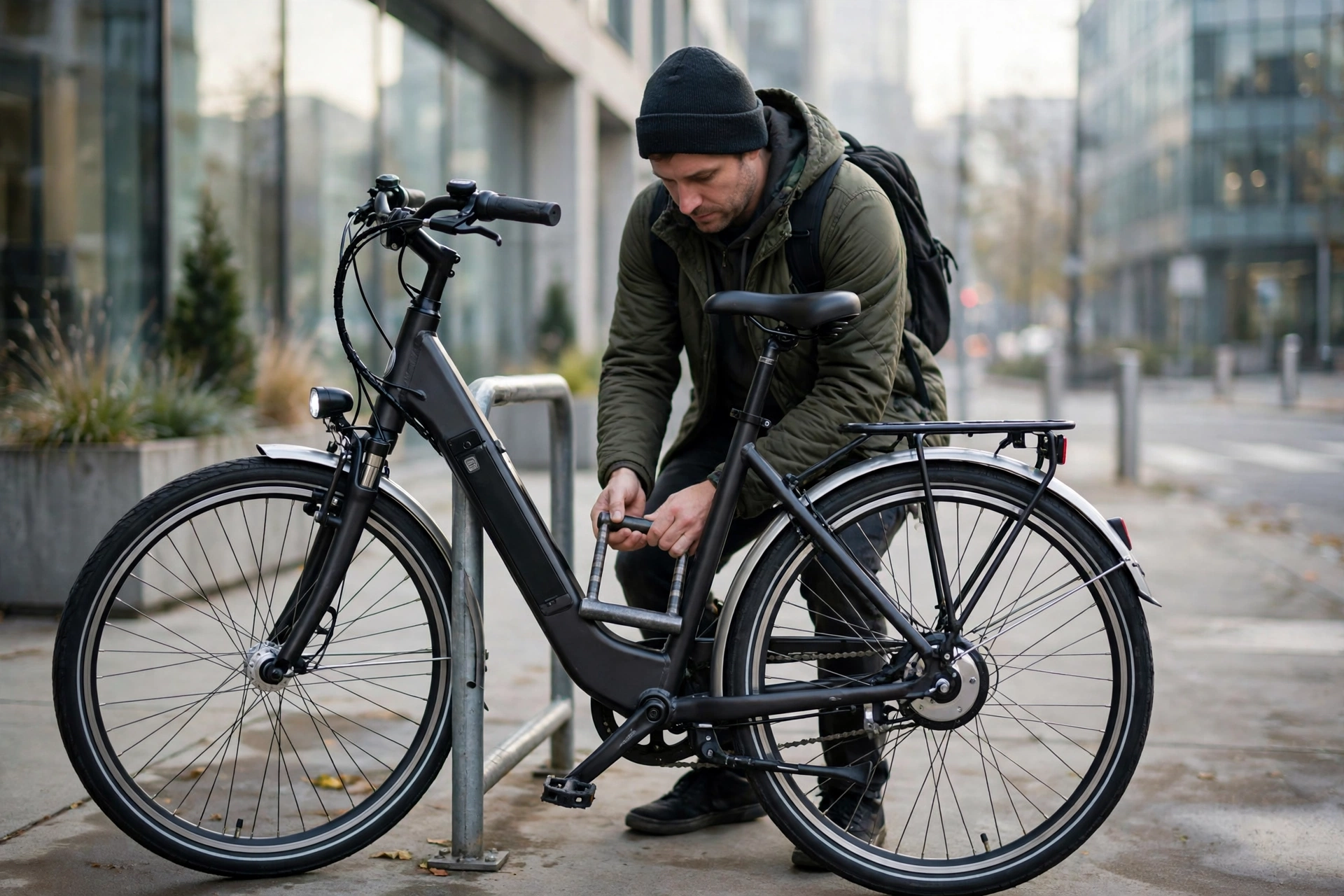
And a practical word, from the city end of the telescope: your legal, license-free bike is also a stealable bike with no plate and no registration record anywhere. Photograph the serial number (it is stamped under the bottom bracket), keep the purchase receipt, and treat a proper U-lock — or a folding bike you can carry inside, all 42 lb of it — as part of the purchase price. Theft-proofing is not paranoia in a city. It is the second-largest cost of ownership, right after the bike.
The UK and EU answer takes thirty seconds
Britain runs one category: the EAPC, or electrically assisted pedal cycle. Pedals that work, a motor of no more than 250 watts, assistance that stops at 15.5 mph, riders 14 and up. Meet that and GOV.UK’s answer mirrors the American one — no license, no registration, no tax, no compulsory insurance. Miss it and the bike is a moped in British law too, with the full licensing stack.
Most of the EU uses the same 250-watt, 25 km/h recipe for its basic pedelec, and both systems agree on the fast lane: speed pedelecs that assist to 45 km/h are mopeds, needing a license, a plate, insurance and a proper helmet. The numbers are stricter than America’s 750 watts and 28 mph. The shape of the answer is identical on both continents: bicycles are free, motor vehicles get paperwork, and the border between them is drawn in watts and miles per hour. Do you need a license for an electric bike in London or Lyon? Only the day it stops being a bicycle — same as Ohio.
Our verdict on the American system
For all its state-by-state wobble, the American arrangement is the most rider-friendly in the developed world, and it is friendly for the right reason: it regulates the machine’s capability instead of the rider’s wallet. A bicycle that cannot outrun traffic does not need a driver’s license, and forty-some states have kept that logic intact. New Jersey is the warning light on the dashboard, not the new normal — one state, one rushed law, opposed by essentially everyone who rides.
Ask “do you need a license for an electric bike” almost anywhere else in the country and the answer is still a clean, paperwork-free no. Read the label, stay inside your class, check the trailhead sign, and in 49 states out of 50 the paperwork for your e-bike fits on an index card with nothing written on it. Details of how we check state rules before publishing are on our how we research page.
Our score: 8/10 for the US e-bike licensing system
Answer clarity: 9/10 — one question, three classes, one answer for most riders
Rule consistency: 6/10 — New Jersey rewrote the deal in 2026 and New York’s Class 3 means something else entirely
Paperwork burden: 9/10 — zero dollars and zero forms in most states, docked for the New Jersey exception
Frequently asked questions
Do you need a license for an electric bike in all 50 states?
No — and it was all 50 until recently. In the more than 40 states using the three-class system, no license is required for any class. New Jersey is the exception that now requires a license and registration for every e-bike. A few states never adopted the class system and run their own definitions, so a two-minute check of your state DMV page is still the smart move before a first ride.
I don’t hold a driver’s license at all. Can I still ride an e-bike?
In most states, yes — that is rather the point of treating e-bikes as bicycles. Teenagers, non-drivers and riders whose licenses are long expired all ride legally on class e-bikes in three-class states. New Jersey now requires its own e-bike license from age 15 if you lack a driver’s license. And if your plans involve a moped instead, a license of some kind is required nearly everywhere.
Does unlocking my e-bike’s off-road mode change the legal answer?
Yes, instantly. The classes are defined by what the motor does, not by what the sticker claims. A bike assisting to 32 mph on the street is outside every class and into moped or motorcycle territory, with license, registration and insurance duties attached — and none of the paperwork done. Keep street riding inside the class the bike was sold in.
What about a Sur-Ron or a similar e-moto — is that an e-bike?
No. No pedals and a motor far beyond 750 watts put it outside every e-bike definition in the country. On private land and dirt-bike trails, ride away. On public roads, most states see an unregistered motorcycle, and no pedal kit changes that arithmetic.
I’m visiting New Jersey with a Class 2 e-bike. What changes for me?
On paper, plenty. New Jersey counts your Class 2 as a motorized bicycle, which requires MVC registration, insurance, and a rider holding a driver’s license or the state e-bike license. The MVC’s own visitor guidance says to register the bike with them. Bike-share rentals are the exception: rented low-speed bikes need no rider license, with a minimum age of 16.
Can my teenager ride a Class 3?
Depends on the state. Many three-class states set 16 as the Class 3 minimum — California is one — and require helmets for Class 3 riders. Classes 1 and 2 usually carry no state age floor, though some cities set their own, and New York requires riders of any class to be 16. Check your state and city rules together; they stack.
So, do you need a license for an electric bike? For most riders, the answer is no — but if you are still asking do you need a license for an electric bike before a trip or a move, check your state rules first, because do you need a license for an electric bike can change at a state line.