Last updated: October 27, 2026
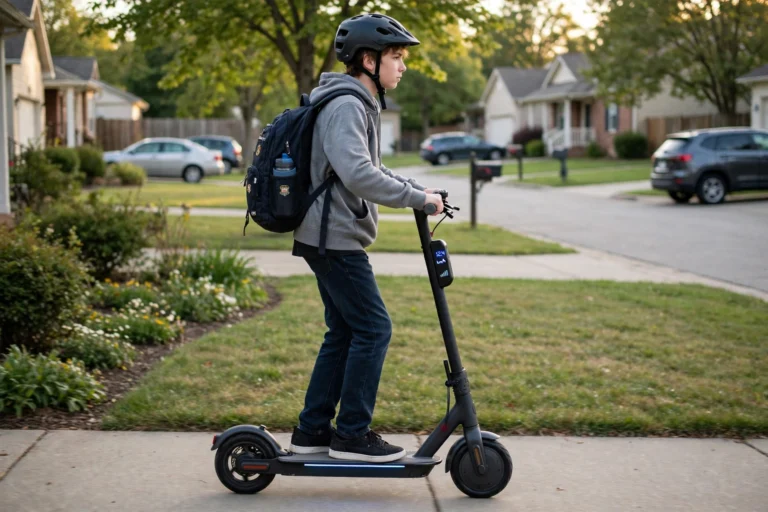
The hiboy s2 pro is the budget commuter scooter I keep coming back to when someone says the magic words: “my route has hills.” Not gentle rises. Real hills, the kind that make a 350-watt scooter slow to walking pace while the rider pretends that was the plan all along. Hiboy’s answer is a 500W motor, a battery half again bigger than the base model’s, and 10-inch tires, wrapped in a plain black folding frame that costs $442.99 on Hiboy’s own store at the time of writing. Prices checked October 27, 2026. That is proper commuter money, and the spec sheet mostly justifies it.
Let me be direct about who should buy this. If your ride to work or the station is under 8 miles each way, has at least one climb that makes cyclists drop two gears, and you are tired of paying car money to sit in traffic, this is your scooter. Flat-city riders with a 3-mile hop? Save the cash and buy the base S2. Everyone else with a hill on the route, keep reading, because the cheaper model will disappoint you exactly where it hurts.
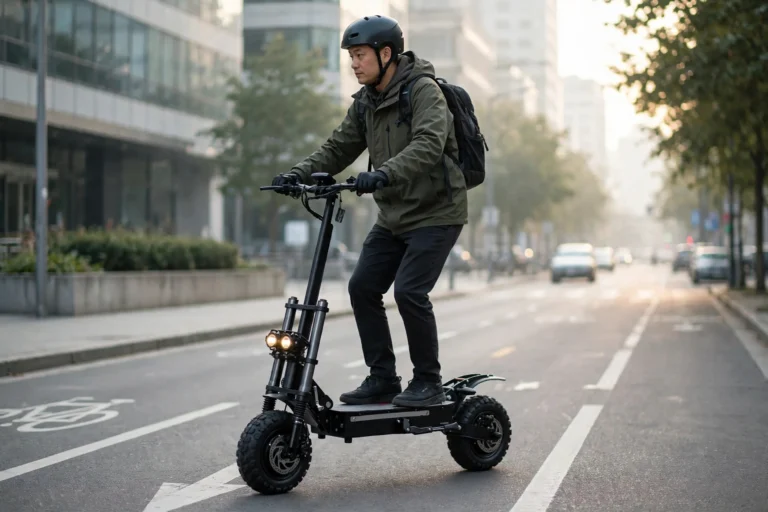
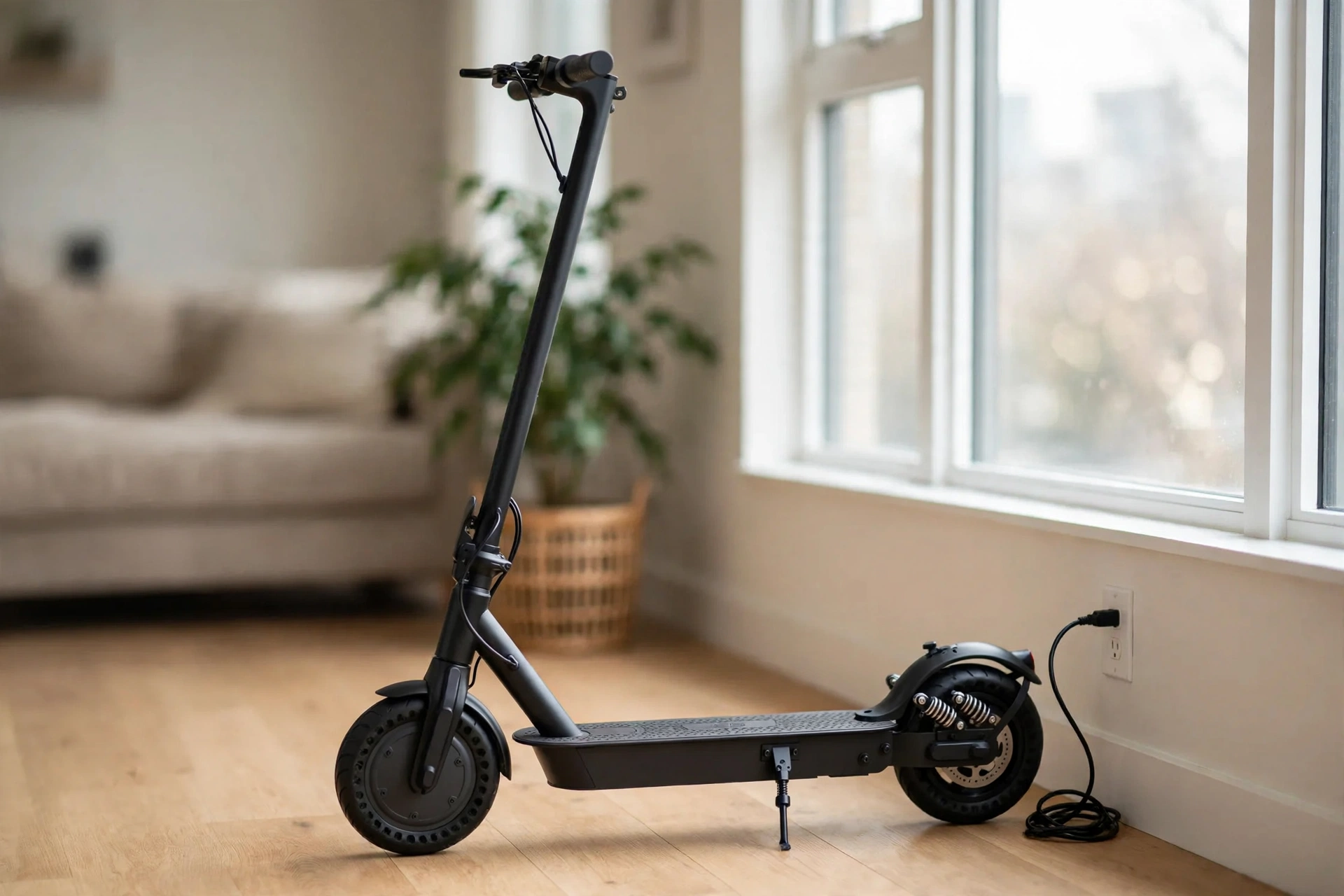
The headline numbers, all from Hiboy’s own spec table: a 500W rear hub motor (600W peak), a 36V 11.6Ah lithium battery, a claimed 25 miles of range, a 19 mph top speed, 10-inch honeycomb tires, rear dual suspension, a 220 lb max load, and a weight of 37.4 lbs. Charging takes 4 to 6 hours. The folded package is 45.3 × 16.5 × 19.3 inches, so it slides under a desk or into a car trunk without a wrestling match. You can read the full factory spec list on Hiboy’s official S2 Pro product page, and everything below tests those claims against what independent reviewers and real owners actually measured.
One correction before we go any further, because half the internet gets this wrong: those 10-inch tires are solid honeycomb rubber, not pneumatic. There is no air in them. You will never pump them, never patch them, and never walk the last two miles because of a nail. You will also feel more of the road than an air-tire rider does. That trade shapes the whole character of this scooter, and I happen to think Hiboy chose correctly. More on that below.
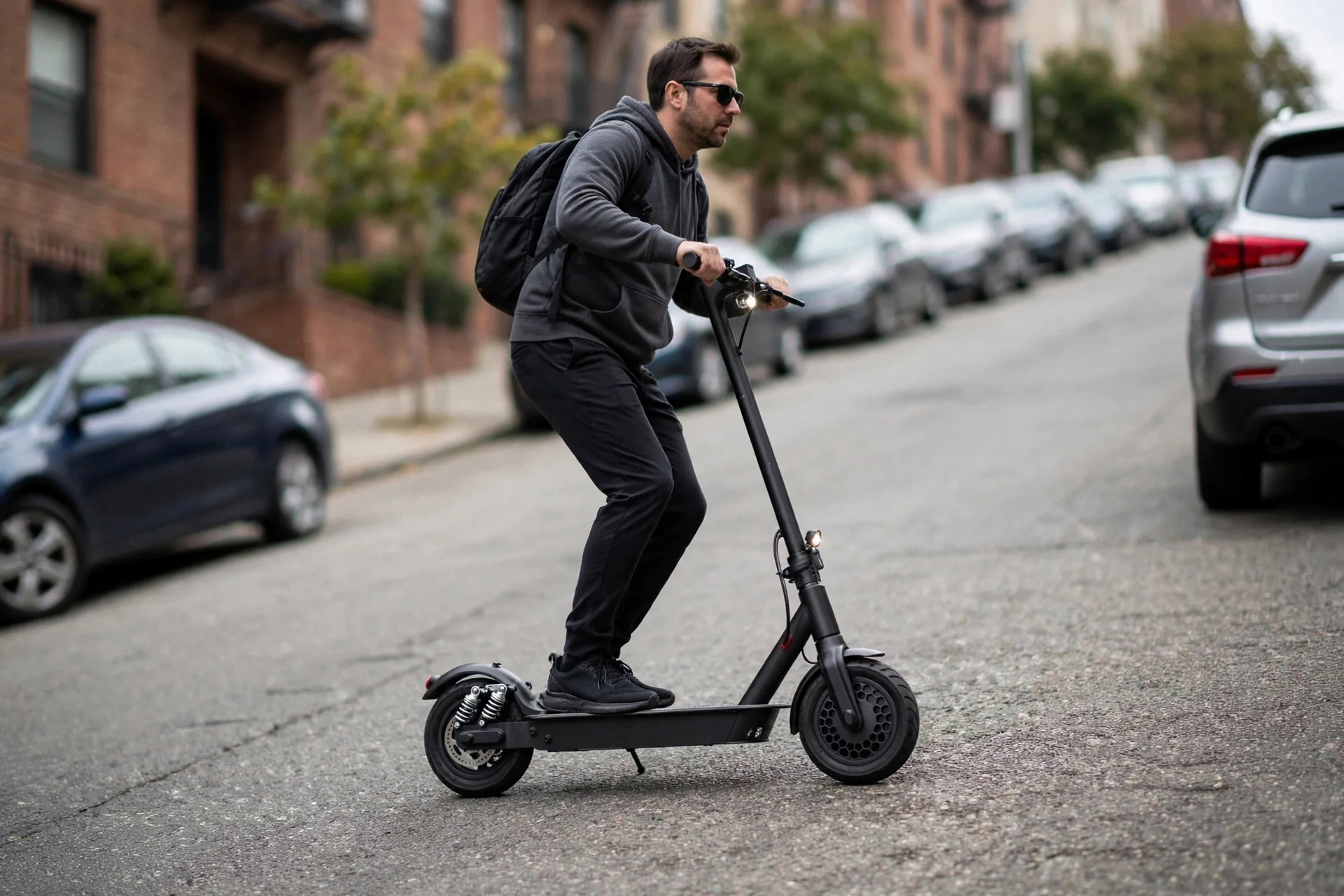
Range is where commuters live or die, so let us start with the honest version. Hiboy claims 25 miles. Independent guides that compile hands-on testing and owner data put the real number at 15 to 20 miles for an average adult, with full-throttle riding in Sport mode landing closer to 15 to 18 miles. Plan around 17 miles (est., the midpoint of those independent reports) and you will never be stranded. Plan around 25 and you will, eventually, be pushing a 37 lb scooter uphill in the dark, learning things about yourself.
Hiboy S2 Pro specs that actually matter
Spec sheets are long. Commutes are short. Here is the short list of numbers that change your daily ride, and the longer list can wait. The motor is the story: 500W rated, 600W peak, in the rear wheel. Rear drive pushes you up hills instead of pulling, which matters on wet pavement, where a front-drive scooter can spin its tire and get vague. The battery is 417.6 watt-hours (36 volts × 11.6 amp-hours), and that number, not the marketing range, is the one to compare across brands. Anything in this price class with under 400Wh is a toy wearing a commuter costume.
The deck measures 17.7 inches long and 6.1 inches wide. Adequate. Not generous. Riders with size-13 feet will ride slightly staggered, one foot angled, and get used to it. The handlebar is 16.5 inches wide, which is narrow, and I count that as a genuine nitpick: narrow bars feel twitchy at 19 mph until your hands adjust, and mirror or bell choices crowd fast. The controls are simple, a thumb throttle and a brake lever, with two riding modes: Comfort at roughly 13 mph and Sport at the full 19 mph. An LED display shows speed and battery bars. Nothing fancy. Nothing missing that a commuter truly needs.
Braking is a dual setup, an electronic regenerative brake plus a rear disc brake, and stopping power is a place where this scooter punches at its price. Independent testing of the S2 family has consistently praised the brakes, and the Pro keeps that recipe. Lights are LED front and rear with side reflectors. The water rating is IPX4, splash-resistant, fine for a surprise drizzle and not fine for a storm. Riders in rainy cities should treat that rating as a hard limit, not a suggestion.
Real range: what the hiboy s2 pro does after the brochure ends
Here is the arithmetic Hiboy hopes you skip. A 417.6Wh battery delivering 25 miles means the scooter sips 16.7 watt-hours per mile, a figure achievable by a light rider, on flat ground, at moderate speed, probably with a tailwind and a positive attitude.
A 175 lb adult at full throttle uses more like 23 to 26 watt-hours per mile (est., based on the consumption implied by independent 15-to-20-mile results). Divide 417.6 by 24 and you get 17.4 miles. That is the honest planning number, and it lines up with what owners report: around 17 miles of mixed city riding, less in winter, less with hills, more if you cruise in Comfort mode and keep your ego out of the throttle.
Now the comparison that actually decides purchases. Rider Guide independently tested the base Hiboy S2 at 12.7 miles of real range. The base model costs $299.99, so its tested range costs $299.99 ÷ 12.7 = $23.62 per real mile. The Pro at $442.99 with a 17-mile realistic figure (est.) works out to $442.99 ÷ 17 = $26.06 per real mile.
Interesting, right? The Pro is not cheaper per mile of range. What the extra $143 buys is not efficiency. It buys the hill climbing, the bigger tires, and a battery that still gives you a usable 12-plus miles in year three after normal degradation (est.), where the base model fades toward single digits. You are paying for capability and longevity, not a bargain per mile. I can respect that deal, as long as nobody pretends it is something else.
Cold weather deserves a sentence of its own. Lithium batteries lose capacity in the cold, and a scooter stored in an unheated garage at near-freezing temperatures can surrender 20 to 30 percent of its range (est., standard lithium behavior, and the reason our cold-weather guides exist for cars too). If your winter commute is 7 miles each way, charge at work or accept the bus on the coldest days. The scooter is not lying to you. Physics is just collecting its tax.
Hills: where the hiboy s2 pro earns its money
Hiboy rates the climb capability at 15 degrees. Translate that: a 15-degree slope is a 27 percent grade, steeper than almost any paved city street, and no 500W scooter carries a 200 lb rider up it at speed. What the rating really promises is strong work on the 8 to 12 percent grades that real neighborhoods are built on. On those, the Pro holds a working pace, roughly 10 to 14 mph for a mid-weight rider (est., consistent with owner reports from hilly areas), where the 350W base S2 sags toward single digits and begs for a kick.
Riders at the 220 lb load limit, on a steep grade, near the bottom of the battery: expect to help with a foot. That is not a defect. That is 600 peak watts meeting gravity, and gravity does not negotiate.
My take, and I will not soften it: if your route has a real hill, the base S2 is the wrong purchase at any discount, and the Pro is the cheapest scooter that fixes the problem properly. Saving $143 to arrive at work sweating, having half-pushed your scooter up the avenue, is not thrift. It is a subscription to regret, billed daily. Riders comparing against the long-range kings should look at our Segway Ninebot Max G30P complete guide, which covers a heavier, pricier machine built for distance first. The Pro’s game is different: enough range, real hill power, half the weight penalty.
Ride quality and the honeycomb tire argument
Solid tires have a reputation problem, and some of it is earned. The honeycomb design carves voids into the rubber so the tire can flex a little, and the dual rear shock absorbers take the sharpest edges off curbs and expansion joints. The result is a ride that is firm, communicative, and honest about bad pavement. On smooth bike lanes, it is perfectly pleasant. On broken asphalt, you will know about every crack, and your wrists will file the report. Riders coming from pneumatic tires, like the air-filled setup on the big-wheel machines in our Kaabo King GTR scooter guide, will call this harsh. Riders who have fixed a flat at 7 a.m. in February will call it freedom.
Count me in the second group, firmly. A commuter vehicle has one sacred job: be ready at 8 a.m., every day, without a maintenance ritual. Solid honeycomb tires deliver that. No pressure checks, no sealant, no spare tube in the backpack, no walk of shame. The 10-inch diameter also rolls over potholes and tram tracks noticeably better than the 8.5-inch wheels on the base S2, which is a safety upgrade disguised as a comfort one. Bigger wheels forgive more. That matters on streets maintained by optimism.
Build quality nitpicks, because somebody should say them
Now the fault-finding, and the hiboy s2 pro has a few worth naming. First, the folding mechanism and stem hardware on budget Hiboy scooters have a long owner-reported history of developing small creaks and cable rattle over time; a few minutes with an Allen wrench and a zip tie during your first month prevents most of it, and our advice is to check the stem bolts monthly, the way you would check tire pressure on a bike.
Second, that narrow 16.5-inch handlebar again: it makes the scooter easy to carry through doorways, and it also limits how planted the steering feels for broad-shouldered riders. Third, the companion app is functional, not delightful. It locks the scooter, sets cruise control, and switches modes, which is all anyone needs, and it still manages to feel like homework.
The fit and finish elsewhere is genuinely good for the money. The aluminum frame feels dense, not hollow. The deck grip is coarse and stays grippy in damp shoes. The rear fender is sturdy enough to use as a foot brake in an emergency, which is its secret second job. The cable routing is tidy where you can see it. Nothing on this scooter pretends to be premium, and that honesty is refreshing in a market full of scooters wearing carbon-fiber stickers over pot metal.
Weight is 37.4 lbs, light enough for a third-floor walk-up, heavy enough that you will not volunteer to carry it further than necessary. Two hands on the stem, one flight at a time, and you will be fine.
Charging the hiboy s2 pro: cheap, slow, simple
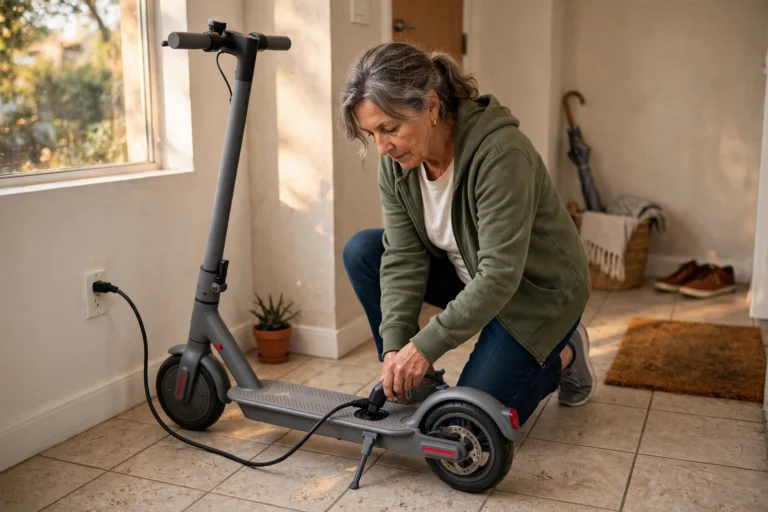
Charging is gloriously boring. A small brick, a barrel plug, a wall socket, 4 to 6 hours from empty. And the cost is the best joke in personal transport. The battery holds 36 × 11.6 = 417.6 watt-hours, which is 0.418 kilowatt-hours. At a typical US household rate of $0.17 per kWh, a full charge costs 0.418 × $0.17 = $0.071. Seven cents. Add a tenth for charger losses and call it 8 cents (est.).
Run the commute math: a 6-mile round trip, 240 workdays a year, is 1,440 miles. At 17 realistic miles per charge that is about 85 full charges, so your annual electricity bill for commuting lands near $6.80 (est.). The coffee you buy to celebrate arriving costs more than a month of electricity.
Two practical notes. The battery is not removable, so the scooter comes to the outlet, not the other way around; apartment dwellers should measure the hallway-to-socket distance before buying, and check that any spare or replacement charger matches the scooter’s connector before ordering, the same compatibility habit we push for car charging gear in our EV charger compatibility checker.
If you want a broader sense of how little these small batteries cost to run, our breakdown of what it costs to charge an electric bike uses the same per-kWh logic on bigger packs. Slow charging is the one real weakness here: there is no fast-charge option, so a midday top-up buys you roughly 3 miles per hour plugged in (est.). Plan your day around one overnight charge and the problem disappears.
Hiboy S2 Pro vs the base S2: is the upgrade worth $143?
The base S2, which we covered in our earlier Hiboy S2 guide on this site, costs $299.99 and gives you a 350W motor, a 270Wh battery (36V 7.5Ah), 8.5-inch honeycomb tires, and a 17-mile claim that independent testing cut to 12.7 miles. The Pro, at $442.99 (prices checked October 27, 2026), gives you 500W, 417.6Wh, 10-inch tires, and a realistic 17 miles (est.). Same top speed on paper, same 220 lb load limit, same folding idea, similar weight. The independent Levy Electric Hiboy guide, which compiles hands-on data across the range, confirms the Pro’s tested top speed at 18.6 to 19 mph and its real-world range band at 15 to 20 miles, which matches the arithmetic above.
So the $143 buys three things: hill competence, roughly 4 extra real miles (est.), and bigger wheels that treat rough streets with less contempt. If your route is flat and under 5 miles each way, none of those three things will ever matter to you, and the base model is the smarter buy. If even one of them matters, the Pro pays for itself the first week. This is the cleanest upgrade decision in the whole Hiboy range, and it is not close.
Our verdict on the hiboy s2 pro
Our score: 8.1/10 — Range: 7.5/10 · Charging: 7/10 · Value: 9/10
The value score carries this scooter, and deliberately so. At $442.99 it delivers a real 500W of hill-climbing work, a battery big enough for a genuine two-way commute, tires that cannot puncture, and brakes that respect physics. It loses points for the 4-to-6-hour charge, the narrow bars, and a claimed range figure that should embarrass whoever approved it. None of those change the conclusion. For hilly commutes under 8 miles each way, this is the budget scooter to buy, and the base model is the one to skip. Our scoring follows the same research method we apply to cars and bikes across the site, which you can read on our how we research page.
Frequently asked questions
How far does the hiboy s2 pro really go on one charge?
Plan on 15 to 20 miles for an average adult, with 17 miles as the safe planning figure (est., from independent results). Hiboy’s 25-mile claim needs a light rider at moderate speed on flat ground. Hills, cold weather, and Sport mode all pull the number down.
Can it handle a steep hill with a heavier rider?
On typical city grades of 8 to 12 percent, yes, at a working pace. At the 220 lb load limit on the steepest streets, expect speed to fall off and a helping kick to be needed near the top. The 15-degree rating is a laboratory best case, not a commute promise.
How much does a full charge cost?
About 8 cents (est.). The 417.6Wh battery holds 0.418 kWh, which at $0.17 per kWh costs 7 cents before charger losses. A year of daily commuting runs to roughly the price of one sandwich.
Are the tires really puncture-proof?
Yes. They are solid honeycomb rubber with no air inside, so nails and glass cannot flatten them. The cost of that immunity is a firmer ride, partly softened by the dual rear shock absorbers.
Is the S2 Pro waterproof?
It is rated IPX4, which means splash-resistant. Light drizzle on the way home is fine. Sustained heavy rain, deep puddles, and pressure washers are not, and water damage is a standard warranty exclusion.
S2 Pro or the base S2, if I am on the fence?
Look at your route, not your wallet. Any meaningful hill, any commute over 5 miles each way, any rough pavement: buy the Pro. Flat, short, smooth: buy the base S2 and spend the savings on a good lock.