Last updated: October 25, 2026
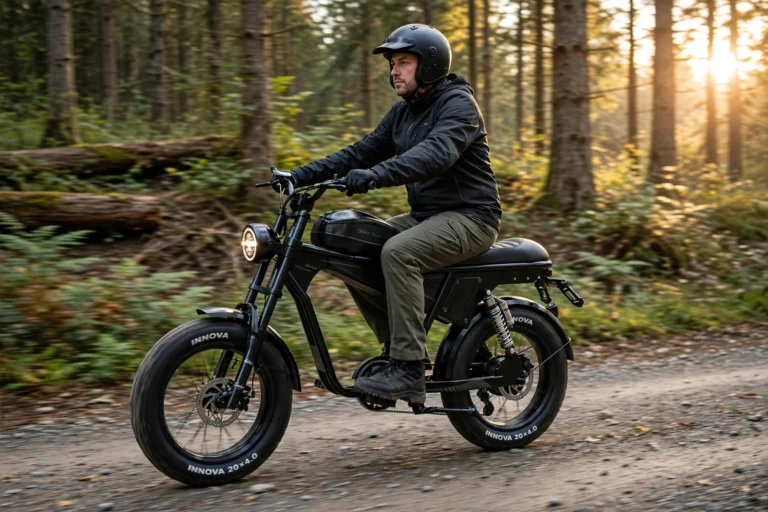
The ouxi v8 electric bike is the cheapest way into moped-style riding that still resembles a real vehicle: a 750W rear hub motor, a removable 48V 15Ah battery, 20×4-inch fat tyres and a long bench seat, sold through Ouxi’s own store at $699 (checked October 25, 2026) against a $1,099 list price. It looks like a small motorcycle. It is priced like a bicycle. A commuter’s job is to work out which of those two facts matters on a wet Tuesday in November.
Start with the numbers Ouxi prints, then discount them. The claim is 32 mph and up to 60 miles of range. Independent GPS testing of the standard bike records about 27 mph flat out, with the bike’s own display cheerfully reading 31 to 32. Owner and tester reports cluster around 25 to 30 miles per charge in mixed riding. Those are the planning figures. Anything else is brochure weather.
None of that makes it a bad buy. At $699, a bike that honestly does 27 mph and 30 miles, carries a rack and a passenger pad, and charges from a normal wall socket is a serious piece of transport. The catch list is equally clear: 83.77 pounds of weight, mechanical disc brakes asked to stop that weight from speed, and a spec sheet that changes depending on which marketplace listing you read.
Who should buy it? Someone with a commute under about 10 miles each way, mostly flat or gently rolling, who wants throttle ease and a seat that fits an actual adult. Who should not: anyone whose route ends with a long, steep climb, anyone who must carry a bike up stairs daily, and anyone expecting motorcycle braking from bicycle money. This guide untangles the versions, works out the realistic range from the battery maths, and gives the brakes the scrutiny they deserve. The voice is a commuter’s, because that is the job this bike keeps applying for.
For commuters weighing the options, the ouxi v8 electric bike offers throttle ease and a genuinely usable bench seat, and the ouxi v8 electric bike remains easy to charge from a normal wall socket.
What the ouxi v8 electric bike actually is
Under the styling sits a straightforward machine. The frame is high-carbon steel, built low and long like a 1970s minibike, with a fixed bench seat 33.46 inches off the ground and room, in theory, for two. Power comes from a brushless rear hub motor rated at 750W continuous with a claimed 80 Nm of torque. Ouxi’s own specification table lists peak output at 1,000W; some Amazon headlines for the same bike say 1,500W peak. The ouxi v8 electric bike has not gained 500 extra watts between websites. Treat 750W rated and roughly 1,000W peak as the honest figures, and treat any listing that disagrees as a reason to screenshot everything before you pay.
The battery is a removable 48V 15Ah lithium pack: 720 watt-hours, the single most useful number on the whole spec sheet. It locks into the frame, lifts out for charging indoors, and carries a USB port for a phone. Drive goes through a Shimano 7-speed Tourney drivetrain with five pedal-assist levels and a twist throttle. Ouxi’s product page contradicts itself on whether the assist sensor is cadence or torque type; the tested behaviour, a stepped surge as each level engages, is cadence-style. Plan your pedalling expectations accordingly.
The rolling stock is better than the price suggests. The 20×4.0-inch Kenda fat tyres sit on alloy mag wheels, so there are no spokes to loosen or true. A basic front suspension fork handles kerbs and cracked pavement. Lighting is complete for once: LED headlight, tail light, brake light, rear turn signals and a horn, plus an alarm with a key fob on most listings. Small mercies, gratefully received, on a bike that will live in real traffic.
The versions untangled: standard bike, V8 Max and the marketplace fog
Three things get called a V8, and telling them apart before checkout saves genuine grief.
The standard V8 is the bike described above: single 720Wh battery, mechanical disc brakes front and rear, front suspension only, $699 at Ouxi’s store (checked October 25, 2026). Marketplace prices move around; the same bike has sold near $572 shipped on Temu in independent testing coverage, and Walmart has listed it at $635.99. Buy on the delivered price and the returns policy, not the badge on the listing.
The V8 Max is the dual-battery version: two 48V 15Ah packs for 30Ah and 1,440Wh total, dual hydraulic brakes, claimed peak output of 1,500W from the same 750W-rated motor family (85 Nm claimed), and a $959 price at Ouxi’s store (checked October 25, 2026). Claimed range rises to 99 miles. Hold that thought until the range section below.
Then there is the fog. A V8 Mini with a 36V battery and 500W motor exists. So do V8 Pro and V8 3.0 variants from assorted sellers, an EU version limited to 250W and 25 km/h, and wholesale listings with whatever specification the reseller typed that morning. If the listing in front of you does not state 48V, 15Ah and 750W in the same breath, it is not the bike in this review.
Realistic range from the ouxi v8 electric bike, battery by battery
Range claims on fat-tyre moped-style bikes follow a simple rule: divide by your optimism, then divide again. The honest way is watt-hours and consumption. A heavy bike on 4-inch tyres, ridden by an adult, uses roughly these amounts of energy per mile: 28 to 32 Wh per mile on throttle alone at speed; 20 to 24 Wh per mile in mixed commuting on assist levels 2 to 3 with real pedalling; about 15 Wh per mile ridden gently at low assist. Those bands are estimates based on the bike’s weight, tyre width and tested behaviour, and they line up with the 25 to 30 miles owners actually report.
Now the arithmetic for the single 720Wh battery. Throttle-heavy: 720 ÷ 32 = 22.5 miles, and 720 ÷ 28 = 25.7 miles, so call it 23 to 26 miles. Mixed commuting: 720 ÷ 24 = 30 miles, and 720 ÷ 20 = 36 miles, so 30 to 36 miles is the planning window. Gentle riding: 720 ÷ 15 = 48 miles. Ouxi’s 60-mile pedal-assist claim requires 720 ÷ 60 = 12 Wh per mile, a figure achievable at jogging pace on a calm day by a light rider who treats the throttle as decoration. For a commute, the ouxi v8 electric bike is a 30-mile bike. That is not an insult. Thirty honest miles covers most urban round trips with charge to spare.
The V8 Max doubles the tank to 1,440Wh. Same bands: throttle-heavy gives 45 to 51 miles; mixed commuting gives 1,440 ÷ 24 = 60 miles up to 1,440 ÷ 20 = 72 miles; the 99-mile claim needs about 14.5 Wh per mile, which is gentle-riding territory again. Plan on 60 to 65 mixed miles and the Max stops being a range accessory and becomes a genuine two-or-three-day commuter.
Price per realistic mile is where the Max earns its keep. Using mixed-mode midpoints: the standard bike costs $699 ÷ 33 miles ≈ $21.20 for each mile of usable range. The Max costs $959 ÷ 66 miles ≈ $14.53 per mile of range. The dual-battery bike carries twice the energy for 37% more money, and it is the cheaper machine by the only range measure that matters.
Two weather warnings. Cold is a tax: lithium packs lose roughly 20 to 30% of usable capacity near freezing (est., standard lithium behaviour), so a 30-mile summer bike is a 21 to 24-mile winter bike. And the bar-style fuel gauge on the display is vague to the point of fiction. Ride by miles ridden, not by bars remaining.
Hills, rain and the ride home
Hills first, because hills are where wattage claims go to be audited. Ouxi advertises climbing angles of 35 to 40 degrees; a 35-degree slope is a 70% grade, a surface you would struggle to walk up in smooth shoes. Ignore it. In instrumented testing, the 750W motor took moderate hills on throttle alone without drama, climbed a steeper gravel incline slowly, and failed the steepest test hill on throttle, getting up only with a rolling start and hard pedalling. Translated for commuters: neighbourhood hills and highway overpasses, yes. A long 10% grind at the end of your route, expect to pedal and arrive warm. This is a motor for ordinary terrain wearing an extraordinary costume.
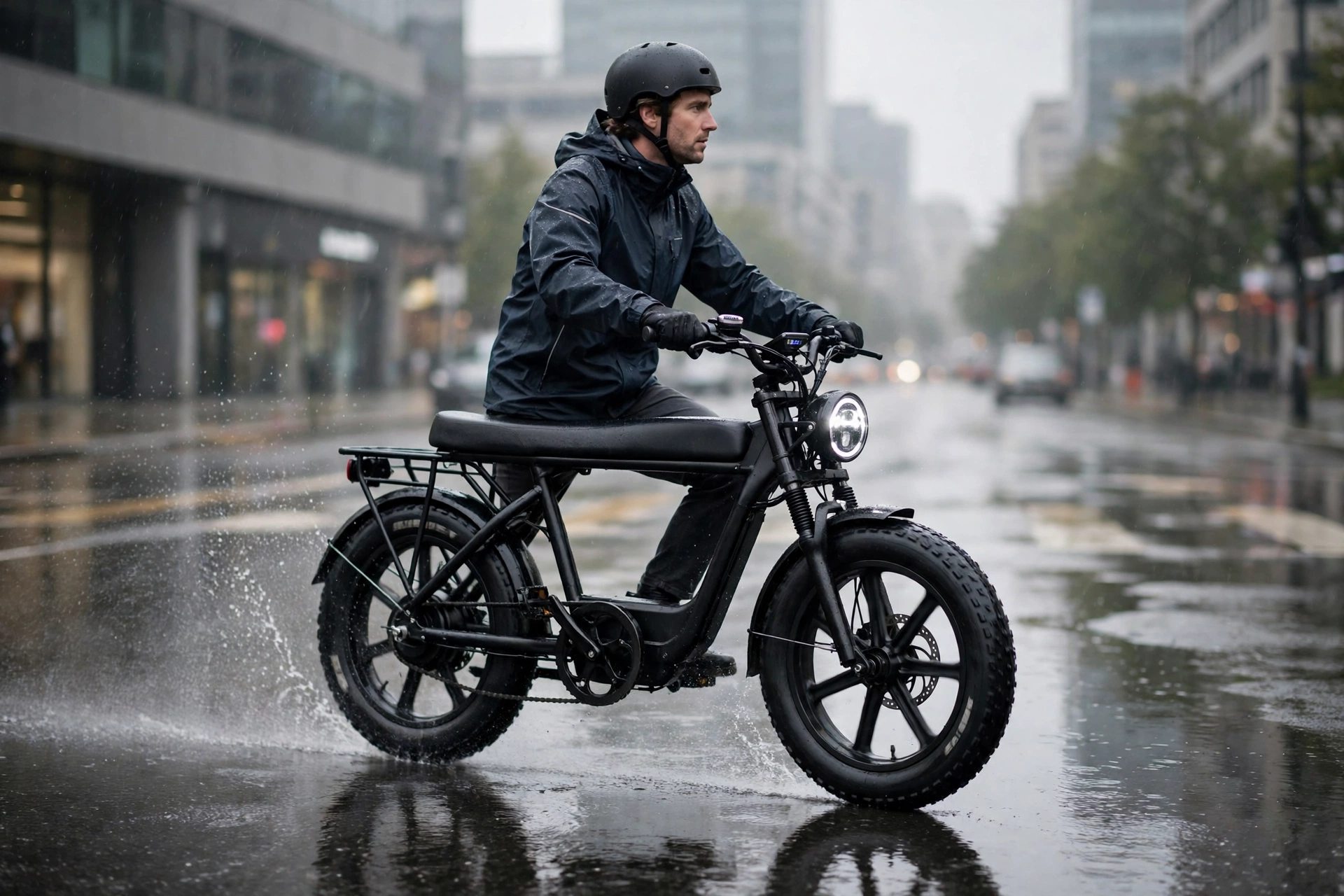
Rain is the other commuter audit, and here the news is mostly decent. The electrical system carries an IP54 rating, which means splash-resistant from any direction: rain on the ride home is fine; a pressure washer is not. The fat Kenda tyres put a wide, stable contact patch on wet tarmac, and the full lighting set, brake light and turn signals included, earns its place when visibility drops. One dry footnote: a V8 dealer page advises, for safety, not riding on rainy days at all. The gap between that caution and the IP54 rating is exactly the riding you will do. Ride it in the rain; dry the chain and connectors afterwards; do not submerge anything.
The arriving-un-sweaty test is the one the ouxi v8 electric bike passes cleanly. Throttle away from lights, sit upright in the wind, let the bench seat and fat tyres iron out the road. Pedalling is genuinely usable, too, because the tall seat gives more leg room than most fixed-bench rivals, though at assist levels 4 and 5 the gearing runs out and your legs become ornamental. Keep it in levels 2 and 3, pedal like you mean it, and the bike rewards you with the mixed-mode range in the maths above.
Brakes and reliability: where the budget shows
The standard bike stops with mechanical disc brakes on 160 mm rotors. On an 83.77-pound machine carrying an adult at 27 mph, that is the weakest specification on the page, and no amount of moped styling changes the physics. Cable-actuated 160 mm discs are adequate in the dry at moderate pace and progressively less adequate everywhere else. BikeRide’s owner coverage reaches the same conclusion from the other direction: replacing the stock brakes with aftermarket hydraulic discs is one of the most common V8 owner upgrades.
Budget $60 to $120 (est.) for a hydraulic conversion kit, or buy the V8 Max, which ships with dual hydraulic brakes fitted. Pick one of those two options. The third option, standard brakes and optimism, is the one this guide votes against.
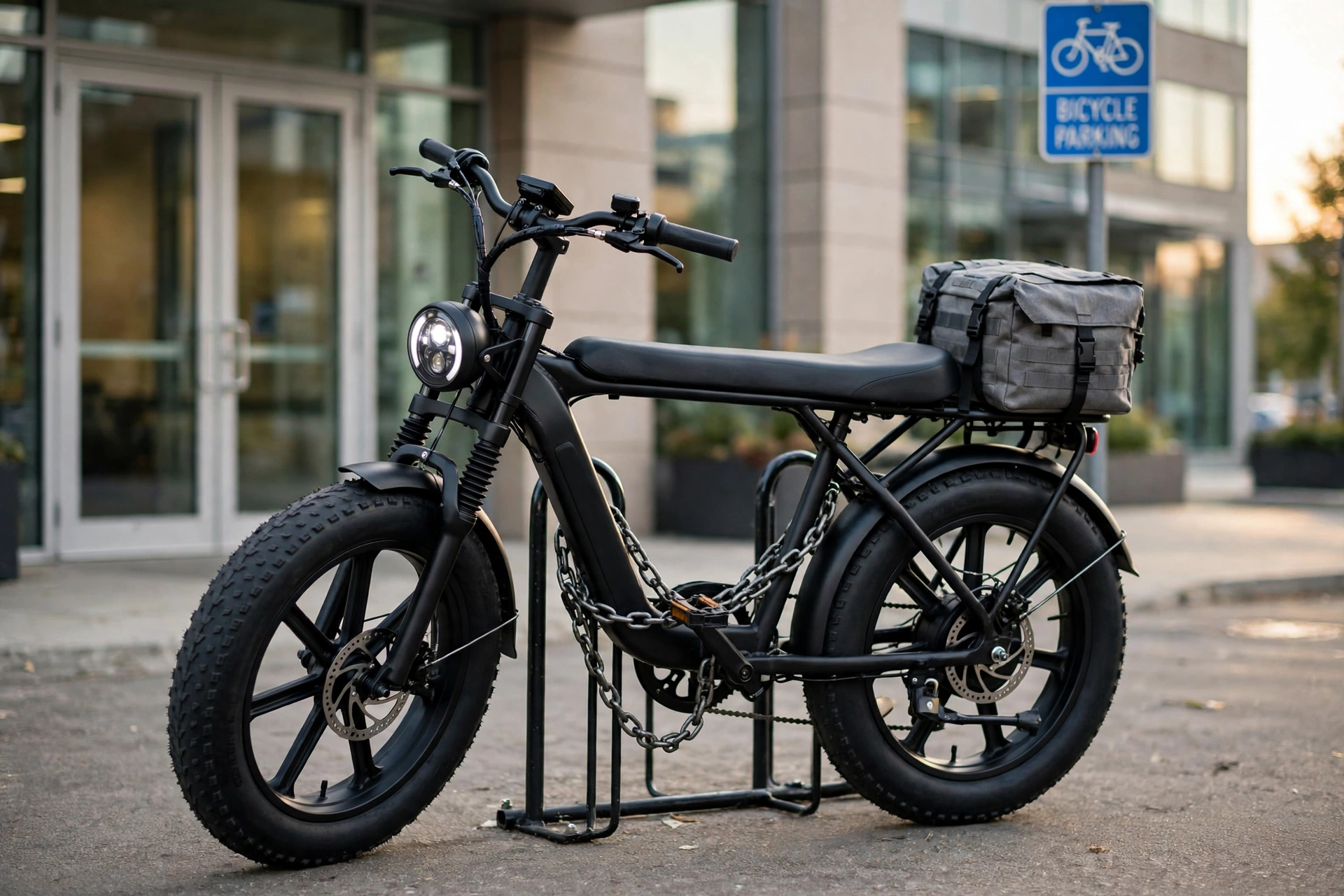
The rest of the reliability picture is ordinary budget-bike stuff, honestly reported. Assembly needs care: one independent tester found the handlebar stem installed backwards in the box and a tail-light cable too short for its rack, fixed with patience and rerouting. Documentation is thin. The Shimano Tourney derailleur, the chain and the brake pads are standard, cheap and available everywhere, which is the practical kind of reliability a commuter actually uses.
Carrying capacity deserves one firm paragraph. The 330-pound maximum load is the bike’s total, rider included, and the passenger pad and footpegs invite a second person the brakes have not agreed to carry. Two-up riding on the standard bike, on mechanical 160 mm brakes, is a bad idea dressed as a feature. Ride solo; use the pad as cargo space.
Warranty is one year from the manufacturer, per the manual. Support runs through the seller, which is why the returns policy of the shop you choose matters more than another $30 off the price.
Charging the ouxi v8 electric bike: time, cost and the two-battery wait
Ouxi quotes 5 to 7 hours for a full charge of the 15Ah pack, and the honest planning figure is the upper end of that, especially from fully flat. The pack lifts out, so charging happens at a desk or kitchen socket rather than wherever the bike sleeps. Electricity cost is nearly beneath notice: 720Wh drawn through a charger at roughly 85% efficiency (est.) takes about 0.85 kWh from the wall, which at a US average residential rate of $0.17 per kWh (est.) is about 14 cents a charge. Spread over 33 realistic miles, that is under half a cent per mile. Our guide to what it costs to charge an electric bike runs the same maths across the whole category, and the V8 sits at the cheap end of it.
The Max has a scheduling problem instead of a cost problem. Two packs, 1,440Wh total, cost about 29 cents to fill (est., same rate and efficiency). The wait is the issue: the box ships with a single charger (est.), so two flat packs charge one after the other, roughly 10 to 14 hours (est.) from empty to both full. Fine for a weekend top-up habit; annoying if you drain both packs daily. A second charger is the obvious fix, and it should be in the box at $959.
Is the ouxi v8 electric bike legal where you ride?
Plainly, then. The US three-class system tops out at 750W, which the V8’s motor meets exactly. Class 2 allows a throttle up to 20 mph. Class 3 allows pedal assist up to 28 mph, with the throttle, where fitted, limited to 20 mph. The ouxi v8 electric bike ships with a display setting that raises its limit to about 50 km/h, throttle live well past 20 mph, and GPS-verified speed around 27 mph.
As delivered and unlocked, it is not a Class 2 bike and not a clean Class 3 bike in most states. It sits in the gap regulators describe as an out-of-class electric vehicle, and some jurisdictions treat throttle bikes that exceed the classes as motorised bicycles or mopeds, with registration, licence and helmet rules to match, and no right to bike lanes or multi-use paths.
The practical fixes are simple. Set the display limit to 20 mph and you have a defensible Class 2 machine for paths and lanes. Our Class 1 e-bike guide explains the class framework in full, including why trail managers care about the distinction. Also check battery certification: New York City and a growing list of landlords, employers and transit agencies require UL 2849-certified systems. Current Amazon and Walmart listings describe the V8 as UL 2849 certified; Ouxi’s own pages are vaguer, so inspect the label on the battery when the box arrives and keep a photo of it.
Running costs over a year of commuting
Take a 12-mile round trip, five days a week, 46 weeks a year: 2,760 miles. Electricity at the figures above runs to roughly $12 a year (est.). The real budget is wear parts. Brake pads on a heavy bike at urban stop-start pace: two sets a year, $20 to $30 (est.). One rear tyre a year, since the motor wheel does the work and takes the wear: about $45 (est.) for the Kenda. A chain annually, $15 or so. Add a hydraulic brake upgrade in year one if you bought the standard bike, and budget a replacement battery around year three to four at several hundred dollars (est.), priced when the current pack fades rather than promised in advance.
Total honest running budget: under $120 a year in consumables (est.), plus your time. Against parking charges or a transit pass, the V8 pays for itself in arithmetic a child could check. Against a lighter commuter bike, it pays in comfort and throttle ease, and charges you in weight every time the route includes a staircase.
Over a full year, the ouxi v8 electric bike therefore stays cheap to run, provided brake pads, tyres and the chain are checked on schedule.
Verdict: who should buy it, and the scores
Buy the standard ouxi v8 electric bike if your commute is short, your terrain is gentle, your storage is at ground level and your budget is firm. It is honest transport at an unusually low price, provided you spend the brake money. Buy the V8 Max if your round trip passes 25 miles, or you want hydraulic brakes fitted from the factory and two-to-three-day charging intervals. Look elsewhere, somewhere in the direction of the machines in our RTR electric bikes guide, if your route is properly hilly, your building has stairs, or your local paths enforce the classes strictly and you cannot face the display settings.
Ouxi V8 (single battery, $699): Our score: 6.8/10 — Range: 6/10 · Charging: 6/10 · Value: 9/10. Thirty real miles, an overnight charge, an unbeatable price, and brakes that cap the whole score.
Ouxi V8 Max (dual battery, $959): Our score: 7.4/10 — Range: 8/10 · Charging: 5/10 · Value: 8/10. Twice the tank, proper hydraulic brakes, the better cost per realistic mile, and a two-pack charging wait that marks it down. Full specification and current pricing for both versions sit on Ouxi’s official V8 product page, and the GPS numbers quoted throughout are drawn from GoEBikeLife’s instrumented V8 review.
Frequently asked questions
How far does the ouxi v8 electric bike really go on one charge?
Plan on 30 to 36 miles of mixed commuting from the single 720Wh battery, 23 to 26 miles on throttle alone, and 60 to 72 mixed miles from the dual-battery V8 Max. The 60- and 99-mile headline claims assume consumption no commuter achieves.
Can I ride it in the rain?
Yes, within reason. The electrics are IP54 splash-resistant, the fat tyres are stable on wet roads and the lights are properly bright. Dry the chain and connectors after wet rides, never pressure-wash the bike, and do not ride through water deep enough to reach the motor or battery.
Is the Ouxi V8 a Class 2 e-bike?
Only after you set it up as one. The motor is 750W, which fits the class ceiling, but the bike ships able to throttle past 20 mph, which no US class allows. Limit it to 20 mph in the display settings for Class 2 use, and check your state’s rules before riding paths or lanes.
Standard V8 or V8 Max for commuting?
Under 10 miles each way on gentle ground, the standard bike plus a $60 to $120 (est.) hydraulic brake upgrade is the value pick. Beyond that distance, or on a route with real hills, the Max’s second battery and factory hydraulic brakes justify the $260 difference.
What breaks first, and what does it cost?
Brake pads, then the rear tyre, then the chain: roughly $100 to $120 a year in consumables (est.). The battery is the big deferred cost, several hundred dollars (est.) around year three or four. Mechanical parts are standard Shimano-pattern items any bike shop stocks.