Last updated: October 25, 2026
Pick up a jetson scooter and the first thing you notice is the weight, or rather the lack of it. These are 27 to 30 lb machines built for short hops: the school run, the campus crossing, the last mile from the bus stop. Jetson does not build long-range commuters and does not pretend to. What it builds is the cheapest respectable way into electric riding, priced from roughly $120 for a kids’ model to about $650 for its best adult commuter (prices checked October 25, 2026).
For short, flat trips, a jetson scooter is an easy first step into electric riding.
That positioning matters, because a Jetson gets judged wrong when it gets judged like a Segway. The right test is narrower and harder. Does it stop properly? Does it grip when the road is wet? Does the battery deliver anything close to the miles printed on the box? A first scooter is a teaching tool, and it teaches at 15 mph on small wheels, which is exactly why the hardware details matter more than the light shows.
This guide goes through the current lineup model by model, then scores each one on the three things that decide whether a first scooter is a good teacher or a bad lesson: brakes, tyres and honest range. Figures we could not confirm from Jetson or a credible test are labelled (est.) with the basis stated. Nothing here is based on a test ride; it rests on published specifications, retailer listings, manuals and independent reviews.
One rule before any of it, and it is not negotiable: nobody rides any scooter here without a helmet. Not on long rides only. Not just in the neighbourhood. Every model here travels at bicycle speed or faster on wheels smaller than a bicycle’s, and small wheels lose arguments with potholes, wet leaves and painted crosswalks. Helmet on, every ride, plus closed shoes and gloves for anyone riding in traffic. If the budget is tight, cut the scooter budget before you cut the gear budget.
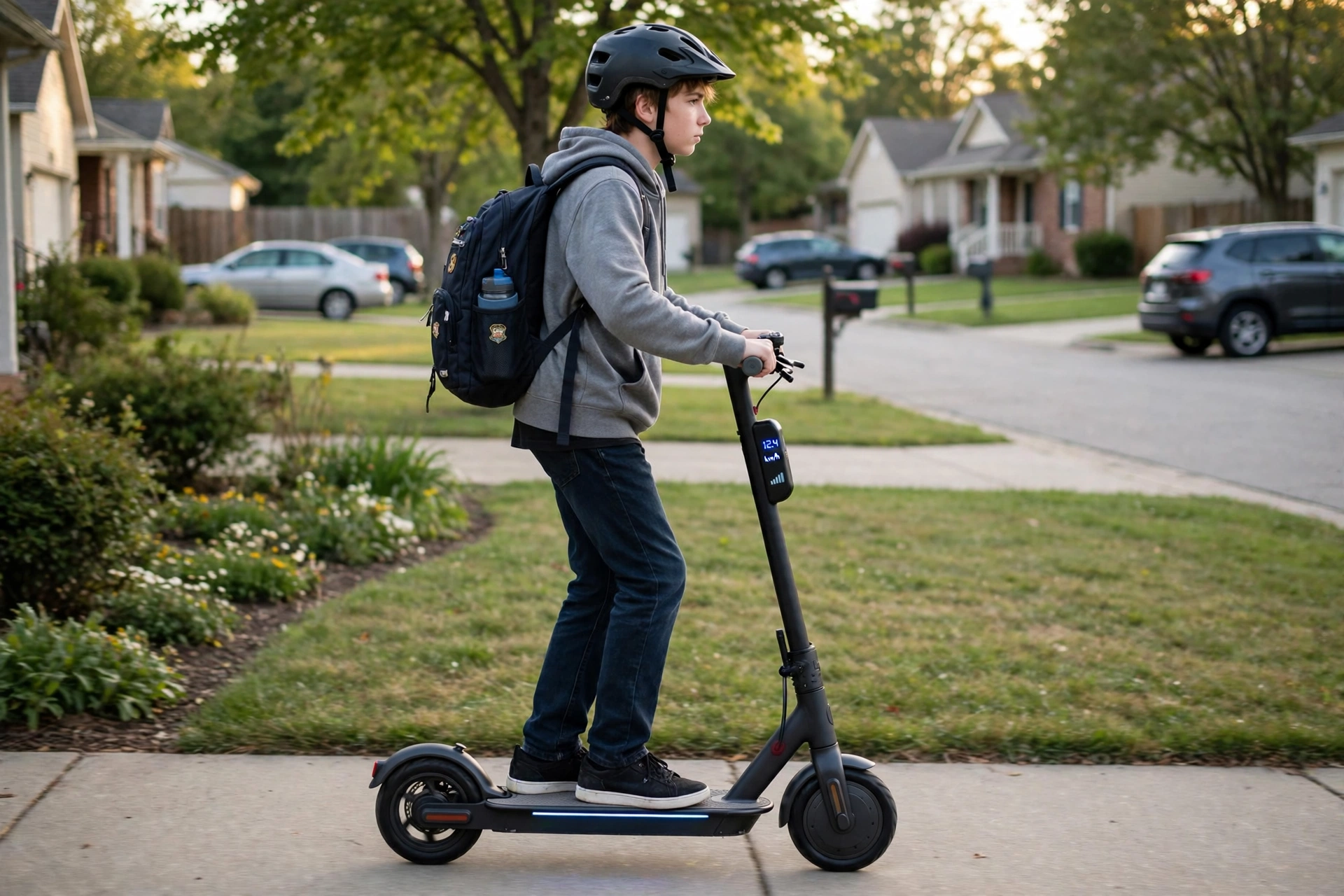
The jetson scooter lineup in late 2026: what is actually on sale
The official Jetson electric scooter collection currently shows the Knight, the Loomis, the Ora Pro and the Eris Pro as the live adult and teen range, with the Shield, Ryder Pro and Ember marked sold out. Retailers add the kids’ Omega and older stock such as the Eris and the Quest. That spread is the whole story of the brand: breadth at the bottom of the market, nothing at the top.
The Knight is the most complete commuter Jetson makes. It runs a 350W motor, a removable 36V 5Ah (180Wh) battery that lifts out of the stem, pneumatic 8.5-inch tyres, a hand brake backed by a rear foot brake, and a claimed 15.5 mph top speed with up to 15.5 miles of claimed range. It weighs 28 lb, carries riders up to 220 lb, charges in about 3 hours, and is UL-2272 certified. List price sits at $499.99 (checked October 25, 2026), and Amazon has run it as low as $348, so never pay list.
The Eris Pro is the other serious option, and on paper the stronger stopper. Its 350W hub motor is rated for 16 mph and up to 12 miles of range, a figure Jetson’s own packaging says was tested carrying a 170 lb rider. It rolls on 8.5-inch pneumatic tyres and stops with a rear disc brake, the best brake hardware in the current lineup. Three speed modes and a 265 lb rider limit round it out; the packaging states it is UL listed. Dick’s Sporting Goods lists it at $649.99 (checked October 25, 2026).
The Ora Pro is the lightweight. A 250W motor (that figure is peak power, per Jetson’s manual), a top speed of 15.5 mph, and a claimed range of 10 to 12 miles, with the manual’s own test note recording 10 miles at 12 mph carrying 170 lb. It weighs just 27 lb and folds small. The compromises are the wheels and brakes, covered next: 6.5-inch solid tyres, an electronic brake and a rear foot brake. Dick’s lists it at $349.99 and Target has sold it at $212.49 (both checked October 25, 2026), and at the Target price its compromises are far easier to accept.
The Loomis is the fun-first model: a 200W motor, up to 15 mph, up to 8 miles of claimed range, solid tyres, a light-up deck and a built-in Bluetooth speaker with beat-synced lights. Dick’s lists it at $399.99 and Target at $322.99 (checked October 25, 2026). Judge it as entertainment, not transport, because 8 claimed miles is a neighbourhood loop, not a commute.
The Omega is the kids’ entry point, for ages 8 and up. A 100W motor (up to 150W), three speed modes topping out at 10 mph, a light-up deck, solid tyres and a 120 lb rider limit, at 15.5 lb. The claim is 5 miles per charge; independent testing found 3 to 4 real miles, which is still plenty for the riding a 9-year-old should be doing. It sells for roughly $100 to $130 at big-box retailers (checked October 25, 2026).
The Quest is the older model that refuses to disappear from used listings and leftover retail stock. Launched in 2019 at $599, it pairs a 250W motor with a 36V 7.5Ah (270Wh) battery, claims 15 mph and 15 to 18 miles, and stops with a rear mechanical disc brake plus front regenerative braking. Its weakness is 8.5-inch airless solid tyres and no suspension. Electrek’s review of the Quest praised its features and value at launch, and a clean used one remains a rational buy, with the tyre caveat below. If the rider in your house would rather sit down and pedal, our Jetson e-bike guide covers the brand’s bikes with the same honesty about range.
Brakes and tyres: where every jetson scooter earns or loses trust
Here is my position, stated plainly: solid tyres are the wrong default on anything a teenager rides to school. A puncture is an inconvenience you fix at the kitchen table. A front wheel washing out on a wet painted crosswalk is an injury. Solid and airless tyres trade exactly the wrong way, giving up wet grip and bump absorption to save the rider from ever using a pump. Buy pneumatic, check the pressure every week, and accept the small puncture risk. That single decision matters more than motor watts.
Model by model, then. The Knight gets the tyre call right: pneumatic 8.5-inch rubber that grips and cushions, and retailer listings also credit it with dual suspension. Its braking is a hand-operated brake plus a rear foot brake, which is adequate rather than excellent. The Eris Pro gets both calls right: pneumatic 8.5-inch tyres and a rear disc brake that keeps working in the wet and can be serviced with standard pads. It is the stopping setup I would choose for a teen riding in traffic. The Quest has the disc brake but the solid tyres, so its strong hardware is undermined exactly when the road gets slippery.
The Ora Pro is where I draw a line. A rear foot brake is not a brake system. Pressing your heel onto a fender gives you weak, inconsistent stopping power, and the Ora Pro pairs it with an electronic brake and 6.5-inch solid wheels that are the smallest and least forgiving in the lineup. At 15.5 mph on flat, dry pavement, it is tolerable. In the wet, downhill, or around cars, it is not enough. A hand lever working a mechanical brake should be the minimum hardware on any scooter carrying a teenager through traffic, full stop.
The Loomis uses hand-operated brakes with solid tyres, which suits its actual job: slow, flat, recreational riding. The Omega gives young riders two brakes at speeds capped at 10 mph, which is proportionate. One more warning applies across the range: an 8.5-inch wheel drops into cracks that a bicycle tyre rolls over, and a 6.5-inch wheel is worse. Teach new riders to cross cracks at an angle and slow down for broken pavement.
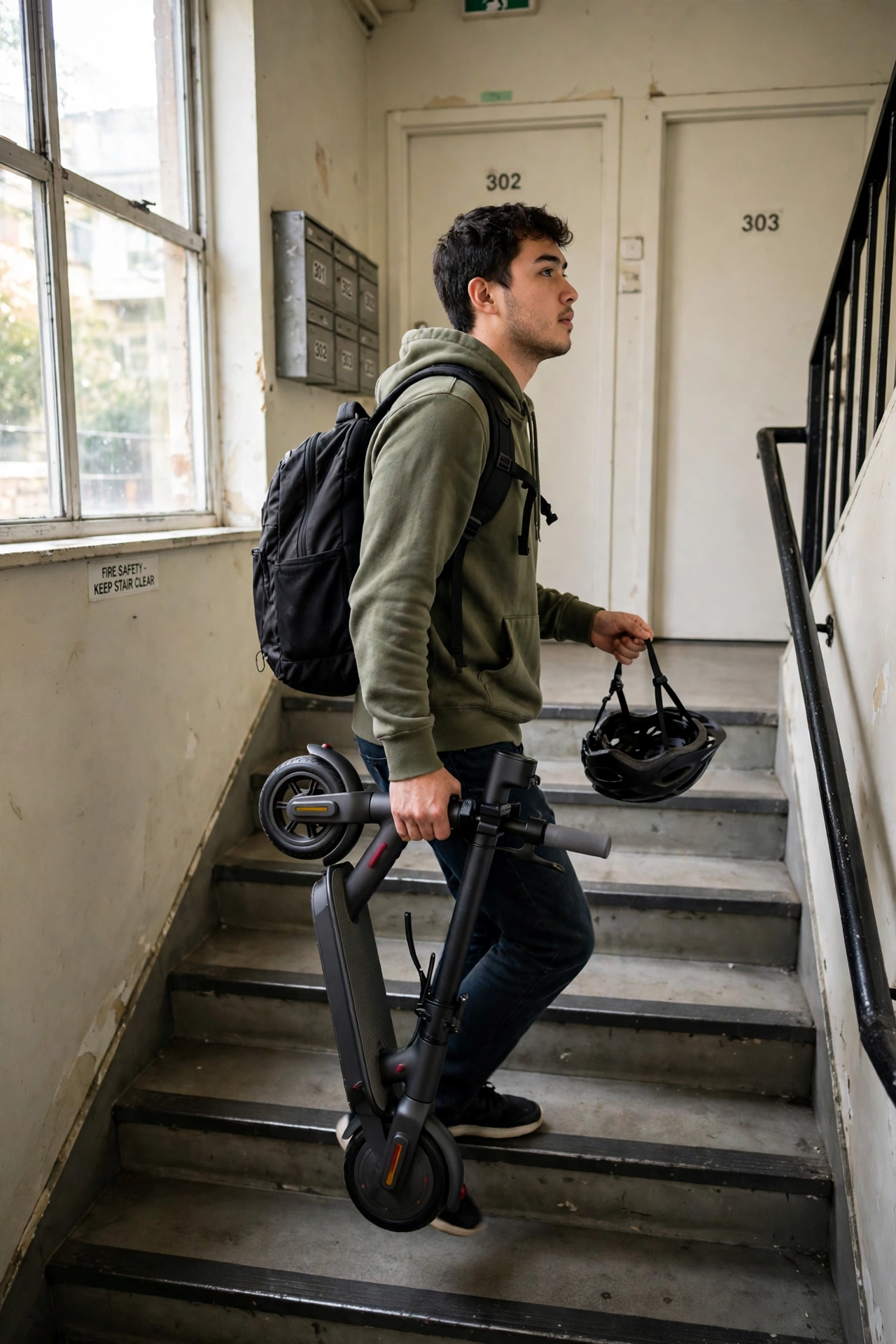
Range honesty: claimed miles vs the miles you will actually get
Every range figure in this category is a best case: light rider, steady speed, flat ground, and Jetson is more candid than most: the Ora Pro’s manual states its test conditions outright (170 lb, warm weather, 12 mph). Real riding means stop-start traffic, hills and a battery that ages. Plan on roughly 60 to 70 percent of the claim, and treat the figures below as planning numbers, not promises.
- Knight: claimed 15.5 miles. Realistic 9 to 11 miles (est., based on its 180Wh battery and typical consumption for this class). The removable battery is the saving grace: a spare pack resets the clock.
- Eris Pro: claimed 12 miles, tested by Jetson at a 170 lb rider weight. Realistic 8 to 10 miles (est., same basis) for most adults, more for lighter teens.
- Ora Pro: claimed 10 to 12 miles, with 10 miles recorded in Jetson’s own manual test. Realistic 7 to 9 miles (est.) in mixed riding.
- Quest: claimed 15 to 18 miles from the biggest battery here, 270Wh. Realistic 11 to 13 miles (est.), still the longest legs in the Jetson range.
- Loomis: claimed 8 miles. Realistic 5 to 6 miles (est.). Fine for its purpose, useless beyond it.
- Omega: claimed 5 miles; independent testing measured 3 to 4 real miles. Labelled honestly, this is the one claim in the range we can check against a test, and it lands where the 60 to 70 percent rule predicts.
The practical reading: a round trip of 5 miles or less suits the Knight, Eris Pro and Quest comfortably. A round trip of 8 miles or more leaves no margin on anything Jetson sells, and a rider doing that daily should step up a class entirely.
Charging: times, and what a full battery actually costs
Charging a jetson scooter is the cheapest part of owning one. The Knight’s 180Wh battery holds 0.18 kWh, so a full charge at a typical US residential rate of $0.17 per kWh (est., around the current national average) costs about 3.1 cents. The 270Wh packs in the Quest and the original Eris cost about 4.6 cents to fill. Run the school-commute maths: 4 miles a day, 180 school days, at roughly 20Wh per mile works out to about 14.4 kWh a year, or near $2.45 (est.) of electricity annually. Nobody’s budget notices that.
Charge times matter more than cost. The Knight refills in about 3 hours. The Ora Pro takes roughly 3 to 4 hours, per its manual. The Eris takes up to 5 hours, the Quest up to 6 hours, and the Omega up to 5 hours. The Loomis publishes no fast-charge figure, so plan on an overnight charge (est. 3 to 5 hours, based on its battery class). Two habits protect these small batteries: charge indoors at room temperature, never on a bed or sofa, and unplug once full. The Knight’s removable pack earns its keep here, because the battery can come inside even when the scooter lives in a garage.
Our own computation: price per realistic mile
Sticker prices flatter Jetson, so we divided each price by realistic range instead of the claimed figure, using the estimates above. The arithmetic changes the ranking.
- Omega: $119.99 ÷ 3.5 tested miles = $34.28 per realistic mile. Cheap because the job is small.
- Ora Pro: $349.99 ÷ 8 miles (est.) = $43.75 per realistic mile.
- Quest: $599 launch price ÷ 12 miles (est.) = $49.92 per realistic mile, and used examples at lower prices improve that fast.
- Knight: $499.99 ÷ 10 miles (est.) = $50.00 per realistic mile.
- Eris Pro: $649.99 ÷ 9 miles (est.) = $72.22 per realistic mile. The best brakes in the range, priced like it.
- Loomis: $399.99 ÷ 5.5 miles (est.) = $72.73 per realistic mile. You pay for the speaker and lights, not for transport.
The Segway Ninebot Max G30P, covered in our Segway Ninebot Max G30P guide, sells for about $799 and has repeatedly tested at roughly 24 real miles. That is $799 ÷ 24 = $33.29 per realistic mile, cheaper per usable mile than every Jetson on this page. Jetson wins on purchase price and on weight. Segway wins on cost per mile of actual transport. If the scooter is a daily vehicle rather than a toy, the second number is the one that counts.
Safety gear and age guidance: the non-negotiables
Gear first, with prices so nobody can claim surprise: a certified bicycle helmet runs $35 to $60, gloves $15 to $25, and both together cost less than one urgent-care visit for a scraped palm and a gashed chin. Add a small lock ($15 to $25, est.) for school or shop stops. Lights are fitted across the range, though the Omega has no true headlight and should never be ridden at night.
Match the scooter to the rider, using Jetson’s own minimums as the floor, not the target. The Omega (ages 8+) suits supervised riding on private ground and quiet paths at 10 mph. The Ora Pro, Knight and Eris Pro carry a 12+ rating, and 12 is right for a rider with the road sense to handle 15 mph near traffic; younger teens belong on the slower modes until their braking is automatic.
Local law sits on top of all of this: many cities set minimum ages, helmet rules and sidewalk bans, and some campuses require UL 2272 certification. The Knight is UL-2272 certified and the Eris Pro’s packaging states UL listed; verify the specific unit you are buying, because certification is per model, not per brand.
Running costs of a jetson scooter over two years of real use
Electricity is a rounding error, as shown above. The real running costs are wear items. Pneumatic tyres need tubes at roughly $8 to $15 each (est.) when punctures happen, and worn solid tyres cost roughly $25 to $45 (est.) to replace. Disc brake pads for the Eris Pro and Quest run about $10 to $20 a pair (est.). Brake cables stretch and bolts rattle loose; a monthly five-minute check with an Allen key prevents most of it.
The big-ticket risk is the battery. On most of these models the pack is sealed into the deck or stem, so a dead battery after two or three years of hard use effectively ends the scooter. The Knight is the exception, and its removable pack (replacement est. $120 to $160, based on comparable 36V 5Ah packs) is a genuine ownership advantage. Budget under $25 a year in consumables for a typical rider (est.), plus the discipline to store the battery between 40 and 80 percent charge over winter.
Verdict: who should buy a jetson scooter, and which one
Buy a Jetson if the job is short, flat and light: a teen’s school run under 3 miles each way, campus hops, a last-mile link from transit, or a child’s first electric ride under supervision. Choose the Knight for the removable battery and pneumatic tyres, or the Eris Pro if braking hardware matters most and the budget stretches. Choose the Ora Pro only at a discount and only for flat, dry routes. Do not buy any of them for a hilly 8-mile commute; that rider needs a bigger battery and bigger wheels, and the far end of the market shows why: our Kaabo King GTR guide covers dual-motor machines at several times the price.
Knight — Our score: 7.4/10. Range 6/10, Charging 8/10, Value 8/10. The most complete jetson scooter: pneumatic tyres, a removable battery, a fast 3-hour charge. It loses marks for range per dollar, not for manners.
Eris Pro — Our score: 6.8/10. Range 5/10, Charging 6/10, Value 6/10. The best brakes Jetson sells, on pneumatic tyres, with a 265 lb rider limit. The $649.99 tag is simply too close to better scooters from rival brands.
Ora Pro — Our score: 6.9/10. Range 5/10, Charging 8/10, Value 8/10. Featherweight and quick to charge, marked down hard for the foot-brake-only hardware and 6.5-inch solid wheels. At Target’s $212.49 it is a fair buy; at $349.99 it is not.
Quest — Our score: 7.0/10 (as a used or leftover-stock buy). Range 7/10, Charging 5/10, Value 7/10. The biggest battery and a proper disc brake, held back by solid tyres and slow charging. Condition is everything; check the battery before the paintwork.
Loomis — Our score: 5.6/10. Range 3/10, Charging 6/10, Value 5/10. A speaker with wheels. Fun at a sleepover, wrong tool for getting anywhere.
Omega — Our score: 7.8/10 for its specific job. Range 4/10, Charging 6/10, Value 9/10. Honest speeds, honest weight, sensible brakes for an 8-year-old, and a tested real range close to the claim.
Before buying, compare each jetson scooter on brakes and tyres first, then on claimed range.
Frequently asked questions
How far does a jetson scooter really go on one charge? Plan on 60 to 70 percent of the claimed figure. That means about 9 to 11 miles from the Knight, 8 to 10 from the Eris Pro, 7 to 9 from the Ora Pro, 11 to 13 from the Quest, 5 to 6 from the Loomis, and 3 to 4 tested miles from the Omega (estimates, as detailed above). Heavier riders, hills and cold weather all pull those numbers down.
Are Jetson scooters UL certified? The current adult models are sold with UL 2272 certification; the Knight is explicitly UL-2272 certified and the Eris Pro’s packaging states UL listed. Certification is per model, so confirm it on the exact scooter you are buying, especially used stock. New York City and a growing list of campuses require it.
Which Jetson should a teenager ride to school? The Knight, for its pneumatic tyres, removable battery and reasonable brakes, with the Eris Pro as the pick if your route has traffic and hills, because its disc brake is the strongest stopper in the range. Either way: helmet, gloves, and a route that avoids fast roads. If the ride is longer than about 4 miles each way, buy a class up instead.
Can adults ride these scooters? Within limits. The Eris Pro carries up to 265 lb, the Knight, Ora Pro and Quest up to 220 lb. Adults near those limits will see range fall well below the estimates above. A tall or heavy adult commuting daily is better served by a 10-inch-wheel commuter scooter.
How long does charging take, and can the battery be replaced? Roughly 3 hours for the Knight, 3 to 4 for the Ora Pro, up to 5 for the Eris and Omega, and up to 6 for the Quest. Only the Knight has a user-removable battery; on the other models the pack is sealed in, which is the strongest argument for buying the Knight if you plan to keep the scooter for years.
Can you ride a Jetson scooter in the rain? We would not. Some models are listed as water resistant against splashes, but solid tyres on wet pavement give up grip exactly when you need it, and no model here should be ridden through standing water. Wet roads are also when the Ora Pro’s foot brake is at its weakest. Dry days only is the right rule for this whole range.