Last updated: October 25, 2026
The red triangle appears mid-journey, the dash adds a calm little message — “Check Hybrid System” — and within the hour somebody is quoting you a figure that sounds like a roof replacement. Breathe. A hybrid battery replacement cost is a genuine bill, and it is also one of the most misquoted numbers in the car world. Before anyone prices a part, your car has already stored the evidence: a fault code that tells us whether the pack is dying, whether one block inside it is dying, or whether a $180 twelve-volt battery is impersonating a catastrophe. This guide reads the codes first, then prices every route honestly, model by model.
My name is Ahmed Khalil, and I cover diagnostics, software faults and recalls here. My working rule never changes: never price a part before you read the fault. A warning light is a question, not a quote. Some lights mean the high-voltage pack is finished. Others trace back to a weak 12-volt battery (code C1241), a lost-communication glitch (U0100), or a tired inverter coolant pump (P0A93) — repairs in the $150 to $700 range (est.), not the thousands a frightened owner gets quoted over the phone. If a shop gives you a pack price without scanning the car, hang up.
When the scan does come back P0A80, the news is real. That code’s official wording is blunt — “Replace Hybrid Battery Pack” — and the battery computer sets it only after watching the pack’s internal blocks drift apart in voltage beyond a set limit, on two separate trips. It does not clear itself, it does not respond to wishful thinking, and it almost always means the pack, not a sensor. If you are new to how these cars split work between engine and motor, our explainer on what a hybrid car is and how it works covers the basics in plain language.
Between that light and the invoice sit three genuinely different routes: a new pack from the dealer, a new-cell pack fitted by an independent hybrid specialist, and a reconditioned pack rebuilt from tested used modules. The sticker prices differ by thousands of dollars. The cost per year of service differs by far less, and the “cheap” option quietly works out the most expensive per year. We will do that maths in the open, with the arithmetic shown, before the verdict.
Before comparing quotes, it helps to treat the hybrid battery replacement cost as a total installed figure, not just a part price. A clear hybrid battery replacement cost also makes it easier to judge whether a warranty claim, a new-cell pack or a reconditioned pack is the better value.
The Light Comes On: Read the Codes Before You Read a Quote
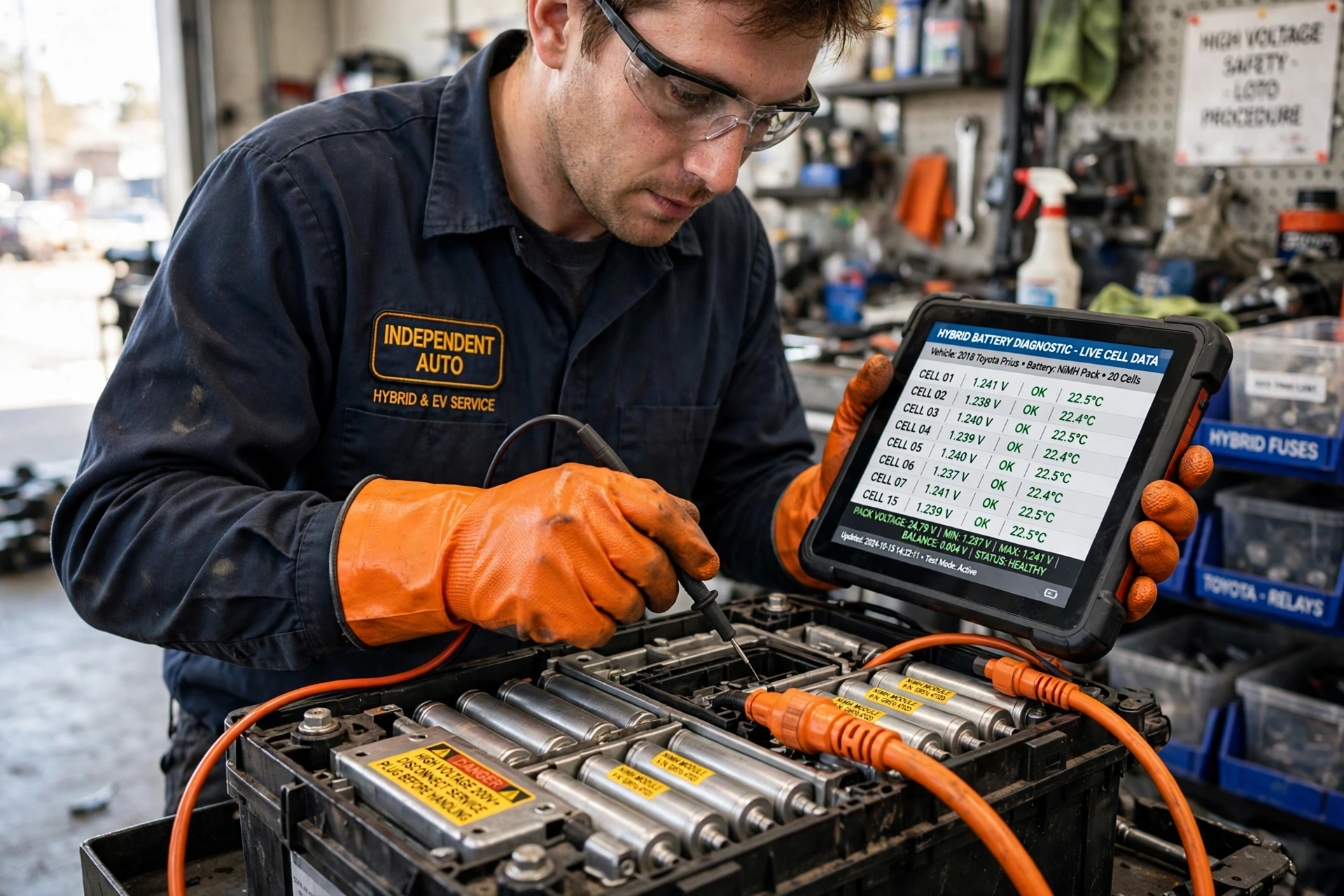
Hybrid fault codes look cryptic because they are written for technicians, so let me translate the ones that matter. The U.S. Department of Energy’s Alternative Fuels Data Center has a clear overview of how hybrid electric cars work, and it helps to picture the system first: the pack is not one battery but a chain of modules, watched block by block by a battery computer that reports the first sign of imbalance.
| Code | Plain-English meaning | What it usually costs |
|---|---|---|
| P0A80 | Replace hybrid battery pack — blocks have drifted too far apart in voltage | The pack itself; see the table below |
| P3011–P3024 | One specific block is weak — the last two digits name the block | Points to the failing modules inside the pack |
| P0A7F | Hybrid battery pack deterioration — internal resistance too high | Early warning; pack ageing, plan the replacement |
| P0A93 | Inverter cooling system performance — usually the electric coolant pump | Roughly $400–$700 fitted (est.) |
| P0AA6 | High-voltage isolation fault — voltage leaking toward the chassis | Stop driving; diagnosis first, price second |
| C1241 / U0100 | Low 12-volt supply or lost communication | Often just the 12-volt battery, $150–$220 (est.) |
Two details separate a careful diagnosis from a guess. First, P0A80 is a two-trip code: the car must see the same imbalance twice before the light stays on, so a single odd reading is not a death sentence. Second, the block codes matter. A P3017, for example, tells the technician block 7 is the weak one — and a pack with one weak block at 120,000 miles is a different conversation from a pack with five tired blocks at 210,000 miles. Ask whoever scans your car for the code list and the block voltages, in writing. Any competent hybrid shop will show you both without being asked twice.
What “Dead” Actually Means: Modules, Blocks and the Weakest Link
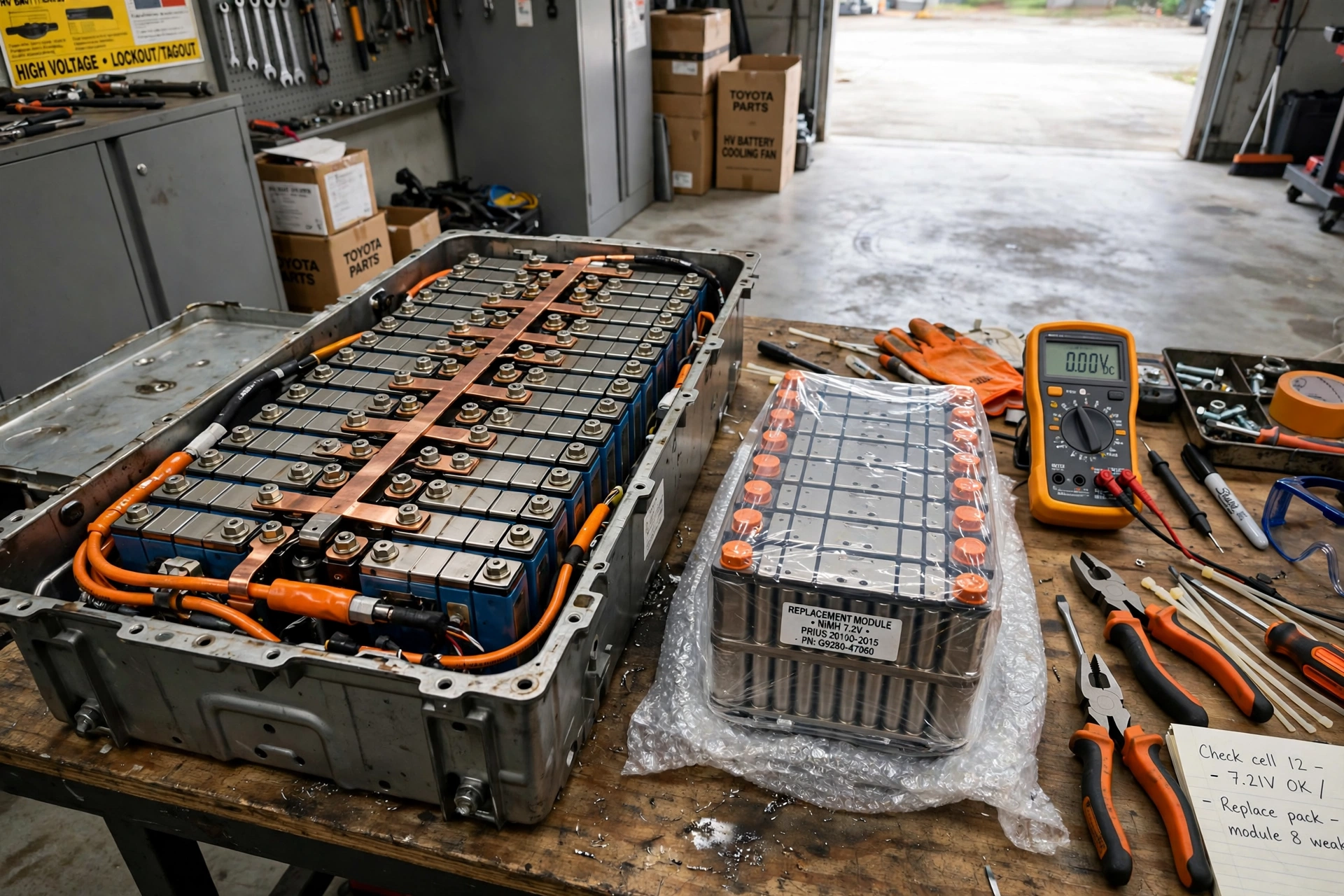
Open a third-generation Prius pack and you will find 28 individual nickel-metal hydride modules, each about the size of a paperback book, wired in series and monitored as 14 pairs called blocks. The pack delivers roughly 201.6 volts, and it performs exactly as well as its weakest module. One module loses capacity, its block voltage sags under load, the battery computer sees the spread pass roughly 1.2 volts (est.), and P0A80 arrives. The other 27 modules may be perfectly serviceable. That single fact shapes every repair option in this article.
Heat is the pack’s main enemy, not mileage alone. The modules breathe cabin air drawn through a cooling fan and a filter that clogs with dust and pet hair; a choked filter cooks the middle modules first, which is why failures so often start in the centre blocks. Cars in Phoenix routinely lose packs years earlier than identical cars in Portland. Service life in temperate use is typically 150,000 to 200,000 miles and 10 to 15 years — long enough that most owners never pay this bill at all, and long enough that Toyota now warranties the pack for a decade, which brings us to the check far too many owners skip.
Check the Warranty Before You Check Your Bank Balance
Here is my strongest opinion in this entire article: a surprising share of the people quoted four figures for a battery were still covered and never checked. Toyota’s own support page states the terms plainly — hybrid components including the battery are covered for 8 years or 100,000 miles, and every Toyota hybrid battery from the 2020 model year carries 10 years or 150,000 miles from the date the car was first used.
Cars sold new in California and the states that follow California emissions rules — New York, Massachusetts, Connecticut, Maine, Maryland, New Jersey, Oregon, Rhode Island, Vermont and Washington among them — get the 10-year/150,000-mile emissions coverage on many earlier cars too. Honda’s hybrids sit at 8 years/100,000 miles federally, with the same California-state extension.
Three practical points. Coverage runs from the in-service date, not the model year, so a 2019 car first sold in March 2020 may still be inside an 8-year window today. Coverage transfers to later owners, so a used hybrid can carry protection the seller never mentioned. And recalls sit outside warranty entirely: Ford’s recall 23S33 on 2019–2020 Fusion Energi battery control modules is free at a dealer regardless of age, so run your VIN through the manufacturer’s recall checker before paying anyone anything. Only once coverage is truly exhausted does the hybrid battery replacement cost become your problem — and then it pays to know the market.
Hybrid Battery Replacement Cost by Model: Three Routes, Real Numbers
These are installed totals — part, labour and typical fees — gathered from published specialist price lists and reported dealer quotes, checked on October 25, 2026. Dealer labour alone runs four to five hours on some models because seats and trim come out to reach the pack. Figures marked (est.) are ranges we built from comparable models where a route is thinly supplied.
| Model | Dealer, new OEM pack | Independent, new cells | Reconditioned pack |
|---|---|---|---|
| Prius 2004–2009 | $2,600–$3,400 | $1,950–$2,894 | $1,195–$1,899 |
| Prius 2010–2015 | $3,200–$4,500 | $1,850–$2,600 (est.) | $1,474–$2,250 |
| Prius c 2012–2019 | $2,800–$3,600 (est.) | $1,395–$1,999 | $1,395–$1,800 (est.) |
| Camry Hybrid 2012–2017 | $3,500–$5,000 | $1,599–$2,999 | $1,800–$2,600 (est.) |
| RAV4 Hybrid 2016–2018 | $4,500–$6,500 (est.) | $2,499–$3,499 (est.) | Limited supply |
| Accord Hybrid 2014–2017 | $3,800–$5,500 (est.) | $2,800–$3,600 (est.) | Scarce |
| Fusion Hybrid 2010–2012 | $3,000–$4,000 (est.) | $1,950 | $1,550 |
The anchors behind those ranges are concrete. One published dealer quote for a 2006 Prius lists the Toyota pack at $2,463 plus $750 labour — $3,213 before tax — and, remarkably, that new Toyota pack carries only a 12-month parts warranty. Specialist Greentec Auto publishes Prius packs from $1,250 to $2,250 depending on cell type and warranty length (12 to 48 months), Camry Hybrid packs from $1,599 to $2,999, and a 2010–2012 Fusion Hybrid reconditioned pack at $1,550 or $1,950 with new-generation cells and a 36-month warranty.
Green Bean Battery, the best-known reconditioned supplier, lists a 2004–2009 Prius pack at $1,624 with mobile installation at your home included, $1,899 with lifetime coverage, and $2,894 for a version built with all-new modules. Dealer quotes for larger, newer Toyota hybrids stretch much higher — $6,000 is a common quote and five-figure outliers exist — which is exactly why the independent market thrives.
Hybrid Battery Replacement Cost per Year: The 2012 Prius Maths
Sticker price is the wrong way to compare these routes, so here is our own analysis. Take a 2012 Prius at 187,000 miles (est. scenario) with a confirmed P0A80 and one weak block. The car is otherwise sound. Four ways out, each divided by the service life you can realistically expect, using failure patterns the rebuilders themselves publish — Green Bean, for instance, quotes an expected lifespan of 3 to 5 years for a reconditioned pack:
- Dealer new OEM pack: $3,300 installed (est.) ÷ 8 expected years = $413 per year. Repeat-failure risk inside five years: under 10% (est.). The catch is that the pack itself is warranted for only 12 months.
- Independent new-cell pack: $2,250 installed ÷ 6 expected years = $375 per year. New cells throughout, warranties of 3 to 5 years from reputable suppliers, risk of an early repeat failure around 10–15% (est.).
- Reconditioned pack (mobile install included): $1,624 ÷ 3.5 expected years = $464 per year. Roughly a one-in-three chance (est.) of needing a warranty swap inside three years — covered, and they come to you, yet your car is still off the road each time.
- Single module swap: $650 (est.) ÷ 1.2 expected years = $542 per year. Around a 60% chance (est.) of P0A80 returning within 18 months, for reasons the next section explains.
Read that list again, because it inverts the sales pitch. The module swap, the option that sounds thrifty, is the most expensive way to buy a year of driving. The new-cell independent pack is the cheapest per year and carries a longer warranty than the dealer’s own battery.
And doing nothing has a price too: a Prius limping on a failing pack commonly drops from 48 mpg to about 38 mpg (est.). Over 12,000 miles that is 316 gallons instead of 250 — 66 extra gallons, roughly $224 a year at $3.40 a gallon (est.), spent to postpone a repair that still arrives. For scale, a full EV pack is a different universe of money; our EV battery replacement cost estimator shows why hybrid owners should count themselves lucky.
The Module Swap: Why the Cheap Fix Keeps Coming Back
A module swap sounds surgical: find the two dead modules, replace them, rebalance the pack, drive away for a few hundred dollars. The physics disagree. Modules in a series string share every charge and discharge equally, so a fresh module placed among 27 tired ones gets worked hardest precisely because it is strongest — and the next-weakest original module, the same age and nearly as worn, becomes the new bottleneck. Owners call it whack-a-mole, and the name is earned. Grid-charge reconditioning can revive a pack for weeks or months by topping up the laggards, and it has real diagnostic value, yet it cannot restore capacity the chemistry has lost.
My position: a module swap is a legitimate tool in exactly two situations — selling a car honestly with the work disclosed, or buying yourself two seasons to save for a proper pack while fully expecting the light to return. Sold as a permanent repair on a high-mile pack, it is a rental, and the rent is due every year or so. Judged honestly, the hybrid battery replacement cost of a module swap is not the $650 ticket; it is $650 repeated until you stop. Spend accordingly.
Sell It or Fix It? The Decision in Four Questions
The hybrid battery replacement cost only makes sense against the car’s value and the rest of its health, so run these four checks. One: what is the car worth repaired? A tidy 2012 Prius with a fresh pack is a $7,000–$9,000 car (est.); with the triangle lit, it is a $2,500 problem someone else discounts further. Two: what else is due? A pack plus a head gasket plus tired suspension is a different decision from a pack alone.
Three: how long will you keep it? Under two years, the reconditioned route’s cheaper ticket starts to win despite its weaker per-year maths. Four: what does the replacement car cost you? A $2,250 pack that returns a paid-off car to 48 mpg is brutally hard to beat with any monthly payment. Owners fixating on this bill should also read our Tesla battery replacement cost guide for a sense of proportion — a hybrid pack is a repair, a big EV pack can be a write-off.
Verdict: What Every Hybrid Battery Replacement Cost Route Scores
Dealer new OEM pack — Our score: 7.4/10 (Longevity 9 · Downtime 9 · Value 4). Fresh cells, factory fit, car back the same week. It loses on value alone: the highest price in the table paired with a 12-month pack warranty is a poor bargain, full stop.
Independent new-cell pack — Our score: 8.6/10 (Longevity 8 · Downtime 8 · Value 9). The route I would choose with my own money. New cells at roughly two-thirds of the dealer ticket, warranties up to five years, and the lowest cost per year of service in our analysis.
Reconditioned pack — Our score: 6.1/10 (Longevity 5 · Downtime 6 · Value 7). A fair tool for a short remaining ownership window, especially with mobile installation and a transferable lifetime warranty. As a long-term fix it asks you to accept repeat visits as part of the deal.
Whichever route you pick, finish with the same two habits: get the block-voltage printout from the new pack for your records, and clean or replace the battery cooling filter at every service from now on. A $20 filter is the cheapest hybrid battery replacement cost you will ever pay.
When you compare quotes, remember that the hybrid battery replacement cost should include labour, fees and warranty terms, not just the battery itself. Asking for the hybrid battery replacement cost in writing also makes it easier to compare a dealer quote with an independent quote. Finally, a lower hybrid battery replacement cost is only a saving if the pack lasts long enough to justify it.
Frequently Asked Questions
How much is the hybrid battery replacement cost for a Prius in 2026?
Installed, expect the hybrid battery replacement cost for a Prius to run $1,195 to $2,250 for a reconditioned pack, $1,850 to $2,894 for an independent pack with new cells, and $2,600 to $4,500 at a dealer with a new Toyota pack, depending on generation. The second-generation Prius (2004–2009) sits at the cheap end of every route; third-generation cars (2010–2015) are the sweet spot for independent supply.
What does fault code P0A80 actually mean?
It means the battery computer has measured the pack’s blocks drifting too far apart in voltage — beyond roughly 1.2 volts (est.) — on two separate trips, and its official instruction is “Replace Hybrid Battery Pack.” It confirms the pack rather than a sensor, but always check for companion codes first: P0A93 points at a cheap coolant pump, and C1241 can mean the little 12-volt battery is the real culprit.
Is my hybrid battery still under warranty?
Check before paying anyone. Toyota covers hybrid batteries for 8 years/100,000 miles on pre-2020 cars and 10 years/150,000 miles from the 2020 model year, measured from the date of first use; cars first sold in California-emissions states often carry the longer term on older models too. Honda matches 8 years/100,000 miles federally. Coverage transfers to second owners, and recalls such as Ford’s 23S33 are free regardless of warranty status.
Can I keep driving with a failing hybrid battery?
Short distances, usually — at a price. Expect fuel economy to sag toward the high 30s in mpg, the petrol engine to run almost constantly, and a real risk the car refuses to start one morning in a car park rather than your driveway. Keep driving for months and you also overwork the inverter, a part that costs considerably more than the pack. Treat the light as a two-to-four-week planning window, not a lifestyle.
Is a reconditioned hybrid battery worth the money?
If you will keep the car two years or less, yes — especially from a supplier whose warranty includes free mobile re-installation, since repeat swaps are part of the reconditioned bargain. If the car is a keeper, the per-year maths in this guide says a new-cell pack from an independent specialist costs less for each year of service and disturbs your life less often.