Last updated: October 25, 2026
Let us begin with the name, because names matter. The vehicle this page is about is the Lucid Gravity, and “Lucid SUV” is simply what most people type into a search bar when they come looking for it. Lucid, the California company that built its reputation on the Air sedan and its unlikely range figures, now makes exactly one SUV, and the Gravity is it: a three-row electric flagship that is longer than a Range Rover, lower than most crossovers, and rated by the EPA at up to 450 miles on a single charge. That number is the headline. The cabin, as we will see, is the story.
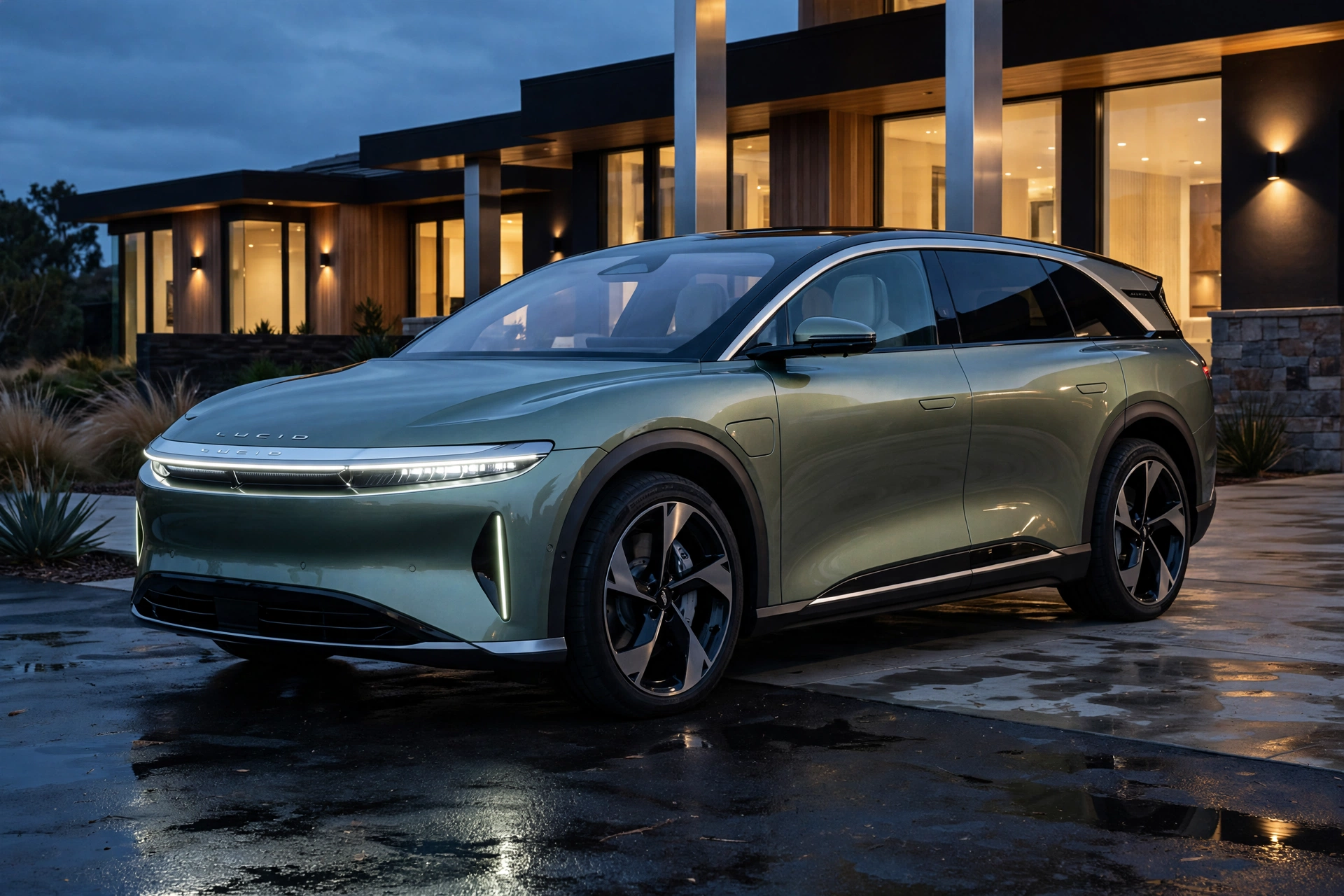
Stand beside one and the proportions take a moment to settle. At 198.2 inches long the Gravity is a substantial object, yet it stands only 65.2 inches tall, stretched over a 119.5-inch wheelbase with a drag coefficient of 0.24 — a figure sports cars used to boast about. The surfacing is calm to the point of restraint: a full-width light bar across the nose, another across the tail, flush handles that present themselves as you approach, and a glass canopy roof that runs nearly the length of the car. In Aurora Green metallic, one of five colours, it has the quiet confidence of a well-cut coat. Nothing shouts. Everything has been considered. In short, this lucid suv looks lower and longer than its rivals.
The range splits into two trims for 2026, with a third that has already passed into collector territory. The Touring starts at $79,900, or $81,550 once the $1,650 destination charge is added: 560 hp, an 89 kWh battery, an EPA rating of 337 miles. The Grand Touring starts at $94,900 ($96,550 delivered) and brings 828 hp, a 123 kWh battery and that 450-mile ceiling. The Dream Edition — 1,070 hp, 373 miles, $139,900 before destination — was a limited launch edition and can no longer be ordered; Lucid has dropped it for 2027 and replaced it with a GT-S at $125,900.
Prices here were checked October 25, 2026, against Lucid’s own configurator, which you can browse on the official Lucid Gravity page. One caution for shoppers: the incoming 2027 Grand Touring rises to $98,900, albeit with more equipment made standard, so a 2026 car in inventory is not a leftover. It is a small bargain wearing last year’s badge.
What makes those range figures possible is not a bigger battery. It is discipline. Lucid’s drive units are famously compact — the company describes a complete motor, inverter and gearbox package small enough to hold in two hands — and that compactness buys cabin space and aerodynamic freedom at the same time. The Grand Touring carries 123 kWh, roughly what rivals carry, yet extracts more miles from each one. Efficiency is an unglamorous word. In an electric car it is the whole game, because every mile squeezed from the battery is a mile you do not have to stop and buy back at a charger.
Lucid SUV range: an efficiency story, checked against the testers
The EPA figures first, since they are the ones on the window sticker. The Touring is rated at 337 miles and 111 MPGe combined. The Grand Touring’s rating depends on how it is specified: between 386 and 450 miles, with the full 450 belonging to the two-row car on 20- and 21-inch all-season tyres, and 108 MPGe in its most efficient form. Wheel choice is not a detail here; it is a decision worth dozens of miles, and Lucid’s own listings at fueleconomy.gov make the spread plain for anyone who cares to compare configurations before signing.
Independent testing tempers the brochure, as it should. Edmunds ran a Grand Touring on all-season tyres — the 450-mile configuration — through its standardised range test and recorded 400 miles, using 35.0 kWh per 100 miles against an EPA estimate nearer 31. On summer performance tyres, a configuration the EPA rates at 407 miles, the same testers recorded 388 miles. Read those results carefully and a pattern emerges: this lucid suv does not quite reach its rosiest number, yet 400 tested miles remains the longest figure any three-row electric SUV has managed in that test, and the shortfall belongs mostly to the tyres. Choose the elegant 22- and 23-inch wheels and you are spending range on appearance. The car will not stop you. It simply keeps the receipt.
Performance, since it would be rude not to mention it: the Grand Touring’s 828 hp and 909 lb-ft of torque deliver a claimed 3.4 seconds to 60 mph, and instrumented testing has recorded 3.3. The Touring, at 560 hp and 4.0 seconds, is not the slow one in any company that matters. Both are dual-motor, all-wheel-drive, and both ride on air suspension that keeps a 6,000-pound vehicle (est.) remarkably level through corners. The speed is real. It is also, for most families who will buy this car, the least interesting thing about it.
Charging the Lucid SUV: 400 kW, a native NACS port, and honest arithmetic
Under the body sits a 900-volt-class electrical architecture — Lucid quotes 924 volts — and it is the reason the charging numbers read the way they do. The Grand Touring accepts up to 400 kW from a DC fast charger, and Lucid claims roughly 200 miles of range returned in under 11 minutes at peak. The Touring peaks at 300 kW and claims 200 miles in about 15 minutes. Peaks are peaks, of course; no battery holds its maximum rate for long. But even allowing for the taper that every fast charge involves, a 10-to-80 percent stop of around 24 minutes (est.) in the Grand Touring is a coffee, not a meal, and that changes how a family plans a long day on the road.
The charge port is the newer NACS design, natively, which means the Gravity plugs straight into Tesla’s Supercharger network — more than 25,000 stalls in North America — without an adapter. At those chargers it draws up to about 220 kW (est., based on published figures for the network’s current hardware), slower than its best CCS performance but fast enough that the distinction rarely matters in practice. For the remaining CCS stations, an adapter restores the full 400 kW ceiling. Few owners will think about any of this after the first month. The car simply charges quickly almost everywhere, and the subject closes.
At home the arithmetic is gentler. A full charge of the Grand Touring’s 123 kWh battery on a typical 11.5 kW wallbox takes roughly 10.7 hours from empty — a number that sounds alarming until you remember that nobody arrives home empty. From the 20 percent most drivers actually plug in at, the car is full well before the alarm clock, adding about 33 miles of range per hour on the cable (est.). At a residential electricity price of $0.16 per kWh (est., close to the current US average), a complete home fill costs $19.68. Hold that figure for a moment. It buys 450 EPA miles.
Inside the Lucid SUV: a 34-inch ribbon of glass and the small things
Open the door — it swings past 90 degrees, a kindness to anyone loading a child seat — and the cabin presents its argument in one sweep. A single 34-inch curved OLED panel arcs across the dashboard, uninterrupted, with a resolution Lucid gives as 6K. It is one piece of glass, not three screens wearing a trench coat, and the difference registers the way the difference between a window and a porthole does. Beneath it sits the smaller Pilot Panel, and beneath that, praise be, a row of physical controls for volume, temperature and fan speed, plus two buttons you may assign as you wish. Someone at Lucid has used a touchscreen with cold fingers and lost patience at the right moment.
The steering wheel is a squircle, flattened top and bottom so the great ribbon of screen reads clearly over it. It is the right shape and the wrong interface: the thumb pads that sweep and slide across its spokes are less satisfying than the beautifully machined rollers of the Air sedan, and on a cold morning they can feel like a small economy made in the wrong place. Edmunds, in its testing, also noted inconsistent fit and finish and driver-assistance behaviour that could feel unrefined — the honest blemishes on an otherwise polished object, and the sort of thing a careful buyer should inspect in person rather than read about. The glass centre console, which slides open at a touch, is the counterweight: a small luxury, repeated daily, that never stops feeling considered.
Materials follow the familiar Lucid pattern of themed interiors. The Touring wears a synthetic leather that is convincing at a glance and honest at a touch. Grand Touring buyers choosing the warmer themes get Nappa leather with a fine, even grain and wood trim whose finish is matte rather than lacquered — the grain is there to be felt, not sealed under gloss. The 22-speaker Surreal Sound Pro system (an option, with Dolby Atmos) is superb in the way good audio is superb: you stop analysing it. And above everything runs the glass canopy, so that rear passengers travel under sky. On a night road in the desert, that roof alone justifies a line item.
Room for people in the Lucid SUV, and for the things people accumulate
The Gravity is a five-seat car as standard and a seven-seat car for a $2,900 option that adds the third row. Adults fit in that third row — not the apologetic, knees-at-chin arrangement the class usually offers, but genuine space that reviewers have repeatedly singled out, helped by second-row seats that slide fore and aft on long rails. Those second-row seats carry another small delight: integrated tray tables that fold out from the seatbacks, airline-style, sturdy enough for a laptop or a child’s full colouring operation, and a small screen of their own for music and climate. Long journeys in the middle row of this car are not an endurance event. They are, quietly, the best seats in it after the driver’s.
Cargo follows the same pattern of generous numbers: 21.3 cubic feet behind the third row, 56.2 behind the second, 111.9 behind the first, and an 8.1-cubic-foot front trunk under the bonnet — roughly 120 cubic feet in total, minivan territory from a vehicle that does not look like one. Lucid even sells a cushion that converts the frunk into a two-person bench, cupholders included, for drive-ins and tailgates. It is a frivolous accessory. It is also the kind of frivolity that suggests the people who designed this car occasionally stop working and go outside.
What this Lucid SUV costs to run, year after year
Electricity first. Using Edmunds’ tested consumption of 35.0 kWh per 100 miles rather than the brochure figure, 12,000 miles a year consumes 4,200 kWh, which at $0.16 per kWh (est.) costs $672 annually (est.). A comparable petrol luxury SUV returning 20 mpg at $3.45 a gallon (est.) spends $2,070 on the same distance. The gap — roughly $1,400 a year (est.) — does not retire anyone, but compounded across a decade of ownership it pays for a great many tray tables. Our guide to what an electric car costs per mile walks through the same arithmetic for smaller cars, and the pattern only sharpens as the vehicles grow.
Servicing is the usual electric story: no oil, no exhaust, brake pads spared by regenerative braking, and a short list of fluids and filters. The honest costs hide in the tyres — a two-and-a-half-tonne vehicle on 22- or 23-inch wheels will not be kind to them — and in the reality that Lucid’s service network remains a young company’s network, thinner on the ground than the German brands’. Anyone weighing the whole picture rather than the fuel line alone should run the numbers through our total cost of ownership calculator, where insurance and depreciation can be given their proper weight. For the broader landscape of what family EVs cost to buy and keep, our survey of EV cars, their range, charging and costs is the wider map.
The Lucid SUV against the Model X, the R1S and the rest
Comparisons clarify, so let us do the one computation the brochures avoid: what each mile of EPA range costs you, at the base price of each car. The Grand Touring works out at $94,900 ÷ 450 = $211 per mile of range. The Touring, $79,900 ÷ 337, is $237. Tesla’s Model X, listed at $99,990 with 352 miles, is $284 per mile — the most expensive range in this company, from the company that taught the industry efficiency. Rivian’s R1S in Dual Max form, at roughly $94,900 (est.) for 410 miles, lands near $231 (est.), though the Rivian will tow 7,700 pounds to the Gravity’s 6,000 and will follow a trail the Lucid should politely decline. Kia’s EV9 undercuts everything here on price, from the mid-$50,000s (est.), and gives back range, pace and material richness in exchange. Cadillac’s Optiq, a class down in size, shows what a legacy badge does with the same electric brief at gentler money.
Scores, then, since a verdict deferred is a verdict dodged. The Tesla Model X — Our score: 7.9/10 (Range 7/10, Charging 8/10, Value 6/10) — remains fast and faintly theatrical, and its cabin, after all these years, still feels like a promise the rest of the car kept better. The Rivian R1S Dual Max — Our score: 8.4/10 (Range 9/10, Charging 7/10, Value 8/10) — is the adventurer’s choice and the better tool for muddy work. Neither of them is the better long-distance family car. On the evidence of range tested rather than range promised, and of a cabin arranged by people who appear to have met a family, the lucid suv takes this class as it stands in October 2026.
Who should buy it — and who should keep looking
Buy the Grand Touring if your life includes regular 300-mile days, children who are growing faster than the car market, and any appreciation for objects made with intent. It renders the Model X, at a higher price with 98 fewer miles of range, very difficult to justify; that is not a close call and we will not pretend otherwise. Buy the Touring if your long days are shorter: it keeps the cabin, the space, the charging architecture and 337 honest miles, and surrenders chiefly horsepower you will use a dozen times a year. The $15,000 between them buys range and speed. For most families, range once a month and speed almost never is a poor trade, and the Touring is the car we would sign for. For a family weighing a lucid suv against its rivals, that combination is hard to ignore.
Keep looking if you tow heavy trailers, if your weekends involve genuine off-roading, or if you live far from the coasts and want a service centre in your own time zone — Lucid’s footprint is growing, but it is not yet a network, and a buyer in the Mountain West should price that inconvenience honestly before falling for the interior. The horsepower theatre of the discontinued Dream Edition, meanwhile, was exactly that: theatre. Its replacement, the GT-S, may prove more convincing, but 1,070 hp in a school-run vehicle is an answer to a question nobody’s children asked.
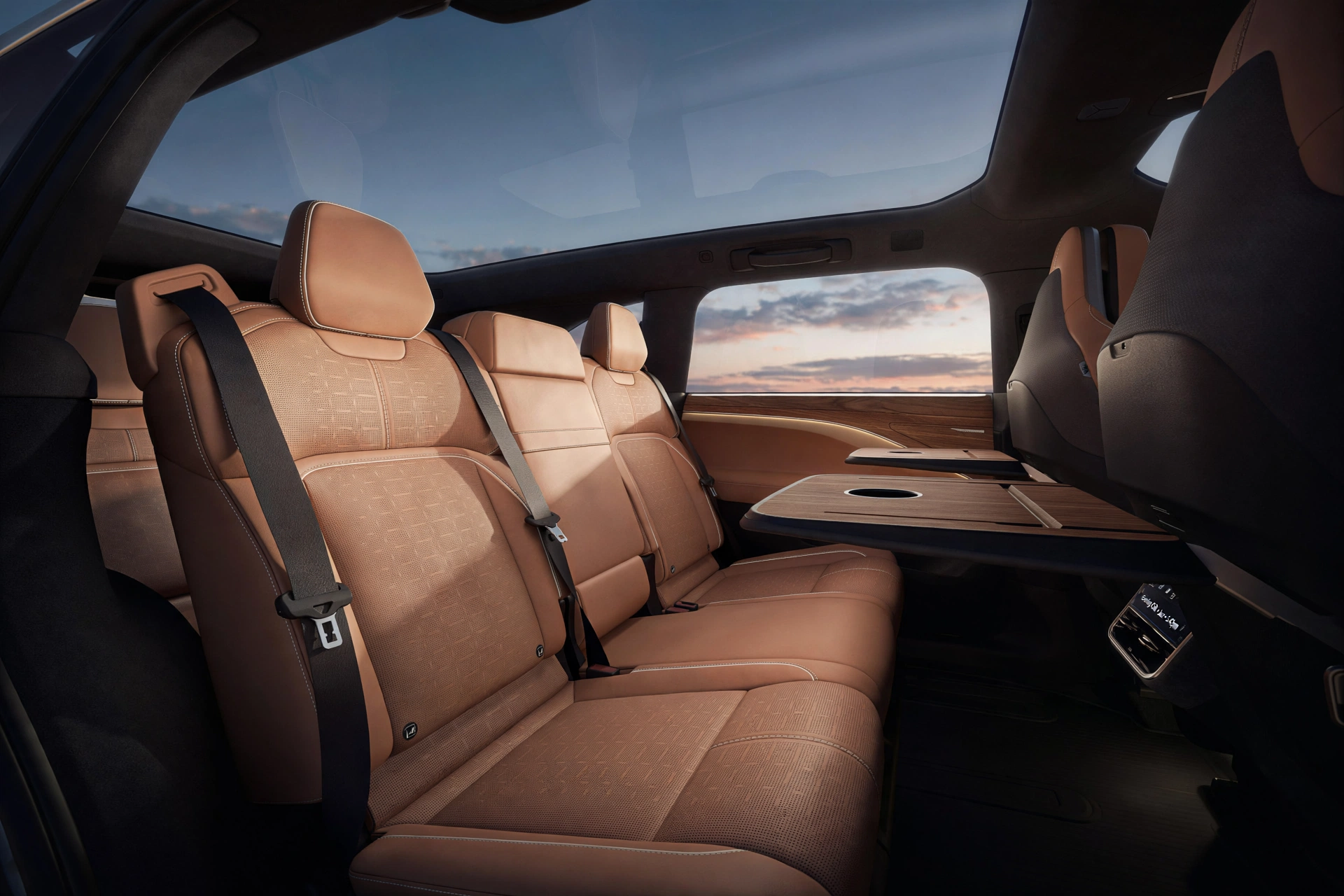
Put together, this lucid suv offers the longest tested range in its class and a cabin that makes long trips easy.
Our verdict on the Lucid SUV
The Lucid Gravity Grand Touring — Our score: 9.1/10 (Range 10/10, Charging 9/10, Value 8/10). The Lucid Gravity Touring — Our score: 8.7/10 (Range 8/10, Charging 9/10, Value 9/10). No other three-row electric SUV currently sold in America goes as far on a charge, charges as quickly, or treats its second-row passengers as first-class citizens. Its flaws — early software roughness in some reports, fit-and-finish that Edmunds found inconsistent, a service network still being built — are the flaws of a young company, and they are real. The car underneath them is the most complete electric family vehicle we have examined this year, and the car itself was named 2026 World Luxury Car of the Year. If your shortlist for a lucid suv began and ended with the usual German and Tesla badges, it is time to rewrite it.
Questions people ask about the Lucid SUV
Is the Lucid SUV actually called the Gravity?
Yes. Gravity is the model’s name; “Lucid SUV” is the description most shoppers search by. It is Lucid’s second vehicle after the Air sedan and, for now, its only SUV, though smaller Lucid crossovers have been announced for later in the decade.
How far does the Grand Touring really go on a charge?
The EPA ceiling is 450 miles for the two-row car on all-season tyres. Edmunds measured 400 miles in its standardised test on that configuration and 388 miles on performance tyres rated at 407. Plan around 380 to 400 miles of mixed driving and you will not be disappointed.
Can it use Tesla Superchargers?
Yes, natively — the Gravity has the NACS port built in, no adapter required, and draws up to roughly 220 kW (est.) at current Supercharger hardware. Its full 400 kW peak needs a high-output CCS station and the supplied adapter.
Does the third row fit adults?
It does, unusually for the class. The $2,900 third-row option seats two adults in genuine comfort for long trips, helped by the sliding second row. With all three rows up you still have 21.3 cubic feet of cargo space, plus the frunk.
What happened to the Dream Edition?
It was a limited launch edition — 1,070 hp, 373 miles, $139,900 — and order books have closed. Lucid dropped it for 2027 and introduced the GT-S at $125,900 with the same 1,070 hp and a projected 373 miles.
What does a full charge cost at home?
About $19.68 for the Grand Touring’s 123 kWh battery at $0.16 per kWh (est.). The Touring’s 89 kWh pack costs roughly $14.24 on the same basis. Both figures assume charging from empty, which in practice almost never happens.