Last updated: October 25, 2026
Stopwatch out. The 2026 Hyundai Ioniq 6 is three cars wearing one badge. A 149-hp commuter that ambles to 60 mph in about 7.4 seconds (est.). A rear-drive sedan Car and Driver timed at 6.2 seconds, with 342 miles of EPA range. And a 641-hp N car that claims 3.2 seconds and hasn’t even reached a US dealer yet. Same slippery shape. Wildly different clocks.
Then there’s the plot twist, and it’s a brutal one. Hyundai discontinued the mainstream Ioniq 6 in the United States in March 2026. Dealers sold 1,348 of them across the first nine months of 2026 as the stock drained away. In September they sold three. Three.
So the 2026 Hyundai Ioniq 6 story in America is a clearance story. The cars left on lots are pre-facelift machines, built in South Korea, wearing final list prices that dealers now have every reason to negotiate down. What’s coming to replace them isn’t a sedan range at all. It’s one limited-run performance car, arriving spring 2027.
This guide runs the numbers that matter. Tested 0-60 times, not brochure times. EPA range against a 75-mph stopwatch. Charge-stop maths. Price per mile of range, Hyundai versus Tesla. And a clear answer on the facelift question, because half the internet is getting it wrong. Short version before the detail: hunt the SE Long Range rear-drive car, haggle like the badge is already dead, and skip the big-wheel trims entirely. The long version follows, with every figure sourced and every price checked October 25, 2026.
The facelift question: what the 2026 Hyundai Ioniq 6 actually is in America
No. That’s the answer. The US car is not the facelift.
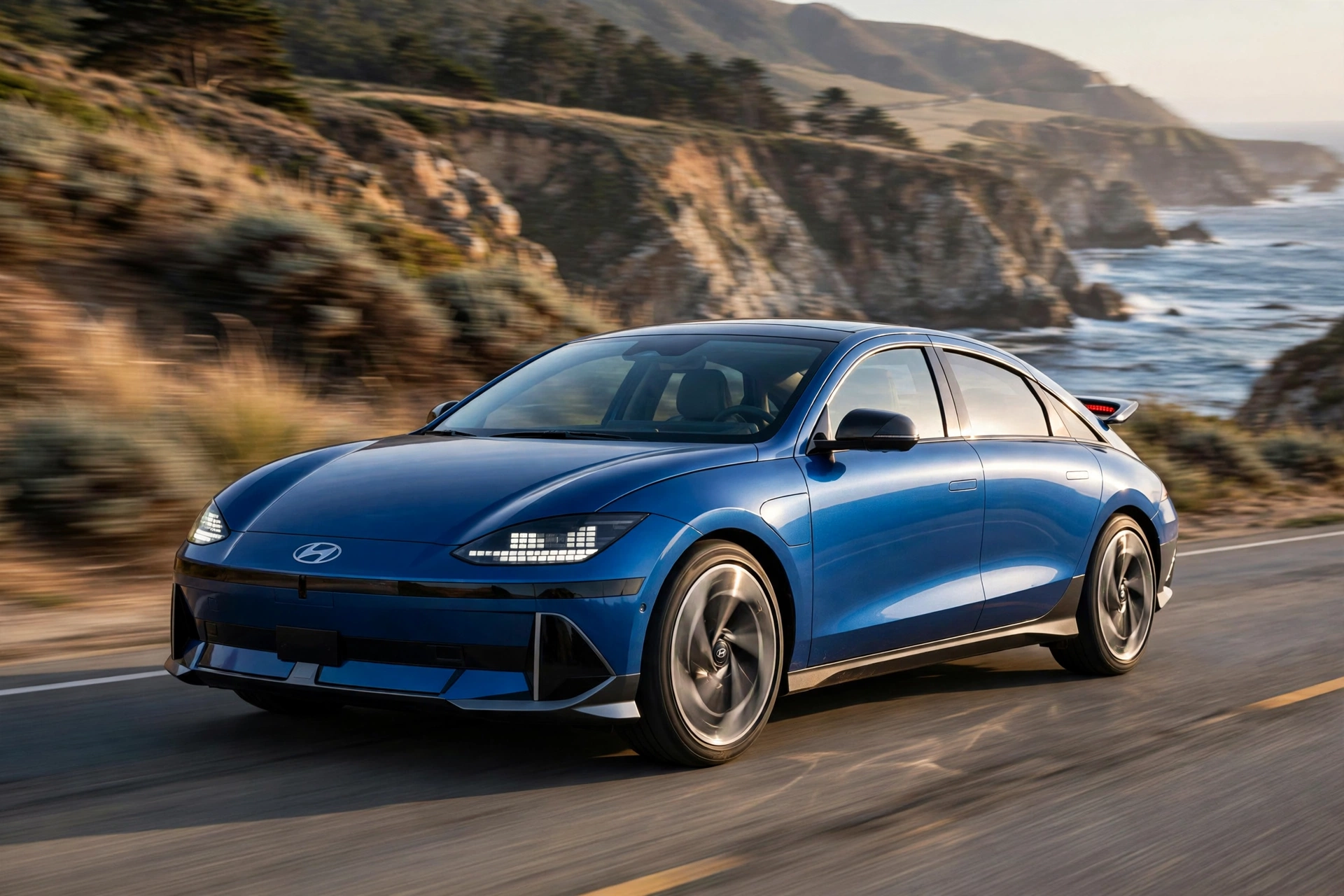
The refreshed Ioniq 6 broke cover at the Seoul Mobility Show in April 2025. Taller, more sculpted hood. Slim horizontal daytime running lights, split away from the main headlights. The old car’s big separate rear wing deleted, replaced by a cleaner extended ducktail. Black cladding stretched up onto the doors. Bigger batteries, too: 63 kWh for the standard car, 84 kWh for the long-range one, up from 53 and 77.4 kWh. Peak charging up to 260 kW. A range claim of up to 680 km on the WLTP cycle. Plus a new N Line trim for people who want the look without the lap times.
That car went on sale in Korea and Europe. Canada gets it for 2027. America does not get it at all. Hyundai USA shelved the standard sedan after the 2025 model year and confirmed the axe in March 2026, blaming nothing in public and everything in the sales ledger: 12,999 US sales in 2023, 12,264 in 2024, 10,478 in 2025. A Korean-built sedan, hit by import tariffs, in a country that buys crossovers. The Ioniq 5 and Ioniq 9 are built in Georgia. The 6 was always the exposed one.
Here’s my take, and it’s not balanced: dropping the car instead of shipping the facelift is a self-inflicted wound. The refresh fixed the old car’s worst feature, that droopy face, and sharpened everything else. American buyers never got the chance to reject the improved car. They rejected the old one, slowly, and Hyundai read that as a verdict on the nameplate.
What remains is simple. A shrinking pool of new-old-stock mainstream cars at dealers. And the N, covered below. If you want the factory’s money in this segment right now, Hyundai has moved it to the crossover side of the showroom, which is why the current Hyundai Ioniq 5 lease deals look so aggressive next to a dead sedan’s window sticker.
2026 Hyundai Ioniq 6 trims, prices and power: the final list
These are the final US list prices before the plug was pulled, checked October 25, 2026. All-wheel drive added about $3,500 where offered, so the AWD prices are marked (est.) on that basis. Destination and dealer discounting will move your real number, and on a discontinued sedan the discounting is the whole game.
| Trim | Price from | Battery | Power | EPA range |
|---|---|---|---|---|
| SE Standard Range | $37,850 | 53 kWh | 149 hp | 240 miles |
| SE Long Range RWD | $42,800 | 77.4 kWh | 225 hp | 342 miles |
| SE Long Range AWD | $46,300 (est.) | 77.4 kWh | 320 hp | 316 miles |
| SEL RWD | $45,600 | 77.4 kWh | 225 hp | 291 miles |
| SEL AWD | $49,100 (est.) | 77.4 kWh | 320 hp | 270 miles |
| Limited RWD | $51,100 | 77.4 kWh | 225 hp | 291 miles |
| Limited AWD | $54,600 (est.) | 77.4 kWh | 320 hp | 270 miles |
Read the range column like a stopwatch reads a lap. The SE on 18-inch wheels is the range car. Step up to the SEL or Limited and their 20-inch wheels hand back 51 miles of range in rear-drive form. Fifty-one miles. Gone. For styling. That is the single most expensive cosmetic choice on the entire price list, and it never shows up on the sticker as a cost.
Every 2026 Hyundai Ioniq 6 carries Hyundai’s 5-year/60,000-mile limited warranty and a 10-year/100,000-mile warranty on the battery and powertrain, with the battery covered if capacity drops below 70 percent. On a discontinued model that coverage matters more than usual, and it’s genuinely strong. The car is orphaned. The warranty isn’t.
Range and charging: the stopwatch runs at the plug, too
EPA numbers first. The SE Long Range RWD’s 342 miles is the headline, the Standard Range car’s 240 miles is the floor, and the full set of ratings lives on the EPA’s listings at fueleconomy.gov. The long-range rear-drive car also posts 25 kWh per 100 miles on the EPA cycle, one of the lowest consumption figures of any car the agency has rated. Aerodynamics did that. A 0.22 drag coefficient, the lowest of any Hyundai, is not a styling statistic. It’s a range statistic.
Now the tested numbers, because labels don’t drive at 75 mph. In Car and Driver’s 75-mph highway range test, the Long Range RWD car ran 260 miles, 82 miles short of its label. The AWD car ran 220 miles. Plan your road trips on the tested figures, not the window sticker, and the Ioniq 6 still covers ground most rivals can’t.
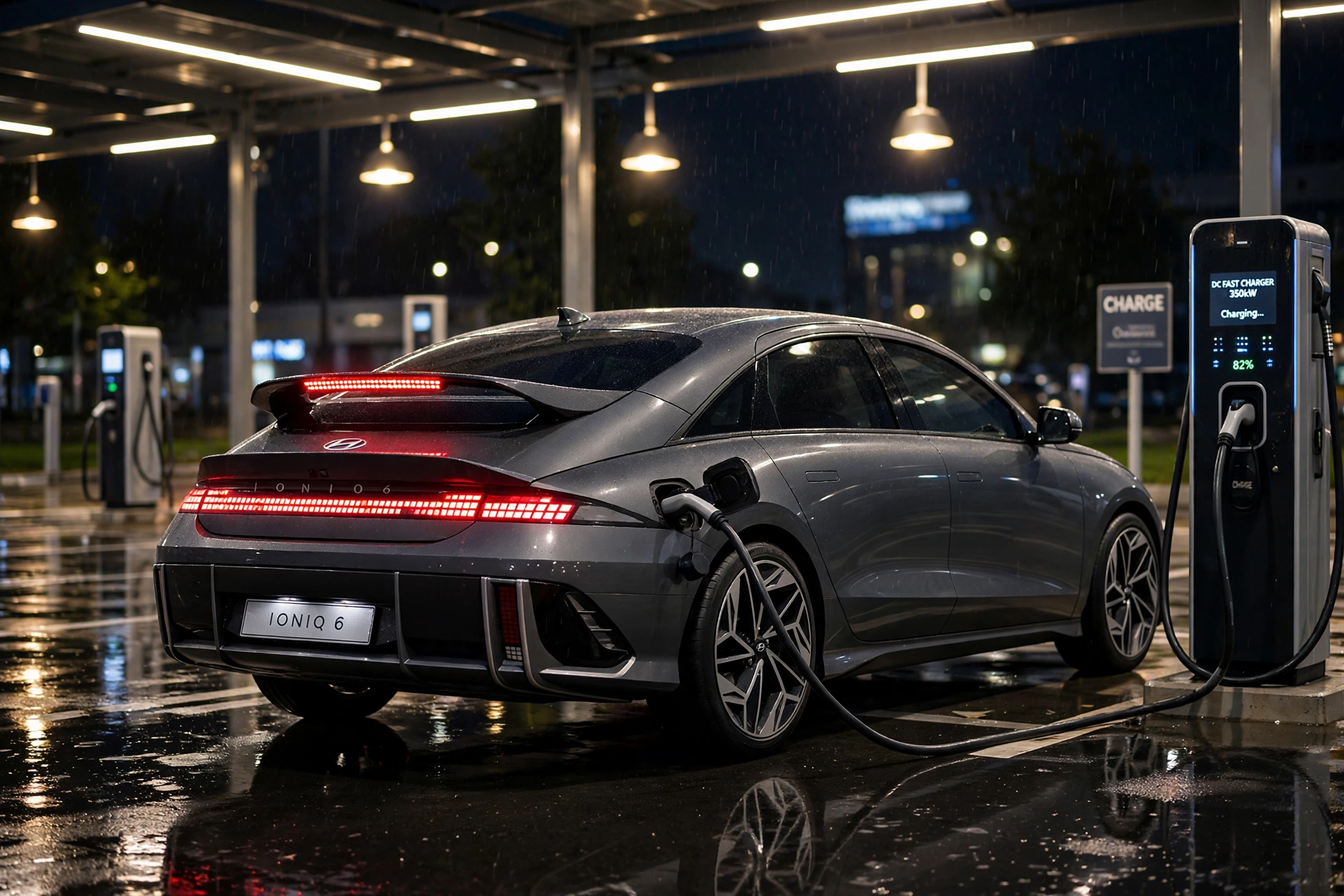
Charging is where this car embarrasses almost everything at its price. The 800-volt architecture peaks at about 239 kW, and Hyundai quotes 10 to 80 percent in 18 minutes on a 350 kW charger. MotorTrend’s yearlong SE Long Range test car charged from 5 to 80 percent in 19 minutes in their hands. Claims and test agreeing within a minute is rare. Savour it.
Do the road-trip maths, because this is our computation and it decides real journeys. Ten to 80 percent of 342 miles is 239 miles of range added in 18 minutes. That’s 13.3 miles per minute plugged in, or roughly 133 miles for every 10 minutes on the cable. The Standard Range car adds about 168 miles in the same 18-minute window, around 93 miles per 10 minutes. No sedan anywhere near $40,000 reloads miles at the SE Long Range’s pace. None.
One port note. Mainstream cars use a CCS port, and Hyundai’s NACS adapter opens up most of Tesla’s Supercharger network, which MotorTrend’s testers used happily on a Seattle-to-LA run. The incoming N skips the adapter entirely, with a native NACS port.
0-60 times: from 7.4 seconds to 3.2, under one badge
The mainstream ladder, tested where tests exist. Standard Range: about 7.4 seconds (est.). Adequate. Nothing more. Long Range RWD: Car and Driver’s stopwatch said 6.2 seconds, MotorTrend’s yearlong car managed 6.0. Long Range AWD: 4.3 seconds, tested, courtesy of 320 hp and 446 lb-ft of torque against the rear-drive car’s 258 lb-ft.
The value play hides in that ladder. The second motor costs roughly $3,500 (est.) and buys back 1.9 seconds to 60 mph against the rear-drive car. As dollars-per-tenth goes, that is the cheapest speed in the whole 2026 Hyundai Ioniq 6 lineup. If your roads are dry and your right foot is patient, the rear-drive car is the range king. If you want the launch, the AWD is priced like a rounding error next to what German brands charge for the same trick.
The N: 641 hp, a swan-neck wing, and a spring 2027 boarding call
Forget the ladder. The Ioniq 6 N burns it. Dual motors, all-wheel drive: 601 hp and 545 lb-ft as standard, and 641 hp with 568 lb-ft when you hold the N Grin Boost button for its 10-second bursts. An 84 kWh battery. Hyundai claims 0-60 mph in 3.2 seconds with launch control, a 160 mph top speed, and 10 to 80 percent charging in about 18 minutes. There’s a simulated eight-speed gearbox with synthesized revs, an N Drift Optimizer, an electronic limited-slip differential, 400 mm-class front brakes, 275/35R21 performance tires, and a swan-neck rear wing you can see from the next county.
The Drive drove a Korea-spec N and rated it more fun than the Corvette E-Ray they stepped out of the same day. The car has already been named 2026 World Performance Car. This is a serious machine, not a trim level.
Now the cold water, all of it labelled. US pricing has not been announced; expect around $70,000 (est., based on the Ioniq 5 N’s $66,200 list and every US report to date). There is no EPA range figure yet; Hyundai quotes 487 km on the WLTP cycle, and a US figure near 240 miles is a reasonable expectation (est.). And the date keeps sliding: Hyundai USA’s own Ioniq 6 N page now reads “Coming Spring 2027 with extremely limited availability at select dealers.” If you want one, your name needs to be on a dealer’s list now, not in spring.
Handling reality: light nose, heavy hips, honest steering
The battery sits in the floor, so the center of gravity sits low, and the car turns flatter than a 4,000-pound sedan has any right to. Even the Standard Range car weighs about 3,950 lb; an AWD Limited is around 4,550 lb. You feel that mass under braking and in quick direction changes. You don’t feel it in a straight line, because the aero is doing silent work.
Regen paddles behind the wheel let you dial one-pedal driving up or down on the move, which is the correct way to build this feature and more brands should copy it. Steering is accurate, light, short on feedback. The ride on 18-inch wheels is composed; on the SEL and Limited’s 20s it turns choppy over broken pavement, which is the second reason the big wheels are a bad trade. First reason was the 51 miles.
The compromises are packaging, not dynamics. The trunk is 11.2 cubic feet with a small opening. Rear headroom is tight for anyone tall, the price of that teardrop roofline. Rear legroom is fine at 34.7 inches. Buy this car for the clock and the charge curve, not for airport runs with four adults and luggage.
Running costs and the Model 3 problem: price per mile of range
Here’s our original analysis, and it’s the table Tesla doesn’t want on a Hyundai page. Take each car’s list price and divide by its EPA range. You get the cost of each mile of range you’re actually buying. Tesla’s prices are from its configurator, checked October 21, 2026, before the $1,640 destination and order fee; Hyundai’s are the final list prices checked October 25, 2026, before destination.
| Car | Price | EPA range | Price per mile of range |
|---|---|---|---|
| Ioniq 6 SE Long Range RWD | $42,800 | 342 miles | $125.15 |
| Ioniq 6 SE Standard Range | $37,850 | 240 miles | $157.71 |
| Ioniq 6 SEL RWD | $45,600 | 291 miles | $156.70 |
| Ioniq 6 Limited RWD | $51,100 | 291 miles | $175.60 |
| Tesla Model 3 Standard | $36,990 | 321 miles | $115.23 |
| Tesla Model 3 Premium RWD | $42,490 | 363 miles | $117.05 |
| Tesla Model 3 Premium AWD | $47,490 | 346 miles | $137.25 |
| Tesla Model 3 Performance | $54,990 | 316 miles | $174.02 |
| Ioniq 6 N | ~$70,000 (est.) | ~240 miles (est.) | ~$291.67 (est.) |
On sticker maths, Tesla wins every rung. The Model 3 Premium RWD undercuts the SE Long Range on price per mile and out-ranges it. Conceded. But stickers aren’t transactions: the Hyundai is a discontinued sedan sitting on lots into a second model year, and the Tesla price is the Tesla price. A four-figure discount on the Hyundai, which is realistic on remaining stock, flips the SE Long Range to about $113 per mile (est.) and wins the table. Negotiation is the Hyundai’s last performance feature, and it’s a good one.
Fuel is nearly free by performance-car standards. At the EPA’s 25 kWh per 100 miles and an assumed $0.17 per kWh home rate (est., US residential average), the Long Range car runs at about $4.25 per 100 miles, and filling its 77.4 kWh battery from empty costs roughly $13 (est.). Run the full ownership picture with our EV total cost of ownership calculator before you sign anything, and cross-check the per-mile maths against our electric car cost per mile breakdown. One more 2026 reality: the federal clean-vehicle credit ended for cars acquired after September 30, 2025, so neither car in that table gets a $7,500 rescue anymore. The discount has to come from the dealer.
Verdict: our scores for the 2026 Hyundai Ioniq 6
SE Long Range RWD — Our score: 8.8/10 (Range 9/10 · Charging 10/10 · Value 9/10). The pick of the entire line. The longest legs, the fastest reload, the sensible wheels. Find one, discount it, drive it for a decade on that battery warranty.
SE Standard Range — Our score: 7.6/10 (Range 6/10 · Charging 9/10 · Value 8/10). The cheap seat. 240 miles and a 7.4-second (est.) sprint make it a commuter, not a road-trip car, but the 18-minute charge window is the same trick the expensive cars do.
Long Range AWD — Our score: 8.2/10 (Range 8/10 · Charging 10/10 · Value 7/10). 4.3 seconds tested is real speed for the money. You pay for it in range: 316 miles at best, 220 tested at 75 mph, and 270 miles if it’s wearing SEL or Limited wheels.
Ioniq 6 N — Our score: 8.4/10 (provisional) (Range 5/10 · Charging 10/10 · Value 6/10). Provisional until a US price and an EPA figure exist. The hardware is a 9. The wait, the scarcity and the estimated $291.67 per mile of range (est.) drag it down. If Hyundai prices it at $65,000 instead of $70,000, this score climbs.
Bottom line from the stopwatch: the mainstream 2026 Hyundai Ioniq 6 is a clearance-rack bargain with a genuinely elite charging curve, and the SE Long Range is the only version worth chasing hard. The N is the future of the badge, a year away and deliberately rare. Our wider EV cars guide shows how the rest of the class stacks up if the Hyundai’s trunk kills the deal for you.
2026 Hyundai Ioniq 6 questions, answered
Is the 2026 Hyundai Ioniq 6 the facelifted model?
Not in the US. The facelift, with its 63 and 84 kWh batteries, ducktail spoiler and N Line trim, sells in Korea and Europe and reaches Canada for 2027. American cars are the pre-facelift design, and the mainstream trims were discontinued in March 2026, leaving remaining dealer stock only.
When can I buy the Ioniq 6 N in the US?
Hyundai USA currently says spring 2027, with extremely limited availability at select dealers. US pricing is unannounced; around $70,000 is the working estimate (est.). There is no EPA range figure yet, against a WLTP quote of 487 km.
How quick is the fastest mainstream version?
The Long Range AWD. Car and Driver tested it at 4.3 seconds to 60 mph, from 320 hp and 446 lb-ft. The rear-drive Long Range tested at 6.2 seconds, and the Standard Range car is the slow one at about 7.4 seconds (est.).
How far does it really go on the highway?
In Car and Driver’s 75-mph test, 260 miles for the Long Range RWD and 220 miles for the AWD, against EPA labels of 342 and up to 316 miles. That’s normal EV behaviour at speed, and the 18-minute charge stop is the car’s real answer to it.
Can the Ioniq 6 use Tesla Superchargers?
Yes, with help. Mainstream cars have a CCS port and use Hyundai’s NACS adapter to access most of the Supercharger network. The Ioniq 6 N arrives with a native NACS port, no adapter needed.
Should I buy one of the last mainstream cars?
Yes, if it’s the SE Long Range and the discount is real. The 10-year/100,000-mile battery warranty outlives the badge’s showroom life, parts support is Hyundai’s legal obligation for years, and the car’s two elite traits, efficiency and charging speed, don’t expire because a trim list did.