Last updated: October 25, 2026
Buying an electric bike for teens starts with a sticker, not a motor. Every legal e-bike sold in the US carries a class label on the frame — Class 1, 2 or 3, with top assisted speed and motor wattage printed on it. That label decides where your teenager may ride, how old they must be, and whether the machine is a bicycle in the eyes of the law or an unregistered motor vehicle. Get it wrong and everything after it — trails, school run, insurance — goes wrong with it.
I ride trails, and I help maintain them, so I will be blunt about why I care: the access fights we are winning — 17,000 miles of trail opened to Class 1 eMTBs in 2025 alone, including 211 miles around Moab from March 2026 — rest on a promise. The promise is that e-bikes are bicycles: capped motors, working pedals, sane speeds. Every overpowered throttle machine handed to a 13-year-old breaks that promise in public, and land managers respond as they always do: they close the gate to everyone.
So this guide works in a fixed order. Law first: classes, age rules, the states that break the pattern. Then power — how much is enough, and the exact line where I stop calling a machine suitable for a teenager. Then sizing, because a bike a teen cannot hold up at a stop sign is the wrong bike at any price. Then three bikes I would put a kid on, with real range, real charge times, and the full first-year cost, arithmetic shown.
My position, stated once and applied throughout: under 16, the ceiling is 20 mph, 500 watts or less, working pedals, and a bike under 50 pounds. For a 16- or 17-year-old with a clean year behind them, Class 3 speed is a conversation — not a default. The shortlist fits inside those lines.
When shopping, remember that an electric bike for teens is a daily transport tool first: it should fit the rider, stop well and charge easily, not just impress on a spec sheet.
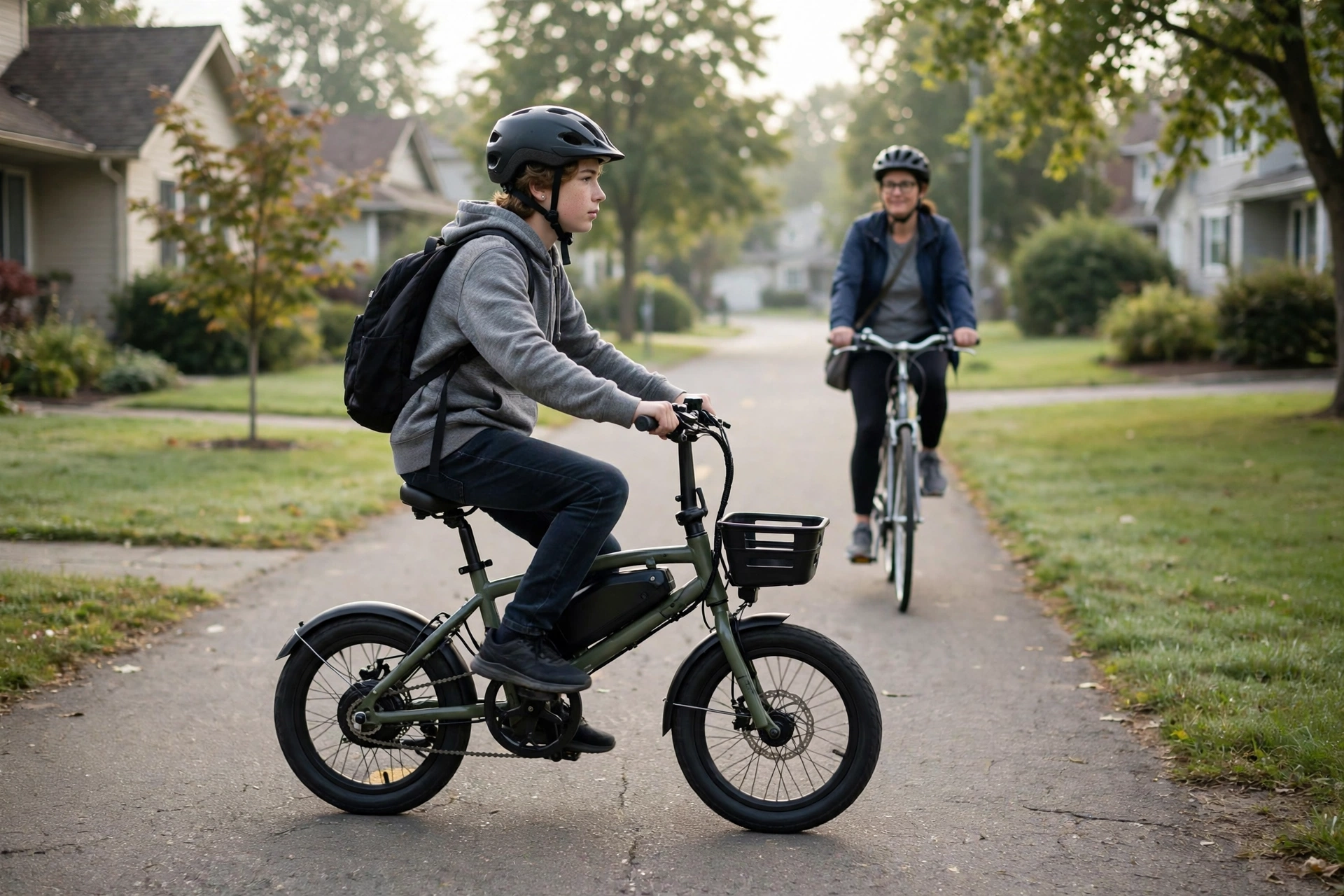
The law first: what makes an electric bike for teens legal to ride
The three-class system is a PeopleForBikes model law that more than 40 states have adopted in some version — their state-by-state e-bike law resources are the fastest check on your own state before spending anything. The classes:
- Class 1: pedal-assist only, no throttle. The motor helps only while the rider pedals and stops at 20 mph.
- Class 2: adds a throttle that can move the bike without pedaling, still capped at 20 mph.
- Class 3: pedal-assist up to 28 mph, with a speedometer. Faster, and regulated like it.
Every class shares one hard cap: under 750 watts. Above that, or above the class speed limits, the machine is not an e-bike in any state using this framework — it is a moped or motorcycle, with registration, licensing and insurance attached. A true e-bike needs none of those three, which is why the class label matters more than any spec on the box.
Ages are where parents get caught out: no federal minimum exists, and most states set no floor for Class 1 and Class 2. Class 3 is different: 16 is the common minimum (California, Colorado, Washington); Texas allows 15, Tennessee and Virginia 14. Then the outliers. Illinois requires 16 for every class; New York and Pennsylvania set 16 for all e-bikes, full stop. New Jersey went furthest in 2026, reclassifying e-bikes as motorized bicycles — license, MVC registration and liability insurance included. The same bike is a plain bicycle in Ohio and a registered vehicle in New Jersey.
Helmets follow the same patchwork. California requires one for every rider under 18 on Class 1 and 2, and for every Class 3 rider at any age; Connecticut, Maryland, West Virginia, Massachusetts and Louisiana require them for all e-bike riders. My family rule is simpler: a teenager on a motor-assisted bike wears a helmet on every ride, because 20 mph on asphalt does not care what the ordinance says.
California rewrote the fine print — expect copies
California’s SB 1271 took effect on January 1, 2025, and closed the cheap end of the market’s favourite loopholes. Class 1 and Class 3 are now strictly pedal-assist, with a walk mode allowed up to 3.7 mph; Class 2 is the only class that may have a real throttle. A bike designed to be modified past the limits — over 750 watts, or over 20 mph on motor power alone — cannot legally be sold as an e-bike at all. From 2026, batteries sold new in California must be certified to UL 2849, EN 15194 or an equivalent.
In April 2026 the Attorney General’s office said the quiet part out loud: anything exceeding those limits is a moped or motorcycle, whatever the retailer’s sticker claims. Enforcement is real — officers can impound a Class 3 bike ridden by someone under 16, and San Diego now bans under-12s from Class 1 and 2 bikes.
Trail access shapes buying decisions too. Class 1 pedal-assist is the only class land managers admit to singletrack, and only where the manager says yes. Throttles are barred on most natural-surface trails; Class 3 is road-and-bike-lane equipment. If your teen’s plan involves dirt, our guide to Class 1 e-bikes and where they can ride covers the access map.
How much power does an electric bike for teens actually need?
Less than the marketing wants you to think. School miles are short and mostly flat, and a 250 to 500 watt motor moves a 120-pound rider up any hill they should be riding, at speeds a developing brain can process. Torque matters more than the headline watt number: 28 Nm feels gentle, 45 Nm pulls away from lights cleanly, 61 Nm is genuinely strong. All three are on the shortlist below, and all three are enough.
Weight is the spec nobody advertises. A 49-pound bike is one a teen can lift onto a bus rack, carry up two steps, and — trail rider talking — pick up off their own leg after a slow tip-over. The popular 750-watt fat-tire machines weigh 65 to 77 pounds — and are the wrong answer for most teenagers for the same reason: mass and power solving problems a teen does not have. An adult struggles with that weight. A 110-pound fourteen-year-old has no chance, and a bike that cannot be muscled around gets dropped more and ridden less.
My hard line, and I do not move it: no working pedals, not a bicycle. More than 28 mph on motor power, not a bicycle. Weighs as much as the kid riding it, wrong tool. An electric bike for teens should still ride like a bike when the battery dies — pedals that work, gears that shift, brakes sized for the speed. Fail those tests and you are shopping for a motorcycle, which brings its own rules, training and licensing for good reason.
The Sur-Ron problem, stated plainly
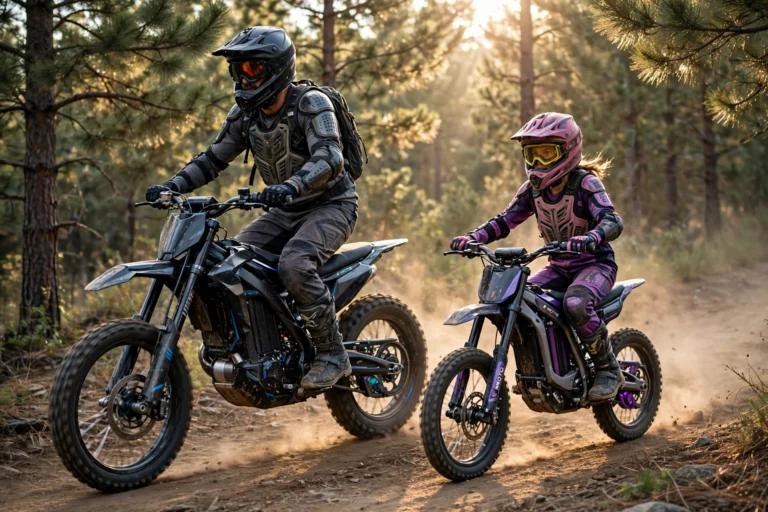
Now the machine your teenager actually wants. A Sur-Ron Light Bee X is a small electric motorcycle: around 8,000 watts of peak power, 47 mph, 126 pounds, a 60V 40Ah battery — and pegs where the pedals should be. US dealers list it at about $4,000 (checked October 25, 2026), sold for private land and OHV areas. It is street legal nowhere in the US in stock form. California’s SB 586 created an “eMoto” classification for such machines from January 1, 2026 — that classifies them; it does not legalize them for streets, paths or trails.
I have watched this play out at trailheads I ride. A kid on a Light Bee meets hikers on a path where motor vehicles are banned, somebody films it, and the next access meeting is about closing that trail to every e-bike — including the legal Class 1 bikes that took a decade to win admission. The rider is in legal trouble too: citations for an unregistered, uninsured motor vehicle, possible impound, parental liability if someone gets hurt.
If your family wants one, buy it as what it is — an off-road motorcycle for OHV parks and private land, with motorcycle gear and motorcycle supervision. Our rundown of e-bike dirt machines and where they belong draws that boundary model by model. What you must not do is hand it to a teenager as a school-run vehicle. That is the single worst purchase in this category, and “he’s a good kid” changes neither the physics nor the statute.
Sizing an electric bike for teens: standover, reach and growing room
Fit decides control. Three checks, all with the actual rider standing over the actual bike:
- Standover: the rider straddles the top tube, both feet flat, with at least an inch of clearance — two is better for a rider still growing into their coordination.
- Seat height: a slight knee bend at the bottom of the pedal stroke; tiptoe at stops is fine, one tiptoe with a lean is not.
- The lift test: the rider picks the bike up off the ground, fully. If they can’t, it’s too heavy. No exceptions for a “great deal.”
The numbers show why the shortlist looks the way it does. The XP Lite 2.0 fits riders from 4’8″ to 6’2″ with a low 22-inch standover — right for a young teen now, still right after a growth spurt. The Soltera 2.5’s small frame starts at 5’1″ with a 29 to 31-inch standover: a tall-teens bike, not a middle-school bike. Buy for the rider in front of you this spring; a frame that is too big today is a crash looking for a date.
The shortlist: three picks, no filler
Three bikes, three jobs. All prices checked October 25, 2026. All three carry UL 2849 certification for the whole electrical system — not just a certified battery in an uncertified bike.
Lectric XP Lite 2.0 — the default buy for ages 12 to 15
$799 with the standard battery, $899 with the long-range pack. A 49-pound folding bike with a gentle 300-watt motor (819 watts peak, 28 Nm), hydraulic disc brakes on 180mm rotors, and a Class 1/2 setup capped at 20 mph. Lectric claims 45 miles from the 374Wh standard battery and 80 from the 672Wh long-range one; in real teen use — throttle-happy, stop-start, backpack aboard — plan on 25 to 32 and 45 to 55 respectively (est.). Charging takes roughly four hours from flat (est.).
It folds to 36 × 16 × 27 inches, ships with a lock and headlight in the box, and its battery is UL 2271 certified inside a UL 2849 system. The honest trade is the single-speed drivetrain: flat-to-rolling terrain only. On a steep hill your teen will walk — in a first e-bike I count that as a feature. Full specs are on Lectric’s XP Lite 2.0 product page.
Our score: 8.6/10 (Range 7/10 · Charging 8/10 · Value 10/10)
Aventon Soltera 2.5 — the one that rides like a real bicycle
$1,199 at list, already seen at $999 in Aventon’s own sales this year. A Class 2 road bike in the proper sense: 46 pounds, a 350-watt motor (540 watts peak) driven by a torque sensor, so the harder your teen pedals the harder it helps — the exact habit to build before anything faster. The 345.6Wh battery is claimed at up to 46 miles; expect 25 to 35 of real use (est.), with a 4 to 5 hour charge.
Shimano 7-speed gearing, Tektro hydraulic brakes, turn signals, and sized frames for riders 5’1″ and up. Fenders are a $69.99 extra; buy them — a school run in the rain without fenders ends with a stripe up the back. The pick for the older teen covering real pavement miles who wants a bike, not an appliance.
Our score: 8.4/10 (Range 7/10 · Charging 7/10 · Value 8/10)
Lectric XPress Lite — for the 16-year-old, with the speed locked down
$1,099. A full-size commuter on 27.5-inch wheels: 500-watt motor with 61 Nm of torque, a 374Wh battery claimed at up to 45 miles (plan on 24 to 33, est.), hydraulic brakes, 8-speed Shimano Altus gearing, and switchable torque/cadence sensors.
It can be configured as Class 1, 2 or 3 — which is precisely why it comes with a parental condition. It stays in Class 2 mode, capped at 20 mph, until the rider is 16, legal for Class 3 in your state, and has a clean year behind them. Set up that way it is a good older-teen bike with room to grow into. Set up any other way for a younger kid, it is a loophole on two wheels, and California-style laws are being written specifically about it.
Our score: 8.2/10 (Range 7/10 · Charging 8/10 · Value 8/10)
Range and charging reality for an electric bike for teens
Claimed range is measured by a light rider, on flat ground, at low assist, in warm weather. Your teenager is none of those conditions. Cut every claim by a third and you will be close; our cost-to-charge guide uses the same derating method. On the shortlist, a school week of 3 to 6 mile round trips fits inside one or two charges.
Charge times run 4 to 5 hours from flat on all three picks: plug in after dinner, unplug before bed. Charging is a supervised, awake-hours activity, done with the charger that came in the box. The XP Lite and Soltera batteries come off the bike to charge indoors in winter; cold packs deliver less range and hate being charged below freezing. A route that is easy in October can be marginal in January — the fix is charging more often, not riding the last mile on a dying pack at dusk.
Real-world testing matters for an electric bike for teens, because claimed range rarely matches a school run with a backpack, hills and cold weather.
Gear, locks and battery safety: the non-negotiables
Helmet. MIPS or equivalent rotational protection, fitted level so it does not rock. Budget $55 to $100 (est.); replace it after any crash, even one that leaves no mark — the foam does its job once. Where the law mandates helmets for teens, treat compliance as the floor, not the goal.
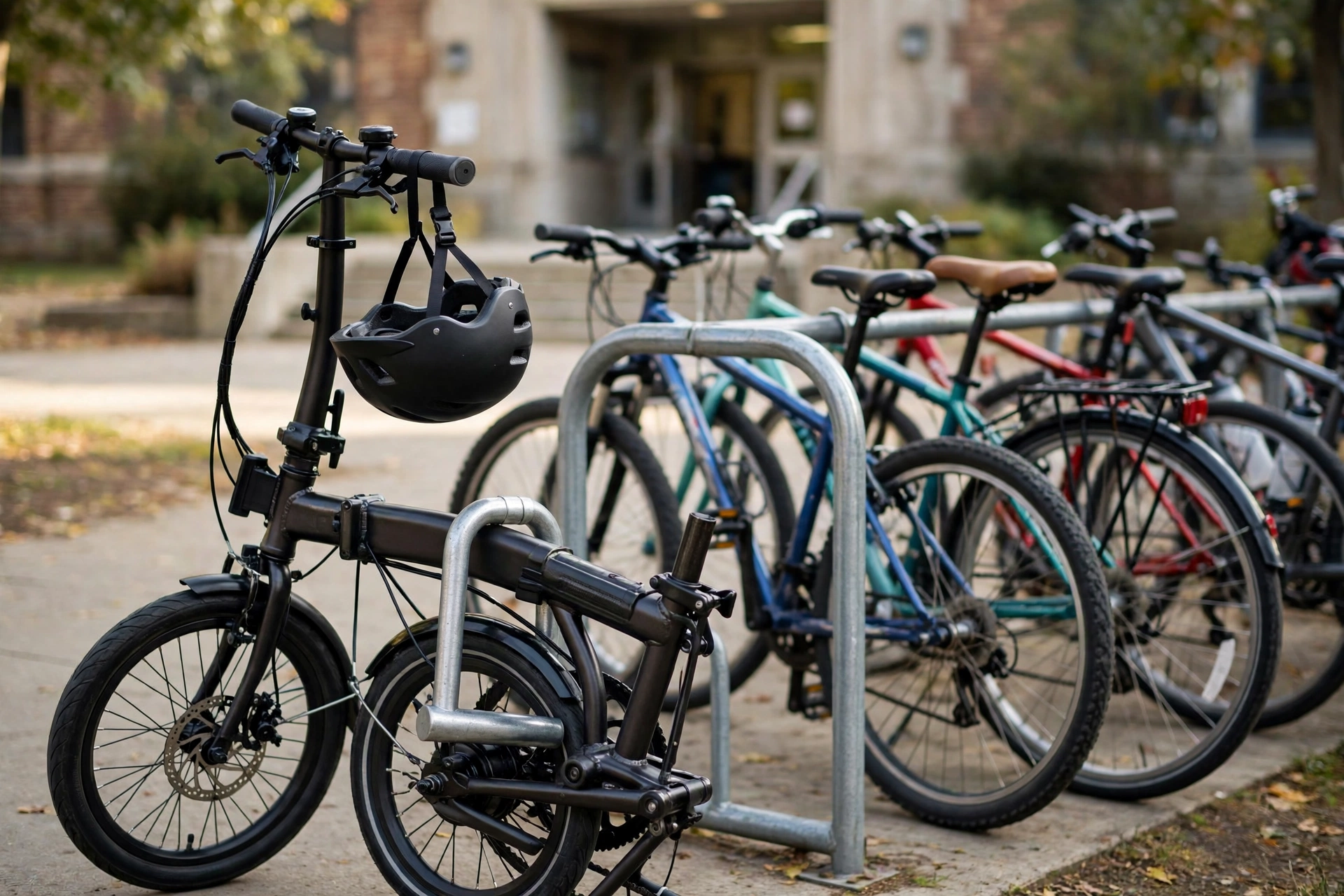
Lock. A school rack is a thief’s showroom, and the cable lock bundled free with half the bikes in this price class is decoration — it snips in seconds. Buy a hardened U-lock with a 14mm shackle (Kryptonite Evolution class, roughly $95, est.), lock frame and rear wheel to a fixed rack; take the battery in if the bike sits outside all day. The XP Lite folds, opening the best option of all: ask the school about indoor storage and skip the rack entirely.
Battery safety. UL 2271 certifies the battery pack alone; UL 2849 certifies the whole system — battery, charger, controller — as one tested unit. California now requires certified batteries for new sales, and every bike on the shortlist carries UL 2849. Three household rules follow: charge on a hard surface away from bedding and exits, never with a random replacement charger, and never buy a no-name spare pack off a marketplace listing. A cheap uncertified battery is the one purchase in this guide that can hurt your family while everyone is asleep.
What the first year of an electric bike for teens actually costs
Sticker price is not the cost of an electric bike for teens; the honest number is bike plus gear plus a year of running. Here is our computation, assumptions on the table: 1,200 miles in the first year (est. — a 6-mile school round trip across a school year, plus weekends), electricity at $0.18 per kWh (est.), and about 15 watt-hours per mile from the wall, charger losses included. That electricity line is 1,200 × 15 Wh = 18 kWh — roughly $3.24 for the entire year. Charging is a rounding error. The gear is not.
| First-year cost | Lectric XP Lite 2.0 | Aventon Soltera 2.5 | Lectric XPress Lite |
|---|---|---|---|
| Bike | $799 | $1,199 | $1,099 |
| MIPS helmet (est.) | $75 | $75 | $75 |
| Hardened U-lock (est.) | $95 | $95 | $95 |
| Fenders | Included (long-range) | $70 | Optional |
| Electricity, 1,200 miles | $3 | $3 | $3 |
| Pads, tire, tune (est.) | $120 | $120 | $120 |
| License, registration, insurance | $0 | $0 | $0 |
| Year-one total | $1,092 | $1,562 | $1,392 |
That is $0.91 per mile for the XP Lite in year one, collapsing to about $0.10 per mile from year two, when only consumables and electricity repeat. The registration line reads $0 because a legal e-bike in a three-class state needs none of the three; New Jersey families are the exception after 2026. The alternative outside this guide: a $4,000 Sur-Ron plus one impound-and-tow episode ($300 or more, est.) buys a machine your teen still cannot legally ride to school. The boring bikes win the spreadsheet as well as the statute book.
Verdict: buy the class label, not the spec sheet
Ages 12 to 15: buy the Lectric XP Lite 2.0, and spend part of the savings on the U-lock and helmet the purchase actually requires. Taller teens riding real pavement miles: the Aventon Soltera 2.5 earns its extra $400. A 16-year-old with experience who needs full-size wheels: the XPress Lite, locked to Class 2 until they have earned more. Notice what none of these picks is: the fastest, the most powerful, or the one from the video your kid sent you. An electric bike for teens is transportation and training wheels for judgment at once. Buy the one that teaches the judgment.
For a first purchase, an electric bike for teens that is light, legal and easy to charge will get ridden far more than a faster, heavier machine.
FAQ
What is the best electric bike for teens under $1,000?
The Lectric XP Lite 2.0 at $799 (checked October 25, 2026): 49 pounds, capped at 20 mph, UL 2849 certified, fits riders from 4’8″. The $899 long-range version doubles the battery. Add roughly $170 for a MIPS helmet and U-lock and the full setup still lands under $1,000.
How old does a teenager have to be to ride an e-bike?
Class and state decide it. Most states set no minimum for Class 1 and Class 2; Class 3 usually requires 16 (15 in Texas, 14 in Tennessee and Virginia). Illinois, New York and Pennsylvania require 16 for every class, and some cities add their own rules — check before buying.
Is a Sur-Ron legal for a teenager to ride on bike paths or to school?
No. A Sur-Ron Light Bee has no pedals and roughly 8,000 watts of peak power — an off-road motorcycle in every state’s framework, not an e-bike. On paths, streets and sidewalks it is an unregistered, uninsured motor vehicle: expect a citation, a possible impound, and parental liability if someone gets hurt. It belongs on private land and in OHV areas.
How far will a teen’s e-bike really go on one charge?
Cut the claimed figure by a third. On the shortlist: 25 to 32 miles from the XP Lite’s standard battery, 25 to 35 from the Soltera 2.5, 24 to 33 from the XPress Lite (all est.). Cold, hills, high assist and a heavy backpack pull them down further.
Does an electric bike for teens need a license, registration or insurance?
In the 40-plus states using the three-class system, no — a labeled Class 1, 2 or 3 e-bike is legally a bicycle. New Jersey is the exception after its 2026 reclassification. And once a bike exceeds the class limits — over 750 watts, or over the class speed — it stops being an e-bike everywhere, and motor-vehicle rules apply in full.