Last updated: October 25, 2026
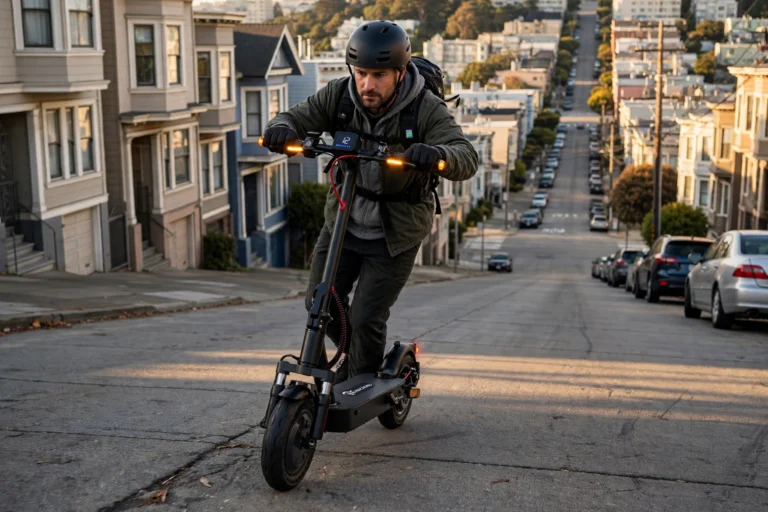
Start with the correction, because it decides everything else in this guide: there is no dual-motor roinside electric scooter. Not a hidden one, not a flagship one, not one quietly listed under a different model code. Every machine this brand sells — and it sells almost entirely through Amazon — runs a single hub motor of 350 or 500 watts. If an advert, a listing title or a well-meaning friend sent you hunting for a 45 mph dual-drive Roinside, that machine does not exist, and any page implying otherwise is trying to sell you a different brand’s hardware with borrowed search terms.
What Roinside actually builds is more modest, and in one case more interesting than the fantasy version. The range splits into light stand-up commuters — the UP6, UP8 and UP12 — and two seated machines, the SUP10 and the SUP20. The SUP20 carries a 48V 22.5Ah battery, 1,080 watt-hours, a figure that would not embarrass scooters costing three times as much. Prices checked October 25, 2026: about $180 (est.) for the UP6 and about $333 (est.) for the SUP20 on Amazon, with the rest of the range in between, and prices at this end of the market move weekly.
I judge scooters by stopping distances and suspension hardware, because those are the components that decide whether a mistake becomes a funny story or an injury. By that standard this lineup is uneven. The stand-up models stop with one mechanical disc brake assisted by motor braking, roll on solid tyres that can never puncture and can never grip like air-filled ones, and hang what the listings call suspension on small steel springs. The base UP6 has no suspension at all. None of this is hidden. All of it is dressed in adjectives.
None of it makes these bad purchases. It makes them specific purchases, for flat cities, short hops and riders who understand what a single 350W motor can and cannot do. Read the range maths before you read the range claims. Count brake rotors instead of brake adjectives. Do that, and one model in this range earns a genuine recommendation. Here is the whole lineup, decoded.
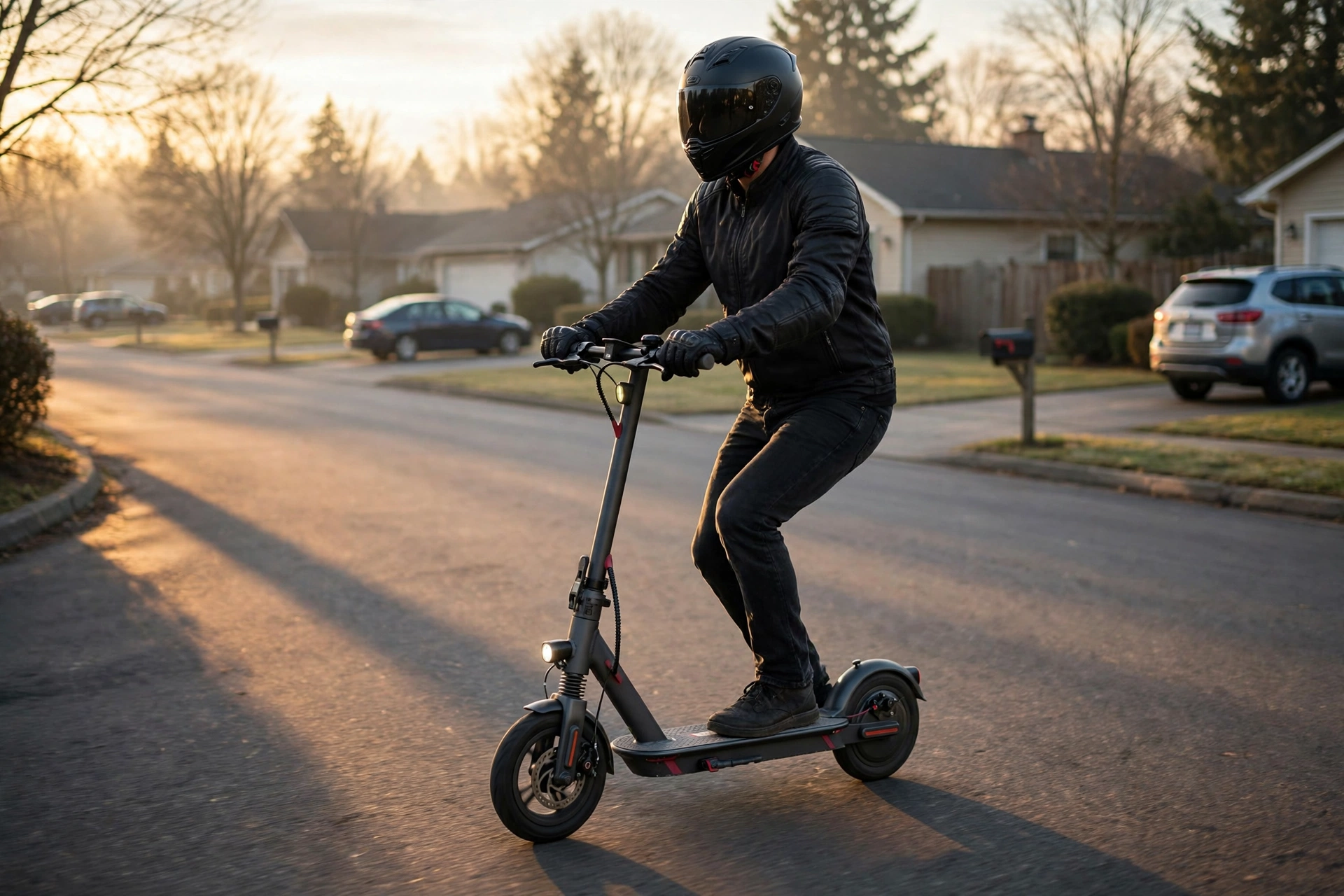
The roinside electric scooter lineup, decoded
Roinside is an Amazon-first brand; the manufacturer named on the listings is Ming Liu Hui Technology Co., Ltd. There is no meaningful dealer network and no showroom. What you get instead is high sales volume — the main UP6 listing reports 800+ bought in a recent month — a 12-month limited warranty, app control on every model, and UL2272 electrical certification across the range, with an Intertek certificate number printed on at least one listing. That certification matters. It is the one line in the marketing I never argue with.
| Model | Motor | Battery | Claimed speed | Claimed range | Tyres | Suspension | Weight |
|---|---|---|---|---|---|---|---|
| UP6 | 350W single hub | 36V, 289–323Wh (listings disagree) | 19 mph | Up to 21 miles | 8.5in solid | None | 24–28 lbs (listings disagree) |
| UP8 | 350W single hub | 36V (capacity not consistently published) | 19 mph | 15 miles | 8.5in solid | Dual springs | 26 lbs |
| UP12 | 350W (500W variants listed) | 36V class | 22 mph | 24 miles | 10in solid | Dual springs | Not consistently published |
| SUP10 | 500W single hub | 48V 10.4Ah, 499Wh | 22 mph | 27 miles | Seated format, basket fitted | Rigid | Not consistently published |
| SUP20 | 500W single hub | 48V 22.5Ah, 1,080Wh | 22 mph | 62 miles | 14in pneumatic | Rigid — tyre volume does the work | 43 lbs package weight |
Every roinside electric scooter in the range carries a 265 lb maximum rider weight, folds at the stem, and offers cruise control and an app-based lock. Treat the inconsistencies in that table as data, not typos: when a brand publishes two different battery sizes for the same scooter on the same page, believe the smaller number and price the machine accordingly. The UP6 is the volume seller, a 19 mph last-mile tool. The UP8 adds springs and loses range on paper. The UP12 stretches to 10-inch wheels and a 22 mph claim. The SUP pair sit you down, add a basket, and — in the SUP20’s case — bolt on the biggest battery in the budget class.
One motor, honestly assessed: power and the dual-motor question
A 350W hub motor is a known quantity. On flat ground with a rider under 200 lbs it holds 17–19 mph without drama, accelerates gently, and asks nothing of you. Add weight or gradient and the maths turns. Load any roinside electric scooter to its 265 lb limit and speed on a modest 5% grade sags into single digits (est., based on the motor’s power-to-weight ratio); one piece of coverage for the cheapest Roinside repeats a listing claim of climbing 25% inclines, which is a laboratory number — a 350W scooter carrying an adult up a true 25% grade is not a thing physics permits for more than a few metres. Plan your route around hills, not through them.
The 500W models are the better tool for rolling terrain. Independent review coverage of the SUP20 describes a deliberately calm throttle map, a working sweet spot of 12–18 mph, and enough reserve to hold 22 mph briefly on the flat. That tuning is correct for a seated commuter. Explosive launches on a folding stem are a defect, not a feature.
So what does a second motor actually buy, in the machines that have one? Traction on loose climbs, torque that does not fade with rider weight, and redundancy if one drive unit fails. Our Kaabo King GTR guide covers that class properly. At 19–22 mph on tarmac, a second motor buys you almost nothing except kilograms. My position, stated plainly: at commuter speeds, spend the money on brakes, tyres and a real helmet before you spend it on a second motor. Roinside’s single motors are not the weak point of these scooters. The weak points are further down this page.
Real-world range for a roinside electric scooter, derated properly
Range claims are manufactured from a simple recipe: take the battery’s watt-hours, divide by the consumption of a light rider at a steady low speed, print the result. Run the recipe backwards and the claims confess themselves. The UP6’s 323Wh pack and 21-mile claim imply 15.4 Wh per mile — achievable at around 12 mph in Eco mode with a light rider, and irrelevant to an adult commuting at full speed.
Adult mixed riding on a small-wheeled scooter consumes roughly 20–25 Wh per mile. So: 323 ÷ 22 ≈ 14.7 miles. Plan on 13–15 miles (est.) from a UP6, less in winter, less again if you are near the weight limit. Aggregated Amazon owner reports for the UP6 cluster around 18–21 miles, but those skew towards lighter riders on flat routes — owner-reported, not tested, and I weight them accordingly.
The SUP20 is the same trick at a bigger scale, with a bigger battery to absorb it. Its 62-mile claim implies 17.4 Wh per mile from the 1,080Wh pack, a seated eco-cruise figure. At a realistic mixed-use 25 Wh per mile, 1,080 ÷ 25 ≈ 43 miles; at 28 Wh per mile, about 39. Plan on 38–45 miles (est.) — still the longest-legged budget scooter in this guide by a wide margin. The SUP10’s 499Wh and 27-mile claim split the difference: plan on 20–23 miles (est.).
Now price the honesty. Cost per mile of realistic range: the UP6 at about $180 (est.) ÷ 14 miles ≈ $12.90 per mile. The SUP20 at about $333 (est.) ÷ 41 miles ≈ $8.10 per mile — the cheapest genuine range in the class. Compare the benchmark: Segway’s Ninebot Max G30P, covered in our Segway Ninebot Max G30P guide, claims 40.4 miles from 551Wh and returns about 24 miles in aggregated rider reports — roughly 63% of claim, the same derating pattern as Roinside’s.
At tracked street prices around $799 (est.), that is about $33 per realistic mile. You are not paying Segway for miles. You are paying for build consistency, a published IPX5 rating and parts that exist. Whether that trade suits you is a budget question, not a performance one.
Braking: count rotors, not adjectives
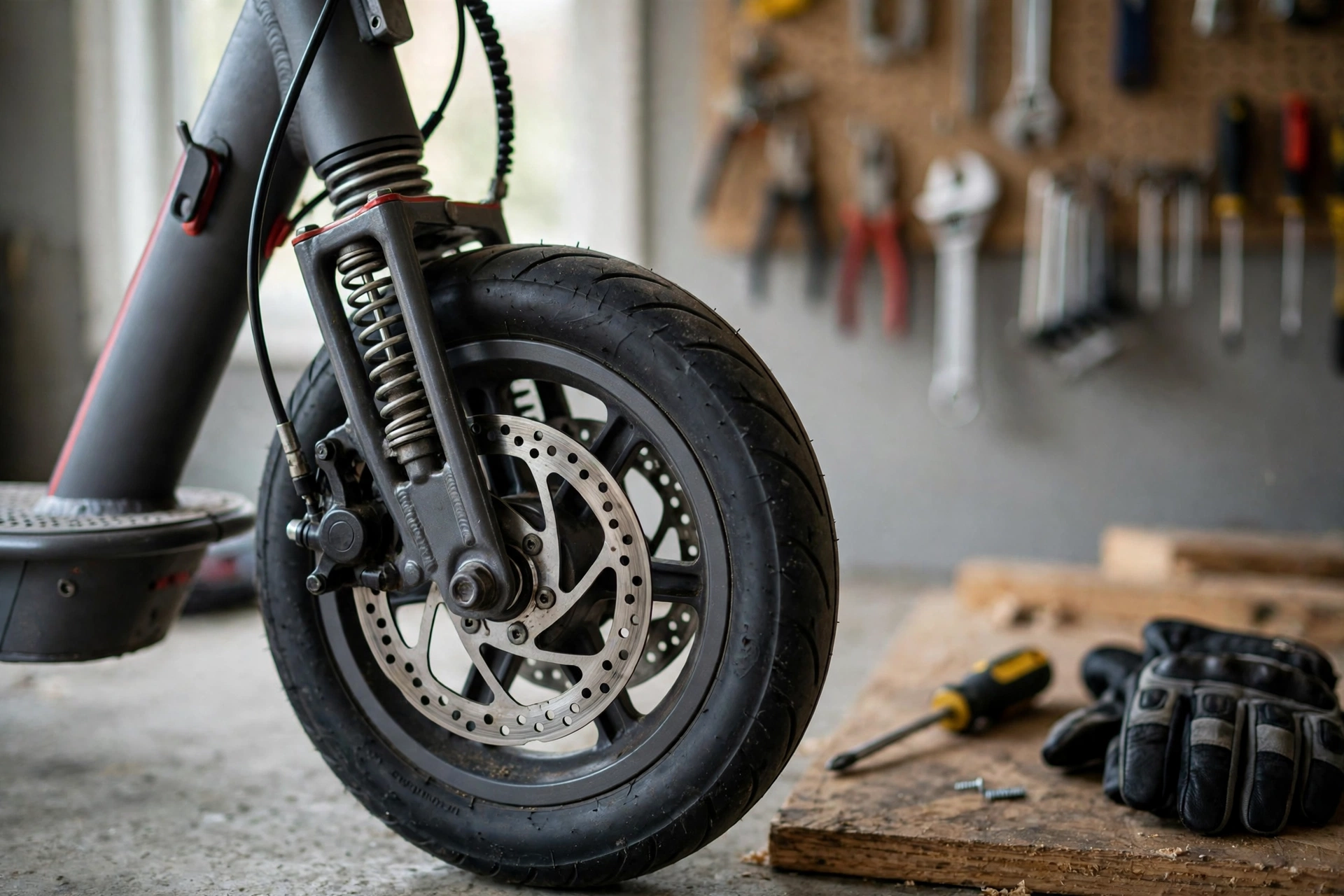
Every roinside electric scooter listing leads with “dual braking system.” Here is what the phrase means in hardware: one mechanical disc brake, plus EABS — regenerative braking from the hub motor, triggered by the same lever. Two mechanisms, one rotor. It is not a second brake.
Regenerative braking is genuinely useful at trimming speed on gentle descents, and it returns a small amount of charge. It acts on one wheel only, its strength depends on the battery’s ability to accept charge — a nearly full battery cannot absorb much, so regen is weakest at the top of the first hill of the day — and if the electronics fault, it vanishes entirely while the disc remains.
Do the stopping maths. From 19 mph, a scooter on small solid tyres managing a realistic 0.35g deceleration needs about 34 feet to stop; at an optimistic 0.5g, about 24 feet (est., computed from v²/2a, reaction distance excluded). A pneumatic tyre’s larger, deformable contact patch is how you get closer to the second number. Solid tyres trade that grip away for puncture immunity, and the trade is worst exactly when you need grip most: wet paint, wet leaves, wet metal covers.
In the rain, on these tyres, double your following distance or do not ride. ScooterPick’s review of the SUP20 flags a related honesty problem — the brand’s own copy is inconsistent about whether that model carries one disc or two — and advises buyers to verify the hardware on delivery. Correct advice, for every model in this range.
Maintenance is the part of braking nobody markets. A cable disc brake is simple and fixable: check pad wear monthly, keep the cable tensioned so the lever does not reach the bar, and replace pads in pairs for a few dollars — generic pads fit, which is one quiet advantage of commodity hardware. If the lever feel changes suddenly, stop riding and find out why. Brakes are not a consumable you stretch.
Suspension and tyres: springs are not shocks
The UP6 has no suspension. The road goes into the solid tyres, the solid tyres pass it to the deck, the deck passes it to your ankles. On smooth tarmac at 15 mph this is tolerable. On broken pavement it is fatiguing and, at the front wheel, a control issue: a wheel that is bouncing is a wheel that is not steering or braking.
The UP8 and UP12 add small steel springs at the wheels, marketed on the UP12 as “quadruple shock absorption” — four springs, in plain language, with no damping. A spring without a damper stores energy and returns it; it softens the first hit and adds a bounce after it. Better than nothing over kerb lips and expansion joints, worse than the marketing, and not comparable to the hydraulic or quality spring setups on mid-range scooters. Keep your knees bent and your speed honest on rough surfaces; you are the second stage of the suspension system.
The SUP20 takes the correct budget route: no suspension at all, and 14-inch pneumatic tyres whose air volume does the work properly. ScooterPick’s ride assessment credits those tyres with the model’s straight tracking and calm over seams, and notes the corollary — tyre pressure is now your suspension adjustment, so check it monthly and run it mid-range. This is the only Roinside where comfort and grip are engineered rather than advertised, and it is not a coincidence that it is also the only one I score above 7.
Build quality, parts and the Amazon ownership reality
The bones of a roinside electric scooter are fine. Aluminium frames, tidy cable routing on the seated models, and that UL2272 certification covering the electrical system. The brand’s storefront is where you will live as an owner: Roinside’s Amazon listing for the UP6 is typical — one page, many variants, specs that shift as you click options. Screenshot the exact configuration you bought. It is your only reliable spec sheet.
Ownership splits cleanly in two. Wear parts are easy: brake pads, cables, grips and SUP-series tyres are generic sizes, cheap and available from any scooter shop. Brand-specific parts are the risk: a cracked display, a failed controller or a worn folding latch means an email exchange with an overseas seller and a wait, with no dealer to walk into.
Two checks on delivery day cut most of the risk. First, the folding latch: it should close with a positive click and zero play — ScooterPick’s setup notes make the same demand of the SUP20’s latch and seatpost clamp. Second, every stem and axle bolt, torqued before the first ride, because a scooter assembled in a hurry announces it at the worst moment.
The app deserves one paragraph and no more. It locks the motor, sets speed modes and engages cruise, and owners find it adequate. It is not a lock. A 26 lb scooter with an app lock and no cable is a 26 lb scooter someone carries away while its motor complains. Budget for a real lock in the purchase price, and treat the app’s security claims the way you treat the range claims: divide by enthusiasm.
Gear and legality: the non-negotiables
Gear first, because this section outranks the verdict. At 19–22 mph, a roinside electric scooter drops you at bicycle speed with motorcycle consequences: the most common serious scooter injury pattern is a forward fall onto hands and face. A full-face helmet is my minimum recommendation for any scooter in this guide — the chin bar is not decoration — plus gloves, every ride, no exceptions for short trips, because short trips are where the complacency lives. If the SUP20 tempts you, add a proper lamp: independent coverage notes the brand does not detail its lighting, and a basket-mounted reflector is not a headlight.
Legality is local, and it is your problem, not the listing’s. US states and cities variously cap scooter speeds at 15–20 mph, restrict sidewalk riding, set minimum rider ages, or treat anything faster as a moped requiring registration. Several Roinside variants claim 22 mph, which is already over some jurisdictions’ caps in their highest mode; run the lower mode where the law asks for it. The 265 lb limit, by contrast, is universal and physical: it is a structural ceiling for the stem and deck, not a suggestion with margin built in.
The verdict: our scores for the roinside electric scooter range
Roinside UP6 — Our score: 6.0/10 (Braking 5 / Range 5 / Value 8). The honest minimum viable commuter: genuinely light, genuinely cheap, certified electrics, and a range claim you should cut by a third before planning a single journey. Buy it for flat, short, dry commutes. Do not buy it for hills, weather or distance.
Roinside UP12 — Our score: 6.3/10 (Braking 5 / Range 6 / Value 8). The 10-inch wheels and spring ends take the sharp edge off city streets, and the 22 mph claim makes it the quickest stand-up in the range. The braking hardware did not grow with the speed, which caps this score. Street prices vary by variant and were not stable at check time; budget under $300 (est.).
Roinside SUP20 — Our score: 7.0/10 (Braking 6 / Range 8 / Value 7). The recommendation. A 1,080Wh battery, 14-inch pneumatic tyres, a seat and a basket at about $333 (est.) is a combination nothing else in the budget class matches, and ScooterPick’s SUP20 review reaches a similar destination on ride quality while flagging the same gaps I would: no published water-resistance rating, so treat heavy rain as off-limits, and brake hardware worth verifying on delivery. It weighs real kilograms and folds like furniture, not like a toy. Accept both, and it is the calmest cheap commute in this guide.
Skip the whole brand if your route has a serious hill, if you ride in the wet weekly, or if a breakdown means a missed shift — buy the Segway and pay for the support network. Buy the SUP20 if your miles are long, flat and dry. Buy the UP6 if they are short ones. That is the entire decision, and no adjective on any listing changes it.
Frequently asked questions
Is there a dual-motor roinside electric scooter?
No. Every current Roinside model uses a single hub motor — 350W on the UP6, UP8 and base UP12, 500W on the SUP10 and SUP20. The word “dual” in the listings refers to the braking system (one disc brake plus regenerative motor braking) and, on the UP8 and UP12, to twin suspension springs. If you need genuine dual-motor performance, you are shopping in the Kaabo class at several times the price.
How far does a Roinside UP6 actually go on a charge?
Plan on 13–15 miles (est.) for an adult riding at mixed speeds. The 21-mile claim comes from dividing the 323Wh battery by an eco-mode consumption of about 15 Wh per mile; real commuting runs closer to 22 Wh per mile. Lighter riders on flat routes report figures closer to the claim, and winter cold will take roughly a fifth off whatever you get in summer.
Are solid tyres a problem?
They are a trade, and you should choose it knowingly. Solid tyres cannot puncture, which is a real benefit on glass-strewn city streets. They also grip less than pneumatic tyres — most noticeably in the wet — and transmit every crack in the pavement to your hands, because rubber that cannot deform cannot absorb. On the stand-up models, ride them as a dry-weather choice.
Is the SUP20’s 62-mile range claim real?
It is arithmetically possible and practically misleading. The 1,080Wh battery divided by 62 miles implies 17.4 Wh per mile, a seated eco-cruise figure at about 12 mph. Rode normally at mixed speeds, expect 38–45 miles (est.). That is still excellent for the price — it just isn’t 62.
What protective gear do I actually need?
A full-face helmet and gloves, as a minimum, on every ride. These scooters travel at 19–22 mph, and the typical serious injury is a forward fall. Add a brighter front light for the SUP20, whose stock lighting is not well documented, and closed shoes with flat soles for deck grip. Gear is not an accessory purchase. It is part of the scooter’s price.
What breaks first, and can I get parts?
Brake pads and cables wear first and are generic, cheap and easy to source. The folding latch and stem hardware need monthly checks. Brand-specific electronics — displays, controllers — are the weak point of ownership: no dealer network exists, so expect email support under the 12-month limited warranty and shipping waits for anything beyond wear items.
For shoppers comparing budget options, a roinside electric scooter makes most sense as a flat-route commuter rather than a hill-climbing machine.
Before buying any roinside electric scooter, check the folding latch, brake lever feel and tyre pressure on delivery day.
In short, a roinside electric scooter is best judged on its brakes, tyres and realistic range, not on its listing adjectives.