Last updated: October 27, 2026
Parents, start here, because most of the confusion around an electric bike for 10 year old riders is deliberate. Two completely different machines hide behind that one search term. One is a bicycle: pedals that work, a small motor that helps them, speeds capped where a child’s legs and judgment can cope. The other is a miniature motorcycle wearing a bicycle’s name: twist throttle, no real pedals, footpegs, built for dirt. Both get sold to the same families, often on the same results page, and the listing copy rarely tells you which one you are looking at.
I judge trail machines for a living, and my trailhead rule applies in your driveway: power must match the rider, and the machine must match the place. A ten-year-old weighs perhaps 30 to 40 kg. Their hands are small, their braking fingers are short, their hazard perception is still under construction. A machine that suits a 16-year-old on a farm track can be entirely wrong for a fifth-grader on a shared path.
So this guide does three things. First, the law, because an electric bike for 10 year old use sits inside rules that vary by state and sometimes by county, and “the shop sold it to us” is not a defence. Second, it separates the two product families and names real machines with verified prices, checked October 27, 2026. Third, it runs the numbers nobody in the sales chain will run for you: power-to-weight, stopping distance, and cost per year before your child outgrows it.
Two promises before we start. I will not recommend anything for public roads or shared paths where the law says no, and where a maker rates a bike for older riders I will tell you, even when the marketing photo shows a younger child. And the helmet is not a section later that you can skip. For a minor, a properly fitted helmet is non-negotiable, every ride, including the two-minute test loop in your own street.
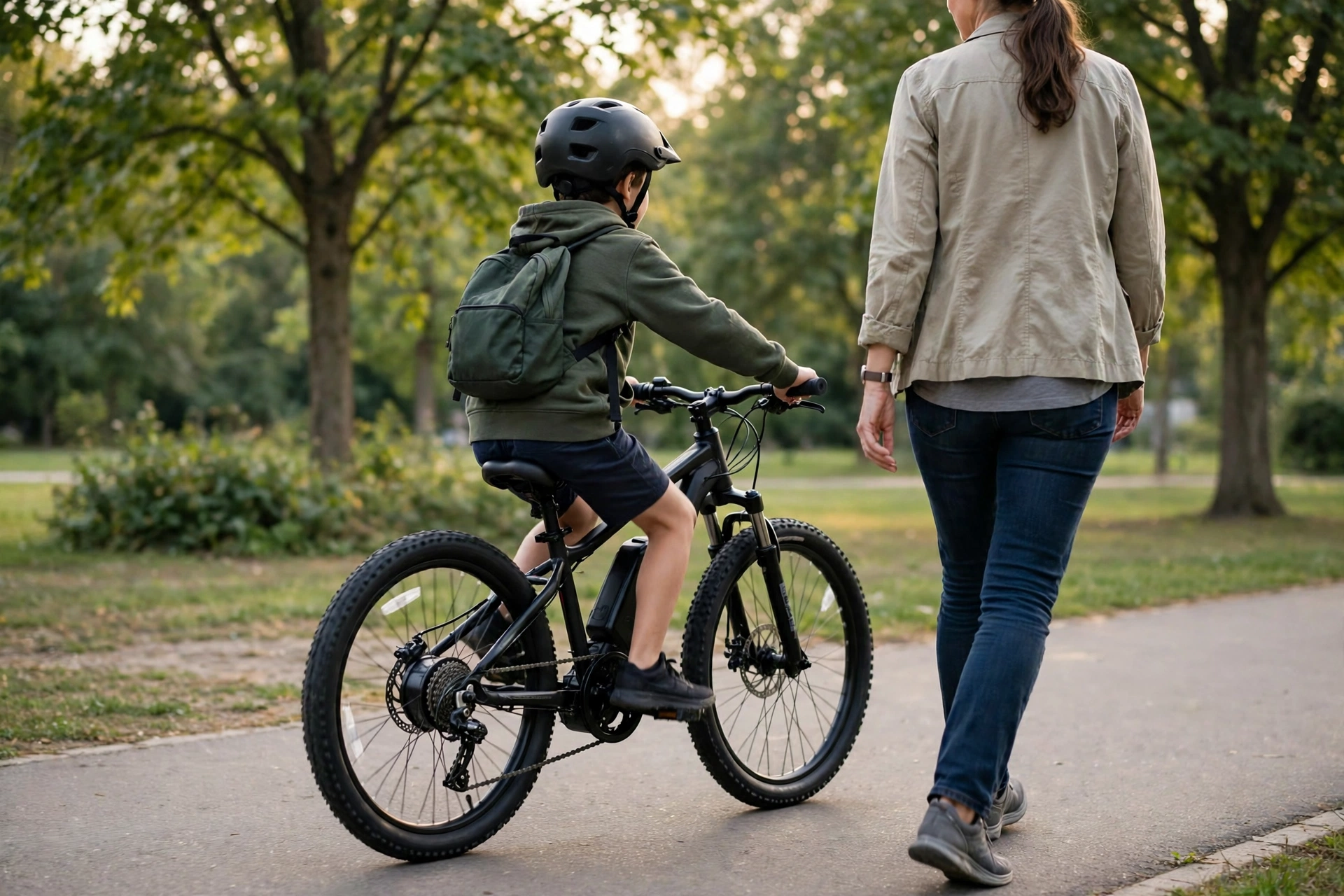
One more honesty note. Plenty of adults buy an adult e-bike, lower the saddle, and hand it down. That is usually a bad answer, and the sections below explain why in kilograms and metres. A 27 kg adult bike is close to a ten-year-old’s entire body weight; asking a child to hold that upright at a stop sign, or catch it when it tips, is asking for strength they do not have yet.
The law decides first: what an electric bike for 10 year old riders can legally be
Federal consumer rules in the US define a low-speed electric bicycle as a machine with fully operable pedals, a motor of 750 watts or less, and a top motor-only speed under 20 mph. Anything outside that frame is not a bicycle in the eyes of the law, whatever the listing calls it. States then layer their class system on top: Class 1 is pedal-assist only up to 20 mph, Class 2 adds a throttle up to 20 mph, Class 3 is pedal-assist up to 28 mph.
California shows the pattern most states follow, so use it as your template, then check your own state. Under the California Vehicle Code, nobody under 16 may operate a Class 3 e-bike, full stop. Every rider under 18 must wear a helmet on any bicycle, e-bike included, and Class 3 requires one at any age. There is no statewide minimum for Class 1 or Class 2, which is exactly where parents get tripped up: “no state minimum” does not mean “no rules.”
Since January 2026, California shops are barred from selling a Class 3 bike to a buyer under 16, and e-bike batteries sold in the state must carry accredited lab certification, such as UL 2849 or EN 15194.
Local law can be stricter still. Marin County’s pilot bars under-16s from Class 2 throttle bikes, and San Diego County’s pilot lets cities set a minimum age of 12 for Class 1 and 2. Other states set their own floors and helmet ages. Before any money moves, read PeopleForBikes’ guidance on buying an e-bike for a child, then confirm your state and city rules. Our complete guide to Class 1 e-bikes explains why pedal-assist-only is the default for young riders: the motor cannot move the bike unless the child pedals, and it is the hardest format to derestrict later.
Private land is a different legal world. On your own property, a farm, or an off-road park that permits it, a throttle mini-moto is a landowner-and-venue question, not a traffic-law question. The line you must not cross is taking that machine onto public roads, bike lanes, sidewalks, or shared paths. The moment it leaves private ground, the pedals test, the watt test, and the speed test all apply, and a pedal-less mini-moto fails the first one instantly.
Two families, one search term: sorting the electric bike for 10 year old market
Family one is the pedal-assist youth bike: 24-inch wheels, a frame scaled to roughly 4’2″ to 5’2″ riders, a 250W motor, assist capped at 12 to 16 mph. Bicycles in law and in spirit. Family two is the throttle mini-moto: 16-inch wheels, a bench seat, a twist grip, pedals absent or decorative. Starter dirt bikes in law and in spirit. Neither family is a scam. The scam is the blur between them.
Family two first, because it causes the trouble: the GOTRAX Fitz16
The GOTRAX Fitz16, listed at Best Buy at $549.99 (manufacturer’s price $699) is the cleanest example of the mini-moto pattern, and to its credit GOTRAX calls it a dirt bike, not an e-bike. Verified spec: a 350W motor, a 36V 7.8Ah battery (about 281Wh), 16-inch pneumatic tyres, front and rear suspension, disc brakes, a digital display, and a top speed of 15.5 mph with two selectable speed modes, roughly 10 mph and the full 15.5 mph.
GOTRAX rates it for ages 6 to 12, up to 220 lbs of rider; the machine weighs about 41 lbs. Claimed range is up to 15 or 16 miles per charge; expect 10 to 13 miles in real family use (est., based on the small pack and throttle-only running).
The certification tells the true story. The Fitz16 is certified to UL 2272, the standard for hoverboards and e-scooters. It is not certified as an electric bicycle system to UL 2849, because it is not an electric bicycle: no functioning pedal drivetrain, so the child cannot pedal it home when the battery dies, and it meets no state’s e-bike definition. Verdict on family fit: as a supervised, private-land starter dirt bike, helmet on, parent holding the speed-mode decision, it is a legitimate product at a fair price. As transport, a school-run machine, or anything that touches a public path, it is the wrong product, and no discount changes that.
Family one: real pedal-assist youth bikes, at real prices
The budget door into family one is the Huffy Quantis 24, $899.99 direct from Huffy. It runs a 250W rear hub motor, a 36V 7.8Ah battery (281Wh, lockable and removable per Huffy’s spec), pedal assist plus a small throttle, and a maker-capped 15 mph top speed, on 24-inch wheels with a Shimano 6-speed drivetrain.
Now the catch: Huffy itself rates the Quantis for riders aged 12 and up, and reviewers who measured it found standover height that suits riders around 5 feet and taller. Its mechanical disc brakes are the weakest link in the spec. For a tall, mature ten-year-old it can work under supervision; for an average-size ten-year-old it is a bike to grow into, not a bike for today.
The engineering benchmark is the Cube Acid 240 Hybrid Rookie Pro 400, at £1,799 in the UK (about $1,999 in the US (est.); Cube’s US availability runs through limited dealer channels, so check stock first). Bosch’s Active Line motor delivers 250W and 40 Nm in a dedicated Youth Edition tune, assistance capped at 20 km/h, about 12.4 mph. The 400Wh PowerPack removes for charging.
Weight is 19.2 kg, about 42 lbs, and the details are scaled properly: 19mm grips for small hands, 160mm cranks, Shimano hydraulic disc brakes with a 180mm front rotor. The newer 400X swaps in the lighter Bosch SX motor at 55 Nm and keeps the same youth cap. This is what “designed for the rider” looks like, and it is the reference point I score everything else against.
For trail families in the US there is one serious option, the Commencal Meta HT 24 Power at $3,500. Its 2026 redesign uses a Bosch mid-drive with an integrated battery, torque-sensor pedal assist with no throttle, hydraulic disc brakes, and an assist cut-off around 15.6 mph. It weighs roughly 36 lbs, the lightest in this guide, and fits riders from about 4’2″ to 4’11”. If your family’s weekends are spent at trail centres, it is the only machine here built for that life. Younger kids belong a tier below: STACYC-class electric balance bikes, roughly $800 to $1,050 (est.).
The maths nobody shows you: power and stopping distance
Here is the computation that should be printed on every listing page. Take a typical ten-year-old at 35 kg. The Fitz16’s 350W motor moving that child plus its own 18.5 kg gives 53.5 kg combined, so 350 ÷ 53.5 = 6.5 watts per kilogram. The adult benchmark: a full-power US e-bike at the 750W legal ceiling, under an 80 kg adult on a 25 kg bike, is 750 ÷ 105 = 7.1 watts per kilogram. Read that again.
In the electric bike for 10 year old market, the little “toy” gives a child 92% of the power-to-weight ratio of the most powerful legal e-bike an adult can buy. The Cube’s youth tune, by contrast, gives 250 ÷ (35 + 19.2) = 4.6 W/kg, and it only delivers that while the child pedals. Wattage numbers on boxes are meaningless without the kilograms underneath them.
Stopping distance is the second half, using the standard model: braking distance equals speed squared divided by twice the deceleration, at a realistic 0.4g (3.9 m/s²) for a child braking hard on dry ground, plus one second of reaction distance. At 12.4 mph (the Cube’s cap), 3.9 m of braking plus 5.5 m of reaction: about 9.4 m total. At 15.5 mph (the Fitz16 and the Quantis), 6.1 m plus 6.9 m, about 13 m. At 20 mph, the Class 2 ceiling, 10.2 m plus 8.9 m, about 19 m.
At 28 mph, Class 3 speed, 20 m plus 12.5 m, roughly 32.5 m: three and a half times the Cube’s number. Speed is not a linear tax. It is a squared one, and children pay it with shorter arms and weaker fingers than the adults those faster classes were written for.
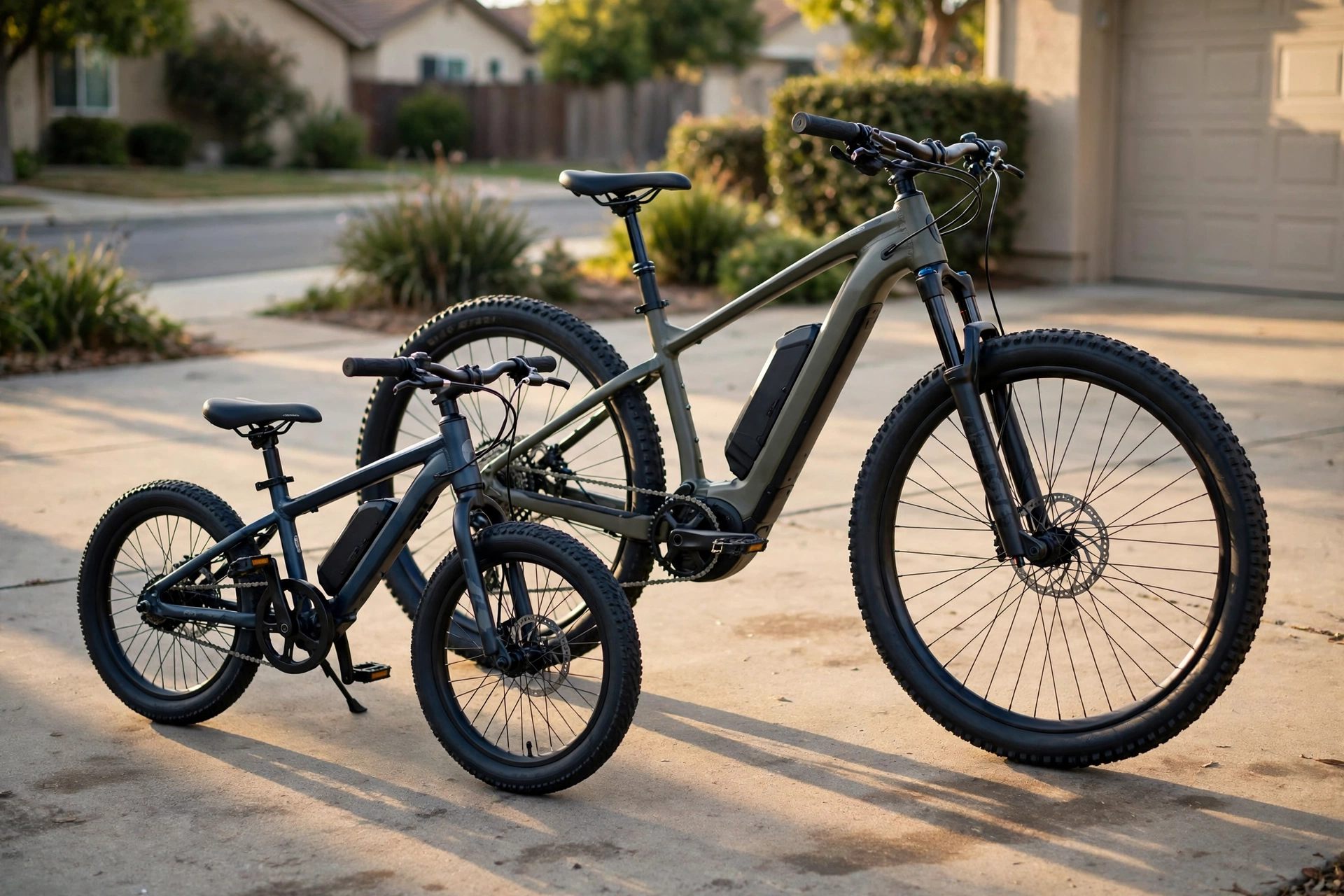
Brakes, hands, batteries: the hardware checks that matter
Brake levers first. A ten-year-old’s fingers are short, so reach-adjustable levers are not a luxury; they are the difference between two-finger braking and a whole-hand grab that locks the front wheel. Hydraulic discs, like the Cube’s Shimano set and the Commencal’s brakes, give strong braking for small finger force; that is why they win. Mechanical discs, like the Quantis’s, work at 15 mph but need cable checks as they stretch. Whatever you buy, do the driveway test: at walking pace, can your child stop the bike with two fingers per lever, without the lever touching the grip? If not, the bike is not ready.
Weight is next, and it is where downsized adult bikes fail. A child should be able to lift their bike over a kerb, pick it up after a tip-over, and hold it upright on a slope. The Meta HT 24 at about 36 lbs and the Cube at about 42 lbs are manageable for most ten-year-olds. A 55 to 65 lb adult commuter is not a hand-me-down, it is a handling hazard with a motor attached. Low, central battery placement, as on the Cube and Commencal, keeps a light rider in charge of the bike.
Battery discipline is the third check on any electric bike for 10 year old riders. Look for UL 2849 system certification or the EN 15194 equivalent, the label California now requires before a shop can sell the bike. Charge where an adult can see it, on the charger the maker supplied, and never leave a child to manage a hot or damaged pack: a puffed, cracked, or waterlogged battery gets retired, not charged “one more time.”
Removable packs, like the Cube’s PowerPack and the Quantis’s lockable unit, help because the battery comes indoors while the bike stays in the garage. Our page on what it costs to charge an electric bike covers the pennies; the real cost line is replacement, and a certified pack from a maker with a parts desk is the cheap option over five years.
Verdict: our scores for each electric bike for 10 year old option
GOTRAX Fitz16 (mini-moto family). Our score: 6/10. Safety fit: 6/10. Age fit: 8/10. Value: 7/10. Honest machine, honest label, sensible speed modes, fair price at $549.99. It loses marks because a throttle-only bike teaches throttle habits instead of pedalling, and families keep buying it for jobs it legally cannot do. Private land, helmet, supervision: yes. Paths and roads: no.
Huffy Quantis 24 (budget pedal-assist). Our score: 6.5/10. Safety fit: 6/10. Age fit: 5/10. Value: 8/10. The 15 mph cap and 250W motor are exactly right, and $899.99 is real money saved. But the maker’s 12-plus rating and tall standover mean most ten-year-olds are a year or two away from it, and the mechanical brakes are the minimum acceptable, not a strength.
Cube Acid 240 Hybrid Rookie Pro 400 (pedal-assist benchmark). Our score: 8.5/10. Safety fit: 9/10. Age fit: 9/10. Value: 6/10. The youth-capped Bosch tune, scaled cockpit, hydraulic brakes, and sane weight make it the machine I would hand to a ten-year-old for family rides on permitted paths and trails. You pay European money for it, and US stock is thin.
Commencal Meta HT 24 Power (trail specialist). Our score: 8/10. Safety fit: 8/10. Age fit: 8/10. Value: 5/10. At $3,500 it only makes sense for families who genuinely ride trails monthly, on land where e-MTBs are welcome, a question our guide to dirt e-biking and trail access works through in detail. For those families it is superb. For a school run, it is a race bike at a bus stop.
Now the cost-per-year maths, because a 24-inch bike fits a child for roughly two to three years before the 26-inch conversation starts (est., based on typical growth of 5 to 7 cm a year now). Fitz16: $549.99 over 2.5 years is about $220 per year. Quantis: $899.99 over 2.5 years, about $360 per year. Cube: about $1,999 over 3 years, less a realistic resale of around half if kept tidy (est.), roughly $333 per year net. Commencal: $3,500 over 3 years, less strong resale (est. 50%), about $583 per year net.
Run your own numbers the way our total cost of ownership calculator does: purchase price is the headline, years of fit is the divisor. The cheapest bike per year is the one that is legal where you ride and sized for the child you have now.
Frequently asked questions
Is an electric bike for 10 year old riders legal on public paths?
It depends on the machine and the state. A pedal-assist youth bike meeting the e-bike definition (working pedals, 750W or less, maker-capped speeds) is generally treated as a bicycle, subject to local path rules and age pilots like Marin’s and San Diego’s. Class 3 is off the table until 16 in California and many other states. A pedal-less mini-moto like the Fitz16 is not an e-bike anywhere in the US and belongs on private land. Check your rules before the first ride, not after the first ticket.
Does my 10-year-old legally need a helmet?
In California, yes: every rider under 18 must wear a properly fitted, fastened helmet on any bicycle or e-bike, and Class 3 requires one at any age. Many other states set helmet ages between 12 and 18; some cities require them for everyone. Our position does not move with the statute: helmet on every ride, fitted, strap snug. A helmet that slides back like a baseball cap is decoration, not protection.
What top speed is sensible at this age?
Twelve to sixteen miles per hour, which is why the serious youth bikes cap assist at 12.4 to 15.6 mph. That is the band a child already reaches on a pedal bike down a gentle hill, with braking distances of 9 to 13 metres from the maths above. Anything governed at 20 mph, or sold with an “off-road mode” that unlocks more, is a machine specified for older riders. PeopleForBikes makes the same point to parents: if it can be easily unlocked, it probably is not an electric bicycle.
Can my child ride to school on one?
Only if every link in the chain is legal: a true pedal-assist machine, your state and city age rules satisfied, the route legal for bicycles, the school allowing e-bike parking, and a helmet on the rider. Many schools set minimum ages above the legal floor, and the mini-moto family fails at the first link anyway. If any link fails, the honest answer is a normal pedal bike this year and the electric bike for 10 year old conversation again at twelve.
How far will these bikes actually go on a charge?
Less than the box says, as always, though the gap is smaller because the riders are light. A 281Wh pack like the Quantis’s, at low assist under a 35 kg child, returns roughly 20 to 30 miles (est., based on pack size and the maker’s 35-mile ideal-conditions claim). The Cube’s 400Wh pack stretches that to roughly 30 to 45 miles (est.). The Fitz16 gives the 10 to 13 miles (est.) noted above. Family rides rarely exceed 15 miles at this age, so range is the least important number here.
What size should I buy, and how long will it fit?
Buy for inseam and standover, not the age on the box. A 24-inch youth bike typically suits riders from about 4’2″ to 5’2″, feet able to touch down, saddle at its lowest still allowing a near-straight leg at the bottom of the stroke. Fit window: roughly two to three years (est.). If your child cannot flat-foot at a stop or reach the levers with two fingers, the bike is too big today whatever the growth chart promises. Our research method page explains how we check claims like these against maker data.
Final word, plainly. The right purchase is boring on paper: a pedal-assist bike, capped near 15 mph, brakes a small hand can work, a battery with a certification label, bought one size honest rather than one size hopeful. It keeps your child legal on the path, welcome at the trailhead, riding a machine that answers to their legs. The throttle mini-moto has its place too, on private dirt, helmet on, parent watching. Keep each machine in its place and both are good fun. Swap them, and you have bought the wrong product at any price.
When you shortlist an electric bike for 10 year old riders, use this guide to compare the electric bike for 10 year old options side by side, and choose the electric bike for 10 year old model that fits your child today.
Before you buy, re-read the safety checks in this electric bike for 10 year old guide, compare each electric bike for 10 year old pick against your child’s height and your local rules, and only then choose the electric bike for 10 year old model that fits.
If you are still unsure, start with the smallest electric bike for 10 year old option that fits today, test it with a helmet on a closed path, and revisit the electric bike for 10 year old choices in this guide as your child grows — the right electric bike for 10 year old purchase is the safe, legal one.