Last updated: October 27, 2026
Honest version first: if you need an electric scooter for heavy adults 400lbs is the point where almost every famous name in scooters quietly leaves the room. Kaabo’s fastest flagship, the Wolf King GTR, is rated at 330 lbs on Kaabo’s own spec page. Most Dualtrons top out at 265 to 330 lbs in their manuals. The EMOVE Cruiser, the scooter the internet recommends to every big rider, is rated 352 lbs in its older spec and 330 lbs on Voro’s newer 2026 baseline. A 400 lb rider wearing a helmet and carrying a backpack is a 415 to 420 lb working load. That erases the entire mainstream catalogue in one line of arithmetic, and any guide that pretends otherwise is setting you up to bend a stem, cook a motor, or void a warranty.
What survives that arithmetic is a short, strange list: a handful of hyperscooters rated at 440 to 500 lbs, one seated machine whose maker is unusually honest about what happens past 352 lbs, and a budget tier where the rating is printed big and the paperwork behind it is thin. This guide sorts those into buys and warnings, with the braking and hill maths done at your actual weight.
My position, stated plainly at the top: at 400 lbs, a scooter rated for exactly 400 lbs is already the wrong scooter. You want the printed rating at least 10 percent above your dressed riding weight, dual motors, dual hydraulic brakes, and pneumatic tyres of 11 inches or more. Everything below that line is a compromise I will name as one.
Prices in this guide were checked October 27, 2026 against maker and retailer listings. Figures I could not verify against a maker’s own page are marked (est.) with the basis stated.
What the load rating actually promises (and what it does not)
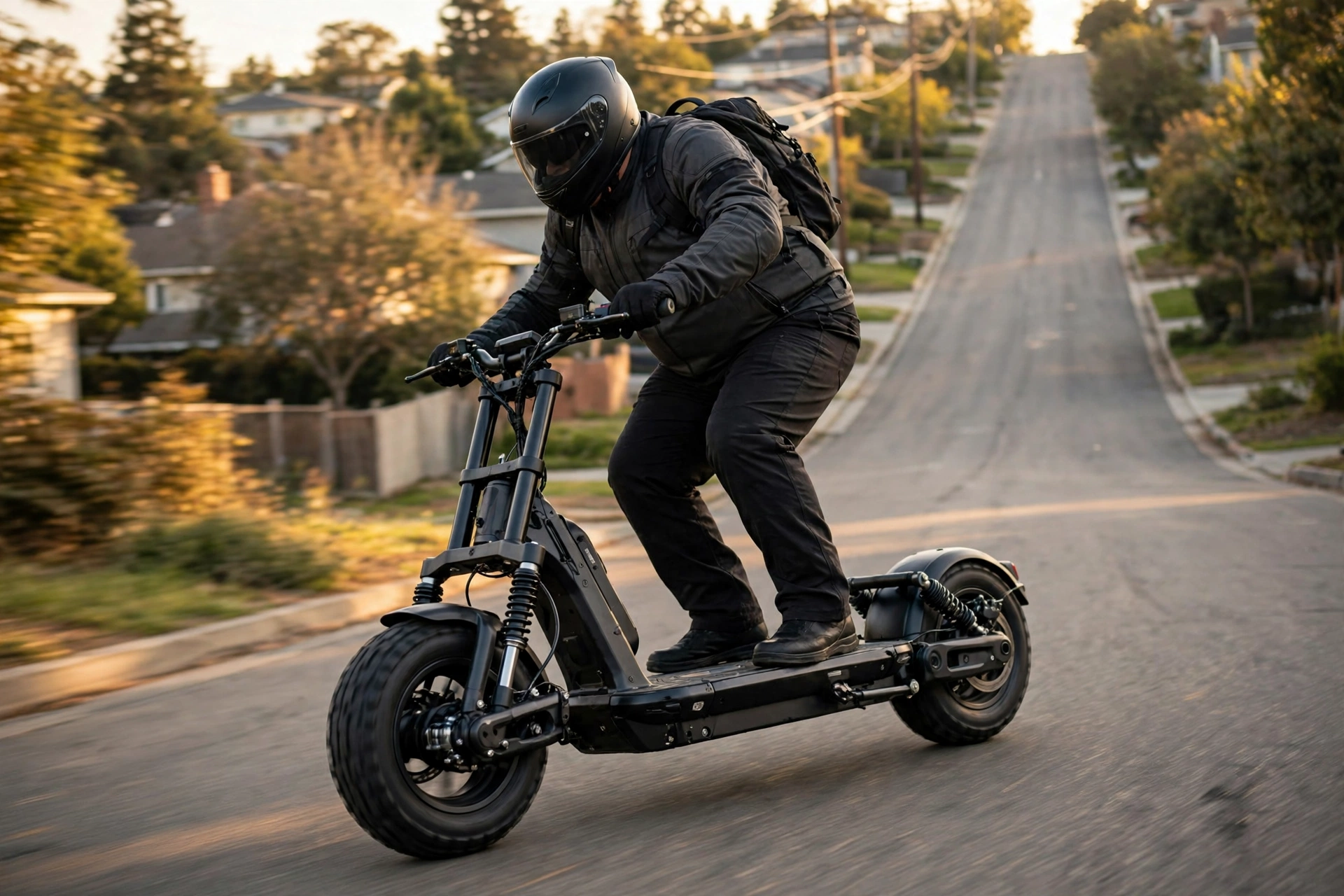
A max-load figure is a static rating. It describes the weight the frame, deck, stem and folding mechanism can carry under test conditions. Your riding load is not static. Every kerb drop, pothole edge and braking dive multiplies the force through the deck and stem clamp for a split second. A 400 lb rider rolling off a 2-inch kerb at 15 mph puts a momentary load through the front of that deck far beyond 400 lbs, and it does it hundreds of times a month. That is why the margin matters more at your weight than at anyone else’s: a 200 lb rider on a 265 lb-rated scooter has the same proportional headroom as a 400 lb rider on a 530 lb-rated scooter.
The second thing the rating does not promise is performance. Range claims are measured with riders around 165 to 220 lbs; ESG’s range tests, the most consistent independent set available, use a tester of roughly 215 lbs. Hill-climb claims are worse: a “50-degree climbing angle” is a short test ramp at full charge, not your street with a week’s shopping in the backpack. And the third thing: exceeding the printed rating typically voids the warranty. Kaabo and Dualtron manuals both frame max load as a hard limit, so the rider who buys a 330 lb scooter at 400 lbs owns every failure that follows.
The four things that decide it at 400 lbs
1. Brakes: run the energy numbers, not the adjectives
Kinetic energy grows with mass and with the square of speed, so let us do the sum the brochures skip. Take a 400 lb rider (181 kg), 15 lbs of helmet, jacket and bag (7 kg), and a 136 lb scooter like the Teewing Mars XTR (62 kg). Total mass: about 250 kg. At 25 mph (11.2 m/s), the energy your brakes must turn into heat is ½ × 250 × 11.2², which is roughly 15,700 joules. A 200 lb rider on the same scooter carries about 156 kg of total mass, which is 9,800 joules at the same speed. You are asking your brakes to shed 60 percent more energy on every single stop, and at 40 mph the heavy setup’s figure climbs to about 40,000 joules. Repeat that downhill and a small single brake does not just feel weak; it fades, because heat is the whole problem.
That is why dual hydraulic disc brakes are not an upgrade at this weight, they are the entry ticket. Two rotors share the heat, hydraulic fluid does not stretch like a cable, and a regen brake on top is a bonus, not a substitute. A scooter with one mechanical disc, or drums alone, at 400 lbs total mass is a hard no from me, full stop.
2. Hill power: a single motor is a breakdown with a date on it
Hills are where single motors go to die slowly. Holding 15 mph up a 10 percent grade with 250 kg of total mass needs about 250 × 9.81 × 6.7 × 0.0995, which is roughly 1,635 watts against gravity alone, plus around 165 watts of rolling resistance. Call it 1,800 watts continuous, delivered for minutes at a time, in a hub with limited cooling. A single 1,000 W motor peaks near that figure on a good day and cannot sustain it; it sags to walking pace, the controller heat-soaks, and the rider ends up pushing on the same hill every day until something gives up. Dual motors split both the work and the heat, and front-wheel drive stops the rear tyre breaking loose on wet climbs. If your commute has one real hill, this section is the whole buying decision.
3. Tyres: 11 inches, pneumatic, no exceptions
At 400 lbs, tyre choice stops being about comfort. A pneumatic tyre flattens into a contact patch that spreads your weight; a solid tyre concentrates it, runs hot, and transmits every crack in the pavement straight into the deck welds and your knees. Solid and honeycomb tyres on small wheels are the worst combination a heavy rider can buy. Look for 11-inch or larger tubeless pneumatics, ideally with sealant, and run them near the top of their pressure range, checked weekly. Pressure matters more for you than for anyone: 5 psi low on a loaded 11-inch tyre is pinch-flat territory on the first pothole.
4. Suspension and structure: sprung for somebody else
Nearly every scooter suspension ships set up for a rider of 160 to 200 lbs. At twice that, an unadjusted shock sits deep in its travel, bottoms over speed bumps, and the handling turns vague exactly when you need it precise. Adjustable preload is not a luxury feature here; set it near maximum, accept a firmer ride, and budget for heavier springs (est.) if the maker offers them. On structure, dual-stem front ends and fixed (non-folding) frames flex less than single-stem folders. The folding clamp is the single most stressed joint on the machine, and at 400 lbs I would rather give up folding than give up rigidity.
Range on an electric scooter for heavy adults 400lbs: the derating maths
Range claims are where heavy riders get lied to most politely, so here is the conversion done in the open. The Teewing Mars XTR carries a 72V 45Ah pack, which is 3,240 watt-hours. Electric Scooter Guide tested it at 56.8 miles on their standard route with a rider of roughly 215 lbs: 3,240 ÷ 56.8 = about 57 watt-hours per mile at a brisk pace. Now load it to your weight. Total moving mass rises from about 164 kg to about 250 kg, a factor of 1.52. Not all consumption scales with mass, since aerodynamic drag does not care what you weigh, so applying that factor to the rolling and acceleration share (roughly 70 percent of the total, est.) gives an effective multiplier near 1.36. That lands at about 78 watt-hours per mile, and 3,240 ÷ 78 gives you roughly 41 to 42 miles at the same brisk pace. At a calm commuting pace, plan on around 50 miles (est., same basis). The brochure’s 88 miles was never yours.
The same maths explains why the honest seat option holds up: the EMOVE RoadRunner Pro’s 40Ah version carries about 2,880 Wh (est.) and Voro quotes 55 miles in ideal conditions and 40 hard-ridden for standard riders, which at your weight becomes a realistic 30 to 35 miles (est.). Big packs are the heavy rider’s only real range insurance. Anything under 1,500 Wh that promises you 60 miles is selling the 165 lb rider’s result to a 400 lb customer.
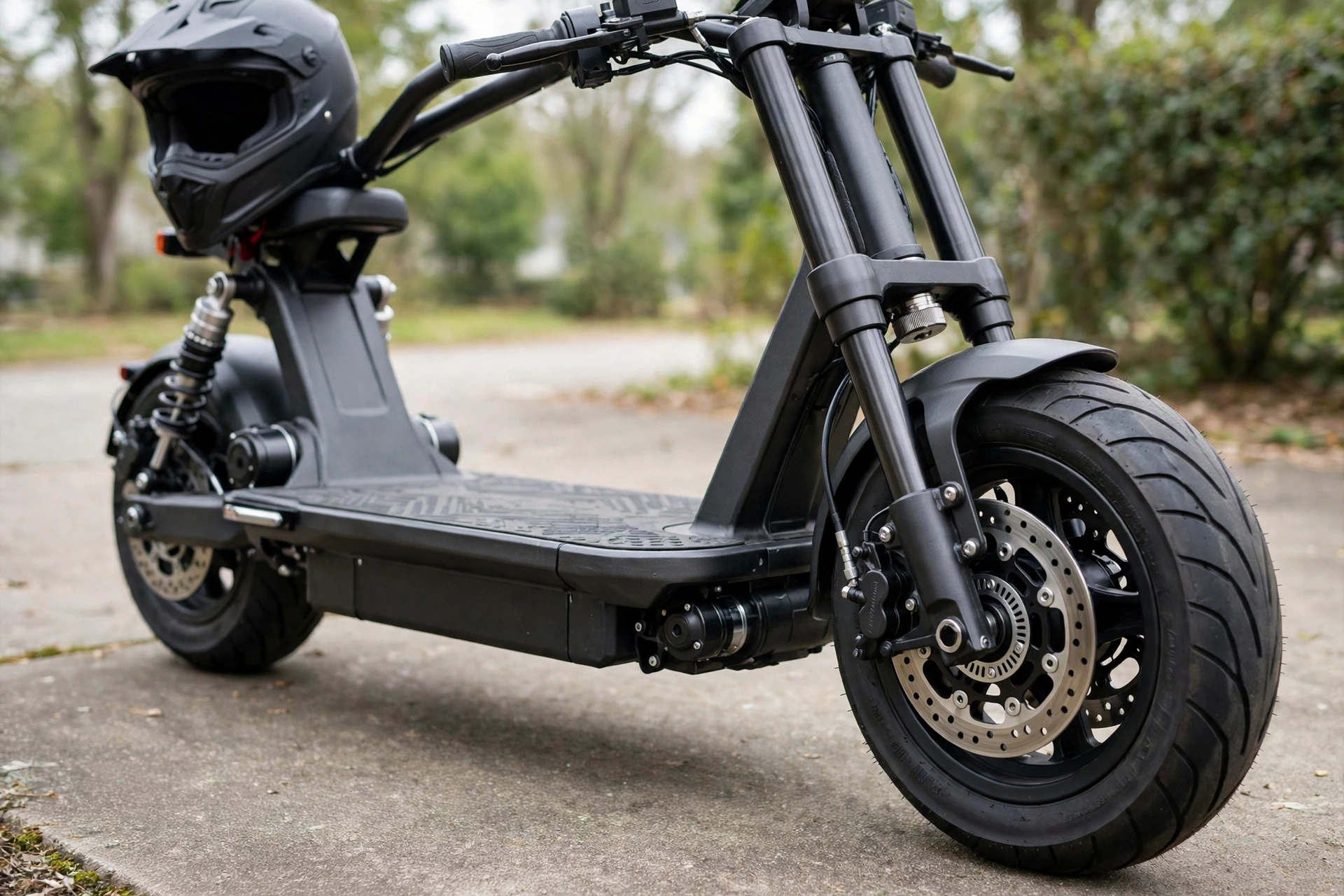
The short list: scooters honestly rated for the job
Teewing Mars XTR: the value pick that actually qualifies
Teewing is not a household name, so judge the spec sheet and the test data. The Mars XTR is rated by its maker at 440 lbs of rider weight, one of only a handful of printed ratings that clear a dressed 400 lb rider with margin. Underneath: dual 2,000 W motors (10,000 W peak), a 3,240 Wh Samsung-cell pack, Nutt hydraulic disc brakes at both ends, 11-inch tubeless pneumatic tyres with sealant, telelever-style front suspension with adjustable hydraulic shocks, and an IP66 rating. ESG’s test returned 65.4 mph top speed and the 56.8-mile range, which derates to roughly 41 miles at your weight. At $3,399, checked October 27, 2026, nothing else rated 440 lbs comes close on hardware per dollar. The nits, because that is my job: ESG lists no UL certification for this scooter, the 136 lb weight means it lives where it parks, and Nutt brakes are good rather than great. Ride it in its middle power modes; 10,000 W of peak output through a twist of the wrist will spin the front wheel at your weight too.
Our score: 8.6/10 — Brakes: 8/10 · Hill power at weight: 10/10 · Value: 9/10
EMOVE Roadster: the 500 lb ceiling, at a price
If you want the highest printed rating in the industry, this is it: Voro Motors rates the Roadster at 500 lbs, and the construction explains why. The frame and stem are carbon fibre, and the stem does not fold at all, removing the weakest joint entirely. Braking is the best on this page: Magura MT5e hydraulic brakes, hardware mountain bikers trust on downhill bikes. Dual motors draw from an 84V 40Ah Samsung pack, 3,360 Wh, on 11×3.5-inch pneumatic tyres. ESG tested 54.7 miles of range and a frankly absurd 72 mph top speed; at 400 lbs the range derates to roughly 40 miles (est., same mass-scaling basis as above). Hills are a non-event. The bill is $5,795, checked October 27, 2026, and that is used-motorcycle money; my honest take is that you are buying the brakes, the frame and the rating, and the speed is a party trick you should lock away in the settings. It also weighs 143 lbs and does not fold, so it needs a ground-floor home.
Our score: 8.2/10 — Brakes: 10/10 · Hill power at weight: 10/10 · Value: 5/10
EMOVE RoadRunner Pro: the seated route, with the maker’s own caveat
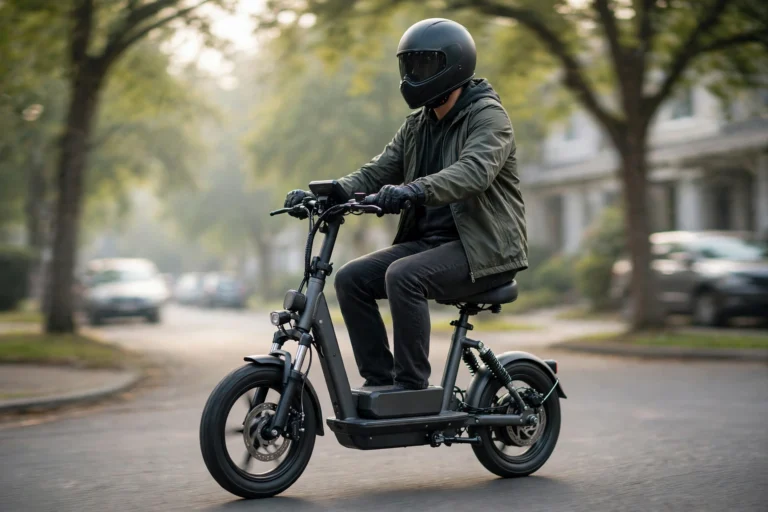
Standing for an hour on a small deck is its own problem at 400 lbs, so consider the seat seriously rather than as a surrender. The RoadRunner Pro is a proper seated scooter: dual motors, a tubular steel frame, DOT hydraulic calipers on large 203 mm rotors, and 14-inch tyres. What earns it a place here is Voro’s own honesty on its product page: it is rated “up to 352 lbs as the ideal maximum, and up to 420 lbs beyond that with reduced performance.” Read that the way an engineer wrote it. At 400 lbs you are inside the maker’s stated envelope, but in the reduced-performance zone: expect the gentler acceleration and the 30 to 35 mile real range from the maths above, and do not expect the warranty conversation to be identical to a 250 lb rider’s. The 60Ah version, at 4,320 Wh, buys back range if your budget stretches. Prices start from about $2,900 (est., Voro launch pricing for the 40Ah model). Between this and a standing scooter ridden at the ragged edge of its rating, I take the seat every time.
Our score: 7.8/10 — Brakes: 8/10 · Hill power at weight: 8/10 · Value: 8/10
FOHOLO F19: the budget claim, bought with open eyes
Amazon-class brands list several scooters at 440 lbs, and the FOHOLO F19 is the most coherent of them: a stated 440 lb capacity, a 60V 33Ah pack (1,980 Wh), dual motors, front and rear hydraulic brakes plus an electromagnetic brake, 13-inch tubeless tyres, full suspension and a removable seat, at around $1,699 (est., typical Amazon listing). On paper it answers every section of this guide for half the Teewing’s price. The gap is everything around the paper: no instrumented range test from a major outlet, a thin dealer and parts network, and certification claims you should verify on the listing before paying; at this end of the market the rating is a marketing line as often as an engineering one. If the budget is hard-capped, it is a defensible gamble with a credit card’s purchase protection behind it. If it is not, the Teewing’s test data is worth the difference.
Our score: 6.4/10 — Brakes: 7/10 · Hill power at weight: 7/10 · Value: 8/10
The not-enough list: good scooters, wrong rating
This section will annoy some owners, but the numbers are the numbers, and it is the section that matters most if you are cross-shopping an electric scooter for heavy adults 400lbs against the famous names. The Kaabo Wolf King GTR and GTR Max are superb machines, and Kaabo’s own store rates them at 330 lbs; Kaabo’s blog even calls 330 lbs “among the highest weight ratings” in the fast-scooter category, which tells you how low the industry’s ceiling sits. I have covered the GTR in depth in our Kaabo King GTR guide, and the verdict stands: brilliant at 300 lbs, out of spec at 400. The Dualtron range, from the Thunder to the X Limited, publishes 265 to 330 lbs in its manuals. The EMOVE Cruiser line is 352 lbs in its 2023 rating and 330 lbs on Voro’s 2026 baseline, and it is a single-motor scooter besides, which fails the hill maths before the rating even comes up. Even the commuter benchmark in our Segway Ninebot Max G30P guide is a 265 lb machine. Riding any of these at 400 lbs does not make you resourceful; it makes you the warranty department’s easiest closed ticket.
Gear, charging and living with a big scooter
Safety kit is not optional decoration at this mass and these speeds. Wear a full-face helmet, not a bicycle helmet: at 25 mph and 250 kg of combined mass, a face-first fall is a motorcycle accident in every way that matters. Add gloves, a jacket with elbow and back protection, and closed shoes with flat soles. Every pick above can exceed 40 mph; dress for the speed the scooter can do, not the speed you promise yourself.
Practicalities, quickly. Whichever electric scooter for heavy adults 400lbs you end up buying, none of these machines is light: 105 to 143 lbs means ramps instead of lifting, a ground-floor charge point, and a tape measure across your doorway before ordering. Charging is from a standard wall socket, several hours for packs this size; if your garage already hosts a car charger, our EV charger compatibility checker explains the car side of the garage, but no car charger will ever plug into one of these scooters. And do the boring homework our research method page describes for every guide here: confirm the load rating on the maker’s current spec page the week you buy, because ratings quietly change between model years, as the Cruiser’s 352-to-330 slide shows.
Verdict
For most riders, the electric scooter for heavy adults 400lbs to buy is the Teewing Mars XTR: the only sub-$3,500 machine with a 440 lb maker’s rating, dual motors, dual hydraulic brakes and an independent range test to derate from. The Roadster is the better scooter and the worse purchase, unless the 500 lb rating and those Magura brakes are worth $2,400 extra to you. The RoadRunner Pro is the comfort answer, bought with its maker’s reduced-performance caveat understood. And the famous names at 330 lbs are not rivals to any of them at your weight, whatever their owners’ forums say. For the test data behind the range figures here, Electric Scooter Guide’s Teewing Mars XTR review is the heavy-rider benchmark worth reading in full, and Kaabo’s own King GTR Max spec page shows the 330 lb ceiling on the flagship class in the maker’s own words.
Frequently asked questions
Does an electric scooter for heavy adults 400lbs actually exist, or is it marketing?
It exists, but the honest list is short. As of October 2026, the printed ratings that clear a dressed 400 lb rider come from the EMOVE Roadster (500 lbs), the Teewing Mars XTR and Mars XT (440 lbs), a few Amazon-class models with 440 lb claims and thin verification, and the seated RoadRunner Pro, whose maker rates it to 420 lbs with reduced performance. Everything from Kaabo, Dualtron, Apollo and Segway tops out at 330 lbs or below.
Can I ride a 330 lb-rated scooter at 400 lbs if I take it easy?
No. Taking it easy does not change the force of a pothole strike through the stem clamp, it does not give a single brake more heat capacity, and it does not restore the warranty you voided by exceeding the rating. The failure mode at this overload is rarely instant; it is a folding mechanism that develops play, a motor that fades earlier each month, and a crack that announces itself at speed.
How much range will I really get at 400 lbs?
Plan on 60 to 75 percent of what a ~215 lb test rider achieves, which usually means 45 to 55 percent of the brochure figure. The worked example in this guide takes the Mars XTR from ESG’s tested 56.8 miles down to roughly 41 miles at a brisk pace, using mass-scaling on its 3,240 Wh pack. Hills and stop-start riding pull it lower; a steady 15 mph cruise pulls it up toward 50 miles (est.).
Is a seat a good idea at this weight?
Often, yes. A seat lowers your centre of gravity, ends the standing-endurance problem, and spreads the ride over a frame designed like a small motorcycle rather than a plank. The RoadRunner Pro is the credible option, with the maker’s own caveat that 352 lbs is the ideal maximum and performance is reduced up to 420 lbs. What a seat does not do is raise a standing scooter’s rating; bolting a saddle onto a 330 lb deck gives you a 330 lb scooter you sit on.
What helmet and gear do I need?
A full-face helmet certified for motorcycle use, gloves, and abrasion-resistant clothing with elbow and back protection. These scooters carry motorcycle-class kinetic energy at your weight; the braking maths earlier in this guide is the polite version of that sentence. A bicycle helmet is rated for a fall from standing height at bicycle speeds, which is not the accident you are dressing for.