Last updated: October 27, 2026
A movcan electric bike is built around a simple trade: you get a lot of motor, a lot of battery and a long spec sheet for not much money, and in return you accept weight, rough edges and range claims written by an optimist. That trade suits some commuters very well. It suits others not at all. The difference is knowing which numbers on the listing are real. Most of them are, roughly. The range figures are not, and we will deal with those first, because a commuter plans around range. Everything else — hills, rain, arriving un-sweaty — follows from that.
Movcan is a budget brand, built in Shenzhen, China, and sold through its own online store plus Amazon, Walmart and TikTok Shop. There is no dealer network. No showroom. If something breaks, you email support and wait for a part in the post. Prices move constantly between channels — the same bike can be $579 in one storefront and $709 in another on the same day — so every price here is marked as checked on October 27, 2026, and you should check two channels before paying. The lineup runs from the V80 step-through at the sensible end to the dual-motor V30 Pro Max at the other, with the fat-tire V30, V60 and V30 Max in between, plus a V70, an EB60 and a folding Q20 mentioned only in passing.
Now the range claims, because they need translating. Movcan advertises up to 70 miles for the single-battery bikes and up to 120 miles for the dual-battery V30 Max. Those numbers come from low pedal-assist settings, a light rider and flat ground. The most useful hands-on test we found, from GoEBikeLife, ran a V60 over an 18-mile mixed loop of streets, gravel and errands and used 40 to 45 percent of the battery — pointing to 35 to 40 real miles against a 70-mile claim. The rule we use throughout this guide: take the claimed pedal-assist range and multiply by 0.55 (est.). The basis is that test plus basic physics — a heavy steel bike on 4-inch tires using 20 Wh per mile or more does not sip electricity. Halve the claim, roughly, and plan your commute around the result. You will not be stranded. Plan around the claim and you will be, somewhere around mile 45, in the rain, pedalling a very heavy bicycle.
Who is a Movcan for? A rider with a commute of 5 to 15 miles each way, some hills, a secure place to park, and a budget under $1,000. Someone who can tighten bolts and bed in brake pads, or is willing to learn. It is not for riders who need to carry a bike up stairs — the lightest bike in this guide is still around 70 lb (est.) — and not for anyone who wants a shop to look after them. Buy for the motor and the battery, tolerate the saddle and the manual, and the maths works.
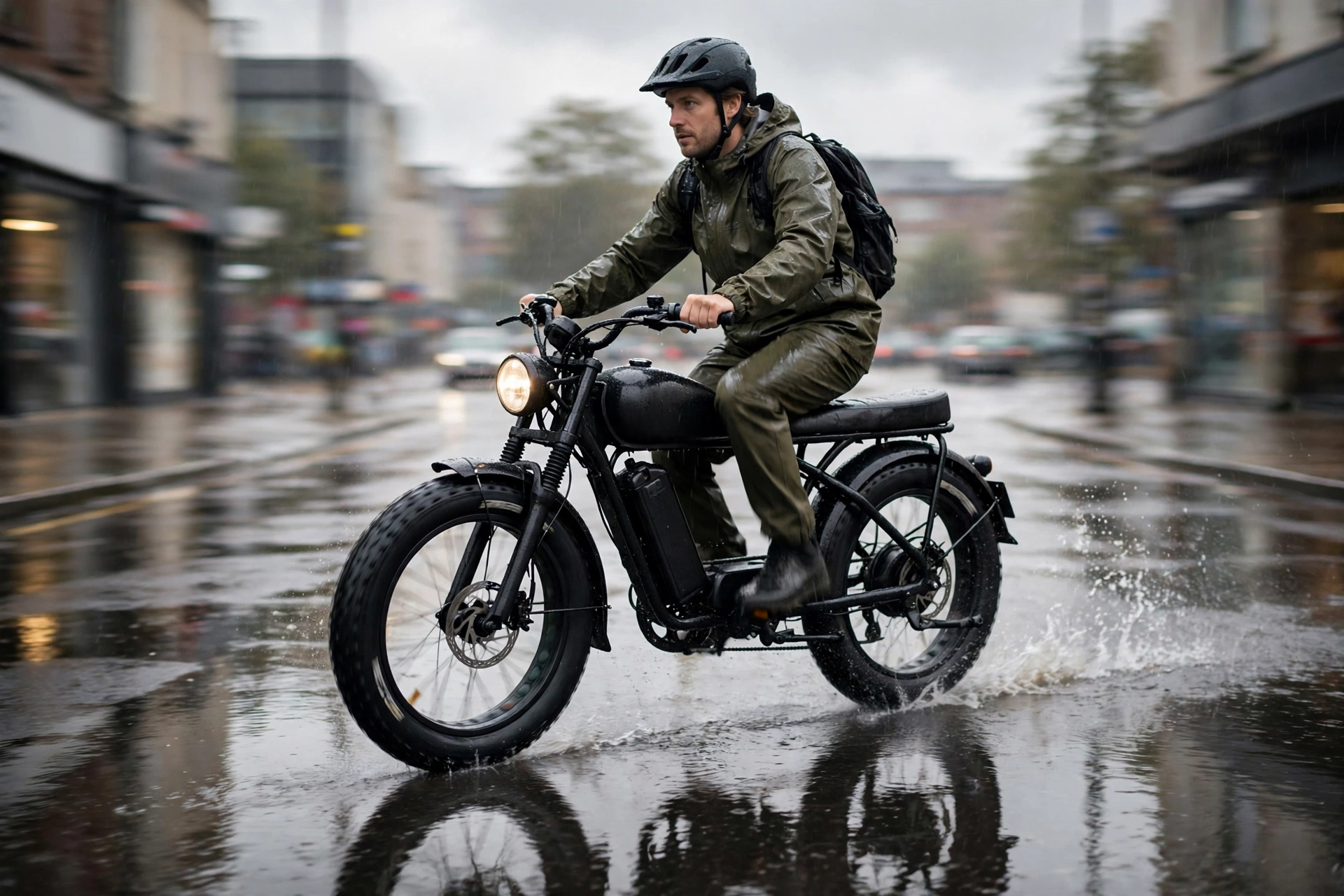
The movcan electric bike lineup, sorted by job rather than price
Ignore the model numbers; they explain nothing. Sort the movcan electric bike range by the job instead. The V80 is the commuter: 26-inch wheels, a step-through frame, normal bicycle proportions, turn signals and a horn. The V30 and V60 are the fat-tire pair: 20×4-inch tires, moped-style frames with long bench seats, full suspension, built for rough streets, gravel shortcuts and riders who value stability over elegance. The V60 Pro adds a claimed 1,500W and a bigger 48V 18.2Ah battery to the same idea. The V30 Max keeps the single motor and doubles the battery. The V30 Pro Max doubles everything — two motors, two batteries — and leaves bicycle territory entirely. The V70 (long-range), EB60 (comfort) and Q20 (folding, for RV and apartment storage) are variations on the same parts bin; the buying logic below covers them too.
One thing the whole range shares: the parts that matter are better than the price suggests. Hydraulic disc brakes on the fat-tire models. Removable, lockable batteries you can charge indoors. Shimano 7-speed drivetrains. The disappointments are shared too — saddles, displays that wash out in sunlight, manuals that read like they were translated twice. Budget for a saddle, and the value case holds up.
Movcan V80: the quiet commuter of the range
The V80 is the movcan electric bike we would point a first-time commuter at, precisely because it is the least extreme of the range. A 26-inch step-through with an upright riding position, it looks like a bicycle because it is one. The motor is listed at 1,000W with a 1,500W peak (manufacturer figures), the battery is a removable 48V 13Ah pack — 48 × 13 = 624 Wh — and the claimed range is up to 70 miles in pedal assist. Apply the rule: 70 × 0.55 ≈ 38 miles on a very good day, and a realistic planning figure of about 30 miles (est.) for mixed commuting with hills and some throttle. GoEBikeLife bought one and tested it: GPS confirmed the 28 mph top speed, they covered roughly 20 miles on the partial charge it arrived with, and a full recharge took about 6 hours. No full instrumented range run exists for this bike, so treat 30 miles as our estimate, not a measurement.
What lifts the V80 above generic budget commuters is the safety kit. Turn signals, a horn, a proper headlight — fitted as standard, not accessories. On a wet November commute, being able to signal without taking a hand off the bar is worth real money. The display washes out in bright sun and the stock saddle is, in the tester’s words, okay rather than good, so add $30 (est.) for a saddle to the price. At $649 (checked October 27, 2026), that still undercuts almost everything with this much motor. Weight is the catch — listings are vague, third-party figures cluster around 70 lb (est.). Fine in a garage. Miserable up three flights of stairs.
Our score: 6.5/10 — Range 6/10, Charging 7/10, Value 8/10. The sensible Movcan. Not exciting, and that is the point.
Movcan V30: the entry fat-tire bike
The V30 is where the moped styling starts: 20×4-inch fat tires, a long bench seat, full suspension and a faux fuel tank that is actually the battery. The motor is listed at 1,000W nominal with a 1,500W peak, the battery is 48V 15.6Ah — 48 × 15.6 = 749 Wh — and the claims are 28 mph and up to 70 miles of pedal-assist range. Realistic range by our rule is around 38 miles (est.), less if you use the throttle the way the bench seat encourages you to. Brakes are hydraulic discs, which matters on a steel bike this heavy — expect around 85 lb (est.) from its siblings’ listed weights.
As a commuter, the V30 is a fair-weather friend with good bones. The fat tires and suspension genuinely help on broken pavement and wet leaves, and the motor has enough in reserve that a headwind on the ride home is an annoyance, not a crisis. Arriving un-sweaty is realistic up to about 10 miles each way in pedal assist. What lets it down is the detail work: no rear rack in the box, a saddle that suits short hops better than hour-long rides, and pedalling geometry that is more moped than bicycle — your legs are a backup system, not the main event. Prices (checked October 27, 2026) ran from $579 on TikTok Shop to $709 through Movcan’s own storefront partners. At the lower price it is a lot of bike; at the higher one, the V60 below makes more sense.
Our score: 6/10 — Range 6/10, Charging 6/10, Value 7/10. A decent rough-street runabout. Buy it cheap or step up to the V60.
Movcan V60: the pick of the range
If a movcan electric bike earns a place in a commuter’s garage, it is this one. The V60 uses the same formula as the V30 — 1,000W rear hub motor, 1,500W peak, up to 90 Nm of claimed torque, 48V 15.6Ah battery (749 Wh), 20×4 tires, dual hydraulic brakes, front and rear suspension — and executes it better. The GoEBikeLife test is the most credible data available on any Movcan: an 18-mile mixed loop used 40 to 45 percent of the battery, giving 35 to 40 realistic miles, and the hydraulic brakes held up in the rain with two-finger lever effort and no fade on repeated descents. That brake finding matters more than any watt figure. Wet commuting is where budget bikes usually show their cheapness; the V60 does not.
Two honest warnings. First, weight. One spec table puts the V60 at 82.7 lb; the Amazon listing and the user manual say 100.91 lb. Those cannot both be the bike alone — the higher figure is likely shipping weight — but Movcan does not clarify, so assume the worst. Second, the 30 mph headline: the V60 ships able to exceed the 28 mph ceiling of the US Class 3 system, and its motor is rated above the 750W class limit, which in strict states puts it outside the legal e-bike classes altogether. How we think about that is covered in our Class 1 e-bike guide: ride it at Class 3 settings on the road and save the rest for private land. Pricing (checked October 27, 2026) sits between $749 and $999 depending on channel — at $749, nothing else with hydraulic brakes, full suspension and a tested 35-plus-mile range comes close.
Our score: 7/10 — Range 7/10, Charging 6/10, Value 8/10. The one we would buy. Charge time of 5 to 6 hours is the main daily friction; plug in at your desk or overnight and it disappears.
V30 Max and V30 Pro Max: where a movcan electric bike stops being a bicycle
The V30 Max keeps a single 1,500W motor and doubles the battery: two 48V 15.6Ah packs, 31.2Ah in total, 48 × 31.2 = 1,498 Wh. Movcan claims up to 120 miles. Amped Cycle actually tested one and recorded 35-plus miles on throttle alone and 60-plus miles in pedal assist, with a GPS-confirmed 28 mph top speed — so for once the tested figure and our 0.55 rule (120 × 0.55 = 66) land in the same place. It weighs about 98 lb. At $1,299 retail, or $1,065 with the discount code in that review (both checked October 27, 2026), it is a range machine for round trips that defeat a single battery.
Our view is blunt: most commuters should skip it. Two batteries means two packs to charge (6 to 7 hours), two packs to store, and two packs to replace at several hundred dollars each (est.). If your commute is 20 miles a day, the V60 does it on one battery with 15 miles to spare and costs half as much to re-battery later. Buy the Max only if your route genuinely demands it.
The V30 Pro Max goes further: dual motors with a combined 3,000W peak claim, two batteries totalling 48V 40Ah (1,920 Wh), and a claimed 37.5 mph, at $1,099 in Movcan’s official store (checked October 27, 2026). Movcan’s own listing gives the weight as 100 lb. Realistic range is around 65 to 70 miles (est.) — our basis is the 1,920 Wh capacity at roughly 28 Wh per mile in mixed dual-motor use; one review outlet reports 55 to 65 real-world miles, which supports the estimate, though single-source figures deserve care. Some third-party pages claim this bike does 60 mph. Nothing credible supports that, and Movcan itself says 37.5. Here is the opinion we will not soften: at 3,000W and 37.5 mph, this is not an e-bike in any legal sense that matters — it exceeds every US class limit on power and speed, and riding it on public roads or bike paths is riding an unregistered motorbike. It may be a perfectly fun off-road machine, in the way the bikes in our RTR electric bikes guide are fun. Just do not let a listing talk you into commuting on it.
V30 Max — Our score: 6.5/10 — Range 8/10, Charging 4/10, Value 6/10. V30 Pro Max — Our score: 5/10 — Range 7/10, Charging 4/10, Value 5/10, judged as transport. As a toy it would score higher; this guide is about getting to work.
The maths: price per honest mile, and what a year of commuting costs
Here is the original computation for this movcan electric bike guide, using the tested figures where they exist and the 0.55 derate (est.) where they do not. Price per realistic mile is simply the street price divided by the range you should actually plan around:
- V80: $649 ÷ 30 miles (est.) = $21.63 per realistic mile
- V30: $709 ÷ 38 miles (est.) = $18.66 per realistic mile
- V60: $749 ÷ 38 miles (tested range, GoEBikeLife) = $19.71 per realistic mile
- V30 Max: $1,299 ÷ 60 miles (tested, Amped Cycle) = $21.65 per realistic mile — or $1,065 ÷ 60 = $17.75 at the discounted price
- V30 Pro Max: $1,099 ÷ 68 miles (est.) = $16.16 per realistic mile — the cheapest miles in the range, attached to the bike you cannot legally commute on
The pattern is worth noticing: doubling the battery does not halve the cost per mile. The V60 — the middle bike, with a tested rather than estimated range — sits within a dollar of the best figure here while staying closest to legal.
Now the annual figure for the V60 on a 12-mile round-trip commute. Distance: 12 × 5 days × 48 weeks = 2,880 miles. Electricity: the V60’s tested consumption works out near 20 Wh per mile, so 2,880 × 20 = 57,600 Wh = 57.6 kWh, and at $0.17 per kWh that is 57.6 × 0.17 = $9.79 a year. Add brake pads and a set of tires at roughly $110 a year (est.) and the total running cost is about $120. The same 2,880 miles in a 30 mpg car burns 96 gallons, about $307 at $3.20 a gallon (est.), before parking, oil or anything else. Our guide to how much it costs to charge an electric bike shows the same arithmetic across other models: electricity is nearly free next to petrol, and the wearing parts are the only real costs. Whether the saving justifies the purchase depends on what you already own, which is exactly what our total cost of ownership calculator is for.
Ownership in the rain: weight, warranty and support
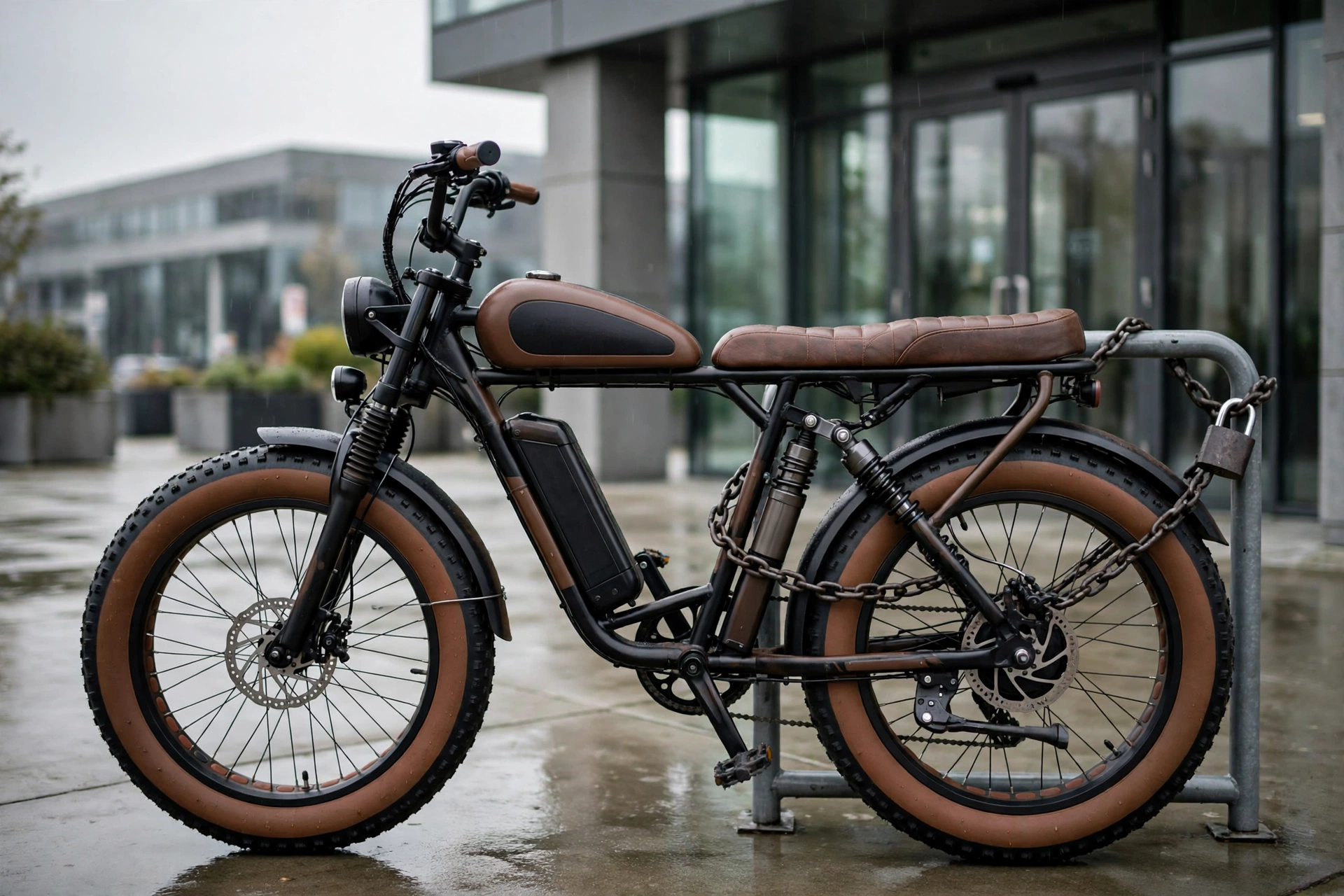
Three practicalities decide whether a movcan electric bike works out in daily use. Weight first. Every bike here is steel-framed and heavy: plan on 70 lb (est.) for the V80, mid-80s and up for the fat-tire bikes, about 100 lb at the top. Ground-floor storage and a removable battery are not optional extras; they are the ownership model. Carry the battery indoors, charge it there, and the bike can live under a cover outside.
Rain second. The V60 carries a manufacturer-stated IP54 rating and its brakes tested well in the wet, but fat tires on painted lines are still fat tires on painted lines. Ride like it. Mudguards on the V80 are standard; on the fat bikes, coverage is partial, so a cheap rear flap (est. $15) saves your back and your laundry.
Support third. The warranty is 12 months, per the user manual, with support by email and a claimed 24-hour response. There is no shop to walk into. The flip side is that these are simple machines — hub motors, standard Shimano parts, generic brake pads — and any competent bike shop can service the mechanical half even if they will not touch the electrics. That calculus, honestly stated, is how we research every budget brand; our research method page explains why we lean on the few real instrumented tests, like GoEBikeLife’s hands-on V60 review, over listing copy.
Which movcan electric bike should you buy?
Commute under 10 miles each way on normal streets: the V80, and spend the change on a saddle and a good lock. Rough streets, gravel shortcuts, hills and weather: the V60, bought at the lower end of its price range. A round trip over 35 miles with nowhere to charge in between: the V30 Max, bought with your eyes open about battery replacement. The V30 sits between stools — fine at $579, hard to justify at $709 with the V60 nearby. The V30 Pro Max is an off-road toy wearing a commuter’s clothes; buy it as the former if you have the land for it, and not as the latter under any circumstances.
Frequently asked questions
Is a movcan electric bike legal to ride on public roads?
It depends on the model and the setting. US e-bike classes cap motors at 750W and assistance at 20 to 28 mph. The V80 is sold as a 28 mph commuter, but Movcan lists its motor at 1,000W, and the fat-tire models are rated higher still — in strict states that takes them outside the class system regardless of the speed limiter. Many riders use them at Class 2 or Class 3 settings without issue, but the law in your state is the law. Set the limiter, keep the pedals turning, and check your local rules before assuming.
How far does a Movcan really go on one charge?
Plan on roughly half the claim. Tested and estimated figures in this guide: V80 about 30 miles (est.), V30 about 38 (est.), V60 35 to 40 (tested), V30 Max 60-plus in pedal assist (tested), V30 Pro Max 65 to 70 (est.). Throttle-only riding cuts those numbers by a third or more, and winter cold takes another slice.
How long do the batteries take to charge?
Five to six hours for the single-battery bikes, from the V60’s stated window and the V80’s tested full recharge of about 6 hours. The dual-battery models run 6 to 7 hours. All are overnight charges; none is a top-up-over-lunch machine. The batteries are removable and lockable, which is the practical answer — charge at your desk.
Can you ride one through winter?
Yes, with the usual conditions. The fat tires genuinely help on slush and packed snow, the V60 is rated IP54 by the manufacturer, and the brakes tested well in the wet. Range falls in the cold, the salt eats chains and rotors if you let it, and a 90 lb bike on black ice is a 90 lb problem. Rinse it, dry it, and bring the battery indoors.
What happens when something breaks after the first year?
The warranty is 12 months and support is email-based, so after year one you are the service department — or your local bike shop is, for everything except the motor, controller and battery. Those parts are generic to the budget e-bike world and widely available, which is quietly one of the better reasons to buy a simple hub-drive bike like this instead of something exotic. Keep the manual, photograph your display settings, and do a bolt check after the first few rides.