Last updated: October 27, 2026
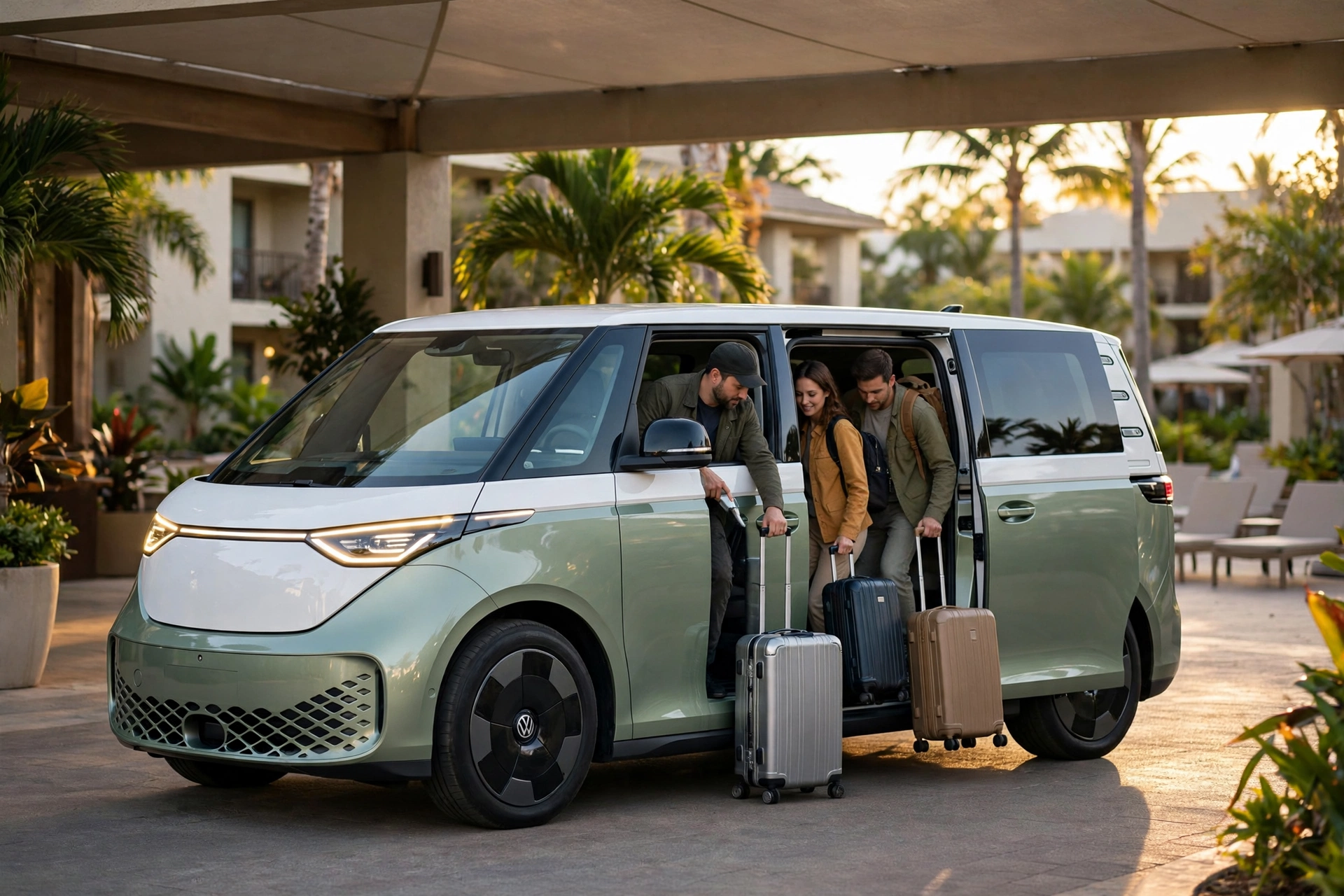
Type “vw electric bus” into a search engine from anywhere in the United States and you land on exactly one vehicle: the Volkswagen ID. Buzz, in the long-wheelbase form VW sells here. There is no Volkswagen transit bus on the American market, no 30-seat electric people mover with a VW badge, and no sign of one coming. So this guide treats the Buzz for what it honestly is — a seven-seat electric minivan that hotels, resorts, campuses, tour firms and small shuttle operators are quietly pressing into light bus duty — and judges it the way a fleet buyer should: seats, duty cycle, cost per mile, and support after the sale.
First, the market reality, because it shapes every price in this article. Volkswagen sold the ID. Buzz in the US for one model year only, 2025, and then skipped 2026 entirely. A 2027 return was planned, then pushed; VW now says the current van comes back as a 2028 model, with a cheaper second generation on a new platform further out. What you can buy in October 2026 is remaining 2025 stock sitting on dealer lots, and dealers are clearing it. List price started at $61,545 including the $1,550 destination charge, and five-figure discounts off that figure have been advertised this autumn (est., based on dealer listings). That discounting is the only reason the fleet maths in this guide work at all.
Seven things decide whether this vehicle earns money or eats it in shuttle work. We go through them in order: what it is, what it carries, how far it goes on real routes, what a mile costs, whether it can carry a wheelchair user, who supports it, and where its limits bite. Prices and specifications were checked on October 27, 2026, against Volkswagen’s own US technical data and the EPA’s fueleconomy.gov listing. Figures we could not confirm from an official source carry an “(est.)” tag and the basis for the estimate.
The short specification, before the detail. The US Buzz is long-wheelbase only, 195.4 inches long, with a 91 kWh battery (86 kWh usable), a 282 hp rear motor or a 335 hp dual-motor all-wheel-drive version, and EPA ratings of 234 miles for rear-wheel drive and 231 miles for all-wheel drive. The sliding doors on both sides and the tall, square cabin are the reasons shuttle operators look at it twice.
The name problem: there is no full-size VW electric bus in America
Volkswagen’s commercial vehicle arm sells genuine working buses and vans in Europe, including a Buzz Cargo panel van. None of that range is offered in the United States. The American operation is a passenger-car business, and the Buzz arrived as a halo product for private buyers, priced like one. When a fleet manager searches for a vw electric bus, the honest answer is that the category does not exist here: what exists is a minivan with bus-like proportions and a bus-like silhouette, and it should be bought, or rejected, on minivan terms.
This matters for procurement. A vehicle bought for shuttle duty gets judged against shuttle alternatives: a Ford Transit passenger wagon, a Mercedes-Benz Sprinter, or — at the heavy end — a proper cutaway shuttle bus on a truck chassis. The Buzz beats none of those on seats or payload. It beats all of them on energy cost, refinement, and the impression it makes at a hotel entrance. If your operation needs more than seven passengers per trip, stop here and buy the Transit; no discount on a Buzz fixes a seat count. Our guide to electric vans for business covers the larger end of that market, where payload and seats per dollar look very different.
One more structural point. Because VW never homologated the Buzz as a commercial vehicle in the US, there is no factory shuttle prep package, no factory wheelchair version, no commercial upfitter programme with published pricing. Every adaptation discussed below is aftermarket, and every one of them lands on your budget, not Volkswagen’s.
Thing 1: Seating — seven passengers is the ceiling, and it is a hard one
Every US Buzz has three rows. The standard layout is a second-row bench giving seven seats in total; the Pro S Plus offers captain’s chairs that cut the count to six in exchange for easier third-row access. The third row holds two, it is sized for adults rather than children, and it can be removed entirely, which shuttle operators running airport duty will do in the first week. Cargo volume is 18.6 cubic feet behind the third row and up to 145.5 cubic feet with rows folded and the third row out — respectable luggage space for a vehicle of this footprint, and the square tailgate opening swallows suitcases without the Tetris a sloped SUV demands.
For shuttle work the seating verdict is mixed. Seven passengers plus a driver is a workable count for hotel-to-downtown loops, wedding venues, winery tours and campus visitor runs. It is a poor count for school contracts, sports teams or any route where a second trip doubles your labour cost per passenger. Labour, not energy, is the dominant cost in shuttle operations, and a vehicle that forces two trips where a 12-passenger Transit makes one will lose money on the route no matter how cheap its electricity is. Run the seat maths against your busiest hour before you run any other numbers in this guide.
Thing 2: VW electric bus range and charging on a real duty cycle
The EPA figures are 234 miles for the rear-wheel-drive Buzz and 231 miles for the all-wheel-drive version, per Volkswagen’s US technical data. Efficiency is where the bill shows up: 37 kWh per 100 miles for the rear-drive van and 42 kWh per 100 miles for the all-wheel-drive van on fueleconomy.gov’s listing for the ID. Buzz. That is thirsty by electric car standards — the Buzz is a tall, blunt box pushing air aside — and it sets the energy cost floor for everything in the next section.
Tested numbers sit below the sticker. MotorTrend’s road-trip range test returned 213 miles from the rear-drive van, and that was a range test, not a working day. Shuttle duty is kinder in one way (low speeds, gentle acceleration, regenerative braking in stop-start traffic) and crueller in another (doors open, cabin heating or cooling running at every stop, short hops that never let the battery settle). For planning, we would schedule a rear-drive Buzz around 200 to 215 miles of mixed shuttle work in mild weather, and 175 to 195 miles in a northern winter (est., based on the EPA rating, the tested highway figure, and typical cold-weather losses for this class of vehicle). A route planner who budgets the full 234 miles in January in Chicago will strand a van; it is that simple.
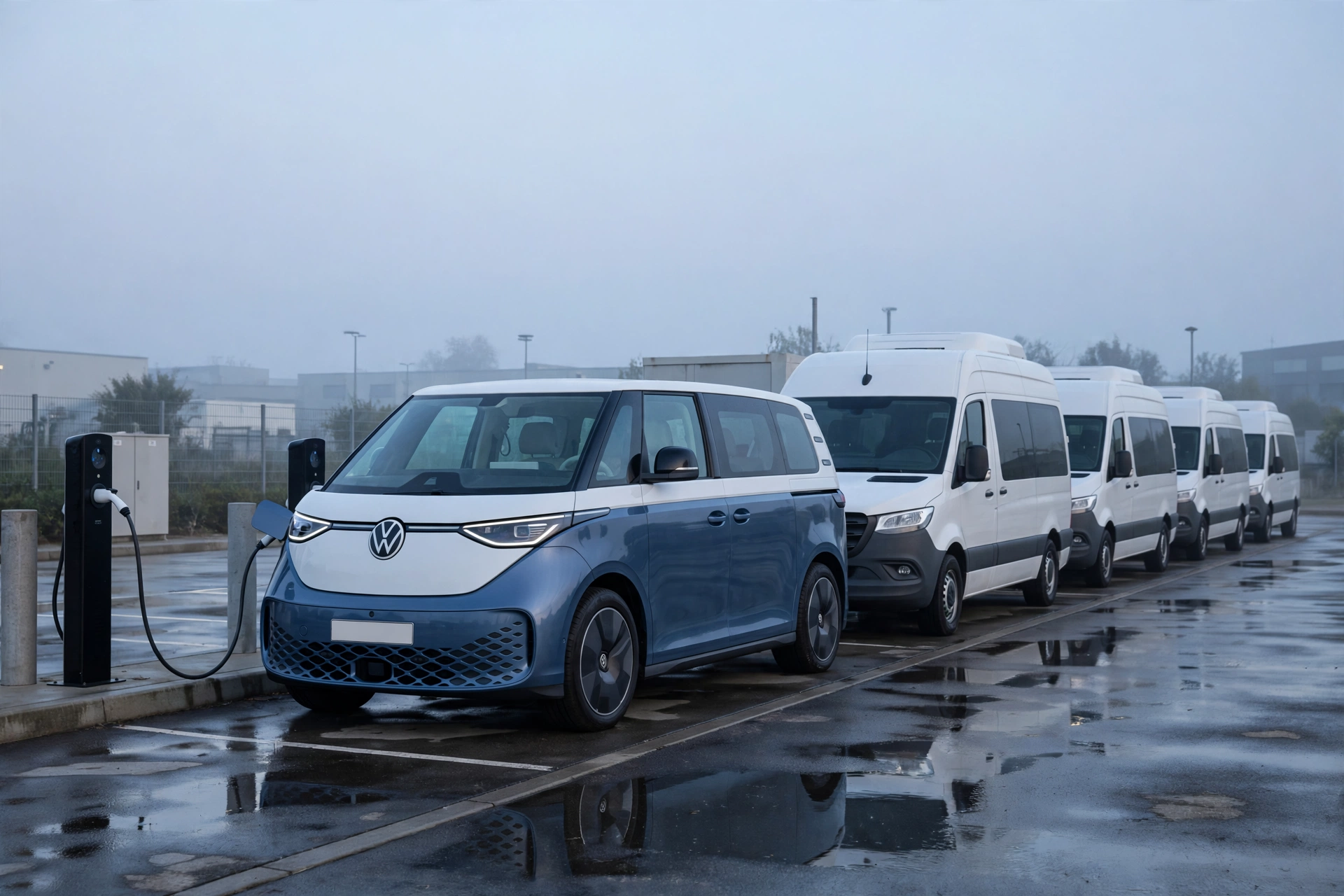
Charging is the strong suit. The Buzz accepts DC fast charging at up to 200 kW and refills from 10 to 80 per cent in about 26 minutes, which makes a midday top-up during a driver break a realistic tactic rather than a fantasy. Overnight, an 11 kW AC supply refills the pack from empty in roughly eight to nine hours, which suits depot parking exactly. Since November 2025, VW EVs have also had access to Tesla’s Supercharger network with a NACS adapter — useful insurance for operators whose routes pass a Supercharger, though no fleet should build its daily plan around public charging prices.
Thing 3: The cost per mile, done with the arithmetic showing
Take a representative duty cycle: an airport and downtown shuttle running 120 miles a day, 300 days a year, for 36,000 miles annually. Run it on depot electricity at $0.17 per kWh.
- Rear-wheel-drive Buzz: 36,000 miles × 0.37 kWh per mile = 13,320 kWh × $0.17 = $2,264 a year, or 6.3 cents per mile in energy.
- All-wheel-drive Buzz: 36,000 × 0.42 = 15,120 kWh × $0.17 = $2,570 a year, or 7.1 cents per mile.
- A diesel shuttle van at 14 mpg (est., typical for a diesel cutaway or Transit in stop-start duty) and diesel at $3.89 a gallon (est.): 36,000 ÷ 14 = 2,571 gallons × $3.89 = $10,003 a year, or 27.8 cents per mile.
The rear-drive Buzz saves roughly $7,700 a year in energy alone against the diesel — about $38,500 over a five-year service life before maintenance, and electric drivetrains also skip oil, belts, exhaust aftertreatment and most brake wear. Per passenger, the picture sharpens: at an average load of four passengers (est.), the van covers 144,000 passenger-miles a year, and $2,264 ÷ 144,000 works out at about 1.6 cents of energy per passenger-mile. Our electric car cost per mile breakdown shows the same pattern across the market: depot-charged electricity is brutally cheap next to diesel, and the gap is the whole argument. Fold the purchase price in with our EV total cost of ownership calculator before signing anything.
Now the condition that makes or breaks those numbers. If the same van fast-charges publicly every day at $0.45 per kWh (est., typical US DC pricing), the bill becomes 13,320 × $0.45 = $5,994 a year. Still cheaper than diesel, but the saving shrinks by half and the van spends its breaks tethered to someone else’s charger. The vw electric bus only earns its keep behind a depot wallbox. Operators without off-street overnight parking should not buy one, full stop.
Thing 4: ADA and wheelchair access — the honest answer is no, not yet
If your service carries wheelchair users — and any public-facing shuttle contract will, sooner or later — the Buzz is the wrong platform in the US today, and we will not soften that. Volkswagen offers no factory wheelchair-accessible version. The mainstream American conversion industry does not list one either: BraunAbility, the largest converter in the country, builds on the Chrysler Pacifica, Toyota Sienna, Honda Odyssey and Chevrolet Traverse, and the vw electric bus is absent from its catalogue. There is a structural reason. The Buzz carries its battery in the floor, and the classic American conversion — cut the floor down, fit a ramp — cannot be done the usual way around a battery pack. European specialists do convert the Buzz with rear lifts and raised-roof work, which proves it is possible; it does not make it a supported, priced, warrantied product in the US.
A bespoke American conversion is therefore a fabrication project: budget $20,000 to $40,000 or more on top of the vehicle (est., based on comparable one-off lift and securement work), expect weeks of downtime, and expect arguments about warranty coverage on anything the conversion touched. For paratransit, non-emergency medical transport or any ADA-committed contract, buy the converted Pacifica or Sienna that the industry already supports, and put the Buzz on the ambulatory routes where it belongs. Splitting the fleet that way is not a failure; it is how mixed fleets have always worked.
Thing 5: Fleet support, funding and the robotaxi distraction
Support is the weakest part of the ownership case. Volkswagen has no commercial-vehicle division in the US comparable to Ford Pro: no fleet-only service lanes, no published uptime commitments, no commercial upfitter portal. Your vans are serviced through the ordinary retail dealer network, on retail terms, behind retail customers. Parts supply for a German-built, single-model-year vehicle deserves a hard question at the dealer before you sign — ask how long a replacement sliding-door mechanism or charge port takes to arrive, and get the answer in the room, not from a brochure. The battery warranty is the standard 8 years or 100,000 miles, which at 36,000 miles a year expires on mileage in under three years. High-mileage operators must price that in.
Funding needs equal honesty. The federal clean vehicle credits that once softened EV purchase prices — including the commercial credit — ended for vehicles acquired after September 30, 2025, so a Buzz bought in October 2026 carries no federal tax credit at all. Federal transit money is not a workaround: FTA grant programmes fund transit agencies buying transit buses, and a seven-seat minivan for a hotel or a private shuttle firm sits outside that world entirely. State and utility incentives still exist in places and are worth an afternoon of checking, but none of them is large enough to rescue a route whose seat count is wrong. How we check claims like these is set out on our how we research page.
Finally, do not mistake Volkswagen’s loudest American fleet project for support you can buy. VW’s fleet energy in the US is going into MOIA, its autonomous mobility arm, which is validating more than 100 self-driving ID. Buzz vehicles in Los Angeles with rides on the Uber platform planned for late 2026. That is a turnkey robotaxi product for platform partners. It tells you VW believes in the vehicle as a shuttle; it gives a small operator in Ohio precisely nothing — no fleet desk, no volume pricing channel, no service priority.
Things 6 and 7: The limits — payload, towing and winter, taken together
Payload first, because it surprises people. The Buzz’s payload is roughly 1,400 pounds (est., from its gross weight rating against published curb weights). Seven adults at 180 pounds each weigh 1,260 pounds. Add luggage and the driver is watching the limit in the mirror: an airport run with seven passengers and seven suitcases is a genuine planning exercise, not a formality. The all-wheel-drive version, with its extra motor, carries slightly less.
Towing is narrow but real. The all-wheel-drive Buzz with the factory hitch is rated to tow up to 2,600 pounds with a braked trailer — enough for a luggage or equipment trailer on event work. The rear-drive van is not tow-rated in the US. Neither figure belongs in the same conversation as a diesel shuttle’s, and range while towing will fall by a third or more (est.), which on a 200-mile planning range means routes under 130 miles. Winter we have already priced into the range section: heat-pump-equipped vans do better, but any operator north of the snow line should treat 180 miles as the working winter ceiling and keep a diesel or a second van for the longest days.
Our verdict: should a fleet buy the VW electric bus?
Our score: 6.5/10 — Duty-cycle fit: 7/10 · Cost per mile: 8/10 · Fleet support: 4/10. As a small shuttle on a fixed, depot-based route under 150 miles a day, bought at today’s discounted prices, the Buzz is a rational, even shrewd purchase: energy at 6 cents a mile, a cabin passengers photograph, and running gear with little to service. As a “bus,” bought at list price, or bought for accessible service, it fails the brief. The discount is the deal; the dealer network is the risk; the seat count is the law.
Frequently asked questions
Is the VW electric bus actually a bus?
No. In the US the term leads to the ID. Buzz, a seven-seat electric minivan. Volkswagen sells no full-size or mid-size transit bus in America, so any route needing more than seven passengers per trip needs a different vehicle class altogether — a Transit-class shuttle or a cutaway bus.
Has the ID. Buzz been discontinued in the US?
Not discontinued, but interrupted. VW sold it for the 2025 model year, skipped 2026, and pushed the planned 2027 return back; the vw electric bus is expected back as a 2028 model, with a cheaper second generation later. In October 2026, US buyers are choosing from remaining 2025 dealer stock, which is why discounts are deep.
How far will it really go on winter shuttle duty?
Plan on 175 to 195 miles for the rear-drive van in cold weather (est.), against the 234-mile EPA rating and a 213-mile tested highway result in mild conditions. Short hops with the heating running and doors cycling sit at the worse end of that range.
Can a Buzz be converted to carry a wheelchair user?
Not through any mainstream US programme as of October 2026. The floor-mounted battery blocks the standard lowered-floor conversion, the big converters do not list the model, and a one-off lift conversion is a five-figure fabrication project (est.). ADA-committed work belongs on converted Pacificas and Siennas.
What will a fleet actually pay for one in October 2026?
List price started at $61,545 including destination when the 2025 models launched, and prices checked on October 27, 2026 show dealers advertising remaining stock well below that — in some cases under $49,000 (est., from dealer listings). There is no federal tax credit on a purchase now; the credits ended on September 30, 2025.
Does fast charging make a midday second shift realistic?
Yes, within limits. A 10-to-80-per-cent charge takes about 26 minutes at up to 200 kW, so a lunch-break top-up can add roughly 150 miles of working range. It works as a tactic for a long day; as a daily routine it costs two to three times the depot electricity price and eats the margin that justified the purchase.