Last updated: October 27, 2026
If you have typed “electric bikes under $200 for adults” into a search bar this month, I understand exactly why. The school run is a twelve-minute drive that eats fuel and patience twice a day. The second car drinks insurance money while it sits at the kerb. Two hundred dollars feels like the amount a family can risk on a different answer. So here is the honest answer first, given warmly but plainly: in October 2026 there is no new, safe, street-legal adult e-bike on sale for $200. Not at Walmart. Not on Amazon. Not anywhere we could verify.
What exists at that price is a crowd of listings that borrow the words “electric bike” and mean something else. This guide walks through every one of them, because a family that cannot spare $200 is exactly the family that cannot afford to lose it.
Hold on to the job description while you read. The families who write to us do not want a toy. They want a bike that gets a teenager to a part-time job, carries two bags of shopping home without a wobble, survives a wet Tuesday, and stops — loaded, downhill, in the rain — when a car door opens. That job needs brakes that work on a full-grown adult plus cargo, a battery that still holds a charge next spring, and a frame rated for real weight. Every listing under $200 fails at least one line of that description. Most fail all three.
Search results will show you four different things wearing the same label, so let us name them before we judge them. First, scam storefronts that clone a real brand’s photographs and offer a $799 bike for $179. Second, toy-grade folders with 14-inch wheels and small unbranded packs, sold by marketplace strangers. Third, half-a-bike listings, where the headline price buys a conversion wheel, a battery, or a deposit — not a bicycle. Fourth, children’s ride-ons with the word “adult” stuffed into the title to catch your search. Different tricks, same result: your $200 leaves and the school run stays exactly as it was.
The scam version is the cruellest of the four, because it targets careful people. The website looks polished. The photos are genuine — lifted from the maker’s own pages. A countdown timer insists the sale ends tonight. The U.S. Federal Trade Commission’s warning about low-price social media ads describes the pattern exactly: scammers impersonate real companies, and buyers receive a knock-off or nothing at all.
The FTC’s own checks are simple enough to teach your teenager. Search the seller’s name with the word “scam”. Compare the price against the maker’s own store. If you buy anyway, pay by credit card, because that is the payment you can dispute. A respected folding e-bike that sells for $799 at its maker’s store has never been sold new for $179 by anyone, anywhere. That $620 gap is not a discount. It is the product being sold: your hope.
Electric bikes under $200 for adults, bucket by bucket: toys, halves and ride-ons
The toy-grade folder is the only bucket where a real object sometimes arrives when you search for electric bikes under $200 for adults. On Walmart’s marketplace this month (prices checked October 27, 2026) a 14-inch folding bike “for teens and adults” sits at $169.99, sold by a third-party seller rather than Walmart itself, rated 3.9 stars by its buyers. Read the fine print the headline skips: 14-inch wheels are scooter-sized, the load limit suits a slight teenager, and the pack is small. The arithmetic behind the range claim gives it away.
A typical pack in this class holds about 360 watt-hours. At a gentle real-world draw of 20 watt-hours per mile, that is 18 miles of soft assistance on flat ground (est.) — yet the listing promises 30 miles and more. Hills, a heavier rider, a bag of shopping: all of it comes straight off that number. Some still ship with sealed lead-acid batteries — heavy, short-lived, and sulky in cold weather.
The half-a-bike listing is quieter about its trick. The photograph shows a complete, handsome e-bike. The price says $189. Then the options menu opens and the truth falls out: $189 buys the front-wheel conversion kit alone, or the battery alone, or it is the first instalment of a payment plan presented as a price. A conversion kit can be a fine thing on the right bike, but a kit is not a bicycle, and a family budgeting for transport this month has not bought transport.
The ride-on bucket is simpler still. If the wheels are 16 inches or smaller, the load rating is around 220 lb, and the saddle sits at a child’s height, it is a children’s product wearing an adult keyword. No adult should be asked to balance groceries on it, and no teenager should be sent into traffic on it.
The real price floor for a safe new e-bike
Our price checks follow the method set out on our research page: the retailer’s own live listing, the seller named, the date written down. Every price below was checked on October 27, 2026. Start with the no-name band. Full-size 26-inch e-bikes from unfamiliar marketplace sellers begin around $300 to $370. A few claim UL 2849 certification in their listing text; buyer ratings hover near 3.5 stars; there is no dealer network and no warranty worth the name. That band is a gamble: for some households a gamble at $300 beats a certainty of disappointment at $190, but take it with open eyes.
That is why electric bikes under $200 for adults rarely appear in this band as a safe new buy.
The cheapest new adult e-bike we would put a family member on is the Ancheer Sunshine at $369.99 on Amazon (checked October 27, 2026). It is a real brand with a one-year warranty covering the motor and battery, a removable 48V, 374Wh pack, and a listing that states UL 2849 compliance.
Be clear-eyed about the range: the listing claims up to 55 miles, while independent reviews of the Sunshine in mixed use land at 20 to 25 miles. Plan your school run around the smaller number and you will never be stranded by the bigger one. Treat the Sunshine as the floor for flat ground and modest hills. So the floor for electric bikes under $200 for adults, bought new and safe, does not exist — the floor is $370, and pretending otherwise only moves the cost into replacement batteries and bus fares.
Step up once more from the hunt for electric bikes under $200 for adults and the picture changes properly. Walmart’s own Concord line — sold by Walmart, not a marketplace stranger — lists its 26-inch step-over commuter at $478 and the 27.5-inch step-through at $498 (checked October 27, 2026). In Ebike Escape’s full test of the $498 Concord, maker Phoenix confirmed with documents that the battery is UL 2271 certified and the whole electrical system UL 2849, and testers measured about 20 real miles per charge, disc brakes with a motor cut-off, and a rack and fenders in the box on a 50 lb bike.
That is what the extra money buys, and it is worth naming precisely. UL 2271 tests the battery pack itself — its cells, its management system, its behaviour under overcharge and heat. UL 2849 tests the complete electrical system working together. The U.S. Consumer Product Safety Commission counted more than 200 injuries and at least 19 deaths from micromobility battery fires in 2022 alone. A certified pack is not a sticker. It is the difference between a battery you charge in the hallway and one you should not.
The maths nobody puts in the listing
Now the computation the $200 listings hope you never do. Take the toy folder at $190, a typical result when you chase electric bikes under $200 for adults as a new purchase. Inside its first year it needs a replacement pack: a generic 36V replacement runs $150 to $220 (est., from marketplace replacement-pack listings), so call it $180 (est.). Add $40 (est.) for brake pads, a tyre and a chain. Total: $190 + $180 + $40 = $410. If it gives eight months of real transport before the pack fades — generous for this class (est.) — that is $410 ÷ 8 = $51.25 a month, and its resale value is roughly zero, because there is no brand and no parts book.
Now the Concord at $478 — the bike to compare against any search for electric bikes under $200 for adults. Electricity is nearly free at this scale: a full 374Wh charge costs 0.374 kWh × $0.17 = about 6 cents, and our guide to what it costs to charge an electric bike shows the same pennies-per-charge maths for every pack size.
Three charges a week for three years is 468 charges × $0.06 = $28. Add $90 (est.) of consumables across three years: $478 + $28 + $90 = $596 over 36 months, which is $16.56 a month — and the bike is still worth roughly $200 used at the end (est.), so the honest net figure is $596 − $200 = $396 ÷ 36 = $11 a month.
The “expensive” bike costs a fifth as much per month as the cheap one. Run your own family’s mileage through our total cost of ownership calculator and the shape of that result does not change.
The honest $200 route: a used bike, checked like you mean it
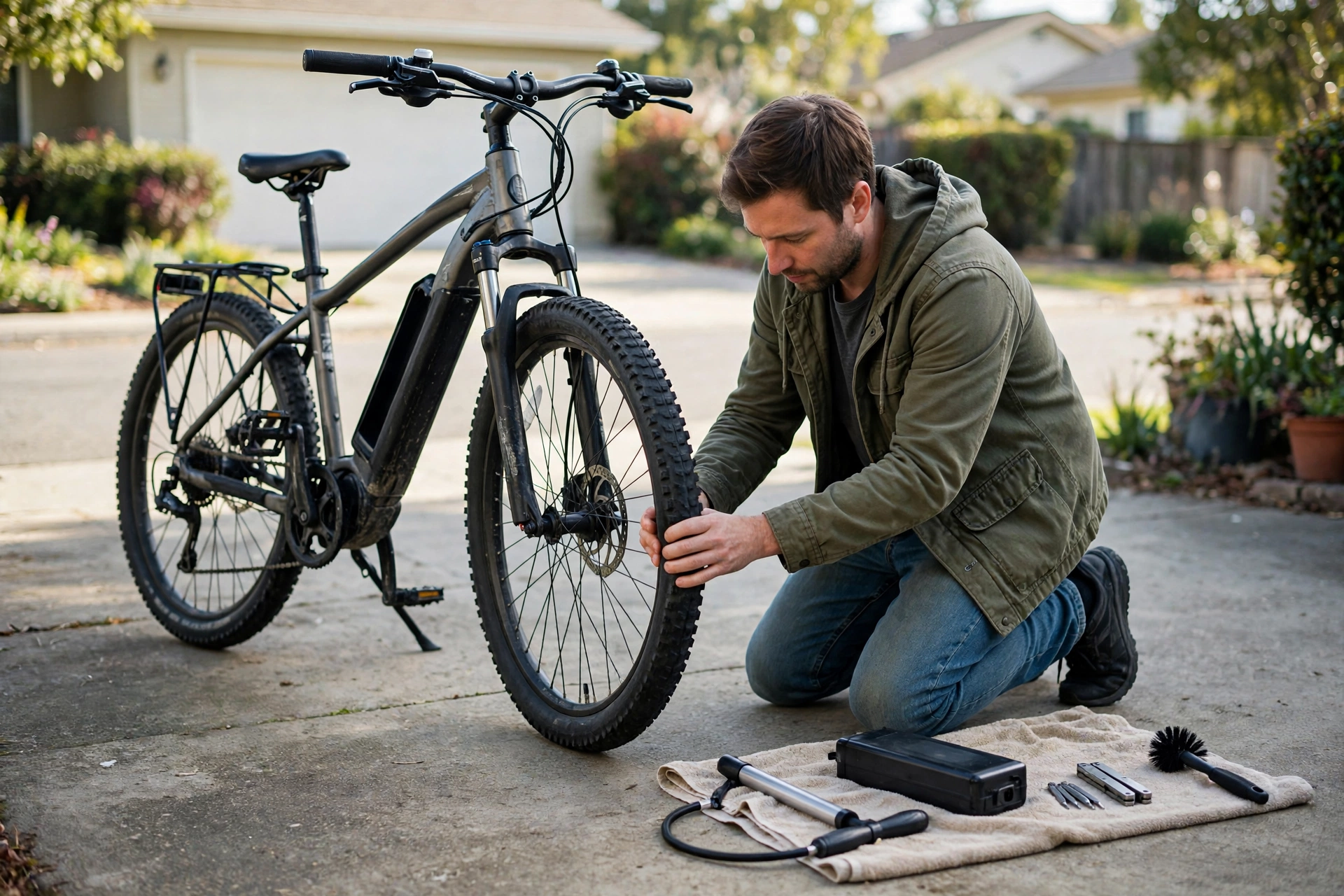
There is exactly one honest way to buy electric bikes under $200 for adults, and it is second-hand. Two-to-four-year-old budget bikes — Ancheer, Concord, Jetson and their classmates — change hands locally at $150 to $250 (est., based on October 2026 marketplace asking prices for this class). The small folder in our Jetson e-bike guide shows why this works: a real brand, sold through big stores in big numbers, means a lively used market and replacement parts that exist. A used bike from a brand you can name beats a new bike from a brand you cannot, every single time. You are buying the previous owner’s depreciation instead of a stranger’s markup.
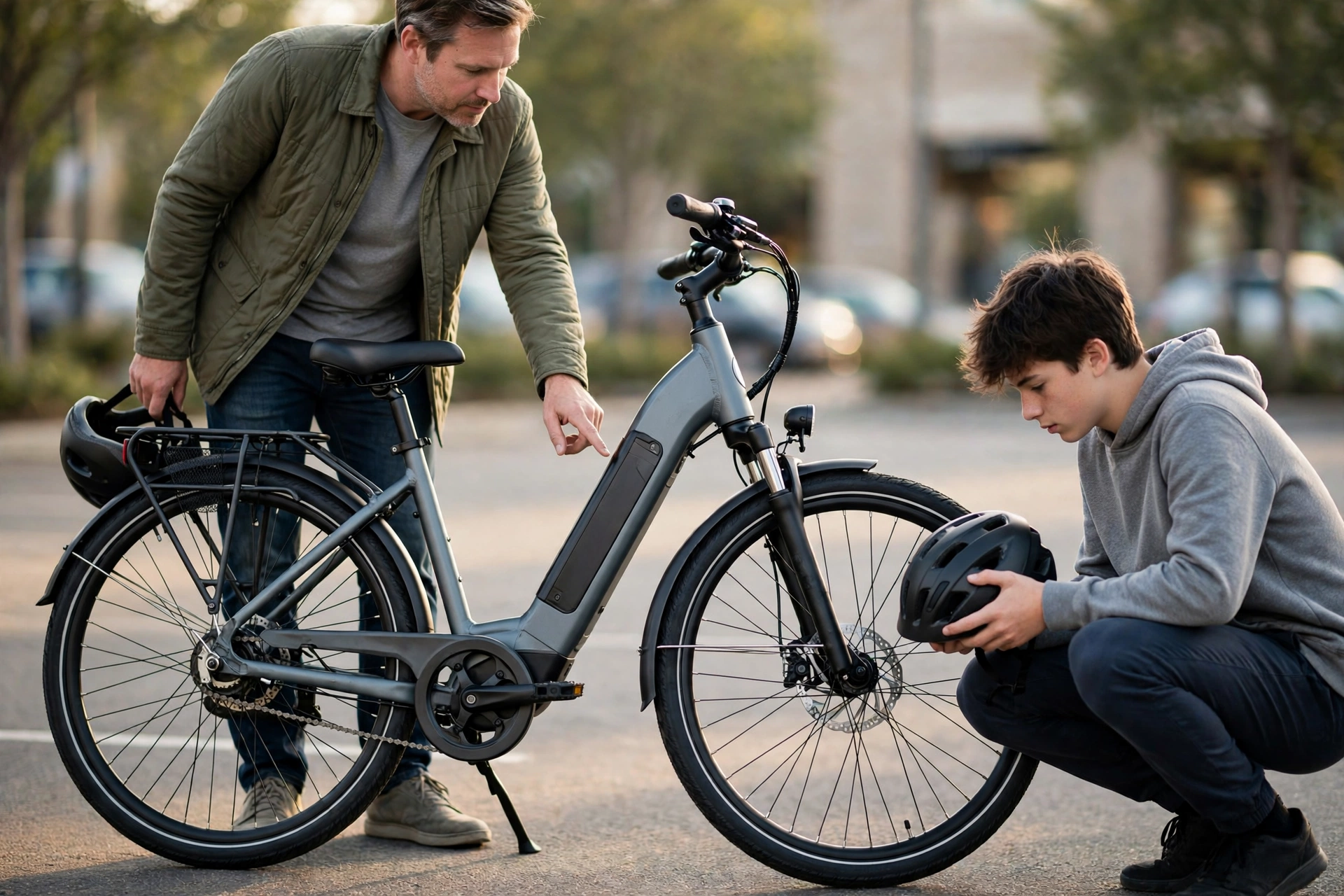
Check the battery first when you buy electric bikes under $200 for adults second-hand, because the battery is roughly 40% of what the bike is worth. Ask its age. Ask whether it was stored charged, flat, or — the good answer — around half charge. Look for swelling, cracks, or a case that no longer closes flush, and walk away from any of them without negotiating.
Then ride it for twenty minutes, not two: a tired pack feels fine around the block and sags on the first long hill. Check the brakes for pad life and a firm lever, squeeze both and confirm the motor cuts out, spin each wheel for wobbles, work the folding hinge if it has one, and confirm the charger is included and matches the battery’s voltage. A missing charger is not a small thing — budget $40 to $70 (est.) for a correct replacement, and never borrow a random one from a drawer.
Learn the dead-battery discount, because it is your best negotiating tool. If a bike is listed at $250 with a pack that is clearly fading, price it as a bicycle minus a battery: $250 − $180 (est., the replacement-pack cost from the maths above) means a fair offer is $70 to $90 — or a polite walk away. Some sellers will take it. And the rule that protects families most: meet in daylight, bring a helmet for the test ride, pay in person after you have touched the bike. A seller who refuses a test ride has already told you the test result. Never wire money, never pay a “delivery deposit”, never buy a bike from a photograph alone.
Refurbished, open-box and the two honest sale windows
Between the used market and the full-price shelf sits a quieter route for shoppers who started out looking for electric bikes under $200 for adults: open-box and returned bikes, checked and discounted because a box was opened, plus maker-run certified refurbished programmes with a real warranty attached. Discounts of 20% to 40% under list are typical in these channels (est., based on retailer refurb listings through 2026). On a $478 Concord-class bike that means roughly $330 to $380 (est.).
Still not $200, and we will not pretend otherwise — but it is a certified, warrantied bike for used-market money, which makes it the sweet spot for a careful family that can stretch a little. It is the closest a new-ish purchase gets to the promise of electric bikes under $200 for adults without lying about what it is.
Timing is the other half of the trick. Real e-bikes are discounted in two predictable windows: the Black Friday season, when Walmart runs its first big deals event in mid-November, and the January clearance, when last year’s colours and sizes are cleared to make room for spring stock.
The plan writes itself: research now, pick the exact model and size, set a price alert, and keep the $200 in the jar while it grows. A family that starts saving in October and buys in a sale window is not being slow. It is being armed. That is the season when electric bikes under $200 for adults stop being a mirage and start being a plan — the jar, the alert and the window, together.
Electric bikes under $200 for adults when $200 is the whole budget
Some months, $200 is not a starting point. It is the whole envelope, and the need is now. Then electric bikes under $200 for adults is simply the wrong search, and the right one is “used hybrid bike near me”. A serviced used hybrid or city bike at $120 to $180 (est., local asking prices) with $40 held back for a tune, a lock and lights will carry a child seat, swallow a week of school bags, and never once strand you with a dead pack.
It is not a consolation prize. For loads and reliability per dollar, a good used acoustic bike is the best transport a family can buy at this money. Start the e-bike jar alongside it: the gap from $200 to the $478 Concord is $278, and at $25 a month that gap closes in about eleven months.
One more honest trade-off. Basic seated e-scooters — sit-down, no pedals, short range — appear new from around $250 to $330 (est., marketplace listings checked October 27, 2026). They can suit a short, flat, solo trip. They are not a school-run answer: no pedals, modest load ratings, and nothing to hang a pannier on. And whatever you buy, buy the right class for your streets — our Class 1 e-bike guide explains the three classes and their speed limits in plain English, because a bargain that is not legal on your route is not a bargain.
Our scores: three routes to electric bikes under $200 for adults, judged
Route 1 — a brand-new bike at $200. Our score: 1.5/10 (Honesty: 2/10 · Safety: 2/10 · Value: 1/10). The listings misdescribe what is being sold, the safety paperwork is absent or invented, and the cost-per-month maths is the worst in this guide. This route spends a family’s money and returns a story.
Route 2 — a used brand-name bike at $200. Our score: 7/10 (Honesty: 7/10 · Safety: 6/10 · Value: 8/10). The value is real and the risk is manageable — provided you test the battery properly, apply the dead-battery discount, and walk away from swelling, missing chargers and refused test rides. Safety scores mid-pack because the bike’s history is yours to verify, not a factory’s.
Route 3 — save to the $478 certified floor. Our score: 8.5/10 (Honesty: 9/10 · Safety: 9/10 · Value: 8/10). The slowest route and the best one. A UL-certified pack, a warranty with a phone number behind it, a rack for the shopping, and $11 a month of honest transport across three years. If your family can wait one sale window, this is where the money should land.
Frequently asked questions
Are there any safe electric bikes under $200 for adults?
New, no — not in October 2026, and not from any retailer we could verify. The cheapest new adult e-bike we would put a family member on is the Ancheer Sunshine at $369.99, and the cheapest with fully documented UL 2271 battery and UL 2849 system certification is Walmart’s Concord at $478. Used is the exception: a checked-over, brand-name used bike at $150 to $250 (est.) can be a safe buy, because you can test the actual battery before money changes hands.
I saw a famous-brand folding e-bike advertised for $179 on social media. Is it real?
Almost certainly not, and this is a common trap for searches for electric bikes under $200 for adults. It matches the pattern in the FTC’s warning about low-price social ads: a cloned storefront, stolen photos, a countdown timer, and a price the real maker never charges. Check the maker’s own store — if the bike is $799 there, the $179 site is selling a knock-off or nothing. Pay by credit card if you proceed at all, and report the ad. The same caution applies to any brand this site has covered: if a deal contradicts the maker’s own price by hundreds of dollars, the deal is the deception.
What should I check first on a used e-bike?
The battery, before anything else. Ask its age and how it was stored, inspect the case for swelling or damage, confirm the correct charger is included, and take a twenty-minute test ride with a hill in it — tired packs sag under load, not in the driveway. Then brakes, folding hinges, wheel wobble and frame cracks. If the pack is fading, use the dead-battery discount: asking price minus roughly $180 (est.) for a replacement pack is the fair offer.
Can a cheap e-bike carry shopping or a child seat?
Mostly, no — and this is where the cargo honesty matters. Budget frames typically rate a total load around 265 lb. Add a 180 lb rider, a 35 lb child and 15 lb of shopping and you are at 230 lb before the child seat itself, on a bike whose brakes and hinge were built down to a price. If carrying loads is the job, buy a bike rated and racked for it. Walmart’s Concord LoadPro cargo model at $648 (checked October 27, 2026) exists precisely because ordinary budget frames are not cargo bikes.
Is a conversion kit a cheaper way to get an e-bike?
A kit on a bike you already own is the one partial listing worth respecting — but price it whole. A basic hub-motor kit plus a battery rarely lands under $300 complete (est., based on kit and pack listings), and the battery is the one part never to buy unbranded or uncertified. If the kit maths reaches $300 anyway, compare it honestly against the $369.99 Ancheer before you commit: sometimes the finished, warrantied bike is the cheaper machine.
How long does a budget e-bike battery last?
Expect two to four years of useful life from the packs in the $370 to $500 class (est., based on maker warranty terms and owner reporting), longer if you store the pack around half charge, keep it out of freezing garages and summer car boots, and avoid running it flat daily. Budget for a replacement at $150 to $300 (est.) inside the bike’s life. That single line in the family budget is the difference between an e-bike that serves for years and one that becomes a heavy acoustic bike by its second spring.
In short, electric bikes under $200 for adults are best approached as a used-bike search, not a new-bike bargain. If you keep the checks in this guide in mind, electric bikes under $200 for adults can still be a safe, honest buy — and the right electric bikes under $200 for adults choice is the one with a tested battery and brakes you trust.