Last updated: October 25, 2026
The leaf lease ad says $459 a month. Run that number through a kitchen table instead of a showroom and it says $543. Both figures describe the same car, the same contract and the same 48 months — the gap between them is the $4,019 Nissan wants from you before the keys change hands, spread out honestly instead of parked in the small print.
This guide does the household maths on every current leaf lease route we could find, using offers checked October 25, 2026. You will get the advertised payment, the amount due at signing, the term, the mileage allowance and — the figure dealers never volunteer — the effective monthly cost once the upfront money is divided across the lease.
One thing before the numbers. The Leaf itself is not the car you remember. The hatchback is gone. The 2026 Leaf is a small crossover with a 75 kWh battery, up to 303 miles of EPA range and a starting price of $29,990, which makes it the cheapest new EV on sale in America. A cheap sticker and a fair lease are two different things, though, and this autumn they do not automatically arrive together.
Our verdict up front: the advertised national deal is mediocre value wearing a friendly headline, the smarter money is a negotiated 36-month deal on the base S+ trim, and none of it works at all unless you can charge at home. The petrol car already sitting in your driveway sets the bar here, and we will keep returning to it, because that is the comparison your bank account actually cares about.

Leaf lease headline numbers, translated into real money
Nissan’s national offer, run through NMAC (Nissan Motor Acceptance Company) under its SignatureFLEX programme and listed with an expiry of November 2, 2026, looks like this:
| Offer detail | 2026 Nissan Leaf SV+ |
|---|---|
| Advertised payment | $459 per month |
| Term | 48 months |
| Due at signing | $4,019 |
| Mileage allowance | 10,000 miles per year |
| Battery / range | 75 kWh / 288 miles EPA |
| Trim MSRP | $34,230 (plus $1,575 destination) |
Now the arithmetic the ad skips. 48 payments of $459 come to $22,032. Add the $4,019 due at signing and the lease costs $26,051 before tax, title and dealer fees. Divide $26,051 by 48 months and the honest figure is $542.73 — call it $543 a month. That is $84 a month more than the headline, every month, for four years.
Here is our first strong opinion, and we will not soften it: the 48-month term is the trick in this offer. When the new Leaf launched in autumn 2025, Nissan advertised the same SV+ trim at $499 a month over 36 months with $3,699 due at signing — an effective $602 a month, but a total bill of $21,663.
A year later the headline has dropped by a friendly $40, the term has quietly stretched by a full year, and the total you hand over has risen by $4,388. Cheaper per month. More expensive per car. Households budget by the month, so the trick works, and that is exactly why you should refuse to judge any leaf lease by its monthly figure alone.
The three leaf lease routes on sale right now
The national offer is not the only door into this car. Checked October 25, 2026, there are three realistic routes, and they suit three different households.
Route 1: the national NMAC SignatureFLEX offer
As above: $459 a month, 48 months, $4,019 due at signing, 10,000 miles a year, on the SV+ trim. Carfax’s roundup of current Nissan deals lists the same figures and the November 2, 2026 expiry. It asks for top-tier credit, it excludes tax and title, and the due-at-signing figure assumes a dealer contribution you may have to argue for. Predictable, available almost everywhere, and — at $543 effective — not cheap for a car whose mid-trim sticker is $34,230. The payment equals about 1.59% of the sticker price every month, and the old lease rule of thumb says a genuinely good deal sits near 1%.
Route 2: a negotiated 36-month deal at market rates
Edmunds’ current buying guidance suggests a typical Leaf lease lands around $490 a month with roughly $3,700 due at signing on a 36-month, 12,000-mile term. The same translation applies: $490 × 36 = $17,640, plus $3,700, is $21,340, which divides to $592.78 — about $593 a month effective. That stings next to the $543 above, and the comparison teaches the real lesson. The 36-month route costs more per month and less per car: $21,340 total against $26,051. You also hand the car back a year earlier, stay inside the 3-year/36,000-mile basic warranty for the whole lease, and get 12,000 miles a year instead of 10,000. For a family that actually drives, this is the shape of deal to aim for.
Route 3: regional offers and the base S+ trim
CarsDirect, updated October 25, 2026, shows advertised Leaf leases starting from $449 a month in some regions, a modest $325 of NMAC special lease cash, and a calculator example for the base S+ trim at $485 a month over 36 months with $3,157 down — $17,460 in payments plus the down payment totals $20,617, or about $573 a month effective.
Regional ads vary wildly and usually hide the worst due-at-signing figures, so treat $449 as an opening bid, not a promise.
The S+ is the trim worth hunting regardless: it carries the same 75 kWh battery and 214 hp motor as every other 2026 Leaf, posts the longest range of the range at 303 miles EPA, and starts $4,240 below the SV+. Edmunds notes the S+ is also the hardest trim to find on lots, which tells you plenty about how Nissan expects people to shop.
The car behind the deal: not the hatchback you remember
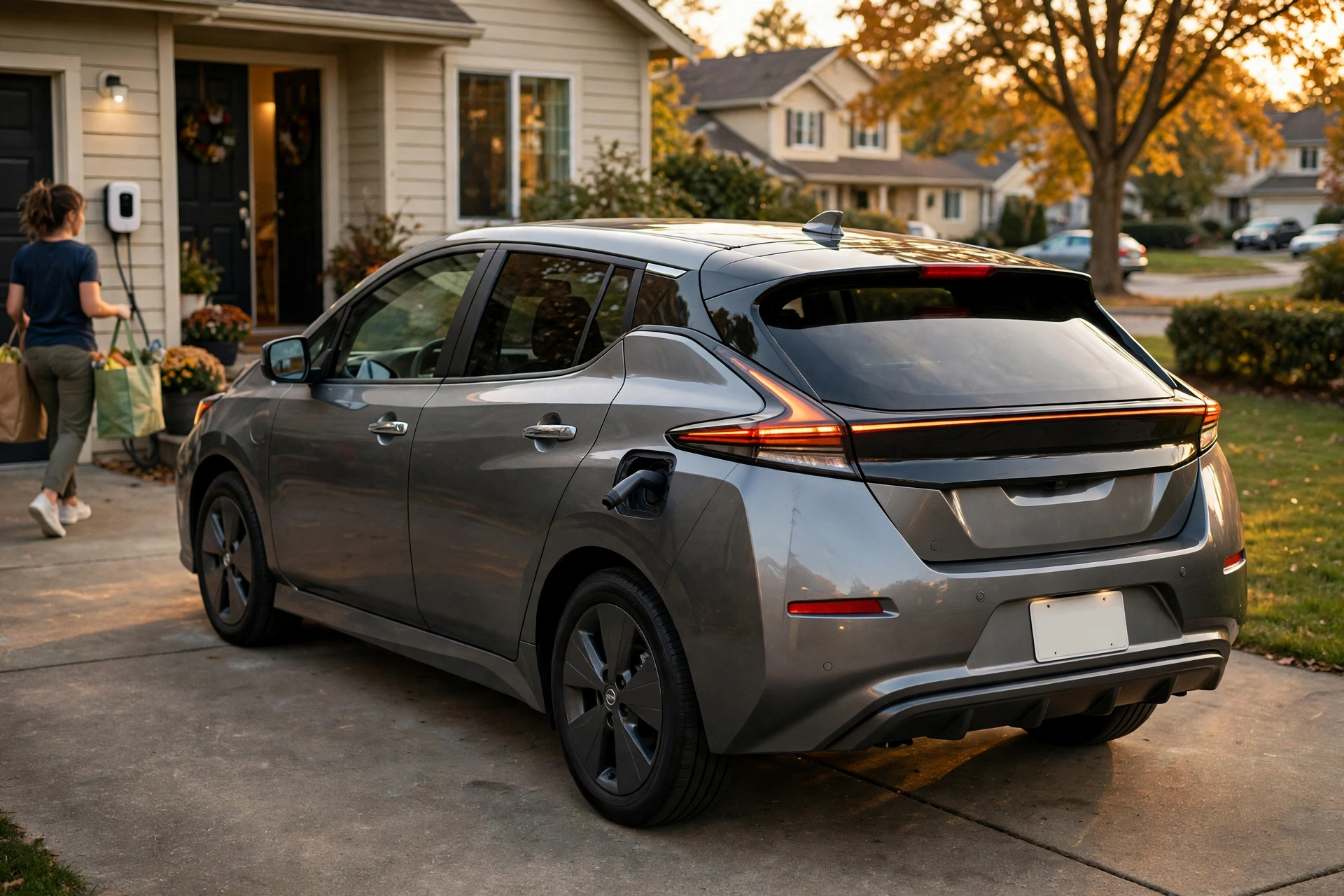
Plenty of households carry an old picture of the Leaf: worthy, dumpy, 149 miles of range, battery cooked by summer heat. Scrap it. The third-generation car is a sleek subcompact crossover on the same CMF-EV platform family as the Ariya, with a liquid-cooled battery, a NACS charging port that plugs straight into Tesla Superchargers, DC fast charging up to 150 kW (10% to 80% in about 35 minutes) and dual dashboard screens. Nissan’s official 2026 Leaf specs and pricing page confirms the lineup below; prices checked October 25, 2026, excluding the $1,575 destination charge.
| Trim | MSRP | EPA range | Notes |
|---|---|---|---|
| S+ | $29,990 | 303 miles | The value pick; longest range of the three |
| SV+ | $34,230 | 288 miles | The trim in the national lease offer; bigger screens, more kit |
| Platinum+ | $38,990 | 259 miles | 19-inch wheels cost it 44 miles of range against the S+ |
Every trim shares the same 75 kWh battery and 214 hp front motor. The cheaper base S trim Nissan promised — a 52 kWh battery at a lower price — was cancelled for the US 2026 model year before it ever reached a showroom, so $29,990 is the floor. In Edmunds’ real-world range test the car went 310 miles, beating its own EPA figure, which almost never happens. Our full breakdown of the car itself lives in our Nissan Leaf 2026 complete guide. For leasing purposes, what matters is simpler: the base trim is the best car in the range, and it is the one the national advert ignores.
Why leaf lease money looks thinner than it used to
If you shopped EV leases in 2023 or 2024, you remember absurd deals: $199 a month, almost nothing down. Those were not generosity. Manufacturers were passing the $7,500 federal commercial clean-vehicle credit through leases, and the credit did the heavy lifting while the headline took the credit. Both the consumer credit and the lease route ended on September 30, 2025. That world is over.
What replaced it is visible in the small print: the NMAC special lease cash on a Leaf right now is $325. Three hundred and twenty-five dollars, against a $7,500 hole. Nissan is funding this autumn’s offers out of its own pocket, which is why the headline payment looks ordinary rather than spectacular.
Your leverage comes from a different direction: boredom. Edmunds counts roughly 930 new 2026 Leafs in US inventory, sitting an average of about 126 days on dealer lots — four times the market average — with buyers paying around $1,200 under MSRP on average. Cars that sit get discounted. A leaf lease is priced off the car’s selling price, so every dollar you shave before the lease is calculated stays shaved. We will do that maths properly in the negotiation section below.
Leaf lease versus the petrol car already in your driveway
Here is the comparison that decides it for most households. Not Leaf versus some rival EV. Leaf versus the petrol car you already own, which costs you precisely $0 a month in payments.
The Leaf sips electricity at an EPA-rated 121 MPGe combined, which works out to 27.9 kWh per 100 miles. At an assumed home electricity price of $0.17 per kWh (est., close to the current US residential average), a mile costs 4.7 cents. The lease allows 10,000 miles a year — 833 a month — so home charging runs about $39.50 a month. Over the 48-month lease that is roughly $1,900 of electricity.
A petrol car doing 30 mpg on fuel at $3.10 a gallon (est., near the October 2026 national average) costs 10.3 cents a mile: $86 a month for the same 833 miles, and about $4,133 across 48 months. The Leaf saves you roughly $46.60 a month in fuel — call it $2,240 over the lease. Add the oil changes the petrol car needs and the Leaf never will, maybe $300 to $450 across four years (est., at typical independent-shop prices), and the running-cost gap lands near $2,500 to $2,700. Run your own household’s figures through our EV total cost of ownership calculator before you sign anything; five minutes with your real electricity tariff beats an hour of our estimates.
Two warnings, both blunt. First, that maths dies at a public charger. DC fast charging at an assumed $0.45 per kWh (est.) costs 12.5 cents a mile — more than petrol per mile. A Leaf you cannot charge at home or at work is a Leaf you should not lease, full stop. Second, insurance. EVs generally cost more to insure than comparable petrol cars, and while the Leaf sits at the cheaper end of the EV scale, budget an extra $10 to $30 a month over a similar petrol compact (est., based on typical insurer pricing for this class) and get real quotes before the test drive, not after it.
And one term-length trap worth naming: a 48-month lease outlives the Leaf’s 3-year/36,000-mile basic warranty by a full year. The battery stays covered for 8 years/100,000 miles, but a failed screen or sensor in month 40 is your bill. The 36-month routes never face that problem.
How to squeeze a better leaf lease out of the dealer
Negotiate the price of the car first, the lease second. The payment is arithmetic built on the selling price. A Leaf sitting on a lot for 126 days should sell below sticker — buyers are averaging about $1,200 under MSRP. Every $1,000 you cut equals roughly $21 a month across a 48-month lease or about $28 a month across 36 months (est., before interest effects). An hour of haggling over price beats a month of haggling over payments.
Get the money factor and residual in writing. These two numbers, plus the selling price, are the whole lease. A dealer who will not state them plainly is telling you something. Take the quote to a second dealer; with inventory this soft, someone will compete.
Keep the cash at signing lean. Money down on a lease is money at risk: if the car is stolen or written off in month two, that upfront payment does not come back. Pay the required fees and first month, resist the upsell to a bigger down payment, and accept a slightly higher monthly instead.
Buy miles cheap or pay for them dear. The SignatureFLEX structure lets you add miles at $0.10 each, any time, through the NMAC portal or app. Wait until the lease ends and overage penalties run up to $0.25 a mile. A household heading for 12,000 miles a year on a 10,000-mile allowance owes 8,000 extra miles across four years: $800 bought early, $2,000 paid late. Check your real mileage from last year’s service records, not from optimism. Genuinely low-mileage households should also ask about Nissan’s 5,000-mile-a-year ultra-low option — no point renting miles you will never drive.
Cross-shop one rival before you sign. Hyundai has been aggressive on the Ioniq 5, and our Hyundai Ioniq 5 lease deals guide tracks its current terms. Even if your heart is set on the Leaf, a live rival quote is the cheapest negotiating tool in existence. Also check your state: several states still run their own EV rebates or lease incentives now that the federal money is gone, and dealers do not always volunteer them.
Our leaf lease scores, route by route
Route 1 — National NMAC SignatureFLEX offer, SV+, $459/month headline. Headline Honesty: 5/10. Effective Cost: 6/10. Terms: 6/10. Our score: 5.7/10. The $84-a-month gap between headline and reality is legal, disclosed and still designed to be missed. Four years is a long time to rent a car whose basic warranty ends in three.
Route 2 — Negotiated 36-month market deal, around $490/month. Headline Honesty: 7/10. Effective Cost: 5/10. Terms: 8/10. Our score: 6.7/10. The monthly number stings, the total bill behaves: $21,340 all-in, full warranty cover, 12,000 miles a year, and a car back in your hands — rather, out of them — a year sooner. This is the structure we would sign, then attack the selling price to fix that Effective Cost score.
Route 3 — Regional/S+ route, from $449/month advertised. Headline Honesty: 6/10. Effective Cost: 6/10. Terms: 7/10. Our score: 6.3/10. The best car in the range at the lowest price, wrapped in the vaguest advertising. Verify the due-at-signing figure before you drive anywhere, because regional ads are where those numbers go to hide.
The pattern across all three: Nissan is leasing you a genuinely good budget EV at merely ordinary lease value. The car deserves better deals than its maker is advertising, and the gap between the two is closed at the negotiating table, not on the website.
Leaf lease questions, answered straight
What is the cheapest leaf lease available right now?
Regionally advertised deals start from $449 a month (checked October 25, 2026), but the dependable national figure is the NMAC SignatureFLEX offer at $459 a month over 48 months with $4,019 due at signing — $543 a month once you count the upfront money honestly. Any quote below that needs its due-at-signing figure inspected before it means anything.
How much is really due at signing?
On the national offer, $4,019 — and that is before tax, title and any dealer fees the specific contract adds. It typically bundles a down payment, the first month’s payment and acquisition costs. Ask for the full itemised figure in writing; the advertised number assumes a dealer contribution that is not guaranteed at every store.
Is 10,000 miles a year enough for a family?
It is 833 miles a month, or about 27 miles a day. One commuting parent plus school runs can fit inside it; two commuting parents usually cannot. Check your current car’s mileage over the last 12 months and be honest. Extra miles cost $0.10 each bought during the lease through SignatureFLEX, and up to $0.25 each if you settle up at the end.
Can I still get the $7,500 tax credit on a Leaf lease?
No. The federal clean-vehicle credits — including the commercial credit that used to be passed through leases — ended on September 30, 2025. Current support is Nissan’s own money: the NMAC lease cash we found was $325. Some states still offer their own incentives, so check your state’s energy office before signing.
Should I lease or buy the 2026 Leaf?
Lease if you drive under 12,000 miles a year, can charge at home, and want the battery-risk and resale-risk parked with Nissan — a fair position on a brand-new generation. Buy if you drive more, keep cars for eight years, or plan heavy road-trip use. The car’s 310-mile tested range and 8-year battery warranty make buying more respectable here than with most new-generation EVs.
What happens when the lease ends?
You return the car, pay for any excess miles not already bought and any damage beyond fair wear, or exercise the purchase option at the residual price stated in your contract. Ask for that residual figure before you sign — on a car in soft demand, the buyout price can occasionally make keeping it the smartest move of all.