Last updated: October 25, 2026
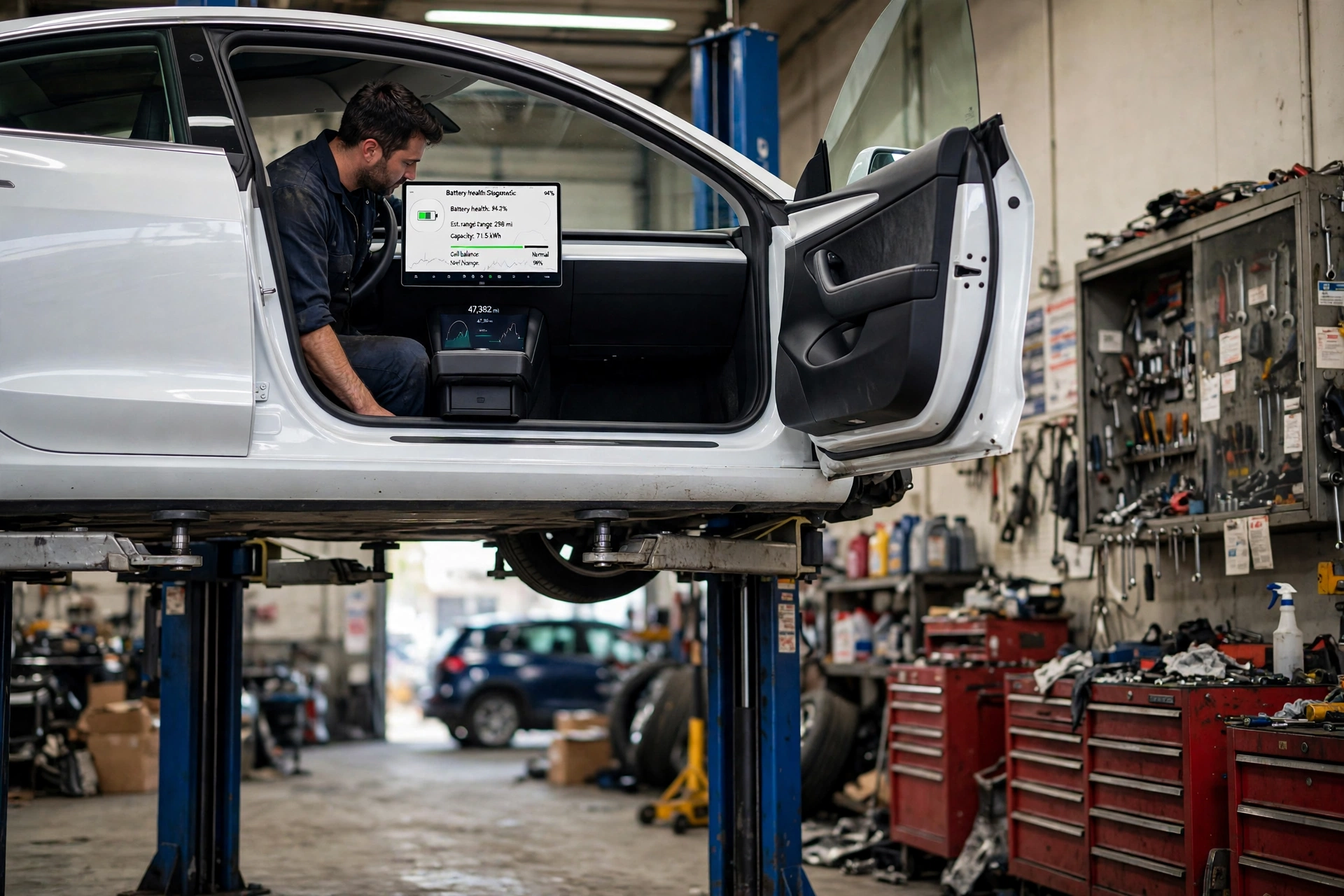
Put a Tesla with 90,000 miles on the odometer on a lift, plug it in overnight, and run a 90000 mile tesla battery test, and the result upsets two groups of people at once. It upsets the seller who swore the battery was “basically new,” and it upsets the buyer who arrived expecting a dying pack and a huge discount. The honest answer sits in the middle: a typical Tesla at this mileage has lost somewhere between 8% and 12% of its original battery capacity. That is a real loss you can measure in miles. It is not a reason to fear the car.
Before you negotiate, a 90000 mile tesla battery test gives you the number that matters more than the odometer reading. This 90000 mile tesla battery test summary explains what a healthy result looks like and what to budget next. Keep this 90000 mile tesla battery test guide handy when you compare two cars at the same mileage.
The biggest dataset on this comes from Aviloo, an Austrian battery diagnostics firm that has run roughly 500,000 battery tests worldwide since 2022. At 150,000 km — 93,205 miles, close enough to our 90,000-mile mark — the median Model Y still held 90.3% of its usable capacity, and the median Model 3 held 88.9%. Read that again. The middle-of-the-road Model 3, the car everyone worries about, kept nearly nine-tenths of its battery after the kind of mileage that sends most petrol engines to the rebuild shop.
Tesla’s own fleet numbers tell the same story. In its Impact Report, Tesla puts average capacity loss at about 12% after 200,000 miles for the Model S and Model X, and about 15% after 200,000 miles for Long Range versions of the Model 3 and Model Y. Recurrent, which tracks thousands of Teslas through their telematics, sees roughly 1% to 2% of range loss per year, with the steepest losses in the first 50,000 miles. Three sources, three methods, one shape of curve.
Here is what that looks like in the workshop. High-mileage Teslas come in with a clean battery report and a front end that clunks over every speed bump. The pack is rarely the problem at 90,000 miles. The control arms are. The 12-volt battery is. The tyres definitely are. This guide covers what the test shows, how to run it free, the warranty left, and the exact wear bill we would budget before buying one.
What a 90000 mile tesla battery test shows, model by model
Start with the two cars that make up most of the used market. A 90000 mile tesla battery test on a median Model 3 returns about 89% state of health, using Aviloo’s measured median at 93,205 miles. On a 2021 Model 3 Long Range AWD, rated at 353 miles when new, 89% works out to roughly 314 miles shown at a full charge. You have lost about 39 miles of range across five or six years of driving. Annoying on a long trip. Irrelevant to a 40-mile commute.
The Model Y does slightly better in the same dataset, holding a median of 90.3%. A 2021 Model Y Long Range, rated at 326 miles when new, lands near 294 miles at a full charge at this mileage. The Model S and Model X are harder to pin to one dataset, so the cleanest guide is Tesla’s own curve: 12% gone at 200,000 miles implies roughly 7% gone at 90,000 (est., interpolating Tesla’s published 200,000-mile figure). A 2020 Model S Long Range Plus rated at 402 miles would show around 374 miles. The big cars age gracefully.
The warranty floor puts these numbers in perspective. Tesla only promises 70% retention inside the warranty period. A healthy 90,000-mile car sits at 88–93%, which is 18 to 23 percentage points above the line where Tesla would owe you a pack. Recurrent’s data backs that gap up: outside of recalls, under 4% of the EVs it tracks have ever had a battery replaced at all. Packs wear. They seldom die.
Why two cars at 90,000 miles give different results
Four things explain most of that 13.5-point spread. The first is heat. Geotab’s 2025 update, built on 22,700 EVs, found cars in hot regions degrading roughly 0.4% per year faster than cars in mild climates. A Phoenix car and a Seattle car with identical odometers are not identical cars. Ask where the car lived, not just how far it drove.
The second is charging power. Geotab puts the overall average at 2.3% capacity loss per year across all EVs, but cars that leaned hard on DC fast charging above 100 kW averaged 3.0% per year, against about 1.5% for cars charged mostly on AC. Recurrent’s Tesla-specific work softens that a little — regular DC fast charging hurt the Model 3 and Model Y less than owners feared — but the direction never flips. Home charging is the kind habit.
The third is where the battery sat day to day. Packs parked at 100% or run to near-empty age faster than packs kept in the middle band. The fourth is chemistry. The lithium iron phosphate (LFP) pack in the rear-wheel-drive Model 3 tolerates being charged to 100% — Tesla tells those owners to do it weekly for calibration — and fleet experience puts LFP cars at the slow end of the Model 3’s degradation spread. Two Model 3s, same year, same miles, different chemistry, can be three or four points apart with nothing wrong with either of them.
Age counts too: calendar aging runs even when a car sits, so a 2019 car has had seven years of chemistry ticking over while a 2023 car did the same miles fast. We would take the younger high-miler for battery health — and either of them after seeing an actual test result.
How to run the 90000 mile tesla battery test in the car
Tesla built the real test into the car, and it costs nothing. Since software version 2025.8.3, the touchscreen carries a Battery Health test that discharges the pack, rests it, measures cell voltages at the extremes, then charges it back to full and reports your remaining capacity as a percentage of new. There are two ways to run a 90000 mile tesla battery test — this built-in one, and the quick overnight check in the next section — and the built-in one is the number a serious negotiation should rest on.
- Update the car to software 2025.8.3 or later, and update the Tesla app while you are at it.
- Drive the battery down to 20% or below. The test needs a low starting charge to measure the full sweep.
- Park and plug into AC charging — a Wall Connector or Mobile Connector delivering at least 5 kW. A Supercharger will not do; this is a slow, deliberate cycle.
- On the touchscreen, go to Controls, then Service, then Battery Health, and tap Start Test. Read the warnings first. Some versions ask you to authorise the test by holding the turn-signal stalk up while pressing the brake pedal.
- Leave the car alone, plugged in, for up to 24 hours. It will drain the pack to near empty, rest, then charge to 100%. Fans run hard, the screen may go dark, and climate and Sentry Mode switch off for stretches. Do not unplug it mid-test.
- Read the result: a percentage of original capacity, and a freshly recalibrated range figure that is often a few miles kinder than the one you had been seeing, because the battery management system finally knows where the bottom of the pack really is.
Two ground rules. Run it at most about once every six months — each run is a full deep cycle the pack did not need. And if you are buying, insist the test happens before money moves.
The overnight 90000 mile tesla battery test check
No time for the full cycle? The five-minute version gets you within a couple of points, and it is the check to use in a seller’s driveway. You are comparing the range shown at a full charge against the car’s rated range when new.
- Switch the battery readout from percentage to distance: Controls, Display, then set Energy Display to show miles.
- Charge to 100% and let it finish — wait for the “charging complete” message, not just the moment the counter first touches 100.
- Note the displayed miles immediately.
- Divide by the car’s rated range when new and multiply by 100. That is your state-of-health estimate.
Worked example: a 2020 Model 3 Long Range was rated at 322 miles when new. At 91,000 miles it charges to 100% and shows 287 miles. 287 divided by 322 is 0.891 — about 89% health, squarely on the Aviloo median. No fault. No story. Just a normal pack.
Treat the result as an estimate with a margin of about two points either way. The displayed figure is the battery management system’s best guess, and it drifts if the car has lived between 40% and 70% charge for months. A couple of full charges pull it back into line. If the two checks disagree wildly, believe the in-car test — it measured the pack; the overnight check only asked it a question.
What battery warranty is left at 90,000 miles
This is where the trim badge matters more than the test result. Tesla’s Battery and Drive Unit Limited Warranty runs eight years with a mileage cap that depends on the car, and at least 70% capacity retention inside that window. Confirm the terms for each model on Tesla’s official vehicle warranty page; the cover left on a specific car shows in its Tesla account.
| Model | Battery warranty cap | Cover left at 90,000 miles |
|---|---|---|
| Model 3 / Model Y Rear-Wheel Drive | 8 years or 100,000 miles | 10,000 miles |
| Model 3 / Model Y Long Range and Performance | 8 years or 120,000 miles | 30,000 miles |
| Model S / Model X | 8 years or 150,000 miles | 60,000 miles |
The rear-wheel-drive cars are the trap. At 90,000 miles a Model 3 RWD has 10,000 miles of battery cover left — a year of average driving — and after that the pack is your financial problem. The Long Range car beside it carries three times the remaining cover. Pay the small premium for the Long Range at this mileage; the extra warranty alone is worth it.
Mind the calendar as well as the odometer. The eight years run from the day the first owner took delivery, not from the model year on the badge. A 2018 Model 3 is out of battery warranty in 2026 even at 60,000 miles, and a 90,000-mile 2019 car has months left, not years. The basic vehicle warranty — four years or 50,000 miles — is long gone on every car in this guide, so every suspension, screen and door-handle fault we cover next comes out of the owner’s pocket.
Beyond the battery: the rest of the 90,000-mile inspection
With the car on the lift, this is the list we work through. Prices are US figures, parts and labour, checked October 25, 2026; independents usually beat Tesla’s own service pricing.
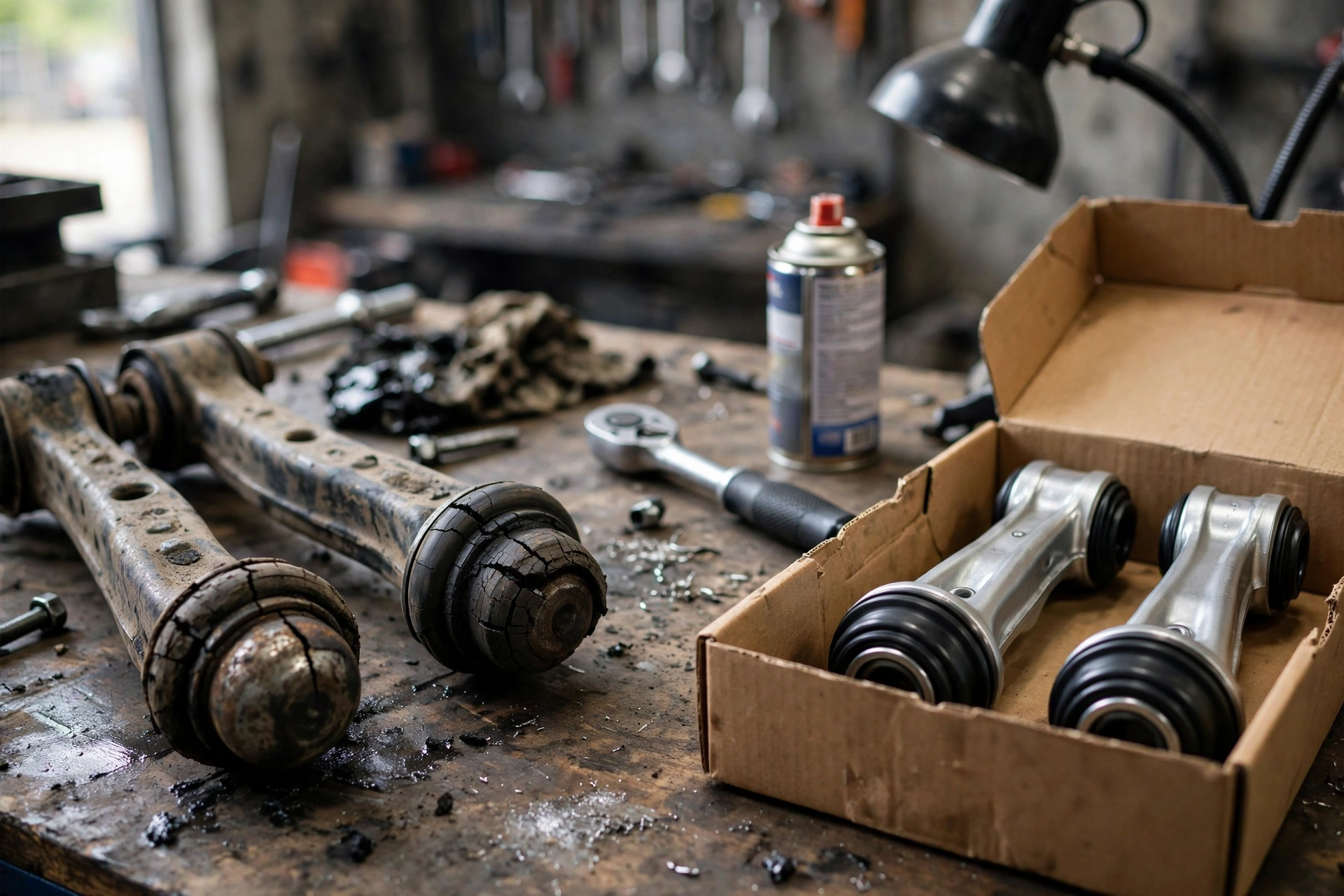
Front upper control arms. The classic Model 3 and Model Y wear item. The ball joint dries out and the arm starts to squeak over speed bumps, then creak, then develop play. Grab the top of the front wheel and push and pull; a clunk is a failed joint. Owner-reported invoices put one arm at about $300 fitted at 90,000 miles, and most cars want the pair, so budget $580 for both sides at an independent (est., based on owner-reported invoices through 2026). Lower lateral and compliance bushes crack with age too — another $350 or so if they have gone (est.).
The 12-volt battery. On cars with the lead-acid auxiliary battery, this is a consumable with a two-to-four-year appetite, and it fails with theatrical timing — a dead 12-volt can leave a car with a full main pack refusing to wake up. The part is $85–$120; Tesla mobile service fits one for roughly $130–$160 all-in. Cars from 2022 onward mostly carry the lithium-ion low-voltage battery, which lasts far longer. Ask when it was last changed; “never” is a small bill already in the post.
Tyres. A heavy car with instant torque eats tyres, and at 90,000 miles most cars are on their third set or due one. Owner-reported costs run $900 for a set of Michelins fitted to a Model 3, up to about $1,200 for the original-equipment tyres. Check the inner edges of the rears; worn bushes and tired alignment show up there first.
The cheap lines. Brake fluid should be tested and, on most cars by this mileage, changed: about $165 (est.). Cabin filters are $30–$60 and a ten-minute job. Brake pads are usually still the factory set — regenerative braking does the work — so a seller advertising “new pads all round” at 90,000 miles is decorating the advert.
Battery coolant is a lifetime fill on the Model 3 and Model Y. Drive units fail rarely at this mileage; a replacement shows up in owner reports around $2,000 using a used unit (est.), a negotiation point rather than a routine expectation. One test worth doing on a pre-heat-pump Model 3: run the cabin heater on full blast, because the resistive PTC heater costs four figures when it dies (est.).
The 90000 mile tesla battery test budget: our own arithmetic
Here is the computation we run before advising anyone on one of these cars: two Model 3s, the measured degradation data applied, then the likely 90,000-mile service bill totalled.
Model 3 RWD (2022, LFP pack), 272 miles rated when new. We estimate 91% health at 90,000 miles (est.) — Aviloo does not split the Model 3 by chemistry, but LFP packs sit at the slow end of the model’s measured spread, which is dominated by older nickel-chemistry cars. 272 × 0.91 = 247.5, so call it 248 miles at a full charge. Range lost: about 24 miles.
Model 3 Long Range AWD (2021), 353 miles rated when new. Apply Aviloo’s Model 3 median of 88.9% directly: 353 × 0.889 = 313.8, so about 314 miles at a full charge. Range lost: about 39 miles. The Long Range gives back more miles because it had more to give, and it still ends the day 66 miles ahead of the RWD car.
The wear-and-service bill at 90,000 miles. Front upper control arms, pair, fitted: $580 (est.). 12-volt battery fitted: $135. Brake fluid change: $165 (est.). Cabin filters: $60. Wheel alignment after the suspension work: $129 (est.). Add them up: $580 + $135 = $715; $715 + $165 = $880; $880 + $60 = $940; $940 + $129 = $1,069. If the car also needs its tyres — and a third of the ones we see do — add $980 for a decent set of four and the honest worst case is $2,049. That is the whole 90000 mile tesla battery test budget for a typical car: about a thousand dollars of ordinary wear, two thousand if the rubber is shot, and nothing at all for the battery.
Hold that against the scare number. An out-of-warranty pack replacement runs well into five figures — our guide to Tesla battery replacement costs has the breakdown — but at 90,000 miles it is a remote contingency, not a budget line. At observed loss rates the typical pack takes 15 to 30 years to reach the 70% warranty floor, per Recurrent’s Tesla battery lifespan research. Sanity-check any replacement quote with our EV battery replacement cost estimator.
Buying a used Tesla at 90,000 miles
The playbook is short. Before the viewing, ask the seller to run the in-car battery health test and send the result with the odometer in the same photo. At the viewing, do the overnight maths yourself on a full charge, then work the inspection list: push and pull the front wheels for control-arm play, check the inner rear tyre edges, test the heater hard, and ask for the 12-volt battery’s age. Check the remaining battery warranty on the car’s own account screen, not from the seller’s memory.
Price what you find, not the mileage. A clean 90,000-mile Long Range with an 89% test result, fresh control arms and 30,000 miles of battery cover left beats a 70,000-mile car with a clunk, bald rears and no test result — our running list of Tesla Model Y problems covers the same failure patterns on the crossover. Expect to pay roughly $17,000–$20,000 for a 2020–2021 Model 3 Long Range at this mileage (est., from asking prices for comparable cars in October 2026). And skip the glossy third-party battery certificates companies sell for a few hundred dollars. They tell you less than the free test already in the car. Keep the money.
Verdict: our scores at 90,000 miles
Model 3 — Our score: 7.8/10. Battery 8/10, Wear items 6/10, Value 9/10. The median pack result is strong, parts are cheap and everywhere, and used prices finally make sense. The front suspension is the tax you pay.
Model Y — Our score: 7.6/10. Battery 8/10, Wear items 6/10, Value 8/10. The best median battery figure of the four (90.3% in the Aviloo data), the same control-arm appetite as the Model 3, and firmer resale prices.
Model S — Our score: 7.0/10. Battery 8/10, Wear items 5/10, Value 7/10. A kind degradation curve and 60,000 miles of battery cover remain at 90,000, but air suspension and ageing electronics write bigger cheques than anything on a Model 3.
Model X — Our score: 6.5/10. Battery 8/10, Wear items 4/10, Value 6/10. The same healthy pack story, the most complex doors and suspension in the range, and a well-documented half-shaft shudder under hard acceleration. Buy one with a reserve fund, not on a whim.
90000 mile tesla battery test: your questions
What should a 90000 mile tesla battery test show on a healthy car?
Between 87% and 93% for most cars. The measured medians are 88.9% for the Model 3 and 90.3% for the Model Y at 93,205 miles. Anything at or above 85% is a normal, honest pack. Below 80%, dig deeper — and if the car is still in warranty, get Tesla’s own diagnostic on record, because the floor is 70% and a steep trajectory matters.
Is 90,000 miles too many for a used Tesla?
No. The battery data says the pack will outlast most of the rest of the car, and with the basic warranty gone at 50,000 miles, the surprises at 90,000 are suspension arms and tyres, not five-figure components. Buy on test results, service history and remaining battery cover, not the odometer alone.
How long does the in-car battery health test take?
Up to 24 hours. The car discharges to near empty, rests, and charges back to 100% on AC power, sitting unusable for much of it. Plan it for a day you do not need the car, keep it plugged in, and ignore the loud fans — they are part of the process.
Does lots of Supercharging wreck the battery by 90,000 miles?
It costs some capacity, not the pack. Geotab’s data puts heavy high-power DC users at about 3.0% loss per year against 1.5% for AC-heavy cars, and Recurrent found the effect smaller still on the Model 3 and Model Y. A Supercharger-heavy car testing three or four points below the median has lived a harder life; price it accordingly rather than walking away on principle.