Last updated: October 25, 2026
Three ways to pay for a broken Tesla windshield walk into this article, and only one walks out with your money’s respect. There’s the tesla windshield protection plan, Tesla’s own monthly subscription sold inside the app. There’s your insurer’s glass cover, riding on your comprehensive policy. And there’s the oldest product in the business: you, paying cash, absorbing the hit.
I’m refereeing this round by round, scores on the table, because that’s the only honest way to judge a product whose value depends on how often stones hit your glass. So be honest about your roads. Not the roads you wish you drove — the gravel shoulders, the construction corridors, the lorry shedding grit ahead of you. Your answer decides this fight before the first bell.
Here’s the shape of the contest. The plan charges you every month whether anything happens or not. Insurance asks for a deductible at the worst possible moment. Cash charges you nothing at all right up until it charges you everything at once. Each contender wins at least one round outright, and anyone who tells you there’s a single correct answer for every Tesla owner is selling you something — possibly a subscription.
The stakes are high because Tesla glass is genuinely expensive glass. The cameras that run Autopilot and Full Self-Driving sit behind the windshield, mounted to it, and every replacement ends with a calibration procedure — Tesla’s own routine includes a driver-assistance reset, a forward-camera aim check against a target, and entering the new glass’s part number into the car. Raked, oversized panes, the panoramic Model X windshield that runs up over the front seats, and a thin aftermarket supply chain push quotes up.
One dated 2024 OEM quote for a 2020 Model X came to $3,418.50 before calibration. That’s not a windscreen. That’s a small holiday.
My scoring, so you can argue with it properly: five rounds, ten points each, no sympathy marks — what you pay when nothing happens, the day a chip appears, the day the glass breaks, getting the job done right, and the fine print, where claims go to die. Running score after every round. Let’s get to it.
What the tesla windshield protection plan actually covers — the terms, decoded
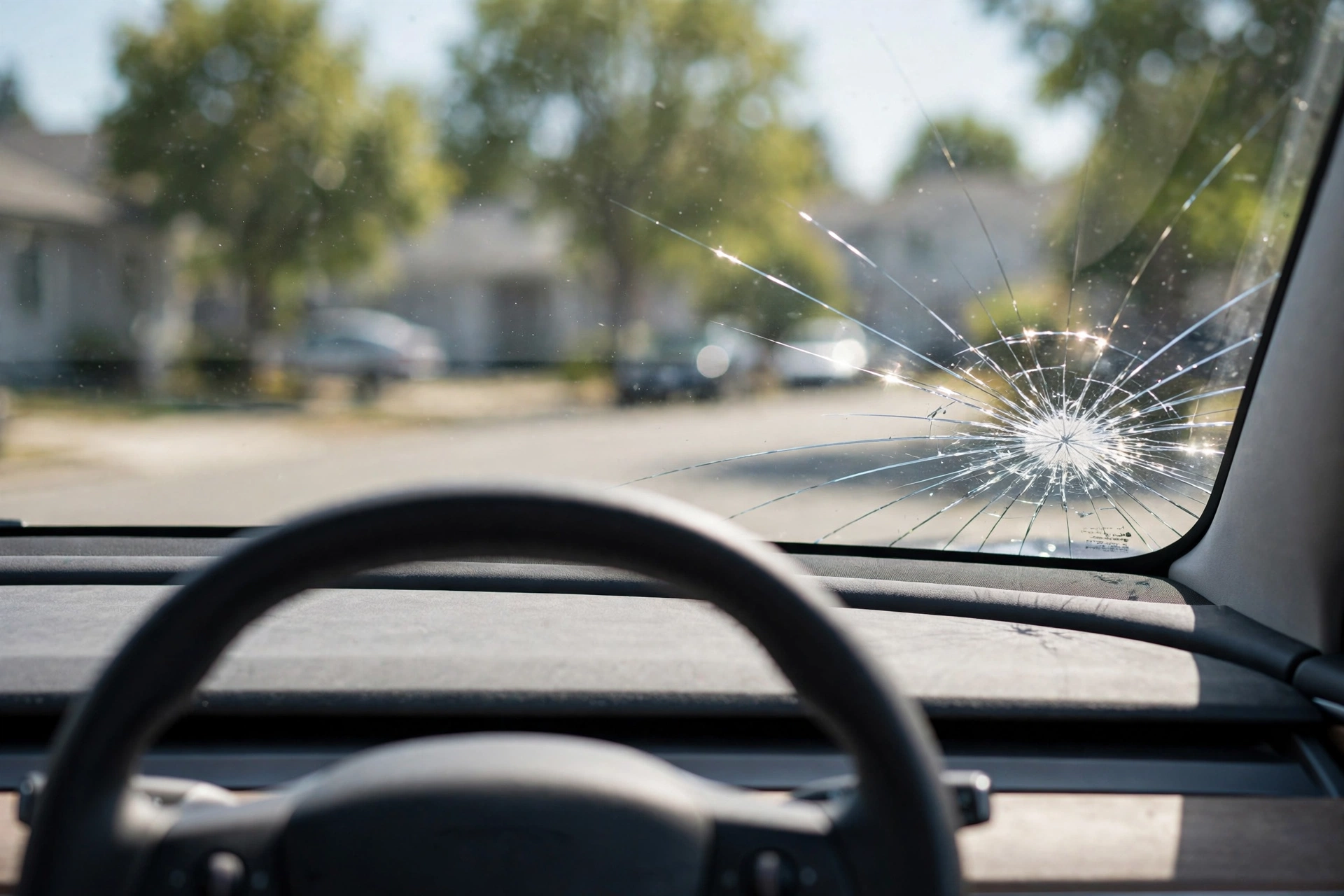
Tesla launched the plan in June 2025, US only, sold through the Tesla app as a month-to-month subscription. No long-term contract; cancel whenever you like. Per Tesla’s own support page for the plan, the coverage is deliberately narrow: front windshield only, for as long as your subscription stays active.
The money first, because that’s what you’re here for. Monthly pricing, checked October 25, 2026:
| Model | Per month | Per year |
|---|---|---|
| Model 3 | $16 | $192 |
| Model Y | $16 | $192 |
| Model S | $20 | $240 |
| Model X | $23 | $276 |
| Cybertruck | $25 | $300 |
What those payments buy: unlimited repairs for chips and minor cracks, at no extra charge. Plus up to one full front windshield replacement free in every 12-month period, counted from your enrollment date. A second replacement inside the same 12 months carries a $100 deductible, and so does a third. The glass is Tesla’s, fitted by Tesla Service, calibration handled as part of the job rather than billed as a surprise extra.
Now the part Tesla doesn’t headline. These prices have moved twice, and coverage didn’t improve either time. The plan launched at $12 a month for Model 3 and Model Y, $15 for Model S, $23 for Model X. On January 1, 2026, the 3/Y price jumped 33% to $16 — Drive Tesla Canada documented the subscriber emails when the rise landed.
The Cybertruck joined in August 2025 at $35 a month, then dropped to $25 on October 1, 2026. Read that pattern like a referee reads a record: Tesla prices from claims data, not generosity. When your model’s price rises, Tesla is telling you its glass breaks often enough to matter.
Enrollment has a gate. Buy a new or used Tesla and you can subscribe in the app within 30 days of delivery. Own the car already? Your windshield gets inspected at a Service Center first, because the plan refuses damage that already exists — more in the exclusions section.
One wrinkle: 2026 Model S and X cars ordered on or after August 15, 2025 arrived with the Luxe Package, bundling four years of this plan. If that’s your car, you’re covered. Do not pay twice for the same glass.
What a Tesla windshield really costs when you’re the one paying
Before anyone can judge the tesla windshield protection plan at $16 a month, you need the cash price of the thing it replaces. Here it is, with the honest mess left in, because Tesla windshield quotes swing wildly by glass source, model year, and postcode:
| Model | Typical fitted replacement, owner-paid (est.) | Dated OEM quote for reference |
|---|---|---|
| Model 3 | $1,100–$1,600 | $2,443.78 (2021 car, US Auto Glass, 2024) |
| Model Y | $1,200–$1,800 | $2,532.59 (2023 car, US Auto Glass, 2024) |
| Model S | $1,300–$2,000 | $1,773.07 (2018 car, US Auto Glass, 2024) |
| Model X | $2,200–$3,400 | $3,418.50 (2020 car, US Auto Glass, 2024) |
| Cybertruck | $2,200+ fitted (est.) | $1,900 for the glass alone (Tesla parts catalogue, Dec 2023) |
The typical ranges are (est.), built from 2024–2026 US quote data across Tesla Service Centers and independent shops; the dated quotes are single published figures, so you can see the ceiling as well as the middle.
Calibration, billed separately, adds roughly $200–$400. The cheapest route — aftermarket glass from an independent — can undercut all of this: one live September 2026 quote put a 2021 Model 3 at $536 fitted, around $846 with a realistic calibration allowance (est.). The cameras notice cheap glass before you do.
Chips are the smaller bill, and the common one. A single repair at a national chain of the Safelite class runs $65–$150, with ~$130 a fair planning figure. Small money — until the chip you ignored in March becomes July’s crack, converting a $130 repair into a $1,400 replacement. Glass damage is a debt that compounds.
Tesla owners already live with four-figure parts exposure elsewhere — the figures in our Tesla battery replacement cost guide make a windshield look almost friendly, and glass chips appear among the niggles catalogued in our Model Y problems breakdown. The windshield is simply the expensive part most likely to bill you in any given year.
The tesla windshield protection plan vs insurance glass cover vs cash: the rounds
Round 1 — what you pay when nothing happens. Cash wins without throwing a punch: zero, every month, forever. Insurance takes second — a full-glass add-on, where offered, runs about $10–$30 a month (est.), and plain comprehensive costs nothing extra until you claim. The plan finishes last because its meter never stops: $192 to $300 a year in exchange for the possibility of a stone.
Scores: Cash 10, Insurance 6, Plan 4. Running total: Cash 10, Insurance 6, Plan 4.
Round 2 — a chip appears. Total reversal. The plan covers unlimited chip and minor crack repairs free, so the round is a walkover: spot it, book it, done. Insurance takes second because many insurers waive the deductible for repairs — a fixed chip costs them less than a replacement — so your chip is often free too, with more phone calls attached.
Cash pays ~$130 a time and, worse, tempts you to skip it. Scores: Plan 10, Insurance 8, Cash 6. Running total: Plan 14, Cash 16, Insurance 14.
Round 3 — the glass breaks outright. This is the round the plan exists for. One replacement per 12 months at no charge, Tesla glass, calibration included: for a Model X owner staring at a $3,418.50-class quote, that’s the best outcome on the card. Insurance lands in the middle — you pay your comprehensive deductible, commonly $250–$1,000, unless you live in Florida, Kentucky or South Carolina, where state law bars deductibles on windshield replacement under comprehensive policies; there, insurance scores a 10, and we will return to that.
Cash takes the full quote to the chin. Scores: Plan 10, Insurance 6, Cash 2. Running total: Plan 24, Insurance 20, Cash 18.
Round 4 — getting the job done right. The plan’s quiet strength. The work happens inside Tesla’s own service system, with the camera aim check and part-number entry done by the people who wrote the checklist. Insurance-funded work goes wherever you choose, and calibration quality at generalist glass shops varies — a sloppy aim check is a safety issue, not a cosmetic one.
Cash buys the same spread of shops, plus the job of vetting yours. Scores: Plan 10, Insurance 7, Cash 7. Running total: Plan 34, Insurance 27, Cash 25.
Round 5 — the fine print. Cash wins again, because cash has no terms and conditions; it has never once denied a claim. Insurance sits in the middle: broad causes, any glass on the car, against a claims record that follows you and a deductible that resets each incident. The plan brings up the rear — front glass only, whole categories excluded, a hard refusal on pre-existing damage.
Scores: Cash 10, Insurance 7, Plan 5. Final card: Plan 39, Cash 35, Insurance 32. Read that card properly. The plan won rounds two, three and four — the rounds where damage happens. If your life contains no round two or three, cash won your fight 20–4 in the rounds that occurred.
The tesla windshield protection plan break-even maths: how many years of payments buy one windshield?
Enough judging on feel. Here is the computation, arithmetic on the table. Take a planning figure (est.) for one fitted replacement — the middle of each range above — and divide by a year of payments:
- Model 3: $1,350 (est.) ÷ $192 per year = 7.0 years of payments per replacement.
- Model Y: $1,500 (est.) ÷ $192 per year = 7.8 years of payments per replacement.
- Model S: $1,650 (est.) ÷ $240 per year = 6.9 years of payments per replacement.
- Model X: $2,800 (est.) ÷ $276 per year = 10.1 years of payments per replacement.
- Cybertruck: $2,200 (est.) ÷ $300 per year = 7.3 years of payments per replacement.
Translation: on replacements alone, the tesla windshield protection plan pays for itself if you break a windshield more often than roughly once every seven to ten years, depending on model. Chips change the picture faster. At ~$130 a repair, a Model 3 or Y plan breaks even on chip repairs alone at $192 ÷ $130 = 1.5 repairs a year.
The Model X needs $276 ÷ $130 = 2.1 repairs a year on chips alone; its replacement maths, not its chips, carry its case — still the strongest of the five.
Now run two drivers through it, (est.) from the frequencies above. Driver one: 25,000 miles a year, construction corridors, winter grit — 1.5 chip repairs a year ($195) plus one replacement every four years ($1,500 ÷ 4 = $375 a year). Expected cash cost: about $570 a year, against $192 for the Model Y plan. The plan wins by roughly $378 a year, and it isn’t close.
Driver two: 9,000 miles a year, garaged, clean suburbs — one chip every five years ($26 a year), one replacement every fifteen ($100 a year). Expected cash cost: about $126 a year. Self-insuring wins by about $66 a year, compounding quietly. Same product. Opposite verdicts. The variable is you.
This belongs in a whole-car budget, not a gut decision, which is why our EV total cost of ownership calculator counts subscriptions alongside energy and servicing. Sixteen dollars a month feels trivial. Across a decade it’s $1,920 — a windshield and a half, paid whether the stones came or not.
A quick word on range, since the title insists
This article’s template title promises “real-world range,” so let’s settle it in one passage: a chipped windshield costs you precisely zero miles of range. So does a cracked one, right up until the crack reaches the camera cluster and the car starts refusing features you paid for.
The only range at stake here is how far your money travels — $192 a year in small steps, or a four-figure bill in one. Glass damage is a wallet-range problem. Anyone who tells you otherwise is padding word count, and I refuse to.
The exclusions that decide tesla windshield protection plan claims
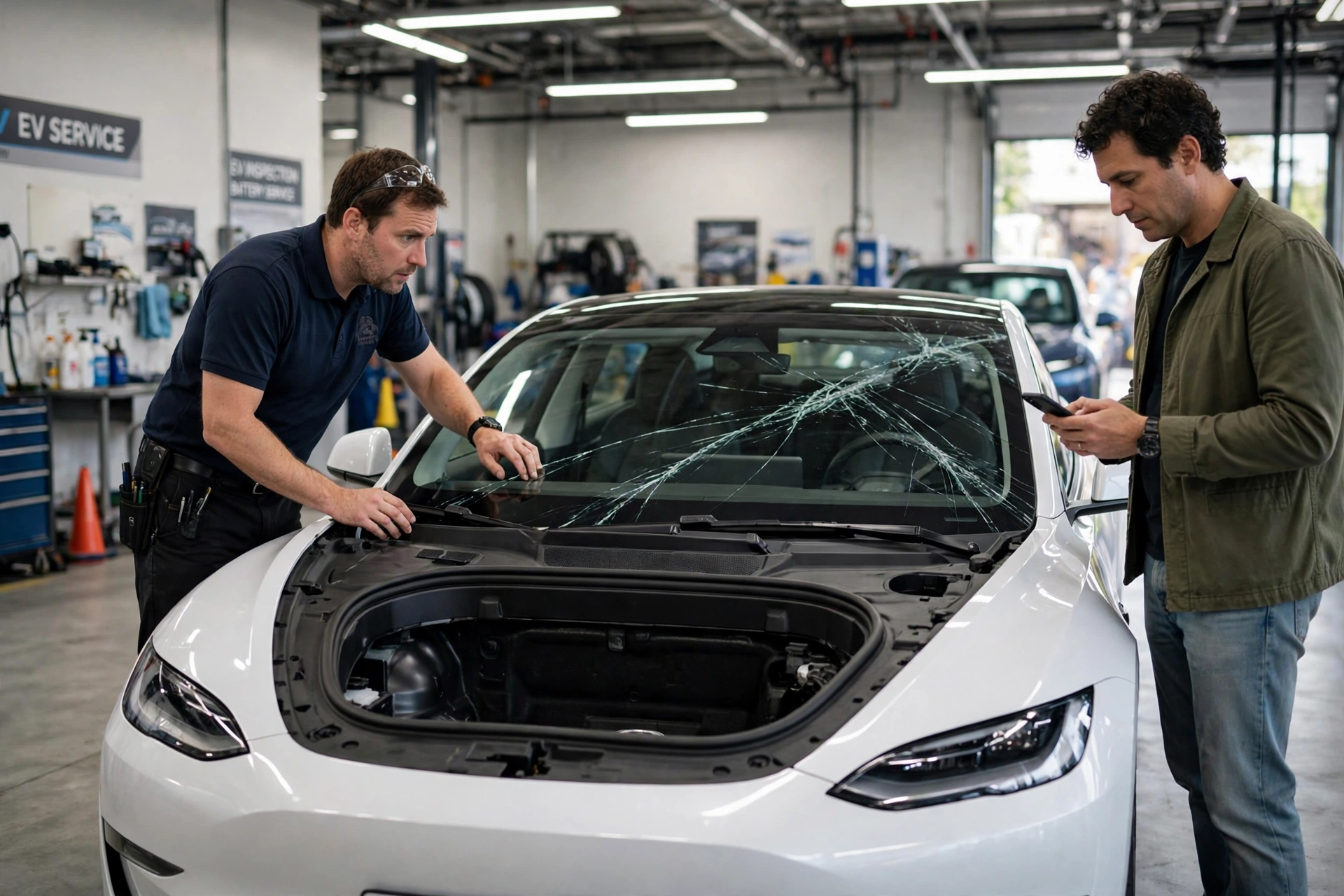
Round five deserves its own section, because this is where real claims live or die. Read these before you subscribe, not after the crack.
Pre-existing damage is excluded. Tesla’s terms rule out events before your subscription’s effective date — precisely why existing owners face an inspection before enrollment. A chip you already have is your chip forever. Subscribing after the stone hits is a small fraud the inspection exists to catch.
The cause of damage matters. Collision damage: excluded. Vandalism: excluded. Weather and natural disasters: excluded. The plan is built around road-debris damage — the stone flick, the grit strike — and quietly steps aside for the dramatic stuff. Your comprehensive insurance, for all its deductible sins, does cover those causes, which is why the two products aren’t the direct substitutes their marketing suggests.
Front windshield only. Not the glass roof. Not the rear window. Not a side window. On a Model X, the enormous panoramic front pane is covered and the rest of that glasshouse is not. Price your risk accordingly.
One free replacement per 12 months, full stop. The counter runs from your enrollment date, not the calendar year. A second replacement inside the window costs a $100 deductible; a third costs another $100. Fair terms, honestly. Drivers on brutal routes should still notice the plan’s generosity has a ceiling, and the ceiling is one.
The work happens at Tesla. There is no “my glass guy did it, reimburse me” route. Tesla Service does the work, on Tesla’s schedule, with Tesla glass. For calibration quality that’s a strength. Three hours from the nearest service center, it’s a logistics problem wearing a subscription’s clothes.
Terms and prices can change — and have, twice in the plan’s first eighteen months. A lapsed subscription means lapsed coverage, and rejoining means the inspection gate again, with whatever your windshield collected in the meantime.
Who should buy the tesla windshield protection plan — and who should walk away
Buy it, without much agonising, if you’re a Model X owner. Ten years of payments per replacement is the best break-even ratio in the range, the glass is the most exposed and the most expensive, and one bad winter pays for years of subscription. Buy it if your commute runs through construction zones, quarries or gritting routes and your honest chip count is one or more a year.
Buy it if your deductible sits at $1,000 with no glass add-on available: your realistic alternative is a $1,000 deductible against a $1,350–$1,500 bill, insurance in name only. And check your paperwork if you bought a 2026 Model S or X after mid-August 2025 — Luxe Package cars may already carry four years of it.
Walk away if you carry comprehensive cover in Florida, Kentucky or South Carolina. State law already gives you $0-deductible windshield replacement; paying Tesla on top of that is buying a second umbrella while standing indoors, and I will not pretend otherwise to fill a verdict.
Walk away if your car is garaged, low-mileage and suburban — the maths above ran your profile and cash won. Walk away if you already pay for a $0-deductible full-glass rider; the overlap is nearly total. And walk away if you plan to sell the car within a year or so (est.): the plan’s value concentrates in a replacement you probably won’t claim before the car goes.
The referee’s decision: scores for the tesla windshield protection plan
The judges’ cards, per model family, scored on Coverage (how much of your glass risk it actually absorbs), Cost (the subscription against the risk), and Value (the expected return on the payments):
Model 3 and Model Y — Our score: 6.5/10 (Coverage 7/10 · Cost 6/10 · Value 6/10). A fair product at $12 that became borderline at $16 — the 33% rise with zero added coverage cost it a full point on this card. For the average 3/Y owner on ordinary roads, self-insuring plus a $130 chip-repair habit beats it. High-mileage drivers on dirty roads, it still wins its rounds.
Model S and Model X — Our score: 7.8/10 (Coverage 7/10 · Cost 8/10 · Value 8/10). Same narrow coverage, far better maths. The X at $23 a month against a $2,800 planning figure (est.) is the strongest value in Tesla’s protection-plan catalogue; the S at $20 against $1,650 (est.) isn’t far behind. Expensive glass forgives a subscription many sins.
Cybertruck — Our score: 7.4/10 (Coverage 7/10 · Cost 7/10 · Value 8/10). The October 2026 cut from $35 to $25 rescued this score. Flat, vast, upright glass meets gravel roads for a living; $300 a year against $2,200+ fitted (est.) is a defensible bet.
Final word. The tesla windshield protection plan is a priced bet on your own roads, and Tesla showed you its odds by repricing twice in eighteen months. Count your chips from the last three years. If the number embarrasses you, subscribe. If you had to think hard to remember one, keep your $16 and be the house instead.
Frequently asked questions
How much does the tesla windshield protection plan cost?
$16 a month for Model 3 and Model Y, $20 for Model S, $23 for Model X and $25 for Cybertruck, checked October 25, 2026. It’s a rolling monthly subscription sold through the Tesla app, with no long-term commitment.
Does the plan cover a windshield that’s already cracked?
No. Damage from before your subscription’s effective date is excluded, and owners enrolling an existing car face a windshield inspection at a Tesla Service Center first. Subscribe before the stone, not after.
What happens if I need two windshields in one year?
The first replacement inside any 12-month period from enrollment is free. The second carries a $100 deductible, each further one another $100. Chip and minor crack repairs stay unlimited and free throughout.
Does the plan cover the glass roof or rear window?
No. Coverage applies to the front windshield only. Roof glass, rear glass and side windows are outside the plan, however expensive they turn out to be.
I live in Florida. Should I still subscribe?
Almost certainly not. Florida law prevents insurers from applying a deductible to windshield replacement under comprehensive cover, so your insurance already delivers the plan’s headline benefit. Kentucky and South Carolina drivers are in the same position.
Can I cancel the plan whenever I want?
Yes. There’s no long-term commitment, and coverage simply runs while the subscription is active. Cancelling and later rejoining means passing the windshield inspection again — with whatever damage the glass has collected in between excluded.
For drivers weighing the options, the tesla windshield protection plan is easiest to judge against your own chip history. If you drive gritty routes often, the tesla windshield protection plan can pay for itself through free repairs alone. Before subscribing, compare the tesla windshield protection plan with your deductible and any glass rider you already hold.
Another way to look at it is simple: the tesla windshield protection plan rewards drivers who actually claim, and it charges drivers who never claim. That is why the tesla windshield protection plan suits high-mileage drivers better than garaged, low-mileage drivers. Before you decide, price the tesla windshield protection plan against one replacement and one or two chip repairs. In short, the tesla windshield protection plan is a bet on your roads, not a bet on Tesla alone.