Last updated: October 25, 2026
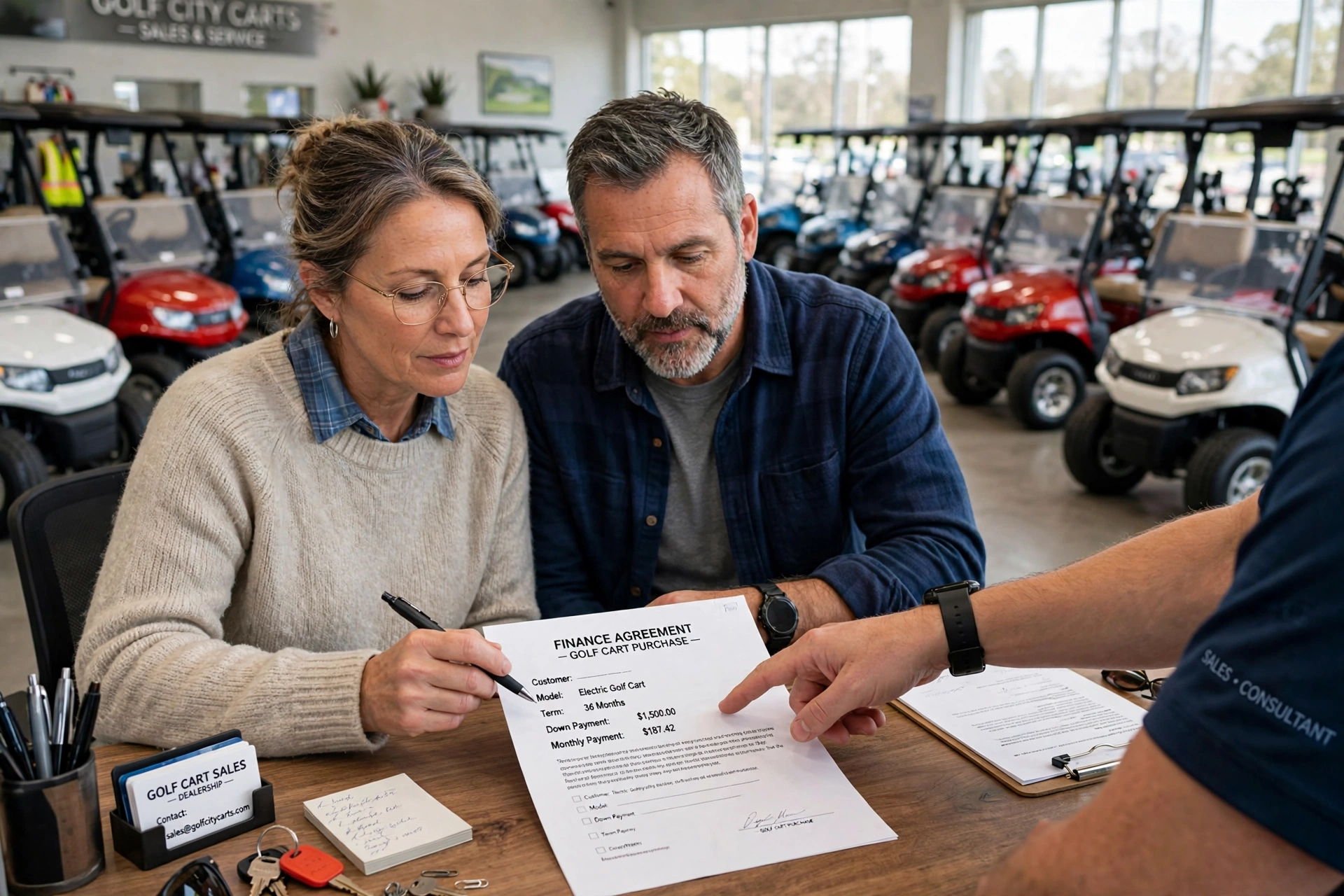
Golf cart financing has a headline rate and a real rate, and this fall the two have drifted far apart. Dealers are advertising 0% APR on new Club Car and E-Z-GO carts through December 31, 2026. The standard loan on the same showroom floor starts at 6.99%. The branded credit card in the desk drawer sits at 15.99%. Same cart, three wildly different prices.
The headline first. Sheffield Financial, the lender behind most Club Car and E-Z-GO dealer deals, is running 0% for 36 or 48 months on new Club Cars and 0% for 24 or 36 months on E-Z-GOs, with a rate ladder behind the promos: 1.99%, 2.99%, 4.99%, out to 60 months. E-Z-GO’s Aqua Finance plans stretch all the way to 84 months at 5.99%. Zero down is on the table for qualified buyers.
Now the catch, because there is one. Several dealers publishing full program terms attach a “convenience fee” to the 0% deals: 5.50% of the amount financed on Club Car’s 0% for 48 months, 5.75% on E-Z-GO’s 0% for 36 months. On a $12,000 cart, that fee is $660, due inside the loan before your first payment. Still cheap money. Not free money.
What to do with all this: if your credit score starts with a 7, shop the promo menu first, and do it before New Year. If it doesn’t, get a credit union quote in your pocket before you sit down at a dealer desk. Everything below is the arithmetic behind those two moves, with rates checked October 25, 2026.
Golf cart financing rates right now: the October 2026 snapshot
Four numbers define the market this month.
0%. The manufacturer promo rate, on new carts, for strong credit. Club Car’s Sheffield promotions are spelled out on dealer pages like Metro Golf Cars’ financing page: 0% for 36 months, zero down, on new Onward, Villager and XRT models. Read the fine print at your dealer, because some published Club Car programs exclude specific models, including the Onward 4 Forward LSV.
6.00%. The credit union benchmark. Eglin Federal Credit Union is advertising 6.00% APR on street-legal golf cart loans up to 60 months, with a 5% minimum down payment. That is a real, published, non-promotional rate, and it beats most dealer standard plans cold.
6.99%. The standard powersports floor. Roadrunner Financial, which lends across 40-plus cart brands, leads at 6.99% APR with terms from 24 to 72 months and a minimum FICO score of 550. If a dealer quotes you double digits on a new cart and your credit is decent, this is the number being ignored.
15.99%. The trap rate. Yamaha’s branded credit card starts at 15.99% APR, revolving. It is a payment card wearing a financing costume, and section eight of this guide does the damage in dollars.
Personal loans sit between the poles: unsecured, no lien on the cart, with good-credit APRs typically running about 9% to 13% (est., based on current national lender ranges). Home equity lines are cheaper on rate, around 8% to 9% (est.), and far more dangerous. Both get their own rows in the table next.
The four routes, side by side
Every golf cart financing deal in America comes through one of these four doors. Here is what each door costs in late 2026.
| Route | Typical APR now | Terms | Down payment | Works for used carts? |
|---|---|---|---|---|
| Dealer / manufacturer (Sheffield, DLL, Aqua Finance) | 0% promo; 2.99%–6.99% standard ladder | 24–84 months | 0%–10% | Sometimes — Sheffield finances carts up to 10 years old at participating dealers |
| Credit union / bank | From 6.00% (Eglin FCU, street-legal carts) | Up to 60 months typical | 5% minimum at Eglin | Yes, often with an age limit (3 model years at Eglin) |
| Personal loan (unsecured) | About 9%–13% for good credit (est.) | 24–60 months typical | None | Yes — the lender never sees the cart |
| Home equity / HELOC | About 8%–9% (est.) | 5–15 years | None, but your house is collateral | Yes |
Dealer financing wins on rate when a promo is live and loses on transparency. The desk quotes a monthly payment first and an APR second, and program fees hide inside the amount financed. Walk in knowing the promo menu exists and half the games stop working.
Credit unions win on honesty. The rate is the rate, the fee schedule is a page long, and Eglin will even refinance a dealer loan you signed within the last 180 days. The trade: membership requirements, an age cap on the cart, and at Eglin a street-legal-only rule.
Personal loans win on freedom. No lien, no age limit, no dealer involvement, and the cart is yours on paper from day one. You pay for that freedom in APR — typically 3 to 6 points above a credit union’s secured rate (est.).
Home equity wins on nothing that matters here. Yes, the rate undercuts a personal loan. The collateral is your house, the asset is a depreciating cart, and those two facts should never meet. My position on this route is in the verdict section, and it is not warm.
What the payment actually looks like at real cart prices
Sticker prices first, checked October 25, 2026. A basic new two-seat course cart runs $8,500 to $11,000. A standard four-seater lands between $11,500 and $15,000. A factory street-legal LSV runs $14,000 to $19,500, and it is the fastest-growing slice of the market: Club Car’s Onward 4 Forward LSV starts at $14,999, an E-Z-GO Liberty starts at $12,999 before its LSV package, and one Florida dealer lists a 2026 Liberty LSV Commuter at $16,424 out the door side of the lot.
Now the payments on real numbers.
An E-Z-GO RXV 4 starts at $10,049. Put down Eglin’s 5% minimum — $502.45 — and finance the remaining $9,546.55 for 60 months at 6.00% APR. Payment: $184.56 a month. Total interest over five years: $1,527.
That $16,087 Onward LSV at Roadrunner’s leading 6.99% over 60 months: $318.47 a month, and $3,021 of interest by the end. The interest alone buys a decent used course cart in some zip codes.
And the default dealer deal nobody should sign: $12,000 financed at 9.99% over 60 months is $254.91 a month and $3,294 in interest. Shoppers fixate on the $254.91. The $3,294 is the number that matters, and it is exactly the habit we push against in our guide to electric car cost per mile — the payment is marketing, the total is the truth.
The $12,000 test: one cart, four ways to pay
Here is our own worksheet. One cart, $12,000 out the door, no down payment, 48 months on every route so the comparison is clean. Interest computed on standard amortization; fees shown where the programs publish them.
| Route | Rate / fee | Monthly | Total paid | Cost of credit |
|---|---|---|---|---|
| Club Car promo via Sheffield | 0% APR + 5.50% convenience fee ($660, financed) | $263.75 | $12,660 | $660 |
| Credit union | 6.00% APR | $281.82 | $13,527 | $1,527 |
| Dealer standard | 9.99% APR | $304.29 | $14,606 | $2,606 |
| Personal loan | 11.99% APR (est., mid-range good-credit quote) | $315.95 | $15,165 | $3,165 |
Read the spread: $2,505 separates the cheapest route from the priciest on the same cart, the same term, the same day. Nothing about the cart changes. Only the paperwork does.
Two lessons fall out of the table. First, the fee-loaded 0% deal still wins by $867 over the credit union. A 5.50% one-time fee is simply cheaper than four years of 6.00% interest. Second, the personal loan’s flexibility costs real money — $2,505 against the promo — which is a fair price only if you genuinely need an older cart or a private-party sale.
Run your own version of this table before you visit a dealer. Our EV total cost of ownership calculator handles the running-cost side of the same question for full-size electric cars, and the discipline transfers: total first, monthly second.
Golf cart financing by credit score: which door opens for you
Your score decides which menu you see. The tiers, as lenders publish them this fall:
720 and up: the full menu. Promos, credit union best rates, the lot. If this is you, your only job is reading the fee line.
700 to 719: still promo country. Published Club Car program summaries put the Sheffield promo threshold at a 700 bureau risk score, so this band qualifies for 0% on the right cart at the right dealer.
660 to 699: prime standard territory. Expect 6.99% to 9.99% from powersports lenders, and get a credit union quote anyway — this is the band where the two quotes diverge most.
620 to 659: approvals get conditional. Rates typically land in the 10% to 15% zone (est., based on current subprime powersports ranges), terms shorten, and a bigger down payment starts doing real work: 20% down on a $12,000 loan at 9.99% cuts total interest from $3,294 to $2,635.
550 to 619: Roadrunner’s floor is 550 FICO, so a loan exists. It will not be pretty. Expect mid-teens APR or higher (est.), and treat any quote as a starting point for a credit-repair timeline, not a destination.
Under 550: the installment market mostly closes. Lease-to-own and buy-now-pay-later platforms approve on income instead of scores, and they cap out around $5,000, which buys accessories and budget carts, not a new LSV. A co-signer with a 700 score changes the conversation more than any other single move.
One timing trick inside the tiers: submit your applications inside a single 14-day window. Scoring models group clustered loan inquiries, so three quotes in two weeks cost you roughly what one quote costs. Three quotes in three months cost more.
Used carts: where golf cart financing gets thin
The promo menu is new-cart only. Full stop. That single fact reshapes the used market, because a five-year-old cart at $6,500 can end up costing more per month than it should once it is pushed onto an expensive loan.
What still works: Sheffield finances used carts up to 10 years old at participating dealers, and credit unions lend on recent used carts — Eglin’s program covers carts up to 3 model years old. Older than that, the personal loan is the last door open, because the lender is lending on you, not the cart.
What does not work: rent-to-own arithmetic. Published guides on used-cart rent-to-own deals show totals topping $8,000 on carts priced between $3,500 and $6,000, once fees and the buyout are counted. That is a second cart’s worth of money for the privilege of paying weekly.
The real used-cart risk is not the rate anyway. It is the battery. A lead-acid pack near the end of its life costs roughly $1,000 to $1,800 to replace (est.), and a lithium conversion runs $2,000 to $3,500 (est.). Neither shows up in the loan quote. Finance a used cart only after a load test on the pack, and price a tired pack as an immediate repair bill, because it is one.
The street-legal stack: costs that land after the loan
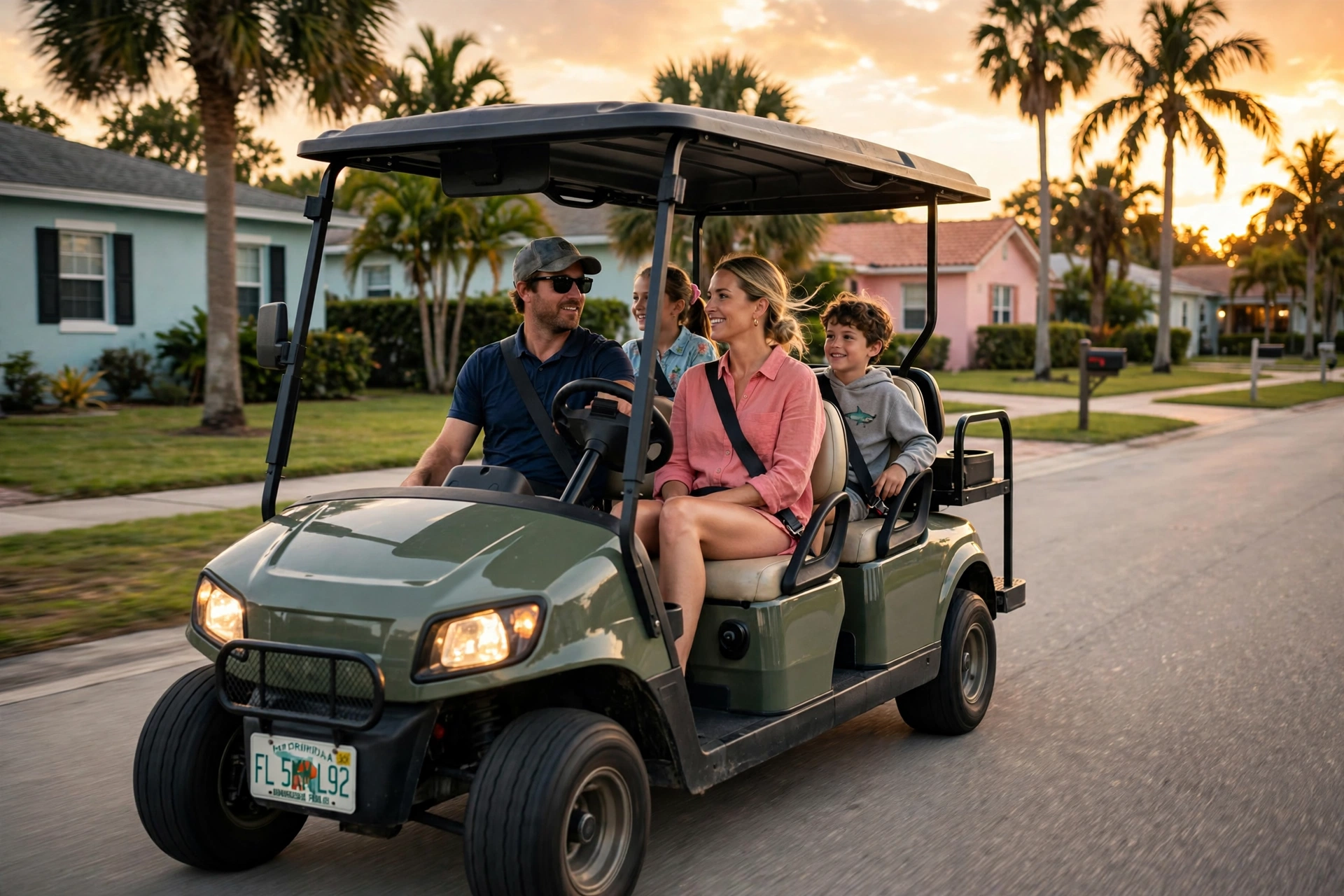
A street-legal LSV is a registered motor vehicle, and it bills you like one. Buyers who budget only the loan payment get surprised four times in the first month.
The vehicle premium. Factory LSV certification adds roughly $1,500 to $2,500 over the equivalent non-street-legal cart. Seatbelts, turn signals, mirrors, a 17-digit VIN and lighting are not free, and buying them factory-fitted is cheaper than converting later.
Title and registration. Using Florida, the biggest LSV state, as the worked example: an electronic title costs $77.25, and title, tag and plate fees at the tax collector typically total $350 to $400. Sales tax is settled at registration if the dealer did not collect it.
Insurance, which is mandatory. Florida requires $10,000 of Personal Injury Protection and $10,000 of Property Damage Liability before an LSV can be registered at all — no policy, no plate. Published estimates put liability-only cover at $100 to $200 a year and full coverage at $300 to $600 or more. Cheap next to car insurance. Not zero.
The conversion route costs too. Turning a plain cart into a titled LSV in Miami-Dade starts with a $40 nonrefundable inspection fee, plus parts receipts, a weight slip and the same title and insurance bills at the end. Add the street-legal parts themselves and most conversions land within a few hundred dollars of the factory premium, with more weekends spent on paperwork.
Total first-year stack beyond the loan, on a factory LSV: roughly $450 to $1,000 (est., combining the registration range and a year of insurance). Build it into the budget before you choose your down payment, not after.
Traps that quietly add four figures
Five of them, in the order they appear in a typical golf cart financing deal.
The convenience fee in a trench coat. “0% APR” with a 5.75% fee on the amount financed is a 5.75% charge for borrowing, disclosed in a different font. It can still be the cheapest money on the table — our $12,000 test says it is — but compare it as a cost, not as a slogan.
The rebate-or-rate fork. On the 2026 E-Z-GO RXV, the factory makes you choose: up to $1,500 off, or 0% for 48 months. Dealer arithmetic on a $10,000 balance over 48 months puts the interest you dodge at about $1,492 against a 6.99% loan and about $2,172 against a 9.99% loan. So the rule is mechanical: if your fallback rate tops roughly 7%, take the financing; if you are paying cash or borrowing under 7%, take the $1,500.
Accessories rolled into the loan. Wheels, a lift kit and a sound bar: $2,000 at the parts counter. Financed at 9.99% over 60 months, that same $2,000 costs $2,549. Pay cash for accessories. Always. No exceptions for Black Friday.
The extended warranty, financed. Dealer service contracts on carts commonly run $1,200 to $2,500 (est.). Roll a $1,800 contract into a 60-month loan at 9.99% and it costs $2,294 — you have paid $494 of interest to insure a vehicle whose most expensive wear item, the battery, is frequently excluded or prorated in the fine print. Read the exclusions before the price.
The 84-month stretch. At 5.99%, stretching $12,000 from 48 months to 84 drops the payment from $281.77 to $175.25 and adds $1,196 of interest — $2,721 total against $1,525. The cart is depreciating the whole time. Seven-year money on a golf cart is a bad trade at any APR, and it is the one term length I would strike from the industry entirely.
And one myth to close the section: no federal tax credit rescues a bad cart deal. Golf carts and LSVs do not qualify for the clean vehicle credits, which is part of the wider picture we lay out in are EVs worth buying without tax credits. Before you sign anything, run the contract against the CFPB’s checklist for finalizing a vehicle loan: APR, finance charge, amount financed, total of payments. If the dealer’s numbers and the disclosure form disagree, walk.
Timing: why the next nine weeks are the window
The promo calendar is the story. The Sheffield rate sheets dealers are publishing run through December 31, 2026. After that date, the 0% menu gets renegotiated, and nobody at a dealership will promise you it survives.
The model-year calendar helps too. 2027 carts are landing while 2026 stock still sits on lots, and a dealer carrying both model years into winter has two problems you can price. October through December is when floor space starts costing dealers money, and golf cart financing promos are one of the levers they pull to move metal.
Sequence for a buyer this month: pull a credit union preapproval first, then visit two dealers inside the same 14-day window, then let each dealer try to beat the number you already hold. If you signed a dealer loan in the last few months and the rate embarrasses you now, check the refinance window — Eglin, for one, will refinance a cart financed elsewhere within the last 180 days.
Verdict: scoring the golf cart financing routes
Our scores, on the late-2026 numbers, with Rate, Flexibility and Value sub-scores:
Dealer / manufacturer promo (Sheffield class): Our score: 8.7/10 — Rate 10/10 · Flexibility 6/10 · Value 9/10. The cheapest money in the market, chained to new carts, dealer desks and a fee line you must read.
Credit union: Our score: 8.2/10 — Rate 8/10 · Flexibility 7/10 · Value 9/10. The 6.00% Eglin benchmark is the best non-promo deal running, and the refinance window makes it the market’s built-in undo button.
Personal loan: Our score: 6.8/10 — Rate 5/10 · Flexibility 10/10 · Value 6/10. The only route that finances any cart, any age, from any seller. You pay $2,505 extra on our $12,000 test for that freedom. Sometimes that is the right trade. Know the price before you make it.
Home equity / HELOC: Our score: 4.9/10 — Rate 7/10 · Flexibility 5/10 · Value 3/10. The rate is fine. The structure is not. A golf cart loses value every single month it sits in your garage, and pledging a house against it inverts the risk of the entire purchase. Do not do this.
Golf cart financing questions, answered fast
How does golf cart financing work at a dealer?
You pick the cart, the dealer submits your application to a partner lender — most often Sheffield Financial for Club Car and E-Z-GO — and the loan is secured by the cart itself. Promotional programs set the rate menu; your credit score picks your row on it. Approval on strong files is same-day, and prequalification at many dealers is a soft inquiry that does not touch your score.
What credit score do I need to finance a golf cart?
Something at almost every level: Roadrunner approves from 550 FICO, prime rates generally start around 660, and the 0% promos sit at roughly 700 and above based on published program summaries. Below 550, expect lease-to-own caps around $5,000 or the need for a co-signer.
Can I finance a used golf cart?
Yes, with tighter rules. Sheffield finances used carts up to 10 years old at participating dealers, credit unions often cap at 3 model years, and personal loans impose no age limit at all. Budget for the battery separately: a tired lead-acid pack is a $1,000 to $1,800 repair (est.) that no lender will warn you about.
How long can I finance a golf cart for?
Terms run from 24 to 84 months depending on the lender. Sheffield’s programs centre on 36 to 60 months, Eglin’s cap is 60, and Aqua Finance offers the 84-month outlier. Our advice is a hard line: 60 months maximum, whatever the payment chart says.
Is 0% financing on a golf cart really 0%?
The interest rate is. The borrowing is not. Published dealer terms attach convenience fees of 3.75% to 5.75% of the amount financed to several 0% programs — $660 on a $12,000 Club Car deal — and some buyers must give up a cash rebate, worth up to $1,500 on the 2026 E-Z-GO RXV, to take the rate. Even after both charges, 0% usually wins. Run the fee, not the slogan.