Last updated: October 25, 2026
The mach e rally is Ford’s gravel-spec Mustang Mach-E, and on paper it reads like a toy for people who watch rallycross on Sundays. Here is the thing nobody tells you at the dealership: it is also the most family-friendly fast Mach-E Ford sells. The rally kit — softer suspension, all-weather tyres, an extra inch of ride height — reads like off-road theatre. In daily life it reads as comfort. Broken suburban tarmac, frost-heaved back roads, a muddy field standing in for a football car park: this is the Mach-E that shrugs at all of it, then does the school run at 3.4 seconds to 60 when the road clears.
Start with the honest bit. You are paying $57,690 (prices checked October 25, 2026) for a car whose party tricks your children will appreciate exactly twice: once when you demonstrate RallySport mode on a gravel lane, and once when a classmate spots the white wheels. Everything else about the mach e rally has to earn its keep at 8:15 on a wet Tuesday morning. So that is the test this guide applies. Not lap times. Strollers, muddy boots, a boot full of PE kits, and whether the range survives a week of short hops without a panic charge.
One point of confusion cleared up first, because Ford’s own marketing muddies it: the Rally is not a limited edition and it is not a farewell special. It joined the range for 2024 as a regular trim, it is on sale now as a 2026 model at $57,690 before the $2,045 destination charge ($59,735 all-in), and Ford has already confirmed the Rally carries into 2027 with the same big battery. You can order one like any other Mach-E.
What changed for 2026 is less cheerful: the big rear spoiler ($995) and the bonnet graphics ($495) that used to be standard are now options, and the white seat trim has been dropped. Same car, slightly quieter wardrobe.
Picture the scene the Rally was built for, then picture yours. Ours involved a gravel farm track, a deadline, and a five-year-old in the back shouting “again.” The car will do that all day. The question that matters is whether it also does the other 360 days — the supermarket, the swimming lesson, the 6 a.m. airport run with a sleeping toddler. Short answer: yes, and in a couple of ways it does them better than the GT sitting next to it in the showroom.
What the mach e rally adds over the GT
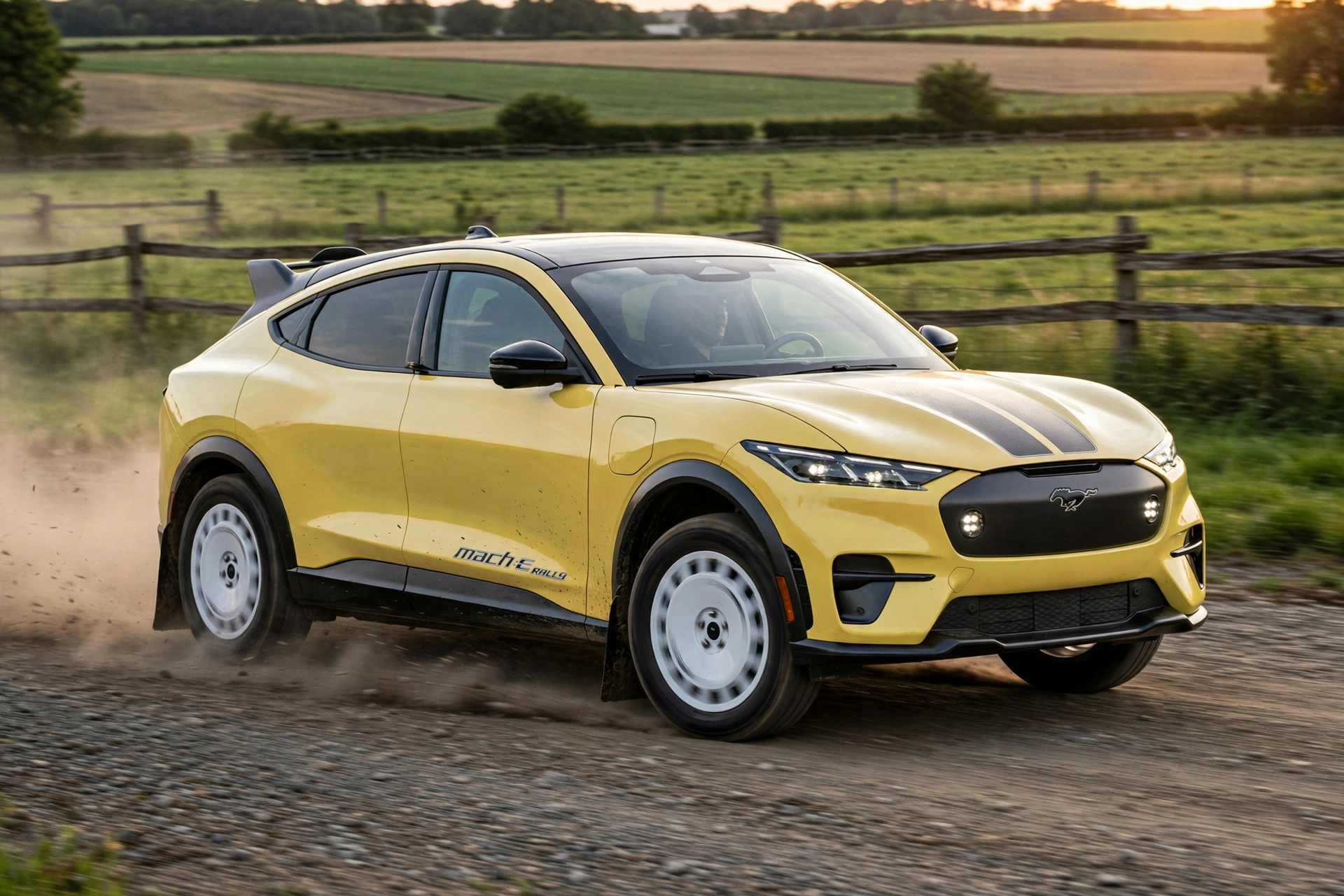
Think of the Rally as a GT that went to finishing school in a quarry. The headline numbers are shared: 480 hp from two motors, the big 91 kWh (usable) battery, all-wheel drive. The differences are in the details, and the details are the point.
- Torque, standard: 700 lb-ft out of the box. A GT makes 600 lb-ft unless you buy the Performance Upgrade, so the Rally’s full shove is baked into the price.
- MagneRide dampers, retuned: rallycross-spec springs and dampers, softer than the GT’s, still standard on the Rally. On the 2026 GT, MagneRide has been bundled into an optional handling package.
- Ride height: roughly an inch taller than the GT, for about 6.5 inches of ground clearance (est.). That inch is the difference between a grazed undertray and a clean pass over a rutted track.
- Underbody protection and mud flaps: shielding underneath, flaps behind the wheels. Anyone who has hosed gravel out of a wheel arch will understand.
- RallySport mode: a dedicated drive mode that loosens the stability control, sharpens the throttle for loose surfaces and lets the car rotate a little. On gravel it is a grin. On a wet roundabout, driven sensibly, it is simply secure.
- Fog lamps in the grille panel: two round lamps set into the closed grille, plus 19-inch wheels wearing Michelin CrossClimate2 all-weather tyres, 235/55 R19.
My firm view, and I will defend it in any car park: the Rally is the better family car of the two fast Mach-Es, because the GT’s firmer setup thumps over the cracked, patched roads most of us actually drive. The Rally’s softer springs take the edge off without turning it into a boat. Ford built the comfortable one by accident, while aiming at a rally stage.
mach e rally specs that matter at the school gate
| Item | Mach-E Rally (2026) |
|---|---|
| Price | $57,690 MSRP; $59,735 incl. destination (checked October 25, 2026) |
| Motors | Dual motor, all-wheel drive |
| Power / torque | 480 hp / 700 lb-ft |
| 0–60 mph | 3.4 s (Ford); 3.3 s (MotorTrend tested) |
| Battery | 91 kWh usable |
| EPA range | 255 miles (fueleconomy.gov) |
| Efficiency | 84 MPGe combined; 40 kWh/100 miles |
| DC fast charging | 150 kW peak; 10–80% in about 36 minutes (Ford figure) |
| Cargo | 29.7 cu ft behind seats; 59.7 cu ft seats folded |
| Seats / rear legroom | 5 seats; 38.1 inches |
| Weight | About 4,950 lb (est.) |
Two numbers in that table deserve a plain-English translation. First, 255 miles: Ford quoted 265 miles for the Rally in its first two model years, and the EPA’s current listing for the 2026 car at fueleconomy.gov says 255. Use 255. Second, 40 kWh per 100 miles is thirsty by EV standards — a standard Mach-E sips noticeably less. That is the tax you pay for the lift, the tyres and the drag of the rally hardware, and it shows up again in the running costs below.
Gravel, wet leaves and the mach e rally on the roads you actually drive
RallySport mode is the feature your kids will beg for and the feature you will use least. What you will use every day is the hardware underneath it. The MagneRide dampers read the road and adjust constantly, and on the broken B-roads and farm tracks where a GT crashes and bangs, the Rally floats a fraction more and lands softer. Independent testers back this up: MotorTrend clocked the Rally at 3.3 seconds to 60 mph — quicker than Ford’s own claim — and reviewers from MotorTrend to Car and Driver have praised the same loose-surface composure, the sense that the car would rather play than punish.
On gravel the mach e rally does something no family crossover has any business doing: it slides, gently and predictably, the tail stepping out a few degrees while the front motor pulls it straight. It feels safe because it is managed, not because it is slow.
On wet tarmac — the surface that actually matters for a school run in November — the CrossClimate2 tyres and the extra clearance over standing water are worth more than any spoiler. These are proper all-weather tyres with real winter ratings, not the summer rubber a GT wears. If your commute involves unploughed side streets, this is not a detail. This is the whole argument.
Ground clearance needs one honest footnote. About 6.5 inches (est.) is tall for a Mach-E and short for a trail vehicle. The Rally is a gravel-road car, a rally car in spirit — it is not a rock crawler, and the underbody shielding is there for stones and ruts, not boulders. Treat it as a car that laughs at bad surfaces, not one that hunts for them. For more on how the performance Mach-Es compare across the range, see our Mustang Mach-E explainer, which covers the GT this car is based on.
Range and charging: the mach e rally on a family week
Work with 255 EPA miles, then be honest about your life. Short trips, cold mornings and a heavy right foot will see a working figure nearer 200–220 miles between charges in winter (est., based on the EPA consumption of 40 kWh/100 miles and typical cold-weather losses). A week of school runs, office commutes and one weekend trip sits comfortably inside that. The 91 kWh battery is the largest Ford fits to the Mach-E, shared with the GT, and it charges at up to 150 kW — a 10–80% top-up in about 36 minutes on a suitable fast charger, per Ford’s figures on the official Mach-E page.
That is mid-pack by 2026 standards, not a headline. Hyundai’s quickest chargers will beat it home.
Home charging is where the family maths settles down. A full charge from empty is 91 kWh; at an assumed $0.17 per kWh (est., roughly the US residential average) that is $15.47 for 255 miles of range.
Run the car 12,000 miles a year at its EPA appetite of 40 kWh per 100 miles and you will buy about 4,800 kWh — roughly $816 a year (est.) through a home wallbox. The EPA’s own annual fuel-cost estimate for this car is $900 at its standard assumptions, so the two figures shake hands. Plug in overnight, twice a week, and range simply stops being a topic. If you are still deciding whether any EV fits your household routine, our guide to EV range, charging costs and who should buy one walks through the daily-use maths in plain terms.
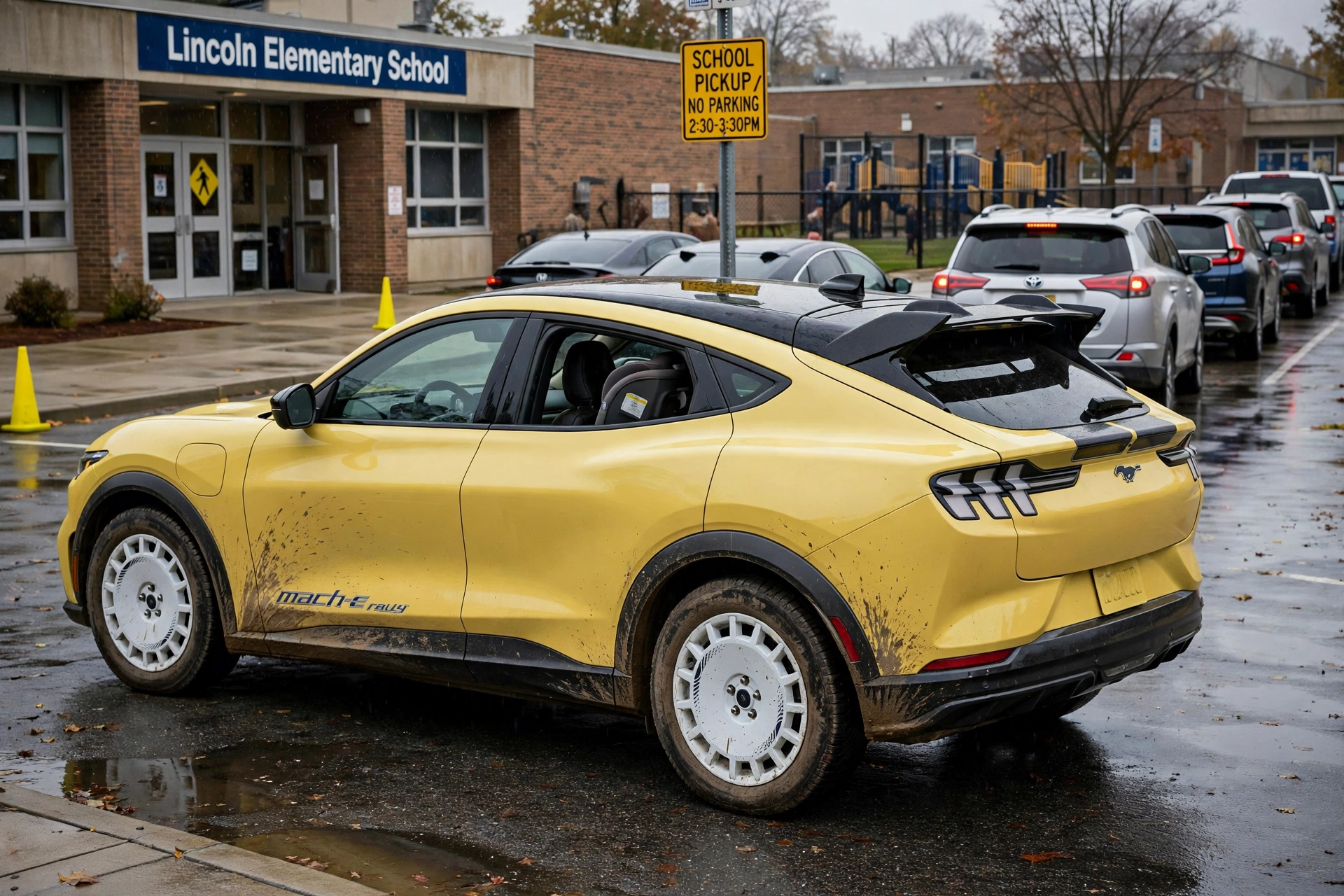
Family duty: seats, strollers and mud in the cabin
Under the rally kit sits the same practical five-seat cabin as every Mach-E, and that is good news. The rear bench takes two child seats with room for a slim booster or a squeezed grandparent between them, rear legroom is a generous 38.1 inches, and the flat floor means the middle passenger is not sitting on a transmission tunnel. The boot swallows 29.7 cubic feet behind the seats — a folded stroller lengthways, a weekly shop, or one enormous dog — and 59.7 cubic feet with the seats down, which covers the tip run and the flat-pack furniture emergency.
Two family-specific notes. First, the frunk: earlier Mach-Es came with a 4.7 cu ft front trunk, handy for muddy boots and charging cables. Ford Authority reports that for 2026 the frunk became a $495 option across the range. If you are ordering new, tick it.
Muddy things belong in a washable plastic tub, not on the boot carpet. Second, the cabin trim: the Rally’s seats wear hard-wearing trim with white accents (the all-white seat trim option is gone for 2026), and the surfaces wipe clean. Fruit-shoot spills, glitter glue, the mystery stickiness of a long drive — it all comes off with a damp cloth. The big vertical touchscreen still runs the whole show, which means glovebox, mirrors and climate hide behind menus. You get used to it. Your passengers will keep asking where the volume knob went. There is a volume knob. It is on the screen, stuck to the bottom of it, and it is genuinely fine.
Mud deserves its own sentence, because this is the one Mach-E that invites it. The mud flaps and the extra clearance keep the worst of a wet field off the sills, and the all-weather floor mats you should absolutely buy take the rest. Arrive at school pickup with gravel dust on the rear bumper and you will get questions. Mostly from other parents asking what it is.
Running costs beyond the electricity
Electricity is the cheap part. The mach e rally’s other costs follow its performance: 19-inch CrossClimate2 tyres are reasonably priced for the class and last well, but this is a heavy, torquey car — drive it like a rally car and you will meet the tyre bill early. Insurance groups it with performance EVs, so get a quote before you fall for the white wheels (est.: expect to pay more than for a Premium trim).
Servicing is the usual EV story of very little to do — Ford’s intervals are long, there is no oil, and the brakes live an easy life under regenerative braking. The battery and motors carry Ford’s 8-year/100,000-mile EV warranty, with capacity coverage if the pack falls below 70%.
Depreciation is the cost nobody puts on the window sticker. Limited-appeal trims can go either way: the Rally’s rarity may hold its value, or the market may treat it as a GT with odd wheels. Honest answer: nobody knows yet, and anyone who tells you otherwise is guessing. Buy it to use it for five years and the question mostly answers itself.
The premium, priced: what $4,295 actually buys
Here is the computation Ford does not print. The Rally costs $57,690; the GT costs $53,395 (both MSRP, checked October 25, 2026). The gap is exactly $4,295. Spend it and you get the 100 lb-ft of torque a GT buyer must option separately ($995 for the Performance Upgrade), MagneRide as standard (an optional package on the 2026 GT), plus the lift, the shielding, the fog lamps, RallySport mode, the tyres and the flaps. Divide the premium by the torque alone and it is $42.95 per extra lb-ft — a silly unit, but a revealing one: after the torque, roughly $3,300 of the premium is hardware a GT simply cannot be ordered with. You cannot build this car from the GT options list at any price.
Now price each car per mile of EPA range, which is the honest way to compare EVs:
- Mach-E Rally: $57,690 ÷ 255 miles = $226 per mile of range
- Mach-E GT: $53,395 ÷ 280 miles = $191 per mile of range
- Mach-E Premium, extended-range RWD: $45,840 ÷ 320 miles = $143 per mile of range
The Rally is the dearest way to buy a mile of Mach-E range, by a distance. You are not buying range with the premium. You are buying capability and character, and this guide’s position is that on bad roads, that trade is worth it. If your driving is all motorway and smooth A-roads, the same arithmetic says buy the Premium and keep $11,850. Both conclusions come from the same table — pick by your roads, not by the brochure. Our earlier piece on electric Mustang buying covers the wider line-up if you are still cross-shopping.
Verdict: who should buy the mach e rally
Buy it if your life includes gravel lanes, ski trips, festival fields, unploughed streets, or a commute over roads the council has given up on — and you still want a car that makes you grin at a slip road. Skip it if your mileage is motorway-heavy and your surfaces are smooth: the Premium does that job for far less money per mile, and the GT does the posing for less too.
Mach-E Rally — Our score: 7.9/10 (Range 6/10, Charging 6/10, Value 8/10). The range and charging are merely adequate for the class in 2026; the value score is high because the hardware is real, standard, and unavailable elsewhere in the range.
Mach-E GT — Our score: 7.7/10 (Range 7/10, Charging 6/10, Value 7/10). Faster-looking on paper, cheaper, and the one to pick for tarmac. On the roads most families drive, the Rally’s softer setup is worth more than the GT’s edge.
Frequently asked questions
Is the mach e rally a limited edition?
No. It launched for 2024 as a regular production trim, is on sale as a 2026 model, and Ford has confirmed it continues into 2027. What did change for 2026: the rear spoiler ($995) and graphics pack ($495) moved to the options list.
How far does it really go on a charge?
The EPA rates the 2026 car at 255 miles and 84 MPGe. Expect roughly 200–220 miles in cold weather with short trips (est.), and nearer the full figure on a gentle summer run. Its 40 kWh/100-mile appetite is the honest number to plan around.
Can it take two child seats and a stroller?
Yes. Two child seats fit across the rear bench with 38.1 inches of legroom in front of them, and the 29.7 cu ft boot takes a folded stroller behind the seats with room to spare.
Is it suitable for real off-roading?
Gravel roads, muddy fields and rutted tracks, yes — that is its brief. Rock crawling and deep ruts, no: about 6.5 inches of clearance (est.) sets the limit, and the shielding is for stones, not boulders.
What does a full charge cost at home?
The 91 kWh battery costs about $15.47 to fill from empty at $0.17 per kWh (est.), and a 12,000-mile year works out near $816 (est.) in electricity on home charging.
For families weighing the options, the mach e rally stands out because its softer setup turns rough daily roads into an easy ride. The mach e rally also keeps its 255-mile range honest for school runs and weekend trips alike, so the mach e rally is easy to live with week after week.