Last updated: October 25, 2026
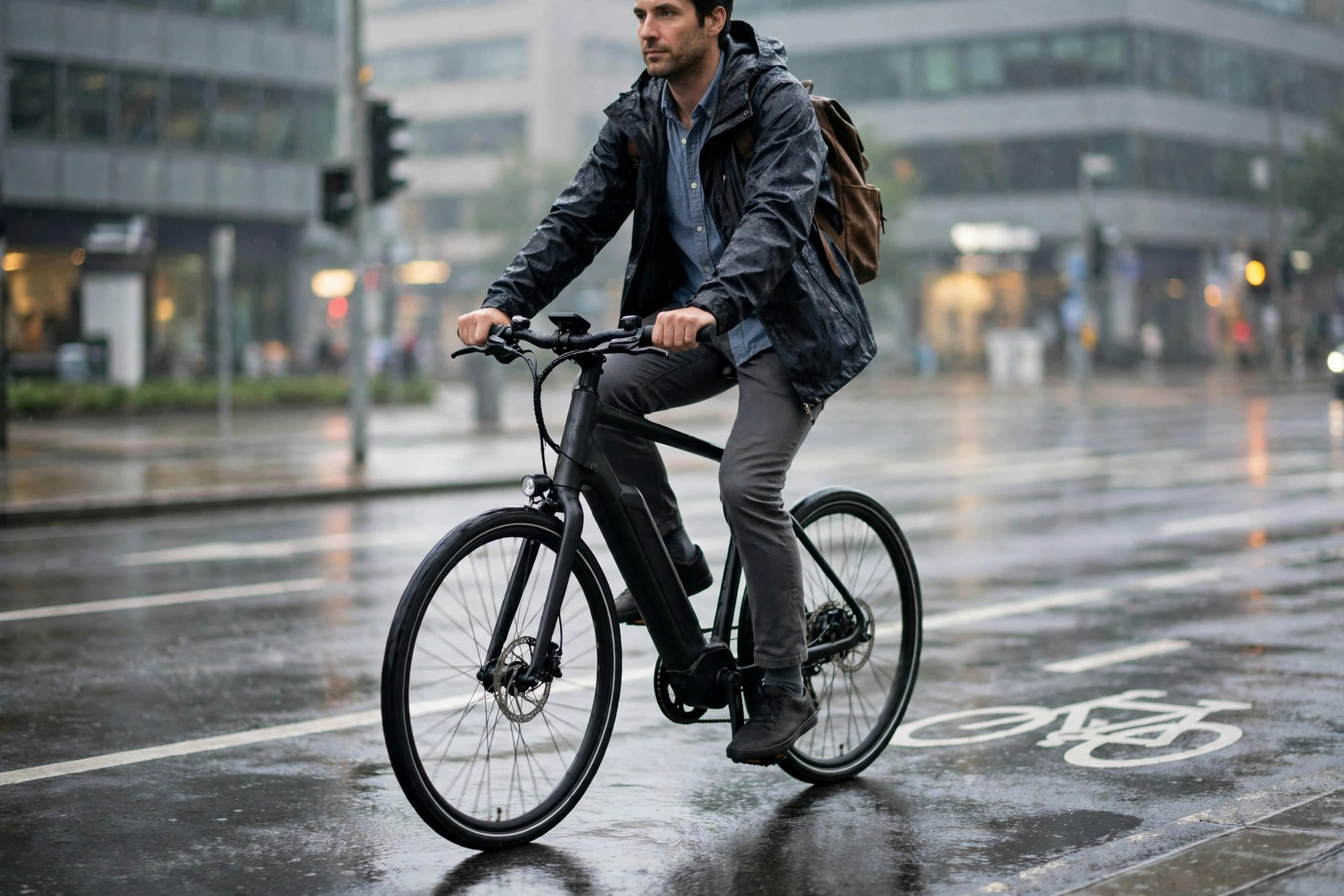
The soltera 2.5 e bike is Aventon’s lightest and cheapest commuter: 46 lb, a 350W rear hub motor with a proper torque sensor, hydraulic disc brakes, and a list price of $1,199. It looks like an ordinary city bike, rides like one, and exists for one job — getting you across town on a weekday without the sweat patch, the parking hunt, or the bus schedule. Aventon sells faster e-bikes and stronger e-bikes. This is the one built for people who measure a commute in minutes and laundry, not in watts.
Weight is the spec that decides whether a commuter bike actually gets ridden in February, and 46 lb is the right side of that line. You can carry it up a flight of apartment stairs without planning the lift. It fits on a standard car rack. At the office it leans in a corner instead of colonising it. Most budget e-bikes weigh 65 to 75 lb, which is fine right up until you meet a staircase, a train platform gap, or a wall hook.
The limits are just as plain, so here they are up front. Assist stops at 20 mph. The motor makes 45 Nm of torque, which is mild. The gearing is narrow. If your city is flat or gently rolling, none of that matters at 8 a.m. If your city is San Francisco, keep reading, because the hill section below is the whole review for you.
Price needs a footnote, because Aventon moves it around. The official Soltera 2.5 page on aventon.com lists $1,199 (checked October 25, 2026), and Aventon has repeatedly sold it direct at $999 during promotions this year. For that money you get integrated lights with turn signals, a kickstand, and the Aventon app. You do not get fenders or a rear rack. Both are factory accessories, and the fender set is $69.99. Budget for them on day one; a commuter bike sold without fenders is a bike bought in two instalments.
What the soltera 2.5 e bike is — and who should walk past it
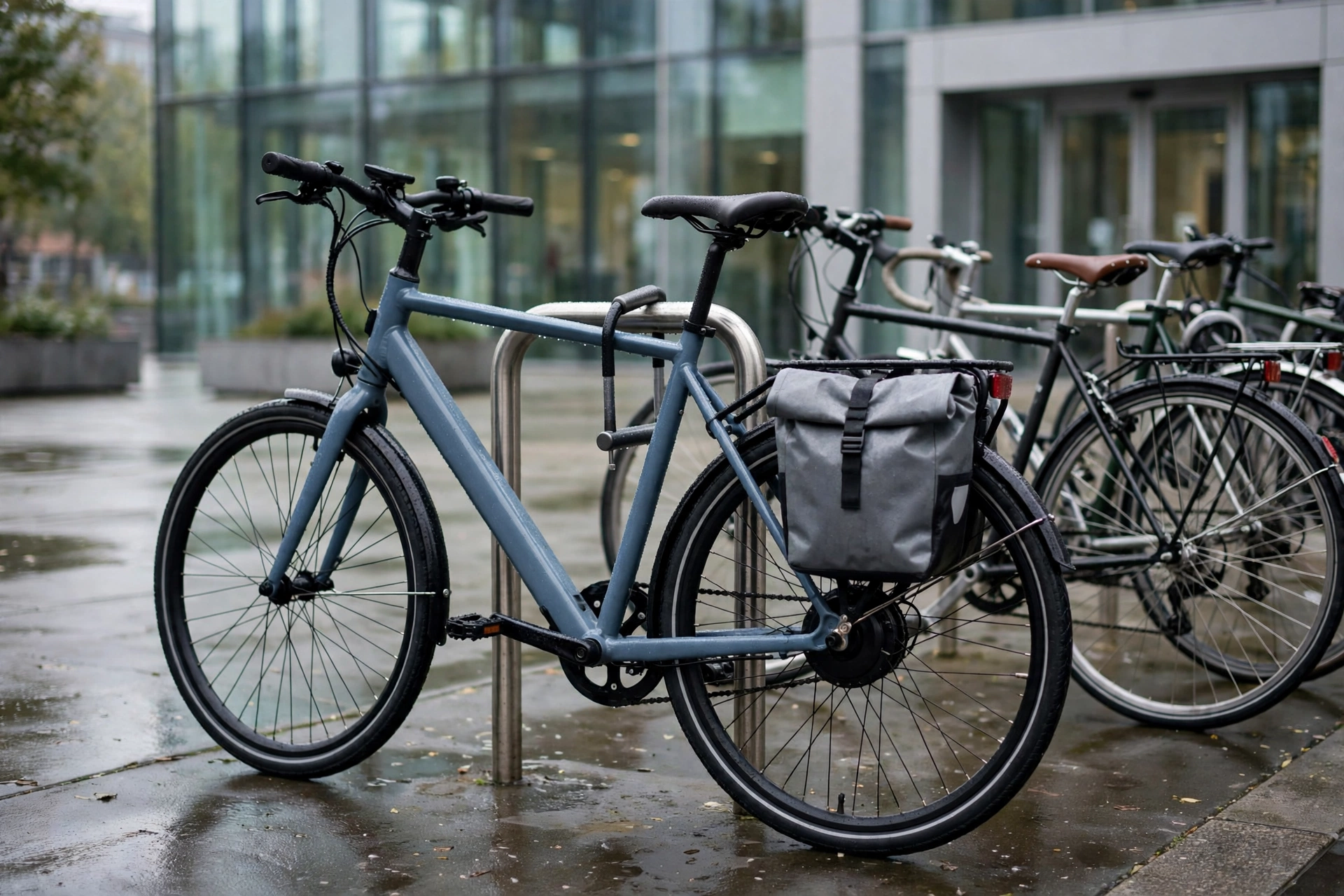
The Soltera 2.5 is a step-over city bike in three sizes (S, M, L) covering riders from 5’1″ to 6’2″, in two colours: Matte Midnight Black and Baja, a muted blue-grey. The frame is double-butted 6061 aluminum with the battery hidden inside the downtube, a flat 620mm bar, and an upright position that Aventon shortened the reach to achieve on this generation. Reviewers consistently single out the handling — quick, precise, more bicycle than appliance. There is no step-through version and no suspension fork. The fork is rigid aluminum, which keeps the weight honest and your wrists informed about potholes.
Buy it if your ride to work is under ten miles each way on paved streets, if you store a bike indoors, or if you mix riding with a train or bus and have to lift the thing daily. Walk past it if you regularly carry a child seat or heavy cargo (the 300 lb payload is real, the frame geometry is not built for loads), if your weekends mean loaded touring — that is electric bike trekking territory, with bigger batteries and lower gears — or if your route includes a serious climb. The next-but-one section does that maths in full.
Soltera 2.5 e bike specs that matter before 9 a.m.
| Item | Soltera 2.5 |
|---|---|
| Price | $1,199 list; $999 in recent Aventon promotions (checked October 25, 2026) |
| Weight | 46 lb |
| Frame | 6061 double-butted aluminum, step-over, S/M/L |
| Motor | 350W rear hub (540W peak), 45 Nm |
| Sensor | Double-sided bottom bracket torque sensor |
| Battery | 36V 9.6Ah, 345.6 Wh, LG cells, removable (4.14 lb), UL 2271 certified |
| Claimed range | Up to 46 miles (Eco, 165 lb rider, flat ground) |
| Charger | 36V 2A, 4–5 hours full charge |
| Assist | 4 levels (Eco, Tour, Sport, Turbo) plus thumb throttle; Class 2, 20 mph |
| Drivetrain | Shimano Tourney 7-speed, twist shift, 48T chainring, 14–28T freewheel |
| Brakes | Tektro HD-T280 hydraulic disc, 180mm rotors |
| Tyres | Kenda K1085 700×38C, reflective sidewalls |
| Display | Aventon BC280 colour LCD with USB-A charging port |
| Lights | Integrated front and rear, with turn signals |
| Payload | 300 lb |
| Warranty | 2 years |
The torque sensor is the component that earns the price. Cheap e-bikes use cadence sensors, which deliver power in a lump a second after you start pedalling and keep pushing briefly after you stop. A torque sensor reads how hard you are pushing and matches it, so the soltera 2.5 e bike pulls away from lights the way a bicycle should — proportionally, without the lurch. In stop-start traffic, that difference shows up fifty times a ride. The BC280 display is clear, the USB-A port will keep a phone alive for navigation, and the Aventon app lets you adjust the assist levels, record rides, and find a dealer when something needs a human.
One classification note, because it decides where you may legally ride: this is a Class 2 e-bike, meaning throttle and pedal assist both cap at 20 mph. If the class system is still a blur, our Class 1 e-bike guide explains what each class allows and where each is welcome.
The gearing question: seven speeds, and one honest answer
Shoppers keep asking whether this bike is single-speed. It is not — the earlier Soltera.2 came in a true single-speed version, while the 2.5 is a 7-speed. The honest problem is different: the seven gears span a narrow window, and narrow gearing plus a mild hub motor is a specific recipe. It works beautifully on the flat. It has a hard ceiling on climbs.
Run the numbers. The chainring is 48T and the freewheel runs 14–28T, so the easiest gear is 48 ÷ 28 = 1.71, roughly 47 gear inches on a 700c wheel. Pedalling at a relaxed 60 rpm in that lowest gear moves you at about 8.5 mph. There is no slower option. On a gentle 3–4% grade that is fine — you spin, the motor helps, you arrive. On a sustained 8–10% grade, 8.5 mph is faster than tired legs want to go, cadence drops into a grind, and your knees file the complaint. Electric Bike Report’s hill testing lines up with the maths: the bike climbed at 8 mph in Eco and 12–13 mph in Turbo with the rider pedalling properly. That is a capable result, and it required the rider. Plan on being part of the drivetrain.
Two more physics facts worth knowing. First, a rear hub motor drives the wheel directly and cannot use your gears — shifting down helps your legs, not the motor, so the 45 Nm is all the motor ever brings. Second, the throttle will start you on a slope and hold a gentle grade, and reviewers found it struggles on its own up steep ones. Treat the throttle as a hill-start aid and a tired-legs lever for the last flat mile. If your commute ends with a long, steep climb every single day, buy a mid-drive with a wide-range cassette instead. That is not a flaw in this bike. It is a boundary, and it is better learned here than on your hill.
Range and charging: the soltera 2.5 e bike by the numbers
Aventon claims up to 46 miles, and the small print is honest for once: that figure assumes Eco mode, flat ground, and a 165 lb rider. What did independent testers get? In Electric Bike Report’s range test, the bike covered 55 miles in Eco and 29.26 miles at maximum power. Electric Bike Review recorded 48 miles at minimum assist and 27 miles at maximum. Both testers beat the claim at the gentle end, which almost never happens in this industry. For a mixed commute — Tour and Sport, some wind, some hills, a rider with a bag — plan on 32 to 42 miles per charge (est.). A five-mile-each-way commuter recharges roughly twice a week.
Now the arithmetic we run on every commuter bike, because it never stops being startling. The battery holds 345.6 Wh. At an average US residential electricity price of $0.17 per kWh (est.), a full charge costs 0.3456 × $0.17 = about 6 cents — call it 7 cents once charger losses are included (est.). Ride 1,000 commuting miles at the realistic 38-mile-per-charge figure from above (est.) and you use about 26 charges, roughly 9.1 kWh, roughly $1.55 of electricity. The real running cost is battery wear: a replacement pack at around $400 (est.) spread over a typical 800-cycle life (est.) works out near $13 per 1,000 miles. Electricity plus battery wear: about $15 per 1,000 miles. A 30 mpg car burning $3.85-a-gallon fuel (est.) spends about $128 on the same 1,000 miles in fuel alone. The bike is not cheaper to run than a car. It is cheaper by an order of magnitude.
One more comparison, this time against its closest rival. Divide the price by realistic range and the soltera 2.5 e bike costs $1,199 ÷ 38 = $31.55 for every mile of range it delivers. The Ride1Up Roadster V3, at $1,295 with a realistic 30 miles (est.), costs $43.17 per mile of range. Range per dollar is the Soltera’s party trick, and it comes from efficiency — a light bike, fast-rolling tyres, and a torque sensor that refuses to waste watts.
Charging itself is unglamorous and fine. The 2A charger needs 4 to 5 hours from empty, which maps neatly onto a workday or a night. The battery slides out of the downtube and weighs 4.14 lb, so it charges under your desk in winter while the frame stays in the cold rack outside. Our breakdown of how much it costs to charge an electric bike runs the same maths across other battery sizes if you are comparing formats.
Riding it in weather: rain, dark, and the fender tax
Hydraulic brakes are the single most valuable wet-weather feature on this bike, and they are standard. Cable brakes get vague as rims and pads get soaked; the Tektro hydraulics keep their bite and, just as usefully, their modulation, so a wet descent to a junction is a squeeze rather than a negotiation. On a commuter that will see a hundred wet rides a year, this is where money should go, and Aventon spent it correctly.
The tyres deserve a plainer warning. The Kenda K1085s are slick, fast-rolling 38C rubber with reflective sidewalls, and Electric Bike Review found they offer little grip when cornering in the wet. So ride them like it: brake upright and early, take wet corners at bicycle speeds rather than e-bike speeds, and give painted lines, manhole covers, and wet leaves the respect they have earned. The reflective sidewalls, the integrated headlight and tail lights, and the seat-stay turn signals handle the being-seen half of a dark commute well. One real miss: the tail light does not brighten when you brake. Turn signals are a nice extra. A brake light is the one that stops the car behind you. Aventon fitted the garnish and skipped the substance there.
And the fenders. They are a $69.99 accessory, which on a bike marketed to commuters is a tax on finishing the product. Fit them. A rear rack is also an accessory, though the frame carries proper mounts, and a pannier beats a sweaty backpack five days a week. None of this is exotic. It is the standard commuter finishing kit, and the $1,199 headline should be read as roughly $1,270 the way you will actually ride it (est., with fenders).
Reliability and what it costs to own over a few winters
The Shimano Tourney drivetrain will not impress anyone at a group ride, and that is precisely its virtue. Tourney parts are cheap, stocked everywhere, and familiar to every mechanic on Earth: a 7-speed chain costs a few dollars, the freewheel is a commodity part, and a stretched or rusted drivetrain is a small bill, not a research project. The hydraulic brakes ask for fresh pads and the occasional bleed. There are no motor cut-off switches in the brake levers, which removes one common failure point and two cables. The alloy fork and frame have no suspension pivots to develop play. Boring, throughout, in the way commuters should pray for.
The paperwork is in order too. The full system is UL 2849 certified and the battery is UL 2271 certified, which increasingly decides whether a building or employer lets you charge indoors at all. Aventon backs the bike with a two-year warranty and sells through a large dealer network, so a warranty claim does not have to become a shipping saga. Budget one set of tyres and brake pads a year for a daily rider (est.), keep the chain clean through winter salt, and the expensive surprise in year three is the battery: around $400 for a replacement pack (est.), by which point the per-mile maths in the range section has already paid for it several times over.
Soltera 2.5 e bike vs Ride1Up Roadster V3
The Roadster V3 is the rival every Soltera shopper should cross-examine. It costs $1,295, weighs about 39 lb, uses a 500W hub motor with 50 Nm and a torque sensor, and can be set up as a Class 3 bike assisting to 28 mph. It includes fenders and lights in the price, and you can order it as a single-speed belt drive — nearly maintenance-free — or with a 10-speed Shimano Deore drivetrain. On paper it wins several rounds. In tested range it does not: Ride1Up claims 20 to 40 miles from a 360 Wh battery, and realistic use lands near 30 miles (est.), well short of what the Soltera’s smaller battery actually delivered in testing. Speed versus distance. That is the whole contest, and it depends on your postcode, not on the spec sheet.
Aventon Soltera 2.5 — Our score: 8.1/10. Range: 8/10 — 55 miles tested in Eco and 29.26 at full power from 345.6 Wh is efficiency most rivals cannot match. Charging: 7/10 — 4 to 5 hours is slow, the removable 4.14 lb pack charges anywhere. Value: 9/10 — torque sensor, hydraulic brakes, UL certification and this range at $1,199, or $999 when Aventon’s promotions land, undercut the field.
Ride1Up Roadster V3 — Our score: 7.9/10. Range: 6/10 — a realistic 30 miles (est.) is adequate for short hops and tight for anything more. Charging: 7/10 — the same small-pack, few-hours routine, equally painless. Value: 8/10 — fenders included, a belt-drive option, Class 3 pace and 39 lb for $1,295 is a strong package, simply aimed at faster, shorter trips.
Choose the Soltera if your commute is a distance event in ordinary clothes. Choose the Roadster if it is a short sprint, you want the belt, or 20 mph genuinely feels like a cage.
Verdict
The soltera 2.5 e bike is the commuter most people describe when they say they want “just a normal bike, with help.” It is light enough to live with, honest enough in its range figures to plan a week around, and cheap enough to run that the fuel maths reads like a misprint. Its boundaries are equally clear: gearing that runs out of answers on steep hills, a 20 mph ceiling, and a fender kit that should have been in the box. Inside those boundaries, at $1,199 — or $999 when the promotion wheel stops on it — this is the budget commuter we would point a colleague at. Our score: 8.1/10.
Soltera 2.5 e bike FAQ
How far does the soltera 2.5 e bike really go on one charge?
Aventon claims up to 46 miles in Eco with a 165 lb rider on flat ground. Electric Bike Report tested 55 miles in Eco and 29.26 miles at maximum power; Electric Bike Review got 48 miles at minimum assist and 27 at maximum. For a normal mixed commute, plan on 32 to 42 miles (est.). Most commuters will charge twice a week, not nightly.
Can it handle the hill on my commute?
Gentle and moderate hills, yes — Electric Bike Report climbed at 8 mph in Eco and 12–13 mph in Turbo, with the rider pedalling. The lowest gear is about 47 gear inches, so long climbs above roughly 8% become a slow grind, and the throttle alone will not rescue a steep grade. Short ramps are fine. A daily wall of a climb means a different bike.
Does it come with fenders and a rack?
No. Fenders are an Aventon accessory at $69.99 and a rear rack is also sold separately, though the frame has proper mounts for both and a kickstand is included. For a rain-commuting setup, treat the fenders as part of the purchase price.
Can I charge the battery at my desk?
Yes. The battery removes from the downtube, weighs 4.14 lb, and charges from the included 2A charger in 4 to 5 hours. The pack is UL 2271 certified and the electrical system UL 2849 certified, which is the paperwork many offices and apartment buildings ask for before allowing indoor charging.
What does a year of commuting cost on this bike?
Electricity is about 6 cents a charge — roughly $1.55 per 1,000 miles, with battery wear adding about $13 per 1,000 miles (est.). Consumables for a daily rider run to a set of tyres and brake pads a year (est.), plus cheap 7-speed chains as needed. A replacement battery is around $400 (est.) when the original fades after a few winters.
Is the Soltera 2.5 a Class 2 e-bike, and where can I ride it?
Yes — pedal assist and throttle both stop at 20 mph, which makes it Class 2 and legal on most streets, bike lanes, and shared paths where e-bikes are allowed, though local rules vary. It can also run with the throttle unplugged where throttles are banned. Check your city’s path rules before assuming; they change more often than the bikes do.