Last updated: October 24, 2026
Segway says the Segway Ninebot Max G30P goes 40.4 miles on a charge. Independent testers say otherwise. One careful test set lands at 27.6 miles when ridden hard, 30.3 miles at a normal pace, and 34.5 miles when ridden gently. A hands-on test by a different reviewer stopped at 21 miles. Rider reports collected by ScooterRank average 37.8 kilometres, which is 23.5 miles.
That spread is the whole story of this scooter. The Segway Ninebot Max G30P is a genuinely good commuter machine sold with a range number most riders will never see. Buy it for the 28 to 35 miles it actually delivers, not the 40.4 on the box, and you will like it a lot. Buy it expecting 40 miles of fast riding in a headwind with a backpack on, and you will feel cheated by lunchtime.
Here is my position up front, plainly stated. For a daily ride under 12 miles each way on decent pavement, the G30P is still the best value commuter scooter in its class in 2026. Nothing else at this price pairs a 551 Wh battery with this build quality and this parts availability. I would buy it over its cheaper sibling and over most no-name 350 W scooters without a second thought.
And here is the other opinion you need before spending $799. The six-hour charge time is a real weakness, not a footnote. If you cannot charge overnight, or you need a midday top-up between shifts, this scooter will frustrate you. Plan around the charger. Plug it in when you get home, every night, the way you charge a phone. Treat it any other way and the big battery stops being an advantage.
Segway Ninebot Max G30P: The Short Answer for Commuters
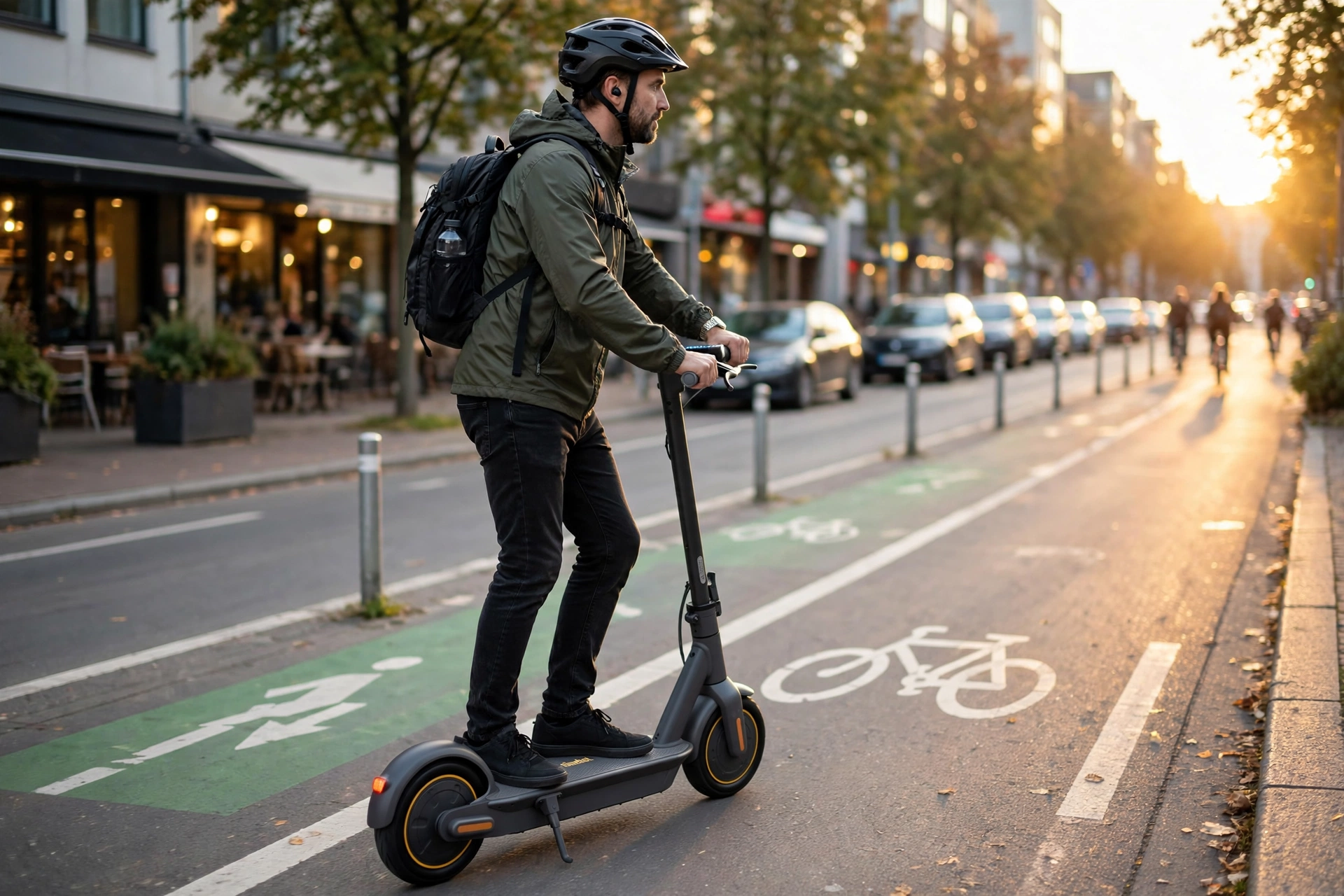
Think of the Segway Ninebot Max G30P as a workhorse, not a thrill machine. Top speed is 18.6 mph. The motor is rated 350 W nominal, with most listings giving a 700 W peak. One comparison table lists 800 W, so treat the peak figure as approximate and the 350 W nominal rating as the number that matters for hills. The battery holds 551 Wh. The scooter weighs 42.1 lbs, carries up to 220 lbs, and folds with one click for carrying into an office or a flat.
Who is it for? A rider with a 3- to 10-mile commute on bike lanes and smooth streets, who wants to arrive without thinking about range, and who charges at home overnight. Who should skip it? Anyone riding broken pavement daily, anyone who must carry a scooter up three flights of stairs twice a day, and anyone chasing speed. At 18.6 mph, this scooter will never feel fast. It was never meant to.
One more thing worth saying early. The G30P has no suspension. None. The 10-inch tubeless tires do all the smoothing, and they do a decent job on smooth asphalt. On cracked side streets, on tree-root-buckled paths, on cobbles, you will feel every flaw in the road through your feet and your knees. I consider that the single biggest comfort trade-off on this scooter, and the main reason to test your actual route before you commit.
Segway Ninebot Max G30P Range: Claimed 40.4 Miles Versus Tested Reality
Segway’s 40.4-mile claim comes with ideal conditions attached: a 165 lb rider, warm weather around 77 degrees, and roughly 60 percent of top speed on smooth pavement. Change any one of those conditions and the number falls. Ride at full speed, add a backpack, climb hills, ride into wind, or ride in cold weather, and the battery drains faster. That is physics, not a defect. Every scooter maker plays the same game with range claims.
What makes the G30P worth writing about is how much independent data exists to check the claim against. The same test set reported through eRideHero gives three useful numbers from a 175 lb rider. Ridden with speed as the priority, the G30P covered 27.6 miles at an average of 17 mph. Ridden normally, it covered 30.3 miles at 14.7 mph average. Ridden with range as the priority, it covered 34.5 miles at 11.9 mph average. Read those three lines together and you get the honest picture: speed costs miles, directly and measurably. See the eRideHero G30P tested range review.
A Ride Junkie hands-on test came in lower still, at 21 miles tested range and 18.4 mph tested speed, with a 5.3-second sprint to 15.5 mph. That result probably reflects harder riding, a heavier rider, or hillier ground. ScooterRank’s five rider reports average 37.8 kilometres, or 23.5 miles, which sits at 63 percent of a 60-kilometre claim figure used on that site. Note the mismatch: ScooterRank quotes the claim as 60 km while Segway’s headline figure converts to 65 km. Small inconsistencies like that are common in scooter specs, and they are one more reason to trust tested ranges over headline claims.
My working number for normal mixed riding, based on all of the above, is 28 to 35 miles. A light rider on flat ground at moderate speed gets the top of that range. A heavier rider at full throttle on hills gets the bottom, or less. If your commute is 6 miles each way, that is 12 miles a day, which means roughly two and a half days of riding per charge on the tested 30.3-mile figure, and roughly three and a third days on the claimed 40.4 miles. The gap between those two answers is exactly one extra charge per week for a daily commuter. Not a disaster. Worth knowing before you buy.
Segway Ninebot Max G30P Price and Our Own Math: What $799 Actually Buys
ScooterRank tracked the G30P at a $699 low, a $794 average, and an $800 high, with the current price listed at $799. Prices move, and sale prices have dipped far lower in the past, including a $500 flash-sale low reported in April 2026, so treat $799 as the checked price for October 24, 2026, not a permanent price. Check the live price before you buy. If you find it under $700, the value case gets stronger still. See the ScooterRank G30P specs and rider-range data.
Here is the math only this site is publishing for this scooter, worked from the figures above. At $799 divided by the claimed 40.4 miles, you pay $19.78 per claimed mile of range. At $799 divided by the tested 30.3 miles, you pay $26.37 per real mile of range. That $6.59 gap is the price of believing the brochure. It is also a useful way to compare scooters: a cheaper scooter with a much smaller battery can look like a bargain until you divide by the miles it actually delivers.
Battery value tells a similar story. At $799 divided by 551 Wh, the G30P costs $1.45 per watt-hour of battery. Compare the smaller sibling below and you will see what the extra money buys: more battery, more real range, and fewer charging days per week. The battery is the most expensive part of any electric scooter, so price per watt-hour is a fairer comparison than price alone.
Charging cost is almost too small to matter, and that is the point. One full charge uses 551 Wh, or 0.55 kWh. At an average US electricity price of about 16 cents per kWh, a full charge costs about 9 cents. Ride 30 charges a month, which is a heavy commuting month, and you spend about $2.70 on electricity. Per mile, that works out to roughly 0.3 cents per mile on the tested 30.3-mile range. Compare that with a bus fare, a rideshare, or parking, and the running cost argument for this scooter is overwhelming. The scooter pays for itself in saved fares for many commuters within a year, provided the commute actually replaces those fares.
Five-year running cost, to put a number on it: 30 charges a month at 9 cents is $32.40 a year in electricity, or $162 over five years, before any tire or brake consumables. Tires on this scooter are self-sealing, which cuts puncture costs, and the drum brake is enclosed, which keeps routine maintenance low. Budget for a set of tires and brake attention over five years, and the total running cost still stays far below any motor vehicle. This is the quiet economic case for a commuter scooter, and it holds up even if you ignore every other argument.
Segway Ninebot Max G30P Specs at a Glance
| Spec | Segway Ninebot Max G30P |
|---|---|
| Motor | 350 W nominal, 700 W peak (most listings) |
| Battery | 551 Wh (36 V class) |
| Claimed range | 40.4 miles / 65 km (ideal conditions) |
| Tested range | 27.6 to 34.5 miles depending on riding mode (est. real range 28 to 35 miles) |
| Top speed | 18.6 mph / 30 km/h |
| Hill grade | About 20 percent |
| Weight | 42.1 lbs |
| Max load | 220 lbs / 100 kg |
| Tires | 10-inch self-healing tubeless pneumatic |
| Brakes | Front drum brake plus regenerative rear brake |
| Suspension | None |
| Water resistance | IPX5 on core components |
| Charge time | About 6 hours (some sources say 6.5 hours) |
| Riding modes | Energy Saving, Standard, Sport |
| Display and app | LED display, Segway smartphone app, Bluetooth, cruise control |
| Safety certification | ANSI/CAN/UL-2272 |
| Price checked October 24, 2026 | $799 (tracked range $699 to $800) |
A note on weight, because sources disagree by a little. Most listings give 42.1 lbs, which is 19.1 kg. ScooterRank lists 18.7 kg, and one deal listing gives 41.2 lbs. I use 42.1 lbs in this guide as the most commonly cited figure. Either way, this is a 42 lb object. Carry it up stairs and you will know it. The one-click fold helps with storage, not with weight.
Segway Ninebot Max G30P Versus G30LP: The Comparison That Actually Matters
Most buyers cross-shop the G30P against its smaller sibling, the G30LP, and that is the right comparison. Same 350 W motor, same 18.6 mph top speed, same IPX5 rating, same lack of suspension, same drum brake setup. The differences are battery, range, and weight.
| Spec | G30P | G30LP |
|---|---|---|
| Battery | 551 Wh | 367 Wh |
| Claimed range | 40.4 miles | 25 miles |
| Weight | 42.1 lbs | 38.6 lbs |
| Price (listed) | $799 | $699 |
Here is my verdict on that choice, stated without hedging. Pay the extra $100 for the G30P. The G30LP saves you 3.5 lbs and costs $100 less, and it gives up 184 Wh of battery and 15.4 miles of claimed range in return. For a commuter, range is the whole point of the bigger scooter. The G30LP makes sense only for a rider with a very short trip, under 5 miles each way, who carries the scooter upstairs daily and counts every pound. Everyone else should take the bigger battery.
One comparison to avoid: the newer Segway Max G2. The G2 adds suspension and newer features, and it costs more. If your roads are rough, the G2 deserves a look, because suspension is exactly what the G30P lacks. If your roads are smooth and your budget is fixed, the G30P at $799 remains the smarter buy. Do not let a newer model talk you out of a proven one that fits your route.
Segway Ninebot Max G30P Charging: Six Hours, Overnight, Every Night
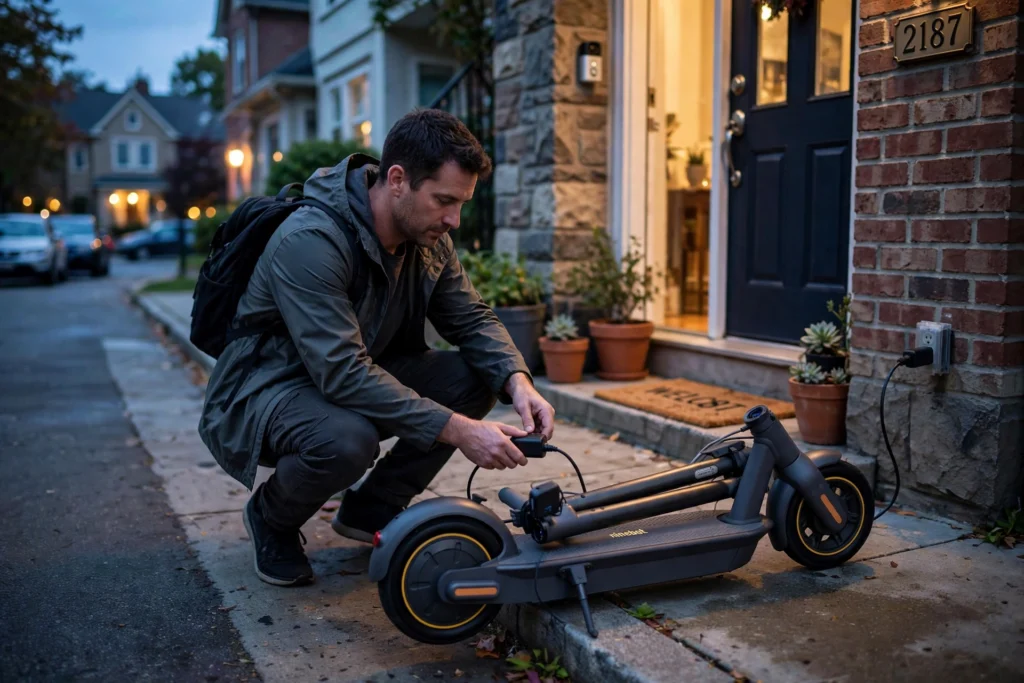
Charging takes about 6 hours from empty, with one source giving 6.5 hours. Either figure means the same thing in practice: this scooter charges overnight, not over lunch. A one-hour top-up adds roughly a sixth of a charge, or about 5 miles of tested range. That is useful in a pinch. It is not a charging strategy.
The right routine is boring and it works. Ride home, plug in, forget it until morning. A 12-mile daily commute uses about 40 percent of the tested range, so you could skip a night and still ride the next day. Do not make a habit of running the battery low. Lithium batteries last longer when they spend less time near empty, and the G30P battery is the part you least want to replace. Overnight charging also sidesteps the scooter’s one real daily annoyance: waiting. You never wait for this scooter if you charge while you sleep.
The three riding modes matter for range planning. Energy Saving mode stretches range by capping speed and softening acceleration. Standard mode is the daily default for most riders. Sport mode gives full power and the fastest drain. If range anxiety hits mid-ride, dropping to Energy Saving mode is the honest fix, not a gimmick. It works because it directly cuts the two things that eat battery fastest: speed and hard acceleration. For more on how charging costs work across electric two-wheelers, see our guide to how much it costs to charge an electric bike, with the same maths applied to the G30P’s 551 Wh battery above.
Segway Ninebot Max G30P Hills, Weight and Build Quality: The Nitpicks
Hill performance is where a 350 W motor shows its limits honestly. Segway rates the G30P for grades around 20 percent, and on moderate hills with a light rider it climbs steadily. Add a 200 lb rider, a backpack, and a steep sustained hill, and speed will drop noticeably. That is normal for this power class. It is not a failure, and it is not a reason to buy a more powerful scooter unless your route includes a hill that steep every day. Test your worst hill, not your easiest one, before deciding.
Heavier riders should read the tested range figures with extra care. The 175 lb test rider in the main test set is lighter than many adult commuters. At 220 lbs, the maximum rated load, expect range toward the bottom of the 28 to 35 mile band, slower hill climbing, and a firmer ride from the tires. The scooter is rated for that weight, and the frame handles it, but physics charges a toll. A rider near the limit who also faces hills daily should look at a higher-power scooter, not because the G30P will break, but because the daily ride will feel strained.
Build quality is where the G30P earns its reputation, with a few nitpicks a daily rider will notice. The folding mechanism is one-click and genuinely quick, which matters when you fold it twice a day, every day. The LED display is clear in daylight and shows speed, battery, and mode without fuss. The 2.5 W LED headlight is adequate for being seen, not for lighting an unlit path at speed, so night riders on dark routes should add a brighter light. The drum brake is enclosed and low-maintenance, which is a real advantage over exposed disc brakes in wet weather, though it gives less stopping bite than a good disc setup. The app connects over Bluetooth and adds cruise control and ride stats, though the app is a convenience, not a necessity. You can ride this scooter happily and never open the app.
One caution I am deliberately not turning into a claim: a secondary roundup mentioned a folding-mechanism recall with free maintenance kits for this model. I could not verify that against a Segway or safety-regulator source at writing time, so I am not publishing it as fact. If you own a G30P, check Segway’s own support pages for your serial number. Do not rely on roundups for safety information.
Segway Ninebot Max G30P Street Legality: Check Your City First
Electric scooter rules vary by city, state, and country, and they change often. Some places allow 18.6 mph scooters in bike lanes, some cap speed lower, some require helmets, and some ban scooters from sidewalks entirely. This guide will not give you a blanket legal answer, because a blanket answer would be wrong somewhere. Check your local rules before riding, and check them again if you move. Our scooter coverage, including the A3 Aero electric scooter guide, takes the same line: local rules decide where and how fast you can ride, not the spec sheet.
On safety gear, my view is simple. Wear a helmet. The G30P is fast enough to hurt you in a fall, and a helmet is cheap insurance against the most common serious scooter injury. Add lights for night riding, keep the tires at proper pressure, and check the folding latch before every ride. Those four habits cost almost nothing and cover most of what goes wrong on a commuter scooter.
Who Should Buy the Segway Ninebot Max G30P, and Who Should Not
Buy it if your commute is 3 to 10 miles each way on smooth streets or bike lanes, you charge at home overnight, you want proven reliability over flashy specs, and you value a big battery more than top speed. Buy it if you are replacing bus fares or short car trips and you want the running cost near zero. Buy it if you want a scooter with wide parts availability and a long track record, because a 2019-era design that is still selling in 2026 has a parts and knowledge base a new model cannot match.
Skip it if your route is rough pavement every day, if you carry the scooter upstairs constantly, if you need a midday recharge, or if you want to go faster than 18.6 mph. Skip it if your commute is over 15 miles each way, because even the tested range leaves too little margin for wind, cold, and detours. For that rider, a bigger scooter or an e-bike is the honest answer. Our Segway sibling coverage, the Segway Xyber guide, covers a very different kind of Segway machine, an e-bike, not a kick scooter, so do not confuse the two when comparing prices.
Our Score: Segway Ninebot Max G30P
Our score: 7.7/10 overall. Range: 8/10. The tested 28 to 35 miles is genuinely useful for commuting, and the gap to the claim costs it the top marks. Charging: 6/10. Six hours is slow, full stop, and it is the scooter’s clearest weakness. Value: 9/10. At $799, with 9-cent fills and a proven design, this is hard to beat for a commuter on a budget. The overall score reflects a scooter that does its main job extremely well and asks you to accept two compromises, charge time and no suspension, in return.
Segway Ninebot Max G30P FAQ
How far does the Segway Ninebot Max G30P really go?
In normal mixed riding, 28 to 35 miles. Independent tests give 27.6 miles ridden hard, 30.3 miles ridden normally, and 34.5 miles ridden gently, all from a 175 lb rider. The 40.4-mile claim needs ideal conditions: a 165 lb rider, warm weather, and moderate speed on smooth pavement.
Is the Segway Ninebot Max G30P street legal?
It depends on your city, state, or country. Rules on speed, bike-lane use, helmets, and sidewalk riding vary widely and change often. Check your local rules before riding. Do not rely on a general guide for a legal question about your street.
Should I buy the G30P or the G30LP?
Buy the G30P for almost every commuter use. The extra $100 buys 184 Wh more battery and 15.4 miles more claimed range, for only 3.5 lbs more weight. The G30LP suits only very short trips where carrying weight matters more than range.
How long does the Segway Ninebot Max G30P take to charge?
About 6 hours from empty, with some sources giving 6.5 hours. Charge overnight. A one-hour top-up adds roughly 5 miles of tested range, which helps in a pinch without replacing the overnight routine.
Can the Segway Ninebot Max G30P handle hills and heavier riders?
Moderate hills, yes, at reduced speed. Steep sustained hills with a rider near the 220 lb limit will feel strained, and range will drop toward the bottom of the tested band. Test your worst hill before buying if hills dominate your route.
Is the Segway Ninebot Max G30P still worth buying in 2026 with the G2 out?
Yes, for smooth-route commuters on a budget. The G2 adds suspension and newer features at a higher price. If your roads are smooth and $799 is your budget, the G30P remains the better value. If your roads are rough, the G2’s suspension is worth the extra money.