Last updated: October 27, 2026
Most e-bike reviews are written on dry weekends. Commutes happen on wet Tuesdays. So judge the lectric xp 4.0 ebike the way a commuter would: does it start every morning, does it get you up the one hill on your route without a fight, does it shrug off rain, and does it arrive with you dry-ish and un-sweaty. On those terms, the XP 4 is the most sorted folding commuter America sells at this price. Not the fastest. Not the lightest. The one that keeps showing up.
There are two versions. The standard bike pairs a 500W rear hub motor with a 500Wh battery for $999. The 750 version — Lectric calls it the Long-Range — fits a stronger 750W motor and an 840Wh battery for $1,299. Both are built on the same redesigned folding frame, in step-over and step-through shapes, and both were checked on Lectric’s official XP 4 page on October 27, 2026, with prices confirmed the same day. Everything below is split by version where the versions actually differ, because on the spec sheet they look like siblings and on a hill they are not.
First, the number that decides who should stop reading now. Lectric lists the frame at 62 lb without its battery. The standard battery adds 7 lb, so the bike you actually lift weighs 69 lb — BikeRide put a shipped bike on a scale and measured exactly 69.0 lb. The 750’s bigger pack takes it to roughly 74 lb (est., based on the same frame weight plus the larger battery). If your commute includes carrying a bike up two flights of stairs, close this tab and buy something lighter. No motor fixes gravity.
For everyone still here: the headline change on the lectric xp 4.0 ebike over the old XP 3.0 is a torque sensor, designed in-house by Lectric, replacing the 3.0’s cadence sensor. That sounds like spec-sheet garnish. It is the whole bike. The XP 4 also gets an 8-speed Shimano Altus drivetrain in place of the 3.0’s 7-speed Tourney, a colour TFT display instead of a mono LCD, turn signals, keyless starting, and — on the Long-Range — a battery that grew from 672Wh to 840Wh. Prices, checked October 27, 2026, have not moved with the upgrades: $999 and $1,299, the same money Lectric asked for the 3.0.
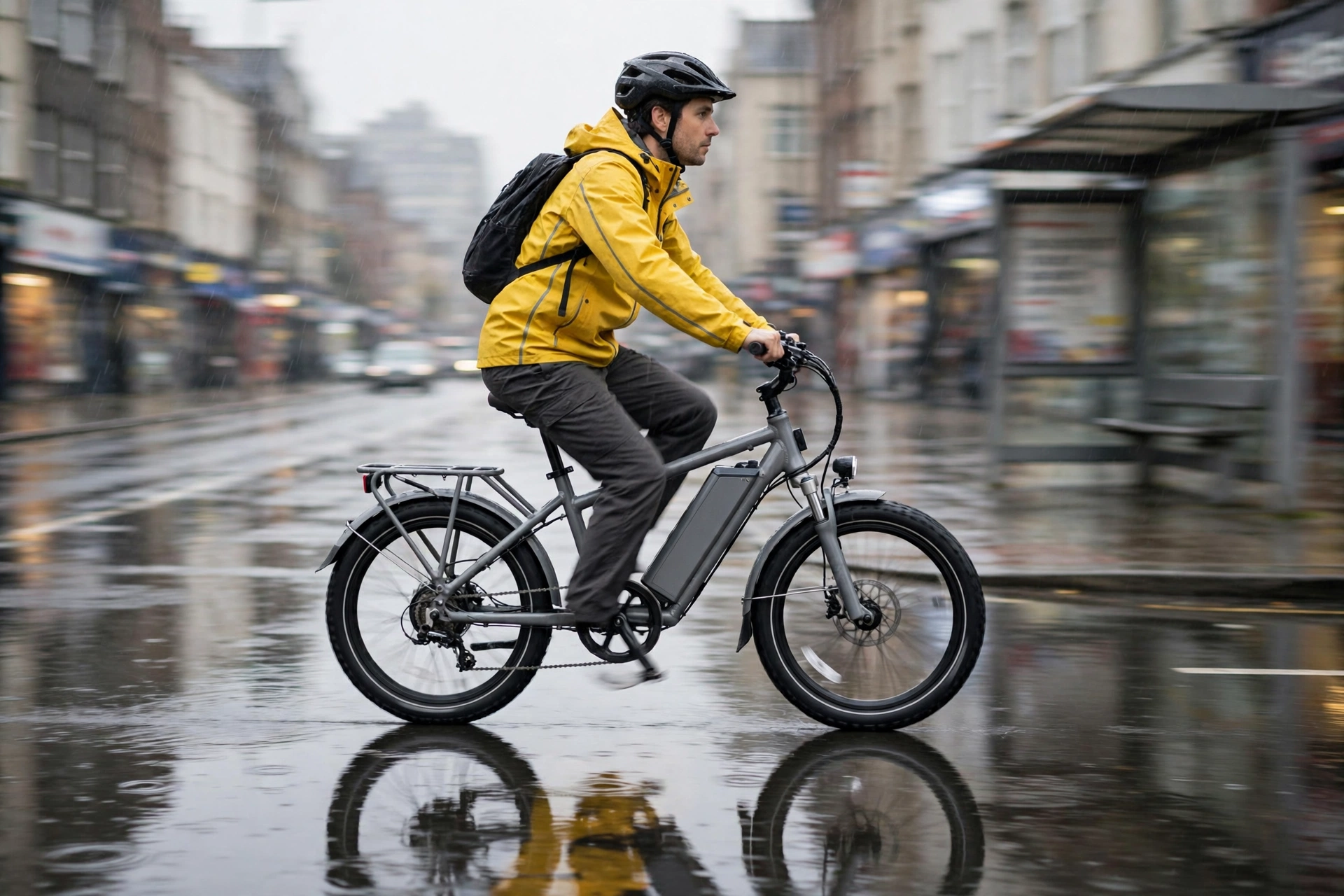
The Lectric XP 4.0 ebike motor and its new torque sensor
The standard motor is a 500W rear hub unit Lectric calls the Stealth M24, peaking at 1,092W with 55 Nm of torque. The 750’s motor peaks higher — OutdoorGearLab’s dynamometer read 1,263W — and produces 85 Nm. Both run a 48V system through an IPX5-rated, potted controller, so rain is a non-event electrically. Five assist levels (Eco, Tour, Sport, Sport+, Turbo) sit under a thumb throttle on the left bar, and the bike can be configured as Class 1, 2 or 3 up to 28 mph; if the class labels blur for you, our Class 1 e-bike guide lays out what each class allows where.
The torque sensor changes how the power arrives. A cadence sensor — the 3.0’s setup — is a switch: pedal, wait a beat, get a lump of power whether you asked gently or not. The XP 4’s torque sensor meters assistance against how hard you are actually pushing, so pulling away from a wet junction is smooth instead of surgy, and low-speed manoeuvring in a crowded bike lane stops being a negotiation.
It also sips. Electric Bike Report measured the standard bike using just 9.1 Wh per mile at its lowest assist setting, well under the 10.9 Wh/mile average of the folding bikes it compared. Smooth and frugal is a rare pairing. At $999, every cadence-sensor folder costing $1,400 should be embarrassed.
Hills: where the two versions stop being siblings
Fifty-five newton-metres is a flat-town number. On level ground and gentle grades the standard bike is entirely adequate — BikeRide clocked 8.0 seconds from 0 to 20 mph on max assist, quicker than the average 500W folder it has tested. Point it at a real climb and the story changes. OutdoorGearLab’s throttle-only hill work had the 500W bike sagging below 10 mph on steeper pitches, its motor audibly straining, and BikeMag’s tester found the same: fine on moderate hills if you pedal with intent, short of breath if you expect the throttle to do the work.
The 750 version of the lectric xp 4.0 ebike exists for that gap. Eighty-five newton-metres and a stronger 24-amp controller (est., per tester teardowns; the standard bike runs a 20-amp unit) hold speed on climbs that flatten the standard bike, and Electric Bike Report’s hill test put the 750’s throttle-only climb at 14.7 mph average where lesser folders crawl. My position is not complicated. Flat city, short hops, tight budget: the standard bike, happily. One meaningful hill on your route, a heavier rider, or a loaded 150 lb-rated rear rack: the 750, and do not talk yourself out of it to save $300 you will resent every morning.
Lectric XP 4.0 ebike range: the claim, the tests, the arithmetic
Lectric claims up to 50 miles for the standard bike and up to 85 for the Long-Range. Treat those as the ceiling of a very gentle day. Electric Bike Report’s instrumented range tests are the numbers to plan around: the standard bike covered 30.2 miles at its highest assist level and 55.1 miles at its lowest. BikeRide’s testers, on a different course, recorded 24.69 miles at maximum assist and 32.76 miles at a mid setting — 66% of the claim.
OutdoorGearLab’s worst-case run, throttle only, Turbo, hills, drained the standard battery in 19.1 miles. Three testers, three courses, one lesson: a working commuter number for the standard bike is 25 to 35 miles, and the claim is a fair-weather ceiling.
The 750’s bigger battery tells the same story one size up. Electric Bike Report rode it 36.9 miles in Turbo and 63.42 miles in Eco under its Class 2 test protocol. OutdoorGearLab got 37.2 miles with over 2,000 feet of climbing in the total. Rider Guide, using throttle alone with a 235 lb rider, managed 25.6 miles — a reminder that the right wrist is the most expensive component on any e-bike. Plan on 35 to 45 miles of mixed commuting from the Long-Range and you will not be walking.
Now the arithmetic Lectric does not print. Price per tested mile, using Electric Bike Report’s figures: the standard bike at full assist costs $999 ÷ 30.2 = $33.08 per tested mile; in Eco trim that falls to $999 ÷ 55.1 = $18.13. The 750 costs $1,299 ÷ 36.9 = $35.20 per tested mile in Turbo and $1,299 ÷ 63.42 = $20.48 in Eco. Counter-intuitive, and worth understanding: at maximum assist the expensive bike is slightly worse value per mile, because the stronger motor drinks faster than the bigger battery pours.
The upgrade maths cuts the other way. The extra $300 buys 840 − 500 = 340 extra watt-hours, which is $300 ÷ 340 = $0.88 per watt-hour — against $999 ÷ 500 = $2.00 per watt-hour for the standard bike as a whole. Lectric sells you the Long-Range’s capacity at less than half its own going rate. In range terms, that $300 buys 36.9 − 30.2 = 6.7 extra tested miles at full assist ($44.78 per extra mile) or 63.42 − 55.1 = 8.32 extra miles in Eco ($36.06 per extra mile). Buy the 750 for the torque and the headroom, not because the per-mile spreadsheet crowns it.
Brakes, tyres and wet roads
Both versions wear Star Union 602 hydraulic brakes biting 180mm rotors that are 2.3mm thick — thicker than the folding-bike norm, which matters on a 69 lb bike descending in the rain with a rack of shopping. BikeRide’s brake test stopped the standard bike from 20 mph in 19 feet, near the top of the folder class, and testers of the 750 recorded 16 feet 1 inch, among the best results in their database. Hydraulics also mean consistent lever feel in February, which mechanical cables on the early XP 3.0 never managed.
The 20 × 3-inch tyres are puncture-resistant and arrive with Slime sealant already inside the tubes — a small thing that prevents the most common commute-ruiner there is. Full fenders are fitted, the headlight is a 90-lumen unit with amber side markers, and the rear light is brake-activated with working turn signals, all powered from the main battery. One honest nitpick, found by OutdoorGearLab: the display reports battery charge in 10% steps, so the readout sits smugly at 100% and then falls in lumps. You learn your route’s real consumption in a week. Until then, the gauge flatters you.
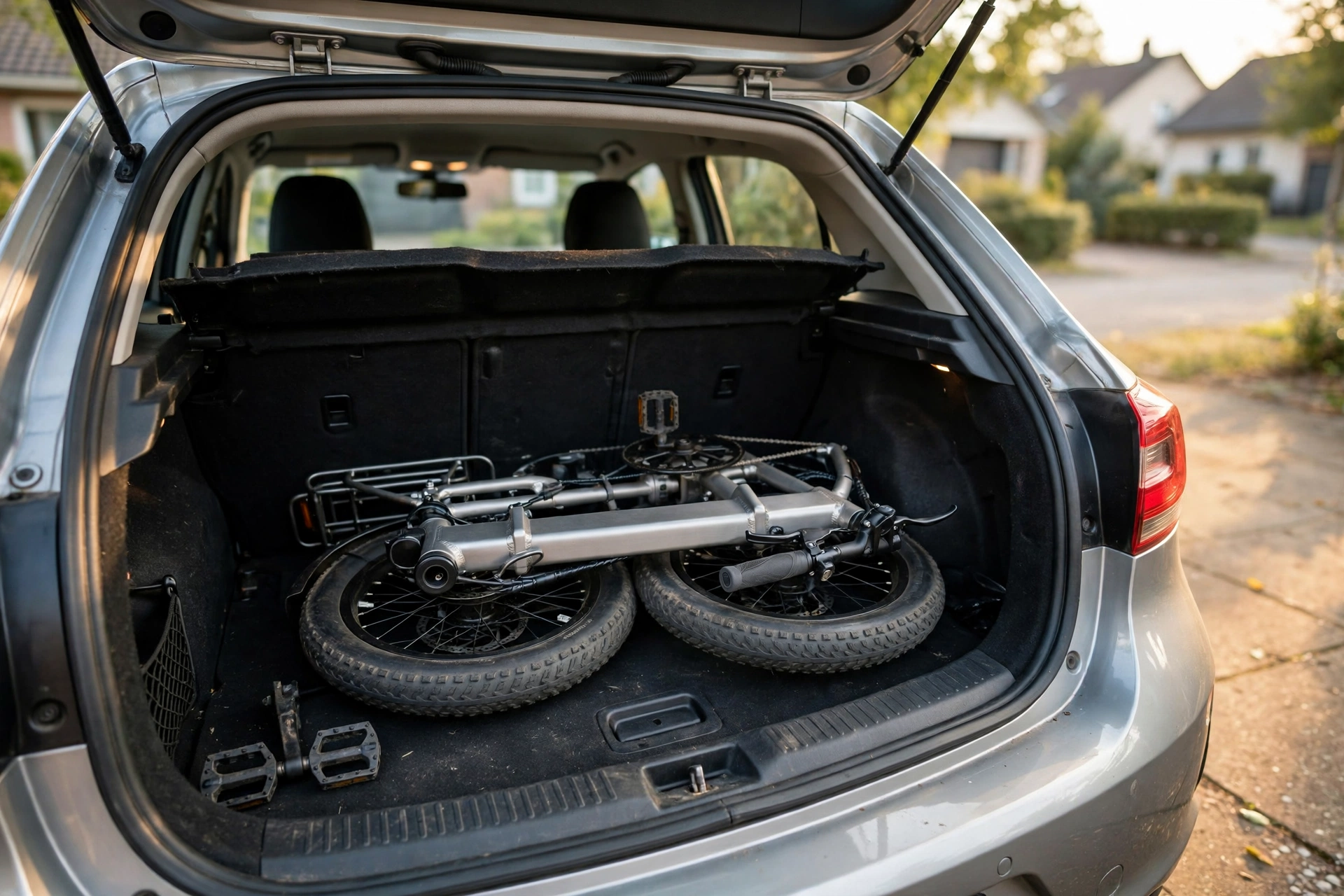
Folding it: the boot test, the train test, the staircase test
Folded, the XP 4 measures 37 × 17 × 29 inches. The fold itself takes 15 to 20 seconds: stem down, frame latch open, swing the halves together. New quick-release pedals — push in, twist, off — remove the old ritual of pedals gouging the car boot’s trim. In a hatchback boot or across an SUV load floor, the folded bike is a non-issue, and this is the honest use case for the folding frame: car boots, motorhome lockers, flat hallways, the corner of a small office.
Stairs are where the brochure language ends. Sixty-nine pounds is a two-handed, brace-yourself lift, and doing it twice a day to a third-floor flat is a gym membership you did not choose. Pulling the 7 lb battery first helps at the margin, not in principle. Commuters with a lift, a garage or ground-floor storage: carry on. Commuters with three flights and no lift: this is the wrong bike, and the right one weighs under 50 lb and costs more. Dry understatement ends there.
In the box, charging costs and living with it
The bike arrives almost fully assembled — unfold the stem, click in the bars, fit the pedals and display; Lectric calls it one-minute, tool-free assembly, and for once the claim is roughly honest. Fenders, the integrated rear rack, lights and the charger are all in the box, which is rarer than it should be at $999. Lectric’s other habit to know about: its sale events rarely cut the headline price far, and instead bundle accessory value — locks, panniers, comfort packages, gift accessories — on top of the same $999 or $1,299. If you were going to buy the accessories anyway, waiting for a bundle week is the discount. If you were not, it is decoration.
Charging is a 2-amp affair: four to six hours from empty on the standard battery, with a 5-amp fast charger sold separately that cuts it to about two hours (est., scaling by charger output for the larger pack). The cost is a rounding error. A full 500Wh charge is half a kilowatt-hour: 0.5 × $0.17 (a typical US residential rate, est.) = about nine cents. The 840Wh pack costs roughly fourteen cents to fill.
We break the habit down further in our guide to what it costs to charge an electric bike, and if you are weighing the bike against a second car, run both through our total cost of ownership calculator — the XP 4’s running costs are so low the comparison stops being sporting.
Ownership security is the quiet headline. The bike is certified to UL 2849 and the battery to UL 2271 — the pair of standards your insurer and your building manager care about, and that plenty of cheap folders skip. The warranty is one year, which is ordinary at this price, and BikeRide’s tested support response time of 36 hours was slower than the 18-hour average across brands it measures. Parts availability is the counterweight: with over 450,000 XP-series riders claimed by Lectric, consumables and spares for this platform are not a scavenger hunt.
Lectric XP 4.0 ebike vs XP 3.0: upgrade or keep yours?
Side by side, the generational changes that matter are four. The torque sensor replaces the cadence sensor, and it transforms low-speed manners more than any motor upgrade could. The drivetrain grows a gear and a better derailleur — Shimano Altus 8-speed with a trigger shifter, against the 3.0’s 7-speed Tourney — so spinning out at 28 mph is less of an issue.
The display is now a 3.5-inch colour TFT with turn signals built into the bike, and the key no longer has to live in the battery while you ride: the XP 4 starts at the push of a button, keys reserved for battery removal. Add the Long-Range battery jumping from 672Wh to 840Wh and the XP 3.0’s twist throttle giving way to a thumb trigger, and the 4 is a thorough rework rather than a facelift.
The catch is weight and price history. The XP 4 at 69 lb is five pounds heavier than the 64 lb XP 3.0, and 3.0s were cleared at discounts the 4 does not need. If your 3.0 still commutes happily, there is no burning reason to swap; its hydraulics (on later production) stop fine and its range was honestly rated. If you are buying new, buy the 4 — the sensor alone is worth choosing the newer bike at the same money.
Verdict: our scores for the Lectric XP 4.0 ebike
Standard 500W — Our score: 8.4/10 — Commuter reliability: 8/10 · Range honesty: 7/10 · Value: 9/10. The default folder for flat-to-rolling cities. Claim 50 miles, plan 30, arrive un-sweaty.
750 Long-Range — Our score: 8.7/10 — Commuter reliability: 9/10 · Range honesty: 7/10 · Value: 9/10. The hill answer and the range answer in one $300 step. Still not a staircase bike. Nothing at 74 lb is.
The range scores stay at 7 because the claims remain fair-weather numbers, and the tested figures — not the box copy — are what we scored against. Everything else about the lectric xp 4.0 ebike is what happens when a company sells hundreds of thousands of one model and actually fixes the complaints list. That is rarer in this industry than any torque figure.
Frequently asked questions
Is the lectric xp 4.0 ebike a Class 2 or Class 3 bike?
Both, by configuration. It ships ready to ride within Class 2 limits (throttle and assist to 20 mph) and can be set up as Class 1, 2 or 3, with pedal assist up to 28 mph in Class 3 trim. Which class you may use depends on where you ride; set the bike to match your local rules before the first commute, not after the first ticket.
How far does the XP 4 really go on a charge?
Tested, not claimed: Electric Bike Report measured 30.2 miles at maximum assist and 55.1 miles at minimum assist on the standard battery, and 36.9 miles (Turbo) to 63.42 miles (Eco) on the Long-Range. BikeRide’s course returned 24.69 miles at max assist for the standard bike. For a five-day commute of ten-mile round trips, either battery covers the week; the Long-Range covers it with the warning lights off.
Can I carry the XP 4 up stairs every day?
You can. You will not enjoy it. At 69 lb (roughly 74 lb for the 750, est.), with the battery removed to save 7 lb on the standard bike, it remains a heavy two-handed lift with a bulky folded shape. Occasional stairs, fine. Daily flights of stairs are a genuine reason to choose a lighter folder or a non-folding bike you can store downstairs.
Is the 750 worth the extra $300?
If your route has a real hill or you are a heavier rider, yes — the jump from 55 Nm to 85 Nm is the single biggest ride difference between the two bikes, and the 340 extra watt-hours come at $0.88 per watt-hour, cheap capacity by any measure. If your commute is flat and under 15 miles a day, the standard bike’s tested range already covers you, and the $300 stays in your pocket with our blessing.
How long does charging take, and what does it cost?
Four to six hours from empty with the included 2-amp charger; an optional 5-amp fast charger cuts that to about two hours for the standard battery. Electricity for a full standard charge is about nine cents at typical US residential rates (est.) — a year of daily commuting charges costs less than one tank of petrol.
Does the XP 4 fit in a car boot?
Yes. Folded to 37 × 17 × 29 inches, it sits in most hatchback boots and SUV load floors, and the quick-release pedals stop the usual paint-and-trim damage. Two folded XP 4s in one vehicle is possible in larger boots (est., depending on the car’s shape) — measure your boot floor against the folded dimensions before promising a friend a lift.