Last updated: October 27, 2026
An electric scooter helmet is not an accessory. It is the only piece of safety equipment that works at the exact moment everything else has failed — after the brakes, after the tyres, after your balance. I test scooters by their stopping distances because stopping is where crashes are decided. The helmet decision deserves the same cold logic: match the protection to the speed, read the certification label before the price tag, and treat anything without a label as costume jewellery.
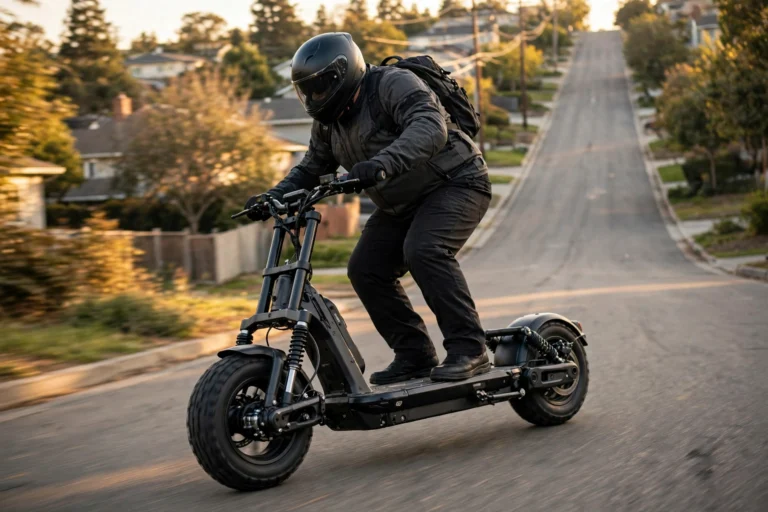
Here is the problem in one line. Scooters now span three different machines wearing the same name. A rental-style commuter tops out at 15–20 mph. A dual-motor performance scooter cruises at 28 mph and keeps pulling. A flagship like the Kaabo King GTR — covered in our Kaabo King GTR guide — is sold on speeds past 40 mph. One helmet category cannot honestly cover all three, and the label inside the helmet tells you which machine it was actually tested for.
Electric scooter helmet standards: four labels, four different promises
Four certification labels cover almost every helmet a scooter rider will meet in a shop. They are not interchangeable, they are not marketing tiers, and the differences between them are measured in test velocity and in how much of your head the standard requires the shell to cover. Learn the four labels and the rest of this guide becomes arithmetic.
Start with the default. Every bicycle helmet legally sold in the United States must meet the CPSC standard at 16 CFR Part 1203 — the rulebook is summarised on the CPSC’s own bicycle helmet guidance page. Its impact test drops a helmeted headform onto anvils and caps peak acceleration at 300g, a threshold set around skull-fracture risk. The hardest drop in the protocol, two metres onto a flat anvil, works out to a head strike at roughly 14 mph. The standard also tests strap strength and whether the helmet stays on during a fall. It is a competent floor for bicycle speeds. It was never written for a 28 mph scooter, and nothing in it claims otherwise.
NTA 8776 is the label written for the faster machines. It is a Dutch standard built for speed pedelecs — e-bikes that assist to 45 km/h, or 28 mph. Three differences matter. The peak acceleration limit drops to 250g, so the foam must absorb more energy before the headform feels the same hit. The required coverage extends further down the back of the head and over the temples, the zones an upright scooter rider exposes in a sideways fall. And the test velocities run higher than the bicycle protocol, because the Dutch wrote the standard around the speeds the vehicles actually reach. A helmet carrying NTA 8776 next to its CPSC label has passed both regimes. That dual label is the single most useful thing to look for on a fast commuter scooter.
ASTM F1492 is the skateboarding standard, and it answers a different question. Skate helmets are built for repeated lower-energy impacts — falls from standing height, again and again — so their liners are designed to survive multiple hits rather than to crush once at maximum absorption. Dual-certified helmets exist (CPSC plus ASTM F1492), and for slow skate-park-speed riding they are legitimate. But a multi-impact skate lid is not a speed upgrade. It was never tested at NTA velocities, and wearing one at 28 mph because it looks sturdy is a category error.
At the top sit the motorcycle standards. The US DOT rule (FMVSS 218) is self-certified: the manufacturer tests its own helmets and applies the sticker, with the DOT auditing and recalling after the fact. Europe’s ECE 22.06 is stricter in structure — independent type approval before sale, more impact points, higher and lower test energies, and oblique impacts that measure rotational acceleration. Either label signals a helmet engineered for moped and motorcycle speeds, with a full chin bar, a retention system built for highway wind loads, and weight to match. That weight is the honest trade: protection at 40 mph is not free.
The energy maths: why speed rewrites the electric scooter helmet rule
Kinetic energy rises with the square of speed. That one sentence is the whole argument, so let us run the numbers properly. Take a head plus helmet at 5 kg — a fair adult figure — and compute ½mv² at the speeds scooters actually travel:
At 15 mph (6.7 m/s): 0.5 × 5 × 6.7² = 112 joules. At 20 mph (8.9 m/s): 0.5 × 5 × 8.9² = 198 joules. At 28 mph (12.5 m/s): 0.5 × 5 × 12.5² = 391 joules. At 40 mph (17.9 m/s): 0.5 × 5 × 17.9² = 801 joules.
Read the sequence again. The 28 mph fall carries about three and a half times the energy of the 15 mph fall — 391 ÷ 112 ≈ 3.5. The 40 mph fall carries seven times. Foam does not scale politely across that range: a liner tuned to crush correctly at 112 joules bottoms out at 391, and once EPS foam has fully compressed, the remaining energy goes straight into the skull. This is why the speed rule in this guide is not a preference. Up to 20 mph, a good CPSC bicycle helmet is working inside its tested envelope. From 20 to 28 mph, you need the standard written for that energy — NTA 8776 — or a full-face bicycle helmet with a certified chin bar. Above 28 mph, the energy maths has left bicycle territory entirely, and the correct answer is a motorcycle-standard full-face. Any rider who tells you their bicycle helmet is “basically fine” at 35 mph is asking 112-joule equipment to do a 600-joule job.
Full-face or open-face? The electric scooter helmet chin-bar question
Scooter falls are not bicycle falls. A cyclist usually goes over sideways or low-sides with the bike. A standing scooter rider who hits a pothole, a kerb or a car door is pitched forward over the handlebar, hands still on the grips, face leading. The face and jaw are exactly what an open-face helmet leaves uncovered, and dental and jaw injuries are among the most common facial injuries in scooter crash reports. I will keep the claim qualitative, because that is what the evidence supports cleanly: cover the chin and you remove a whole class of injury from the table.
A chin bar is only worth having if it is certified as structure. On full-face bicycle helmets, look for the ASTM F1952 downhill standard — it includes a chin-bar deflection test, which is why downhill-rated bars are rigid enough to matter. Treat decorative chin bars on cheap convertible helmets with suspicion: if the bar is not covered by a named standard in the product’s certification list, assume it is styling. Removable bars on certified helmets, like the downhill-rated designs below, are the practical compromise for riders who climb slowly and descend or commute fast.
Fit, retention and rotational liners: the invisible half of protection
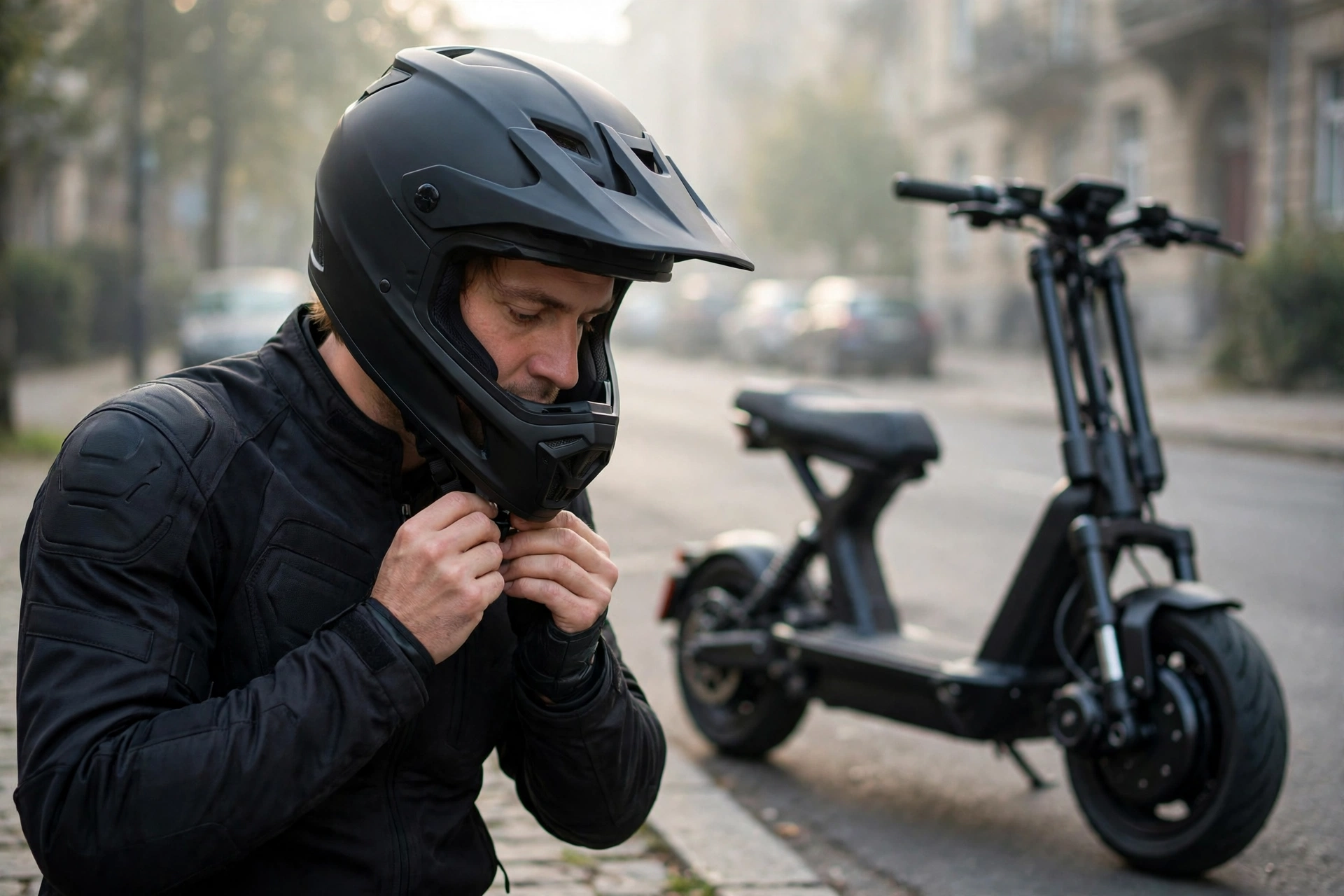
A helmet protects only the head it stays on. Fit is therefore not comfort garnish; it is a safety specification. The checks take thirty seconds. The shell should sit level, low on the forehead — about two finger-widths above the eyebrows. The retention dial should snug the cradle without a pressure point. Push the helmet firmly from the front and back: it should move the skin on your forehead, not slide over it. The chin strap should sit in a V under each ear and fasten tight enough that two fingers fit flat beneath it, no more. A helmet that rotates freely on your head has already failed its first test, whatever its label says.
Rotational injury is the second half of the story. Most real impacts are oblique — the head strikes at an angle and spins — and rotational acceleration is a primary driver of concussion. Slip-plane systems such as MIPS add a low-friction layer that lets the shell rotate a few millimetres against the head, bleeding off some of that spin. The evidence, stated precisely: Sweden’s Folksam insurance group, which crash-tests helmets with oblique impacts weighted heavily in its scoring, has repeatedly found that helmets with anti-rotation systems perform better than average in its tests, and its “Recommended” lists are dominated by them. The Bicycle Helmet Safety Institute remains sceptical that the test rigs flatter the technology. My position, and I will state it plainly: the independent test programmes that measure rotation reward these systems, the premium is often under $25, and no test programme has found them harmful. Buy the slip plane.
The strongest buying tool in this whole category is free. The Virginia Tech Helmet Lab, working with the Insurance Institute for Highway Safety, drop-tests bicycle helmets at six locations and two energies, measures linear and rotational response, and publishes concussion-risk scores on its Virginia Tech bicycle helmet ratings page. Lower score, less risk; the lab recommends four- and five-star helmets. Note that the lab recalibrated its thresholds in July 2025 because helmets had improved so much — the five-star list shrank from 167 models to 38 — so a current five stars means more than it did in 2023. One honest caveat: in a 2024 comparison, Germany’s ADAC found its tested NTA 8776 helmets did not beat good ordinary city helmets under ADAC’s own protocol. Test protocols differ, and the energy maths in the previous section does not change — but it is a reminder that the label is the floor, and independent scores are how you choose above the floor.
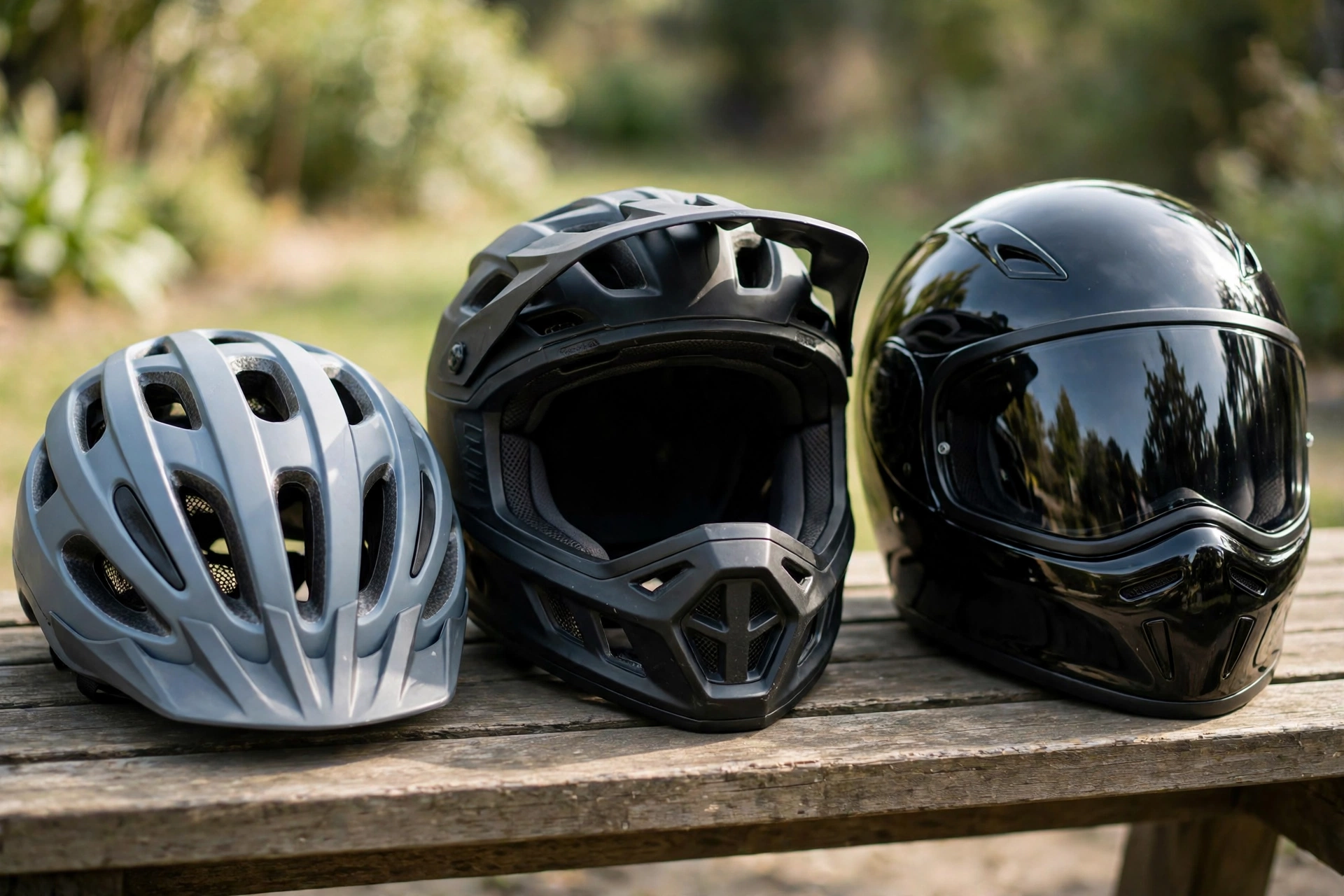
The picks: one electric scooter helmet per speed class
Prices below were checked on October 27, 2026 against retailer and manufacturer listings, and every pick is scored the same way: Protection, Comfort, Value. Cost per year uses the standard five-year replacement horizon — a $65 helmet is $13 a year, which should recalibrate what “expensive” means in this category.
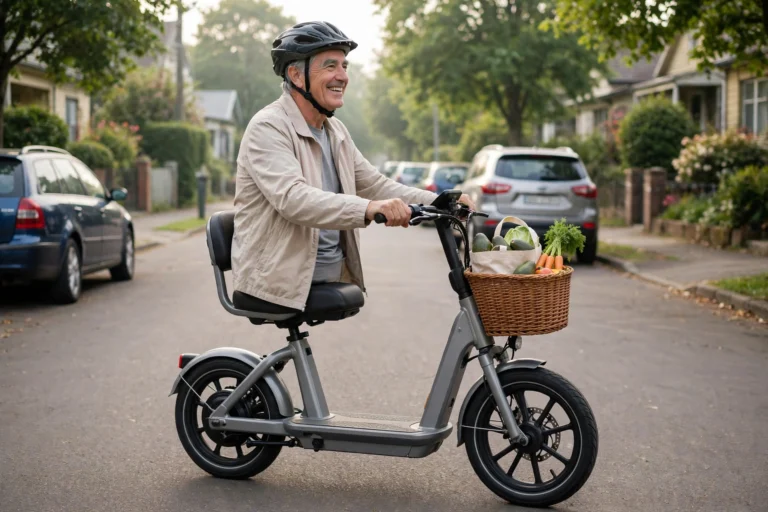
Up to 20 mph — Specialized Align II MIPS (~$50–$65). The commuter class covers machines like the Ninebot Max in our Segway Ninebot Max G30P guide — honest 15–20 mph scooters ridden in traffic and bike lanes. The Align II is the rare budget helmet with receipts: five stars and a 9.55 score at Virginia Tech, a Folksam “Recommended” result in the insurer’s 2021 test, MIPS included, CPSC certified. It launched at $50 and most retailers list it at $65 now; at either price nothing else in the class carries this much independent evidence. Our score: 8.8/10 — Protection: 9/10 · Comfort: 8/10 · Value: 10/10.
20–28 mph — Xnito (~$150). This is the class where the bicycle standard runs out and NTA 8776 takes over. The Xnito carries NTA 8776 alongside CPSC and CE labels, adds front and rear LED lighting built into the shell — genuinely useful on a scooter, where you sit lower in a driver’s eyeline than a cyclist — and the maker offers free replacement after a crash. It has no MIPS liner; riders who want the slip plane at this standard should look at the ABUS Pedelec 2.0 MIPS (~$200), which pairs NTA 8776 with MIPS and scored four stars (11.14) at Virginia Tech. Our score: 8.4/10 — Protection: 9/10 · Comfort: 8/10 · Value: 7/10.
28 mph and fast descents — Bell Super DH Spherical (~$325–$350). For riders whose scooters live at the top of the bicycle world, this is the full-face answer that stays bicycle-light: CPSC certified, MIPS Spherical, and a removable chin bar that meets the ASTM F1952 downhill standard rather than posing as one. You pay for it, and it vents like a bicycle helmet rather than sealing like a motorcycle lid, which matters on a standing scooter in summer. Our score: 8.6/10 — Protection: 9/10 · Comfort: 7/10 · Value: 6/10.
Above 28 mph — HJC C10 (~$110–$150). Past 28 mph the correct purchase stops being a bicycle product. The C10 is a full-face motorcycle helmet, DOT certified in the US (ECE 22.06 versions are sold in Europe), with a proper visor, a shell and liner engineered for energies no bicycle standard contemplates, at a price lower than most premium bicycle helmets. It is heavier and hotter than anything above it on this page. That is the correct trade at 40 mph, and pretending otherwise is how riders get hurt in expensive bicycle gear. Our score: 8.3/10 — Protection: 9/10 · Comfort: 7/10 · Value: 9/10.
Electric scooter helmet law: what is required — and where it stops
US helmet law for scooters is a patchwork, so here is one state verified properly, as an anchor. In California, Vehicle Code §21235(c) requires riders under 18 on a motorised scooter to wear a properly fitted, fastened bicycle helmet meeting ASTM or CPSC standards; adults face no state helmet mandate on a scooter. California treats faster pedal machines more strictly — every Class 3 e-bike rider must wear a helmet regardless of age under §21213, a useful parallel explained in our Class 1 e-bike guide — and the moment a scooter crosses into moped or motorcycle classification, California’s motorcycle helmet rule and a DOT-certified helmet apply. Other states and many cities set their own rules, and rental fleets often impose stricter terms than the law does. Check your state vehicle code before you ride, and understand what the law is actually doing: it mostly regulates the slowest machines and the youngest riders. The 35 mph scooter in your garage is, in most states, legally unaddressed and physically unforgiving. The law is the floor again. Physics is the ceiling.
Mistakes that quietly cancel the protection
Five errors undo a good electric scooter helmet every day. First, the wrong size bought online and never exchanged — measure your head circumference above the ears and buy the size the tape says, not the size you wear in hats. Second, the strap worn loose or unfastened “for a short trip”; a retention system that is not tensioned is decoration, and most scooter trips are short trips. Third, the second-hand helmet: EPS foam history is invisible, a dropped or crashed liner looks identical to a sound one, and no seller can certify the difference. Never buy a used helmet. Fourth, the novelty shell — the leather-look or costume helmet with no CPSC label inside. It is not a cheap helmet. It is not a helmet. Fifth, keeping a helmet forever: manufacturers and the CPSC’s guidance converge on replacing a helmet after any significant impact and roughly every five years as materials age, sooner if the fit pads have compressed enough to change the fit.
Frequently asked questions
What electric scooter helmet do I need for a scooter that does 30 mph?
A motorcycle-standard full-face. At 30 mph the impact energy is beyond every bicycle protocol’s test envelope, NTA 8776 included — that standard tops out at 28 mph design speed. The HJC C10 above is the budget-correct answer; a full-face bicycle helmet like the Bell Super DH is the minimum-defensible option, and only because its chin bar is downhill-certified.
Is a skate helmet (ASTM F1492) enough for a commuter scooter?
Only if it is dual-certified with CPSC and your scooter stays at bicycle speeds. A standalone ASTM F1492 skate helmet is built for repeated low-energy falls, not for a single high-energy impact at 20 mph. Check the labels inside the shell: you want CPSC at minimum, NTA 8776 if your scooter runs toward 28 mph.
Does MIPS actually do anything?
The best independent evidence says yes, modestly. Folksam’s oblique-impact testing repeatedly scores anti-rotation helmets above average, and Virginia Tech’s top-rated helmets are dominated by MIPS and rival systems such as WaveCel and KinetiCore. Sceptics dispute how well the rigs mimic a real head and neck. Given the small price difference, this guide’s instruction stands: buy the version with the slip plane.
My state does not require adults to wear a helmet. Why wear one?
Because the statute was written around 15 mph rental scooters, and your head does not know which vehicle it fell off. The energy at 20 mph is the same whether the law mentions your machine or not. California’s under-18 rule and its all-ages Class 3 e-bike rule show regulators inching toward the physics; there is no reason to wait for them.
Can I use my motorcycle helmet on a slow scooter instead?
Yes — a certified motorcycle helmet is safe at low speed, simply heavier, hotter and harder to hear traffic through. The reverse is never true: no bicycle helmet is acceptable at motorcycle speeds. If you own one good full-face motorcycle helmet and one 18 mph scooter, you are covered; consider a light CPSC helmet for summer comfort, not for added safety.
When exactly should a helmet be replaced?
After any crash impact, after any drop onto concrete — the rule applies to every electric scooter helmet, skate lid and motorcycle helmet alike — from handlebar height or more if the shell or liner shows damage, when the fit system can no longer hold adjustment, and at about five years of regular use regardless of appearance. Foam and fit pads degrade invisibly; the calendar rule exists precisely because you cannot inspect your way around it.
One closing instruction, because it is the whole article in one line: read the label, match it to your scooter’s real top speed, and buy the best independently rated electric scooter helmet in that class. Everything on this page — the standards, the energy maths, the picks — is published so you can check it, the same standard we apply to every guide in how we research. And apply the label habit to the machine, too: our EV charger compatibility checker exists because the plug on the wall obeys standards exactly the way the helmet on your head does. Match the spec to the job, every time.