Last updated: October 27, 2026
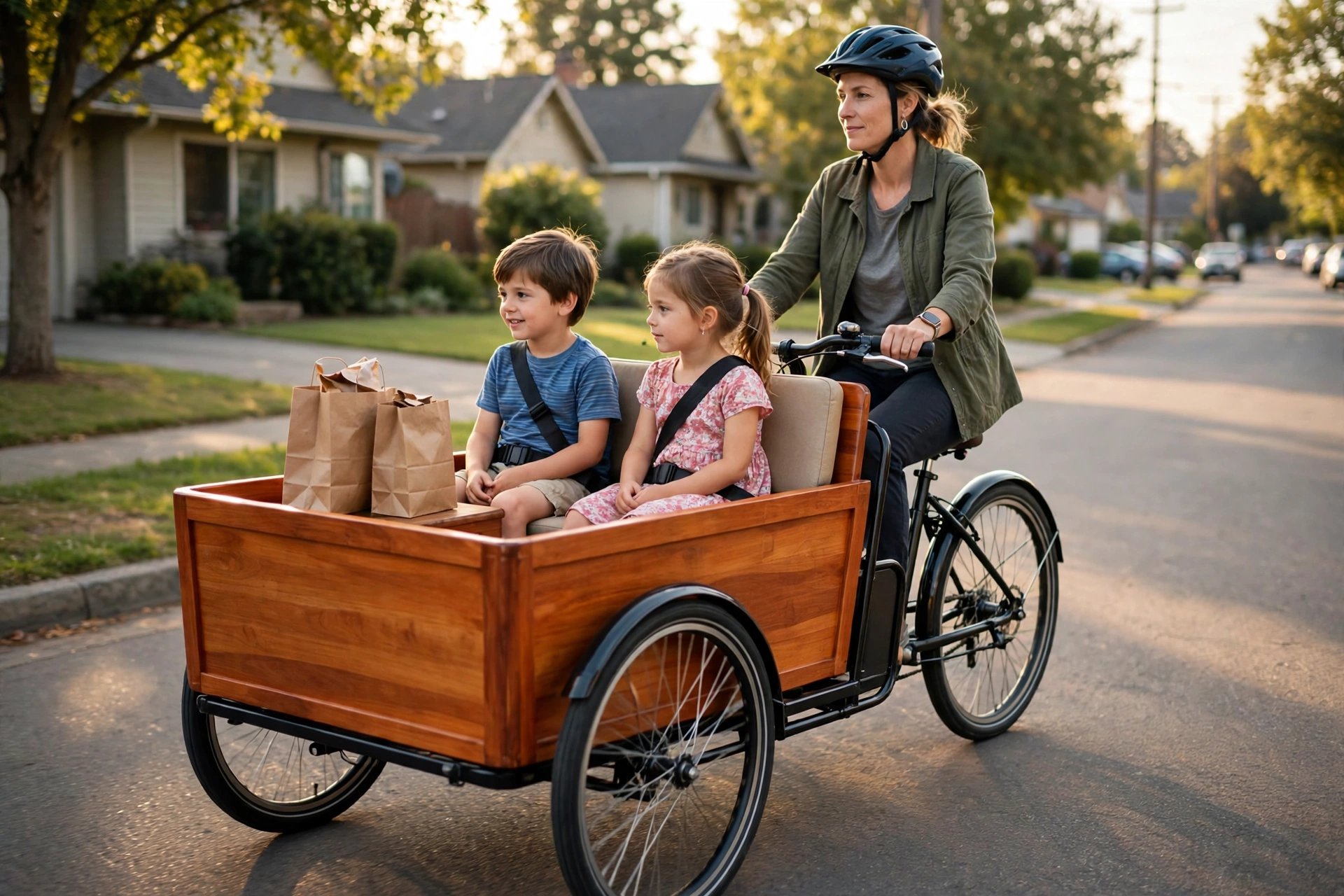
Start with a correction, because the name misleads people. The dirwin caravan cargo electric bike is not a longtail. It is not a fat-tire hauler either. It is a front-loading cargo tricycle: a polished wooden box carried between two front wheels, one driven wheel behind the rider, and seatbelts in that box for up to four children. The current model is the Caravan 2, in stock at Dirwin’s own store at $3,499 (price checked October 27, 2026), with free shipping and free professional assembly. I judge bikes on trails — motors, suspension, brake hardware, honest numbers. A 145 lb trike will never see a trailhead with me, and it should not see one with you. Hauling is engineering too, though. A machine rated for 450 lbs gets judged the same way I judge anything heavy: on its brakes, on whether its load figures survive arithmetic, and on whether the motor can move the mass it advertises.
The Caravan 2 replaced an earlier Caravan that made do with a 350W motor and 160mm mechanical disc brakes, a spec sheet that was never adequate for the weight involved. The new machine fixes the worst of it. The motor grows to 500W, the brakes become 180mm hydraulics with a parking brake, the battery carries a UL 2271 certification, and a torque sensor joins the cadence sensor, so starts with a loaded box are metered rather than jerky. Those are the right upgrades, in the right order. What did not change is the shape of the thing: three wheels, no suspension at either end, a top assisted speed of 15 mph, and a footprint closer to a garden cart than to any bicycle I own. Keep that picture in your head for everything that follows.
What the dirwin caravan cargo electric bike actually is
The box is the product. It measures 40 in long, 23 in wide and 26 in deep, and Dirwin rates it at 400 litres with a 250 lb load limit. Note the first honesty test here: Dirwin’s banner copy still advertises “20 cubic feet” of box space, a figure carried over from the original Caravan’s larger 570-litre box. The current spec sheet says 13.84 cubic feet, which matches the 400-litre box (400 litres is 14.1 cubic feet). Trust the spec sheet, not the banner. The whole trike runs 85.2 in long and 32.3 in wide, turns in a 13.4 ft radius, and weighs 145 lbs before you add a rider, a child, or a single bag of groceries. Two 20 in wheels carry the front; a single 26 x 2.125 in wheel does the work at the back. There is no suspension fork and no rear suspension. Ride quality comes from the tires, the saddle, and low speed, in that order.
Seating is where the Caravan 2 earns its price against two-wheel cargo bikes. Four seatbelts and two cushions come in the box, along with a waterproof rain cover, a soft floor liner, fenders, lights and a rear rack. Dirwin says children from 18 months can ride belted in the box, and the benches remove with basic tools when the cargo is firewood instead of family. An optional front door for dogs was still listed as “coming soon” when we checked. Rider fit is quoted at 5 ft 0 in to 6 ft 4 in. None of this is trail equipment. It is a school-run and market-run appliance, and judged as an appliance it is well kitted.
The motor: 500 watts, a torque sensor, and one missing number
The dirwin caravan cargo electric bike runs a 500W hub motor on a 48V system, with a 2-in-1 torque and cadence sensor, a thumb throttle, five assist levels and a Shimano 7-speed drivetrain behind a 42T chainring. Five hundred watts sounds modest next to the 750W units on Dirwin’s own Pioneer fat bikes. On this machine the modest number is deliberate. The trike is governed to 15 mph, and Dirwin’s own safety guidance goes further: it advises a maximum assisted speed of 13 mph and approach turns at 8 mph. A bigger motor would buy speed the chassis is explicitly not meant to use.
Here is the missing number: torque. Dirwin publishes an 80 Nm figure for its Pioneer 2. For the Caravan 2 it publishes nothing. Torque is the figure that decides whether a loaded trike pulls away from a stop on a ramp or stalls while you dab a foot down, and its absence is a choice, not an oversight. Run the hill arithmetic yourself. At full payload the trike grosses up to 595 lbs (145 lbs of bike plus 450 lbs of everything else), roughly 270 kg. Holding just 8 mph on a 6% grade takes about 569 watts against gravity alone — 270 kg x 9.81 x 3.58 m/s x 0.06 — before rolling resistance and before the extra drag of a wide wooden box. That is more than the motor’s nominal rating, with your legs supplying the difference through the torque sensor. Geared hub motors of this class typically produce somewhere in the 60–80 Nm band (est., based on comparable 500W units), which is workable on gentle ground and honest work on real hills. My ruling: on any machine sold to carry 450 lbs, a published torque figure should be mandatory. Gentle suburbs, fine. A hilly town with a full box — test ride it loaded before money moves, or do not buy it.
Range: the dirwin caravan cargo electric bike claim versus the maths
Dirwin claims 30–45 miles from the single 48V 15Ah battery, 720Wh in total. There is no dual-battery option on this model. If you want two packs and 1,440Wh from this brand, you are shopping for the Pioneer 2, a different machine entirely. Take the top claim apart. Forty-five miles from 720Wh implies consumption of 16 Wh per mile (720 / 45 = 16). That is an efficiency figure a light rider on a light bike achieves at low assist on flat ground. It is not what a 145 lb tricycle with a wooden sail on the front returns in family service.
Now load it the way the advertising photographs load it. A 180 lb rider, two children at 100 lbs combined, and 40 lbs of groceries put 320 lbs of payload aboard and gross weight at 465 lbs. Heavy cargo trikes working at 12–15 mph typically draw around 30–35 Wh per mile (est., based on published consumption for loaded bakfiets-type trikes, which scales with mass and the drag of a third wheel). At 32 Wh per mile, 720 / 32 = 22.5 miles. Run solo errands at a gentler 25 Wh per mile and you get 720 / 25 = about 29 miles. So the honest planning band is roughly 22–29 miles, with Dirwin’s own lower claim of 30 miles describing the lightest use, not family use. Cross-check the rule against a tested rival: OutdoorGearLab’s lab test of the Lectric XPedition2, a lighter two-wheel cargo bike, measured 21.9 miles from its 624Wh single battery — 624 / 21.9 = 28.5 Wh per mile, measured, not claimed. No independent lab has published an instrumented range test of the Caravan 2 yet, so its figures stand untested, and Dirwin’s own cargo guide concedes that loaded riders should “expect the low end.” Plan on the low end. Plan below it.
Charging is a 48V 3A smart charger, quoted at 5–8 hours, so the dirwin caravan cargo electric bike is an overnight machine, full stop. If your daily errand map exceeds about 25 loaded miles round trip, no assist setting saves you; you either build in a midday charge or you buy a different tool. A second battery cannot be added later. That single fact should be settled before purchase, not discovered in November.

Brakes, frame and the 450 lb question
This is the section I care about, and it is where the Caravan 2 gets things mostly right. Braking is by 180mm hydraulic discs with a parking brake. Do the energy sum: at maximum gross weight (270 kg) travelling at its 15 mph ceiling (6.7 m/s), the trike carries about 6,060 joules of kinetic energy — 0.5 x 270 x 6.7 x 6.7 — and every joule of it goes through the rotors at every stop, repeatedly, on every downhill. Hydraulic actuation with 180mm rotors is the minimum specification I accept at this mass, and the parking brake is not a luxury on a machine that will be loaded on sloped driveways. The original Caravan stopped the same 450 lb rating with 160mm mechanical discs. That was underspecced, and the upgrade to hydraulics is the single strongest reason to buy the 2 over a discounted original.
The payload headline needs the same treatment. “450 lbs capacity” is the total: rider, children, cargo and the contents of the rear rack combined. The box itself is capped at 250 lbs. A 200 lb rider leaves exactly 250 lbs before the total limit and the box limit collide; four children at roughly 50 lbs each fill 200 lbs of the box and demand a rider of 250 lbs or less. Run the money side of the same numbers. The dirwin caravan cargo electric bike costs $3,499 / 450 lbs = $7.78 per pound of rated total payload, and $3,499 / 250 lbs = $14.00 per pound of box capacity. Dirwin’s own comparison table prices the Bunch 4+ at $6,499 for 600 lbs total (400 in the box), which is $6,499 / 600 = $10.83 per pound. The Lectric XPedition2 longtail, lab-tested by OutdoorGearLab at a $1,399 list price with the same 450 lb total rating, works out to $1,399 / 450 = $3.11 per pound. If your children can sit behind you in the open, the longtail hauls the same rated weight for less than half the money. If you want them in front of you, belted, under a rain cover, the trike’s premium is the price of the box, and on a per-pound basis it still undercuts the established front-box brands.
Stability deserves one blunt paragraph. Three wheels are honest at a standstill and forgiving at walking pace; they do not lean, so they do not corner like a bicycle. Dirwin’s own warning states the trike may tip if sharp turns are taken at speed or the load sits unevenly, and its guidance caps turns at 8 mph. Believe the warning over the marketing photographs. Load the box low and evenly, slow down before the turn rather than during it, and treat cambered driveways as obstacles to cross straight, not diagonally.
Where you may ride it — and where you may not
On paper the dirwin caravan cargo electric bike sits inside the envelope US rules were drawn around: under 750W, throttle-equipped, governed well under 20 mph. The complication is the third wheel. The three-class system most states use was written for two-wheel bicycles, and states differ on whether an electric tricycle slots into it, is handled under separate low-speed rules, or falls to local ordinance. Dirwin does not resolve that for you, and neither can I from here. Our Class 1 e-bike guide lays out how the class framework works and where to check your own state’s definitions before you ride. Do that check. A 32-inch-wide trike also draws attention a normal bike does not, and “the website said it was fine” is not a defence that survives a traffic stop.
Access is my home turf, so I will be direct. This machine has no business on singletrack, on dirt, or on any trail with a gate, a bollard line or a width restriction — and at 32.3 in wide with a 13.4 ft turning radius, plenty of paved-path entrances will refuse it too. It cannot be lifted over anything at 145 lbs. Its world is streets, driveways, school frontages and the paved paths that legally admit it. Ridden there, slowly, it is a sensible tool. Ridden anywhere else, it is an obstruction with a battery. Sell it to yourself as a neighbourhood vehicle and it will not disappoint you. Sell it to yourself as a bicycle and it will.
Ownership: running costs, warranty and the small print
Running costs are nearly a rounding error, which is the honest charm of the category. A full charge is 0.72 kWh; at an average US residential rate of $0.17 per kWh (est., national average basis), that is about 12 cents a charge, or roughly half a cent per mile at real-world range — the same maths we walk through in our guide to what charging an electric bike costs. Consumables are the real budget line: three tires and hydraulic pads wearing under up to 595 lbs of gross weight will not last like commuter-bike parts (est., based on the load multiples involved), and the 7-speed Shimano drivetrain is basic, cheap to service, and easy for any shop to source. That last part is a genuine virtue. Nothing on this trike is proprietary exotica.
Warranty cover is two years on parts and labour, which beats the one-year terms Dirwin’s own comparison table lists for Bunch and Ferla, and returns run 15 days. Shipping is free in the continental US and assembly is free at a partner shop — Dirwin claims 300-plus partner shops and a build time under an hour, against roughly three hours for the original. One gap to note: the battery is UL 2271 certified, but Dirwin lists full-system UL 2849 certification only for its Pioneer and Pacer Lite models, not for the Caravan 2. On a machine that charges overnight in a family garage, I would rather see both numbers on the sheet. It is not a disqualifier; it is a question to ask before you pay, and it is exactly the kind of check described on our research methods page. Finally, storage: at 85.2 in long, the trike does not fold, hang on a wall, or ride on a car rack. Measure the garage before the test ride. Storage kills more cargo-trike purchases than price does.
Our verdict on the dirwin caravan cargo electric bike
Our score: 6.8/10
- Load honesty: 6/10 — The 450 lb headline is a total that your own body weight spends first, and the box stops at 250 lbs. Credit where due: Dirwin publishes both numbers plainly, which is more than most of this market manages. The missing torque figure and the carried-over “20 cubic feet” banner cost it here.
- Brakes & build: 7.5/10 — 180mm hydraulics with a parking brake are the correct specification at this mass, the A6061 frame and Shimano drivetrain are serviceable anywhere, and the included kit (belts, cushions, rain cover) is complete. No suspension and an uncertified-at-system-level electrical package hold it back.
- Value: 7/10 — At $7.78 per pound of rated payload with free shipping, free assembly and a two-year warranty, it undercuts the established front-box trikes by thousands. It still costs two and a half Lectric longtails, and that comparison is fair to make.
Buy the dirwin caravan cargo electric bike if your life is a flat suburb, a school run inside ten miles round trip, small children who need belts and a rain cover, and a garage with 86 inches to spare. Do not buy it for hills you have not test-ridden loaded, for loaded days beyond 25 miles, or for any route that involves the word “trail.” Run your own totals against a longtail before deciding — our total cost of ownership calculator is built for exactly that comparison. Judged as what it is — a slow, stable, honestly braked neighbourhood hauler — the Caravan 2 is a decent machine with an inflated range claim. Judged as a bicycle, it is a garden cart with delusions. Buy it as the first thing.
Frequently asked questions
Is the dirwin caravan cargo electric bike street legal?
Its power (500W) and speed (15 mph) sit inside the limits US e-bike rules were built around, but most state class systems were written for two-wheel bicycles, and electric trikes are treated differently from state to state and town to town. Check your state vehicle code and local ordinances before riding it on public roads; do not assume the class label on a two-wheeler applies to you.
How far does the Caravan 2 really go on one charge?
Dirwin claims 30–45 miles from its 720Wh battery. The 45-mile figure implies 16 Wh per mile, which is unloaded, low-assist riding. Loaded with a rider, two children and groceries, plan on roughly 22–29 miles (est., from the consumption maths in this guide). No independent lab range test of this model has been published yet.
Can it climb hills with a full box?
Gently, yes; steeply, slowly. At maximum gross weight, holding 8 mph on a 6% grade needs about 569 watts against gravity alone, above the motor’s 500W nominal rating, so your legs make up the difference. Dirwin publishes no torque figure for this model. If your routes are hilly, test ride it with real weight in the box before buying.
Does the Caravan 2 offer a dual-battery option?
No. It ships with a single 48V 15Ah (720Wh) battery and there is no factory second-pack option. Dual batteries and 1,440Wh belong to Dirwin’s Pioneer 2, a two-wheel fat-tire model with a rear rack rather than a front box.
How many children can ride in the box, and from what age?
Up to four children, belted on two cushioned benches. Dirwin states children from 18 months old can ride in the cargo area using the built-in belts and cushions. The box load limit is 250 lbs regardless of how many seats are filled, and the 450 lb total limit includes the rider.
Will it fit through a gate or into a small garage?
It is 32.3 in wide and 85.2 in long, with a 13.4 ft turning radius. Many path gates and bollard gaps built for standard bicycles will be tight or impassable, and it does not fold. Measure your storage space and your regular route’s pinch points before ordering.