Last updated: October 27, 2026
Start blunt. An ancheer electric bike is the cheapest way to buy a brand-new e-bike from a brand that has survived a full decade of Amazon — and the spec sheet lies to you in exactly the same places every budget spec sheet lies. The range figure is fiction. The wattage is a peak number wearing a continuous number’s clothes. The “mountain bike” label is doing heavy lifting no suspension fork at this price can cash. Strip those three exaggerations away, though, and something real remains: a working geared-hub e-bike with a removable battery and disc brakes for under $400. That is a genuinely useful machine. You just have to buy the honest version of it in your head before you buy the real one.
Ancheer sells through Amazon, Walmart and its own store at ancheer.shop; the manufacturer behind the listings is Shenzhen Vanpowers Intelligent Technology. There is no dealer network. There is no shop that will true your wheels under warranty. Support is an email address, a one-year warranty on motor, battery and parts, and a warehouse. Plenty of riders accept that trade for the price. Plenty shouldn’t. Which camp you’re in depends on whether you own a spoke wrench or know someone who does — because on any ancheer electric bike, you are the dealer prep department. The bike arrives mostly assembled, with the fork, brakes and gears set to “approximately.” Budget an hour and a YouTube video, or $60 at a bike shop (est.), before the first real ride.
The ancheer electric bike range in 2026: four bikes that matter
The current headline bike is the Sunshine 26-inch, model AMAK00026. It has been reworked since the version that built the brand’s name: the motor is now a 500W geared rear hub (750W peak), the battery is 48V — 7.8Ah, 374Wh, removable, with a 48V 10.4Ah 499Wh option on some listings — and the drivetrain is a 21-speed Shimano setup (a 7-speed variant also exists) behind a lockable front suspension fork and mechanical disc brakes at both ends. Weight is about 50 lb, capacity 265 lb, and the listing claims UL 2849 compliance. The Gladiator Pro is the step up that matters: the same 500W/750W-peak formula but the bigger 499Wh battery as standard, a claimed 55 Nm of torque, 21 speeds, 26 × 2.1-inch tires and roughly 48 lb. Prices checked October 27, 2026: the Sunshine is $369.99 on Amazon, the Gladiator Pro is $389.99 in Ancheer’s official store, and Walmart has been clearing the 7-speed Gladiator at $500 against a $765 list price.
Behind those two sit a 26-inch fat-tire model with a built-in 48V 15Ah (720Wh) battery, 7-speed drivetrain and an 80 Nm torque claim, at about $600, and a 14-inch single-speed folder — 350W (500W peak), the same 374Wh pack, dual suspension of the decorative kind — at $269.99 to $399.99 depending on the listing. The old 36V 10.4Ah Sunshine (model AM001907 class, 350W, 52 lb) that sold by the container-load from 2019 onward is legacy stock now; if a listing shows 36V and a silver downtube battery, you are looking at the previous generation wearing a new page. There is also an 864Wh electric trike in the catalogue. It is a fine thing. It is not this article.
Range: the arithmetic Ancheer hopes you skip
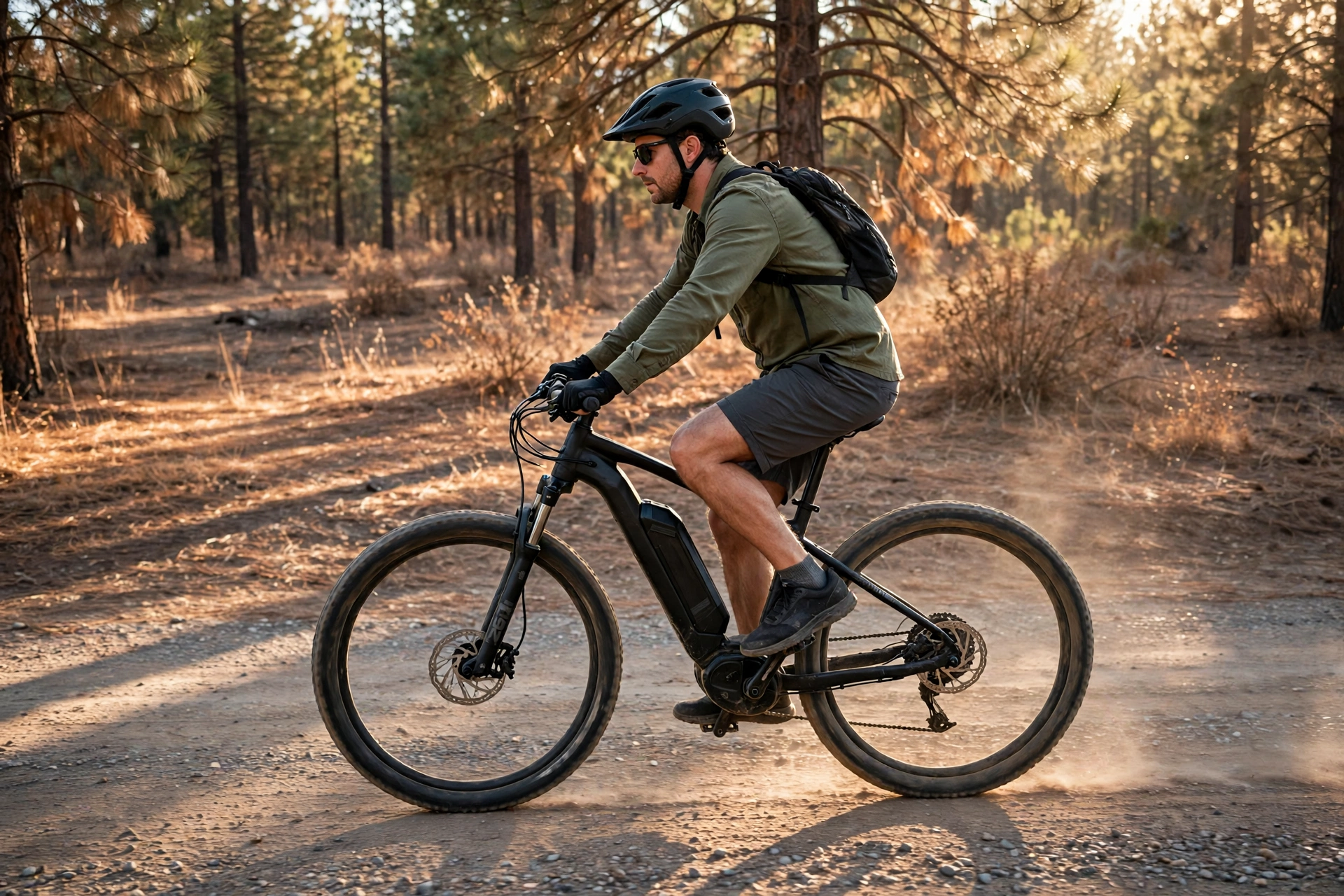
Do the division the listing won’t. The Sunshine claims up to 55 miles from a 374Wh battery. 374 ÷ 55 = 6.8 watt-hours per mile. No geared-hub e-bike carrying an adult sustains 6.8 Wh/mi at any assist level you’d notice — at that consumption the motor is a rounding error and you are simply riding a 50 lb bicycle. Honest consumption for this class of machine runs 15 Wh/mi with gentle pedalling on the flat, and 25 Wh/mi or worse when the throttle does the work. Run the same division honestly and the Sunshine’s real envelope is 374 ÷ 15 ≈ 25 miles pedalling gently, 374 ÷ 25 ≈ 15 miles throttle-heavy. That is not our invention. Electrek’s instrumented test of the earlier Sunshine measured about 20 miles at high output with hard pedalling, and recent independent write-ups of the current bike put mixed use at 25 to 35 miles, with one 500W test bike managing roughly 47 miles of gentle pedal-assist and 28 miles throttle-only. Our range-derating method is set out on our research page; applied here it says plan on 20 to 28 miles from the small pack, and treat anything above that as a tailwind.
Now price the honesty. Price per realistic mile of range, using mid-estimates from the physics above: Sunshine, $369.99 ÷ 22 miles (est.) = $16.82 per mile. Gladiator Pro, $389.99 ÷ 28 miles (est.) = $13.93 per mile. Fat-tire, $600 (est.) ÷ 30 miles (est.) = $20.00 per mile — the biggest battery in the range buys the worst value, because 4-inch tires at low pressure burn roughly 22 Wh/mi before the motor even works hard. The 14-inch folder, $269.99 ÷ 16 miles (est.) = $16.87 per mile. One winner. The Gladiator Pro’s 499Wh pack is worth 125Wh more than the Sunshine’s for twenty dollars more, and 125Wh is five to eight real miles. Every buying decision in this range reduces to that sentence.
Sunshine 26-inch: the default ancheer electric bike, scored
The Sunshine is the bike most people mean when they say ancheer electric bike, and as a $370 proposition it is defensible. The 500W geared hub pulls cleanly to its 20 mph ceiling — some listings say 22 mph, and we’ll deal with that discrepancy below — the removable pack charges indoors, and the 21-speed drivetrain gives you a gear low enough to help the motor on a climb instead of watching it cook. The brakes are mechanical discs: unbranded calipers squeezing adequate rotors. They stop the bike. They need cable adjustment as the pads bed in, and the lever feel is wooden, but at 20 mph on a 50 lb bike they are sufficient, and anyone who tells you a $370 bike needs hydraulics is selling something. The fork is the weak point — a coil unit with more stiction than travel, on a bike that will mostly see cracked pavement, where it earns its keep. Torque is not officially published; figure roughly 45 Nm (est.) by class standards, which is enough for rolling terrain and honest about its limits on a 12% grade. You get four modes — pedal assist across five levels, throttle, a long-press cruise that holds a set speed, and plain pedalling — through an LCD that shows speed, trip and a battery gauge optimistic enough to deserve its own range claim. Cadence sensor, not torque sensor: the motor comes in with a half-second delay and a fixed shove per level, which is crude next to a mid-drive and entirely adequate at 20 mph on the flat. Adjust your expectations to “helpful push,” not “invisible legs.”
Our score: 6.5/10 — Range honesty: 4/10 · Brakes & build: 6/10 · Value: 9/10. Buy it for flat-to-rolling commuting under 15 miles a day. Do not buy it believing the 55.
Gladiator Pro: the ancheer electric bike to actually buy
Twenty dollars. That is the entire price gap between the Sunshine’s 374Wh and the Gladiator Pro’s 499Wh, and it is the easiest twenty dollars in the budget e-bike market. The claimed 55 Nm of torque — plausible for a 500W geared hub, unverified by any instrumented test we could find — gives the Gladiator a meaningfully stronger launch than the Sunshine, and the bigger pack stretches the honest envelope to roughly 25 to 33 miles of mixed riding. Same mechanical discs, same budget fork philosophy, same one-year warranty, same you-are-the-dealer assembly deal. Walmart’s recurring $500 clearance on the 7-speed Gladiator is a worse deal than the official store’s $389.99 Pro — check both before ordering, because Ancheer’s pricing across its own channels is a contact sport. If your commute is over 10 miles each way, this is the only ancheer electric bike on the list with the battery to do it without a midday charge.
Our score: 7/10 — Range honesty: 5/10 · Brakes & build: 6/10 · Value: 9/10. Still not a mountain bike. As a cheap commuter with real range, it’s the pick.
Fat tire and folder: two ways to pay more for less
The fat-tire model’s pitch is a 720Wh battery and an 80 Nm torque claim. The battery is real. The torque figure is marketing arithmetic — no 500W-class hub motor at this price produces a verified 80 Nm, and no instrumented test of this bike exists to back it (est. real output: 55 to 65 Nm by class). Worse, the pack is built into the frame. When it fades in year three — it will — a replacement is a brand-specific part from a brand with an email for a service department, priced around $250 to $350 (est.) if it exists at all. The folding 14-incher has the opposite problem: a real, removable 374Wh pack pushing a single-speed bike on wheels the size of dinner plates. Its listings claim “20 to 50 miles,” a 30-mile-wide range claim that tells you the number was written by someone who has never ridden it. Plan on 12 to 18 miles (est.). It’s a campus and RV-bunk toy for riders under about 5’6″, and at $269.99 it’s honestly priced for that job.
Our score — Fat Tire 26-inch: 5.5/10 — Range honesty: 5/10 · Brakes & build: 5/10 · Value: 6/10.
Our score — 14-inch Folding: 5/10 — Range honesty: 3/10 · Brakes & build: 5/10 · Value: 7/10.
The old 36V Sunshine: a word about the really cheap listings
Search long enough and you’ll find the ancestor: the 36V Sunshine, 350W motor, 36V 10.4Ah pack, 21 speeds, about 52 lb, sold for years around $600 to $800 and still surfacing in marketplace listings and old Amazon pages. Funny thing — its battery is also 374Wh. The voltage changed; the energy didn’t. Electrek measured about 20 miles from it at high assist with hard pedalling back in 2020, and older reviews credited it with a 300 lb capacity the current bike no longer claims. As a new buy it’s gone, and as a used buy it’s a $200 proposition at most: the pack is the bike, a five-year-old pack is a lottery ticket, and a replacement has to match a discontinued battery case. If the listing in front of you says 36V, close the tab. The current 48V bikes are better in every way that matters — stronger motor, same honest range, warranty that still has a pulse.
Is an ancheer electric bike actually Class 2? Read the listing twice
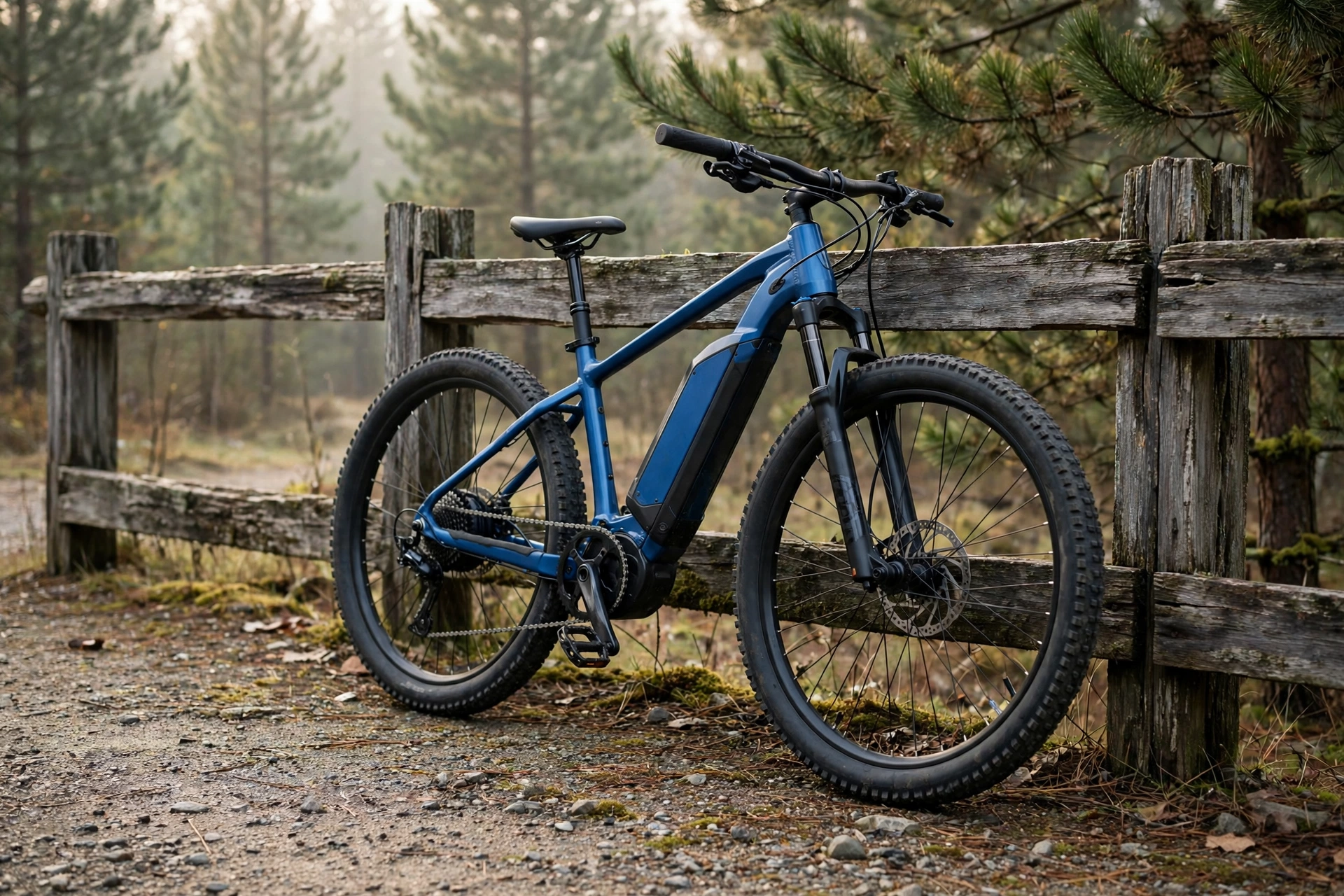
Legal classes run on numbers, not adjectives. Class 2 means pedal assist plus a throttle, both cutting out at 20 mph, on a motor rated 750W or under. Several Ancheer listings advertise 22 mph — the Sunshine’s Amazon title says “20–22 MPH” in one breath — and a throttle that carries you to 22 mph as shipped puts the bike outside Class 2 in the states that use the three-class system, whatever the product page calls it. Most of these bikes can be limited to 20 mph in the display settings, and you should do exactly that before riding anywhere with enforcement. Our Class 1 e-bike guide walks through the class definitions and where each class may ride. The separate problem is the word “mountain.” A hardtail with a coil fork, mechanical discs and 2.1-inch tires is a path-and-fire-road bike. Point it at a real trail system and two things happen: the components suffer, and on land-manager rules that admit only Class 1 pedal-assist, a throttle bike is a guest who can be asked to leave. Torque numbers over styling, always — and legality over both.
Living with one: charging cost, weight and the spokes nobody mentions
Running costs are where the ancheer electric bike quietly wins its argument. A full charge of the 374Wh pack is 0.374 kWh; at a $0.17/kWh home rate (est.) that is roughly 6 cents — the Gladiator’s 499Wh pack is about 8.5 cents. Our e-bike charging cost breakdown shows the same arithmetic across the market; at these pack sizes, electricity is a rounding error and the real running costs are tires, brake pads and one replacement battery in the bike’s life. Charge times run about 3 hours for the 499Wh models with the faster charger, 4 to 6 hours for the small pack (est. from listing data) — overnight, either way. The ownership tax is weight and maintenance: 48 to 52 lb is fine on the ground and miserable up two flights of stairs, the fat-tire bike is heavier still (est.), and budget wheels leave the factory with spoke tension you’ll want checked at 100 miles. Factor a first-year service budget of around $100 (est.) into any total-cost comparison — our total cost of ownership calculator is built for exactly that exercise.
FAQ
Is an ancheer electric bike worth buying in 2026? Yes, one of them is. The Gladiator Pro at $389.99 gives you a 499Wh removable pack, a 500W geared hub and disc brakes at a price the rest of the market doesn’t touch. The rest of the range asks you to accept a smaller battery or a gimmick for similar money.
How far does one actually go on a charge? Plan on 20 to 28 miles for the 374Wh Sunshine and 25 to 33 for the 499Wh Gladiator Pro in mixed riding (both est., from pack size and published tests). Throttle-only riding cuts those numbers by a third or more. The 55-mile claim requires you to do nearly all the work.
Are they legal to ride on roads and bike paths? Only if the assist is limited to 20 mph. Bikes shipped with 22 mph throttle settings sit outside Class 2 in three-class states; set the display limiter, and check your local rules — they vary, and a few places regulate harder.
Can it climb hills? Rolling hills, yes, if you pedal and use the low gears. The Gladiator’s claimed 55 Nm is adequate; sustained steep climbs will heat-soak a small hub motor and drain the pack fast. This is a torque ceiling, not a settings problem.
What breaks first, and can I get parts? Consumables first: pads, tires, spokes, the freewheel. All are generic bike-shop parts. The battery and controller are the brand-specific items — another reason to buy the model whose pack is removable and shared across the range.
What does a spare or replacement battery cost? The removable 374Wh and 499Wh packs are shared across the range, which is the strongest ownership argument Ancheer has. Expect $180 to $280 (est.) from the brand’s storefront channels when in stock — buy the spare when you buy the bike, not in year three when the listing has changed. The fat-tire model’s built-in pack has no such easy answer, which is precisely why it scored lowest on value.
Ancheer or a used name-brand e-bike? A used mid-drive from a major brand with a local dealer beats any ancheer electric bike for support and ride quality if you find one near $600. New against new at $400, nothing with a warranty touches the Gladiator Pro.
Final word. The ancheer electric bike range is a lesson in reading past the headline: ignore the 55-mile claim, ignore the peak watts, divide the watt-hours by fifteen, and buy the biggest removable battery in the line. Do that and the Gladiator Pro is the most honest $390 in e-bikes. Do it not, and you’ll be back here in a month searching for a spare battery.