Last updated: October 27, 2026
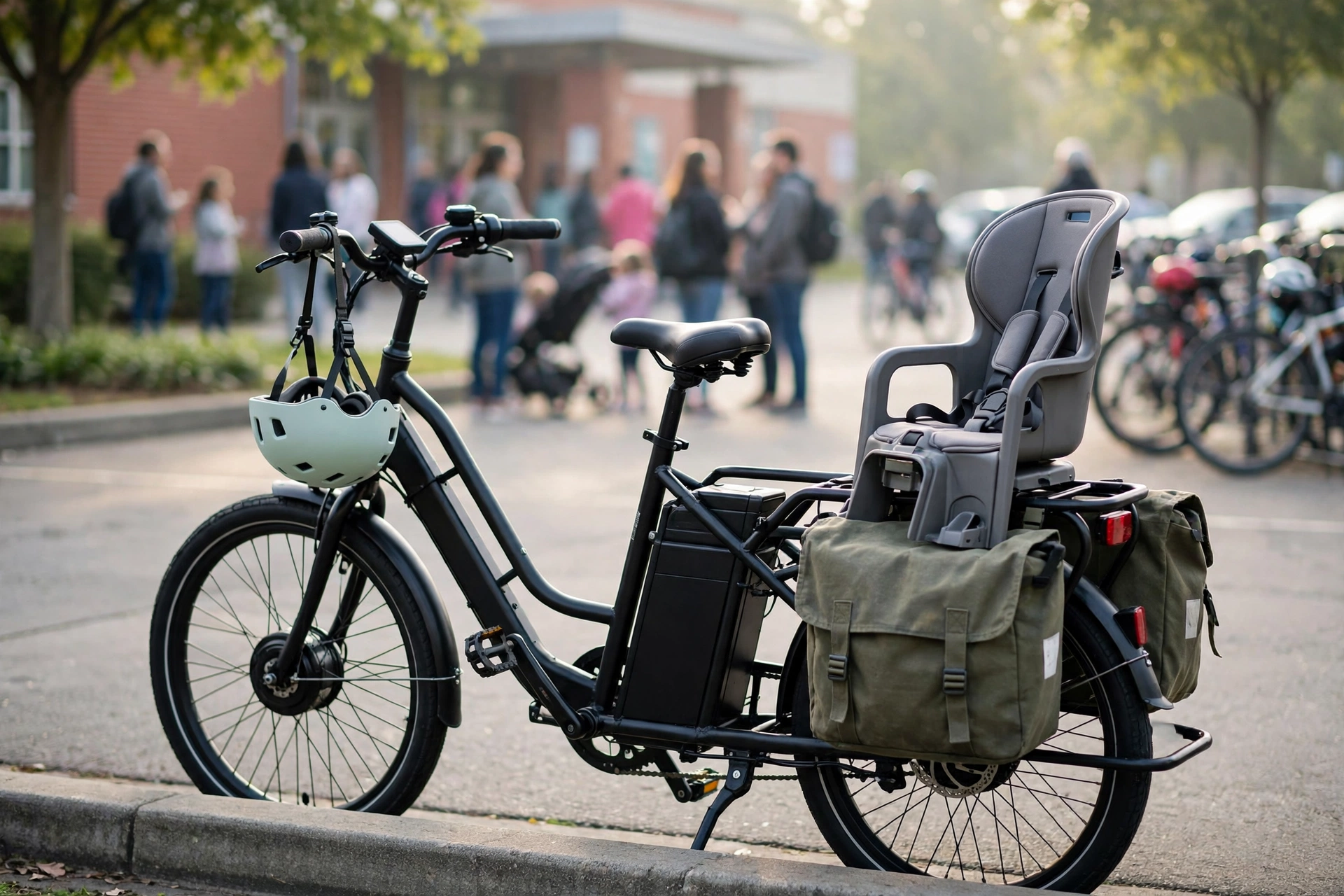
Stand at any school gate at 8:15 in the morning and you can read the whole market in one glance. A longtail cargo bike with two small helmets dangling from the bars. A folding bike being wrestled out of a hatchback. A step-through with a child seat and a week’s worth of pannier space.
The parents riding them bought from different ebike brands, and the brand on the down tube matters more than the colour. Pick the right one and the bike quietly replaces a second car. Pick the wrong one and you own a 70-pound ornament with a dead battery and nobody to call.
So this guide does the unglamorous work. It sorts the brands by how they actually sell and support their bikes, names real prices (checked October 27, 2026), explains what changed in a turbulent 2025 and 2026, and scores each camp on the three things family riders feel every week: honest range, a service network that exists in real life, and plain value for money.
A quick word on how we work: figures come from manufacturer listings and independent test roundups, and our method is set out on our how we research page. Unconfirmed figures carry an “(est.)” tag and their basis. No brand paid for a place in this list.
One framing note. Families do not buy ebike brands the way enthusiasts do. An enthusiast buys a spec sheet. A family buys a school run, a grocery haul, a hill between home and the office, and a Saturday trip to the pool with towels, snacks and one grumpy toddler. The best brand for that life is rarely the one with the biggest motor number.
Keep three questions in your pocket while you read. Who fixes it? What does the battery really do in January? And what does the whole thing cost across five years, not five minutes at checkout?
The two tribes of ebike brands, explained simply
Nearly every brand selling in North America belongs to one of two tribes, and the tribe shapes everything that happens after the box arrives.
Tribe one sells direct. Lectric, Ride1Up and Velotric built their names online: you order from the website, a box lands on your porch, and you (or a mobile mechanic) do the final assembly. Cutting out the dealer margin is how a Lectric XP4 reaches $999. The trade is service. Your “dealer” is a phone queue, a parts warehouse and whichever local shop agrees to touch a bike it did not sell. Some shops refuse. Ask before you buy, not after the first flat.
Tribe two sells through shops. Trek, Specialized and Giant (plus Giant’s Momentum line) ship bikes to actual stores, where a human fits you, assembles the bike, and — here is the part that matters in year three — orders the odd proprietary part and updates the motor firmware while you wait. You pay for that roof and those humans. Trek’s entry electric model, the FX+ 1, sits at $1,999.99, roughly double the Lectric XP4, with a smaller battery and a far bigger support net underneath it.
Aventon is the interesting hybrid. It sells online like a direct brand, yet its bikes also sit on the floors of more than 1,800 US bike shops, a figure Aventon’s own comparison pages put front and centre. Test rides, local assembly and a shop that answers the phone, at direct-brand prices from about $1,199 to $2,899. Hard to beat.
Where do ebike brands like Engwe and Ancheer fit? They are tribe one’s budget shelf, sold through Amazon and Walmart from about $390 (an Ancheer listing at $389.99 appears in current roundups) up to roughly $1,199 (est.) for Engwe’s folding fat-tyre models. The bikes can be genuinely fun. The support behind them is an email inbox on another continent — and a cheap bike that cannot be repaired is not cheap.
What ebike brands actually charge in October 2026
Prices checked October 27, 2026, from brand stores and current comparison listings; sale prices move, so treat the exact dollar as a snapshot and the gaps between tiers as the durable fact.
At the value end, Lectric’s XP4 is $999 and its lighter XP Lite 2.0 is $799. Ride1Up undercuts almost everyone on features per dollar: the Portola 02 folder starts at $895, and the Vorsa all-rounder reads $1,545 to $1,595 depending on the listing. Velotric’s Discover 2 commuter sits at $1,439. Aventon’s range runs $1,199 to $2,899, with the Abound SR family cargo bike at $1,899 and the mid-drive Aventure M at $2,899.
Dealer brands start where direct brands finish: Trek FX+ 1 at $1,999.99, and Specialized’s Turbo Vado SL 4.0 lists at $3,500, though Specialized’s own store has recently shown it at $2,449.99 — a reminder that dealer brands discount too, just quietly.
Do the spread maths, because it is startling. The cheapest credible bike here, at about $390, and Aventon’s range-topping $2,899 differ by a factor of 7.4. Seven times the money does not buy seven times the bike. It buys a torque sensor that reads your legs, hydraulic brakes that stop a loaded cargo bike in the rain, a battery with a traceable safety certificate, and a shop within driving distance. Some of that is worth real money to a parent carrying a child downhill. Some is jewellery. The scoring section separates the two.
Cross-shopping the niches? Our RTR electric bikes verdict shows the same ladder inside one corner of the market.
The year ebike brands were stress-tested: what changed in 2025 and 2026
Every brand guide written before December 2025 needs a correction page, and the correction is called Rad Power Bikes. Rad was North America’s biggest e-bike seller, the default recommendation for a decade, the bike half the school gates in Seattle and Vancouver seemed to own.
On December 15, 2025, Rad filed for Chapter 11 bankruptcy, listing roughly $32 million in assets against $73 million in liabilities. In February 2026 its key assets were sold to Life Electric Vehicles Holdings, and the brand now trades under a new company, Rad Life Mobility, as Electric Bike Explorer’s shutdown update lays out in detail.
Two facts from that collapse belong in every buyer’s head. First, the new owner did not take on the old company’s warranty obligations: bikes bought before December 15, 2025 are not covered. Second, weeks before the filing, the US Consumer Product Safety Commission had issued a public warning over two Rad battery models linked to at least 31 reported fires. A brand can survive one of those stories. Both at once was too much.
Does that make a 2026 Rad bike a bad buy? Not automatically — the new company sells bikes and supports its own sales. But if your household budget has room for exactly one cargo bike this decade, do not spend it testing whether a rescued brand’s parts pipeline holds. Buy the boring, solvent option. Your future self, standing in the rain with a flat tyre and a sleeping four-year-old, will thank you.
The rest of the landscape shifted more quietly. Tariff pressure pushed direct-brand prices up through 2025, which is why the sub-$800 full-size bike nearly went extinct.
Dealer brands leaned the other way, discounting premium stock — that Vado SL at $2,449.99 is part of a wider clear-out of pandemic-era inventory. And certification stopped being a footnote: New York’s rules effectively require UL 2849 for legal sale, apartment buildings increasingly ask for it, and ebike brands that cannot produce a certificate are quietly losing the family market, whatever their Amazon star rating says.
Batteries, UL stamps and the fine print that actually protects a family
Here is the safety hierarchy, stated plainly. UL 2849 certifies the whole electrical system — battery, charger, motor controller working together. UL 2271 covers the battery pack alone. A bike with both, from a lab whose certificate you can look up, is the family-grade choice. A listing that says “UL compliant” or “tested to UL standards” without a certificate number is marketing wearing a lab coat.
Aventon documents UL 2849 and UL 2271 coverage model by model. Velotric states the same pair across most of its range. Lectric calls them out on specific models such as the ONE commuter, but coverage is not uniform across its catalogue, so check the exact bike, not the brand halo.
Dealer brands play this well by default — Specialized’s commuter pages note certification by UL Solutions or SGS. On the budget shelf, certification ranges from genuinely present on some Engwe models to unverifiable on the cheapest Ancheer-class listings. For a battery that charges in your hallway overnight: unverifiable is a no. That is the whole ballgame.
Warranties tell the same story in a different font. Lectric covers its bikes for one year. Aventon and Velotric cover two years (Velotric’s current policy, updated October 2026, spells out two years on the bike, with longer structural cover on frames). Dealer brands pair two-year electrical cover with lifetime frame warranties as a matter of tradition.
And Rad’s new owners cover only their own sales — proof that a warranty is only ever as strong as the company behind it. Read any shortlisted brand’s warranty page in full. If the legal page is hard to find, that is the answer.
Range honesty is where brands misbehave most politely. A claim like “up to 80 miles” is measured with a light rider, flat ground, lowest assist, warm day. Load a cargo bike with a child, a library bag and a headwind, and expect 55 to 65 percent of the headline in winter, 65 to 75 percent in summer (est., from the consumption maths below). Lectric and Ride1Up quotes tend to survive contact with reality; on the budget shelf, a “60-mile” bike delivering 28 is not unusual.
While you compare, our Class 1 e-bike guide explains the speed and throttle classes in plain language.
The family maths: one cargo bike versus a second car
Enough adjectives. Here is the computation this site runs for any family weighing a cargo e-bike against keeping a second car, using the Lectric XPedition2 in dual-battery trim because it is the cargo bike we recommend most at this budget. The dual-battery version lists at $1,799 (checked October 27, 2026), with a combined 1,248 Wh of battery and a rear rack rated for serious loads; the single-battery version is $1,399.
Buying in: bike $1,799 + a child seat at $149 (est., mid-range seat pricing) + lock and two helmets at $180 (est.) = $2,128 all-in.
Running it, per year: a loaded family cargo bike uses about 25 Wh per mile (est., loaded riding with hills). At 3,000 family miles a year — school runs, shops, one parent’s short commute — that is 3,000 × 25 = 75,000 Wh, or 75 kWh. At a US-average $0.17 per kWh, the fuel bill is 75 × $0.17 = $12.75 a year. Call it thirteen dollars.
Servicing, brake pads, tyres and one chain a year at $150 (est.) brings annual running costs to about $163. Our cost to charge an electric bike breakdown walks through the same electricity maths for smaller batteries.
Five-year total: $2,128 + (5 × $163) = $2,128 + $815 = $2,943, covering 15,000 miles. That is $2,943 ÷ 15,000 = about $0.20 per mile.
The second car, same five years: a modest used runabout at $9,500 (est.), insured at $120 a month ($1,440 a year), burning 3,000 miles ÷ 30 mpg = 100 gallons at $3.45 = $345 of fuel a year, with $600 a year of maintenance (est.) and $120 of registration.
Running costs alone: $1,440 + $345 + $600 + $120 = $2,505 a year, or $12,525 across five years. Add the car itself: $22,025 — and that flatters the car, ignoring depreciation and parking.
The gap is $22,025 − $2,943 = $19,082 over five years. Even if you refuse to count the car’s purchase price, the e-bike undercuts the car’s running costs by roughly $9,600.
Run your own household numbers in our total cost of ownership calculator — the conclusion survives almost any honest set of inputs. This is why the brand question matters so much: a machine that replaces $2,505 a year of car costs deserves a manufacturer that will still exist in year four.
Seven ebike brands, honestly scored
Scores weigh what a family feels across five years, not what a spec sheet shouts about. Sub-scores: Range honesty, Service network, and Value.
Lectric — Our score: 8.6/10. Range honesty 8/10 · Service network 7/10 · Value 10/10. America’s value benchmark. The XP4 at $999 tops current independent rankings for a reason, the XPedition2 is the default family cargo answer under $1,800, and the owner community is so large that every problem you will ever have has a documented fix. The one-year warranty is short, and certification varies by model. For most families on a real budget, start here.
Aventon — Our score: 8.8/10. Range honesty 8/10 · Service network 9/10 · Value 8/10. The hybrid model done right: direct prices, 1,800+ shops, two-year warranty, documented UL certification, and the Abound cargo line from $1,899. If one brand here earns the words “default recommendation”, it is this one. The Abound SR is the cargo bike I would point my own sister at.
Ride1Up — Our score: 8.4/10. Range honesty 8/10 · Service network 6/10 · Value 9/10. The connoisseur’s budget pick. Torque sensors at folder prices — the Portola 02 from $895 rides better than bikes costing $600 more. The service net is the thin part: you are the service net, plus a willing local shop. Confident home mechanics, this is your brand.
Velotric — Our score: 8.3/10. Range honesty 8/10 · Service network 7/10 · Value 8/10. The fast learner. A few years ago Velotric was a logo on Amazon; by 2026 it fields polished commuters like the $1,439 Discover 2, 500+ dealers, a clean two-year warranty and UL paperwork in order. It lacks Aventon’s shop depth and Lectric’s community, and it is closing both gaps fast.
Trek, Specialized and Giant (dealer brands) — Our score: 8.7/10. Range honesty 9/10 · Service network 10/10 · Value 5/10. Grouped because the ownership experience rhymes: conservative range claims, the finest service networks in cycling, lifetime frame cover, motors any dealer can diagnose — and prices that make direct brands look like a pricing error.
A family that values a shop relationship over a spec sheet will be happy here for a decade. A family counting dollars will not.
Rad Power Bikes (under Rad Life Mobility) — Our score: 5.5/10. Range honesty 7/10 · Service network 5/10 · Value 6/10. The bikes themselves remain likeable, and the new owner’s own sales are warranted. But a company whose predecessor left hundreds of thousands of owners holding void warranties and a CPSC-flagged battery has to earn trust back the slow way. Score reflects the ownership story, not the hardware. Revisit in a year.
Engwe and the budget shelf (incl. Ancheer) — Our score: 6.0/10. Range honesty 5/10 · Service network 3/10 · Value 8/10. Engwe’s folding fat-tyre bikes deliver real fun per dollar and some models carry proper certification; the no-name end of the shelf does not, and support for both is an email thread.
Buy one as a second bike, a campus hack, a toy with pedals. Do not make a $500 marketplace special your family’s only transport and your child’s daily seat. Some savings cost more than they save.
Choosing for a family, in four decisions
Decision one: who fixes it? Name the actual shop, within actual driving distance, that will service your actual brand — before ordering. If the answer is “me, on the driveway”, buy Ride1Up or Lectric and a $60 stand. If the answer is “nobody”, buy Aventon or a dealer brand, full stop. That shop relationship is what separates the ebike brands you can live with from the ones that leave you waiting for a part.
Decision two: does the battery paperwork exist? UL 2849 on the system, certificate findable, battery removable so it can charge indoors and live indoors in winter. Two of our seven camps fail this test at their cheapest models. Walk past those models. Among ebike brands, a findable certificate is a simple filter that saves a lot of later doubt.
Decision three: size the battery to your worst week, not your best day. Take your longest regular round trip, double it, then halve the brand’s claimed range and see if the numbers still meet. A 1,248 Wh dual-battery cargo bike laughs at this test. A 374 Wh city battery sweats it.
Decision four: total the five years, not the checkout. A $999 bike with cheap, plentiful parts can beat a $1,899 bike across five years — or lose to it, if it needs a proprietary controller shipped from overseas in year two. Of all ebike brands, the ones still selling spare parts openly in year three win this test. The maths section above is the template.
Frequently asked questions
Which ebike brands are best for carrying kids? Aventon and Lectric, for different wallets. Aventon’s Abound line was designed around child seats and cargo from the first sketch, with shops to service it; Lectric’s XPedition2 carries two kids and a week of groceries for $1,399 to $1,799. Whatever the brand, check the rear rack’s rated load and the total payload, not the marketing photo.
Is Rad Power Bikes still in business in 2026? Yes, under new ownership. The original company filed Chapter 11 in December 2025; its assets were bought by Life Electric Vehicles Holdings and the brand now operates as part of Rad Life Mobility. New purchases are covered by the new company. Bikes bought before December 15, 2025 are not — their warranties were left behind in the bankruptcy, which is why Rad scores cautiously in this guide.
Are cheap ebike brands like Ancheer and Engwe safe? Some models are, and the burden of proof sits with the listing. Look for a UL 2849 system certificate and a UL 2271 battery certificate you can verify, a named warranty with a real address, and replacement batteries sold openly on the brand’s own site. If a $400 bike cannot show you any of that, its price is not a bargain; it is the cost of finding out.
Direct-to-consumer or bike shop: which is better for a first e-bike? For a first family e-bike, the shop route wins on everything except price, and Aventon exists precisely to blur that line. Direct brands save you $400 to $900 (est., model-dependent) and cost you assembly, fitting and a service relationship. Handy riders keep the money happily. Everyone else tends to spend it later, at a shop’s hourly rate.
How long do e-bike batteries from the big brands last? Expect 3 to 5 years of family use before capacity fades noticeably, roughly 500 to 800 full charge cycles (est., standard lithium behaviour). Dealer brands and Aventon publish replacement battery prices openly, typically $400 to $700 (est.); budget brands often do not. A brand that hides its battery price is telling you how the story ends.
However you land, land deliberately. The right brand turns a bicycle into the second car your family actually wanted — cheaper, quieter, better company at the school gate. Land on ebike brands that pass those four decisions, not on the launch photo.
When you compare ebike brands side by side, remember that the best ebike brands are not always the loudest ones. The right ebike brands for a family are the ones that stay in business, stock spare parts, and support you in year four as well as week one.
That gap is why comparing ebike brands by real range matters for a family week.
Shortlisting ebike brands is easier when you keep the four decisions in order: who fixes it, whether the paperwork exists, whether the battery fits your worst week, and what five years really cost. The ebike brands that pass all four are the ones worth a test ride, even if they are not the cheapest on the page.
That discipline matters because ebike brands change fast, and a good launch price means little if service, parts, and battery support fade in year three. Judge ebike brands on the shop, the certificate, and the five-year maths, and the right choice usually becomes clear.
For a family, the safest test of ebike brands is the year-four test: parts on the shelf, a shop that answers, and a battery you can still buy. The ebike brands that pass it are the ones to shortlist first.