Last updated: October 25, 2026
An electric bicycle replacement battery is the biggest single purchase most e-bike owners make after the bike itself — anywhere from about $300 to well over $1,200 depending on the system, with prices in this guide checked on October 25, 2026. It is rarely a snap decision. The pack hints for months first: a hill that used to feel easy starts to bite, the gauge that once fell in a smooth line now drops in steps, and one cold morning the bike gives you 14 miles instead of 24. Is it dying, or is it just winter?
That question is where I always start, because I organise battery care the way the year organises it. A lithium pack lives four different lives. Spring wakes it. Summer cooks it slowly. Autumn exposes it. Winter stores it — well or badly. Read your battery’s year correctly and you will replace it once, at the right time, with the right pack. Read it wrong and you either bin a healthy pack in January or nurse a dead one through a season of cancelled rides.
Most fading packs belong to everyday commuters — the same riders our complete Class 1 e-bike guide was written for — on Bosch, Shimano and shark-case hub-drive bikes. The pattern never changes: nobody checks anything until the range is gone.
So this guide works in the order I work: symptoms first, then the free tests, then identifying your exact pack, then the three ways to replace it, with honest prices and the arithmetic I run before spending anything. Where a figure is my estimate rather than a maker’s number, it says (est.) and tells you what it rests on.
The symptoms — and the one season that fakes them
A genuinely tired pack announces itself in ways that have nothing to do with the calendar. The range shrinks on the same route, in the same mode, in mild weather. Assist sags on climbs the bike used to flatten, because an aged pack cannot hold its voltage under load. The charge seems to finish suspiciously fast — there is simply less capacity left to fill. The display percentage falls in chunks instead of gliding.
Some symptoms are not a diagnosis; they are a stop sign. A case swelling, cracked, dented or rattling inside. A pack warm on the shelf, or one that will not wake after storage. Do not charge it, do not ride it — skip straight to the disposal section.
Now the faker. Cold. A lithium pack at freezing delivers roughly 80% of the capacity it gives at room temperature, and down near 0°F you may see half to three-fifths of it. That is chemistry, not death — the capacity comes back when the pack warms up. Headwinds, soft tyres and a loaded rack bag shave miles too. My rule is blunt: never judge a battery in January. If the range worries you in October, test it on the first mild week of spring before you spend a cent on an electric bicycle replacement battery. Half the packs written off every winter are just cold ones.
Test the pack before you buy an electric bicycle replacement battery
Three checks, all free or nearly free, settle the question.
The known-loop test. On a mild day — 60 to 75°F is ideal — charge the pack fully, note the odometer, and ride a familiar, mostly flat loop at your usual assist level until the bike cuts out. Compare the miles with what the bike did when new. No memory of that? Use the pack’s watt-hours: a 500Wh pack at a typical commuter appetite of 12 to 20 watt-hours per mile (est., typical commuter consumption) should give 25 to 41 miles. If your mild-day loop returns under 70% of the pack’s healthy figure, you are in replacement territory.
The app or dealer health reading. Bosch systems report charge cycles and remaining capacity through the eBike Flow app or a dealer diagnostic printout. Specialized’s app shows battery health as a percentage alongside charge cycles. Shimano’s E-Tube does the same job. Five minutes, no tools, and the number ends the argument. Write down the cycle count while you are in there: a cared-for pack delivers 500 to 1,000 full cycles before fading to 70–80% of its original capacity, and a six-year-old pack with 300 gentle cycles can be tireder than a three-year-old with 600.
The wall-meter test. A plug-in energy meter costs about $20 (est.) and tells the truth your display won’t. Run the pack down, then charge it through the meter. A healthy 500Wh pack pulls roughly 550 to 580Wh from the wall, because chargers waste 10–15% as heat (est.). If yours stops at 390Wh, it holds about 390Wh now, whatever the label says.
Identifying your exact pack: mount, voltage, connector, dimensions
More replacement orders go wrong on identification than on price. Before you shop for an electric bicycle replacement battery, photograph the label on your old pack — brand, model or part number, voltage, watt-hours or amp-hours, serial number — and answer four questions.
How does it mount? Frame packs (Bosch PowerPack style) hang on the down tube; rack packs sit over the rear wheel. In-tube packs (Bosch PowerTube, Shimano BT-E8035 family) slide inside the frame — and here is the trap: PowerTubes come in horizontal and vertical versions that are not interchangeable, and the longer 625 and 750 tubes only fit frames built for them. Semi-integrated “shark” and Dorado-style cases (Reention and similar) dominate hub-drive bikes; identify those by shape and a tape measure, in millimetres.
What generation is it? Bosch System 2 packs do not communicate with Smart System motors, and the reverse is also true. Same brand name, different language. Shimano STEPS packs, Yamaha-built packs (including Giant’s EnergyPak line) and Specialized Turbo packs are system-locked the same way: the display expects its own family.
What are the electricals? Voltage must match exactly — 36V, 48V and 52V are different worlds, and a higher-voltage “upgrade” pack on a system built for less is a fire risk, not a tune-up. Note the discharge connector — pin count and shape, 2-pin or 5-pin — and check the charge port matches your charger. Weigh the old pack, too: a genuine 500Wh pack runs roughly 5.7 to 7.5 lb, and a replacement dramatically lighter than that is telling you something unflattering about its cells.
What does the lock need? Most frame packs are keyed to the bike; replacements usually reuse your lock cylinder or arrive ready for a dealer swap. Keep the key code card safe — losing it turns a ten-minute job into a locksmith visit.
Three routes to an electric bicycle replacement battery — and what each really costs
Every replacement lands in one of three buckets, at the prices below (checked October 25, 2026; treat the bands as a map, not a quote).
| System | OEM new pack, typical US price | Notes |
|---|---|---|
| Bosch PowerTube 625 / 750 | $1,019 / $1,143 | US retailer listings; PowerTube 500 class usually $600–$800 (est.) |
| Shimano BT-E8035, 504Wh | $749 | The 630Wh BT-E8036 sits in the same case family |
| Specialized Turbo, 691Wh | $1,000 | The 604Wh Vado pack lists at the same level |
| Giant EnergyPak (Yamaha-based) | $1,000–$1,200 | 800Wh at the top of the band |
| Rad Power Bikes | About $550; newer Safe Shield 680Wh $599 + $49 shipping | Older generation under a CPSC warning — see below |
| Lectric, Aventon and similar commuters | Roughly $300–$700 | Lectric’s own packs sit at the lower end (est.) |
| Generic Reention/Dorado-case packs | $200–$500 | Quality varies enormously; certification is the filter |
Route one: new OEM. The manufacturer’s own pack, from a dealer or the brand’s store: $500 to $1,200+ by system, a two-year warranty on the big brands, certified cells, and a bike whose warranty, diagnostics and resale value stay intact. Dealer fitting runs about $30 to $100. Bosch’s own battery pages list the current PowerPack and PowerTube families — check yours there before ordering; the horizontal/vertical and System 2/Smart System splits catch people every week.
Our score: 8.7/10 (Safety 10 / Longevity 9 / Value 7).
Route two: quality third-party. For open systems (mostly hub-drive bikes with generic cases), reputable aftermarket makers sell 500Wh-class packs around $300 to $600 (est., current listings for certified packs). The rules are strict: named cells inside (Samsung, LG or Panasonic), a real UL 2271 listing you can verify in the certifier’s directory, and at least a one-year warranty. Smart systems largely close this door; a Bosch bike wants a Bosch pack, full stop.
Our score: 7.4/10 (Safety 8 / Longevity 7 / Value 8).
Route three: recell, or rebuild. A specialist opens your old case, keeps the electronics and shell, and spot-welds in fresh cells: $200 to $500, roughly 60–70% of a comparable new pack, with a 6 to 24-month specialist warranty. Because the original BMS stays, smart systems usually recognise the pack again. The honest caveats: opening the case voids the manufacturer’s warranty, Bosch’s position is that an opened battery should never go back into service because its certification testing cannot be repeated on a single unit, and the result is only ever as good as the person holding the spot welder.
Rebuilders’ own rule of thumb is the one I use: a recell only earns its keep when the quote lands at least 25–30% below the street price of a new pack. Where recelling genuinely wins is the discontinued pack — the ten-year-old bike whose OEM battery no longer exists.
Our score: 6.3/10 (Safety 6 / Longevity 6 / Value 8) — rising to the top of the list when the OEM pack is simply gone.
The arithmetic I run first. Before I recommend any electric bicycle replacement battery, I price each route per 100 charges on a typical 500Wh commuter pack. OEM: $750 ÷ 800 cycles = $0.94 per charge, so $94 per 100 charges. Certified third-party: $420 ÷ 600 cycles (est., mid-grade cells) = $0.70 per charge, $70 per 100 — but if that pack fades at 400 cycles instead, the same maths gives $1.05 per charge, worse than the factory pack.
Recell: $340 including return shipping (est.) ÷ 500 cycles (est., the case and BMS are already old) = $0.68 per charge, $68 per 100. Now the electricity for those same 100 charges: 100 × 0.5 kWh = 50 kWh, at $0.17 per kWh (est., US residential average) that is $8.50. As our guide to how much it costs to charge an electric bike shows, the electricity is the cheap part of e-biking. The pack is the bill. The same maths scales up in our EV battery replacement cost estimator.
Safety certification for an electric bicycle replacement battery: the non-negotiables
Two standards matter and they are not the same thing. UL 2271 tests the battery pack on its own — cells, management system, enclosure. UL 2849 tests the whole e-bike electrical system together: pack, charger, motor, controller, wiring. A replacement pack should carry at least a genuine UL 2271 listing, and “genuine” means you can find it in the certifier’s online directory. A blurry logo on a marketplace listing is decoration, not certification.
This is law now in the places that learned the hard way. New York City’s Local Law 39 has required certified systems and batteries for anything sold, leased or rented in the city since 2023, and FDNY figures show e-mobility fire deaths falling from 18 in 2023 to one in 2025 as the law bedded in. The US Consumer Product Safety Commission has separately warned owners to stop using certain older Rad Power battery models after fires that started in storage, on bikes that were not even charging. Fires that start on a bike nobody is riding: that is the risk profile of an uncertified pack.
My position, and I will not soften it: never buy a no-name pack, never buy a pack whose seller cannot name its cells and its certifier, and never charge any replacement on a charger it did not come with or that the maker does not approve. The $150 you save is priced against your house.
Fitting the new pack, and the first charge
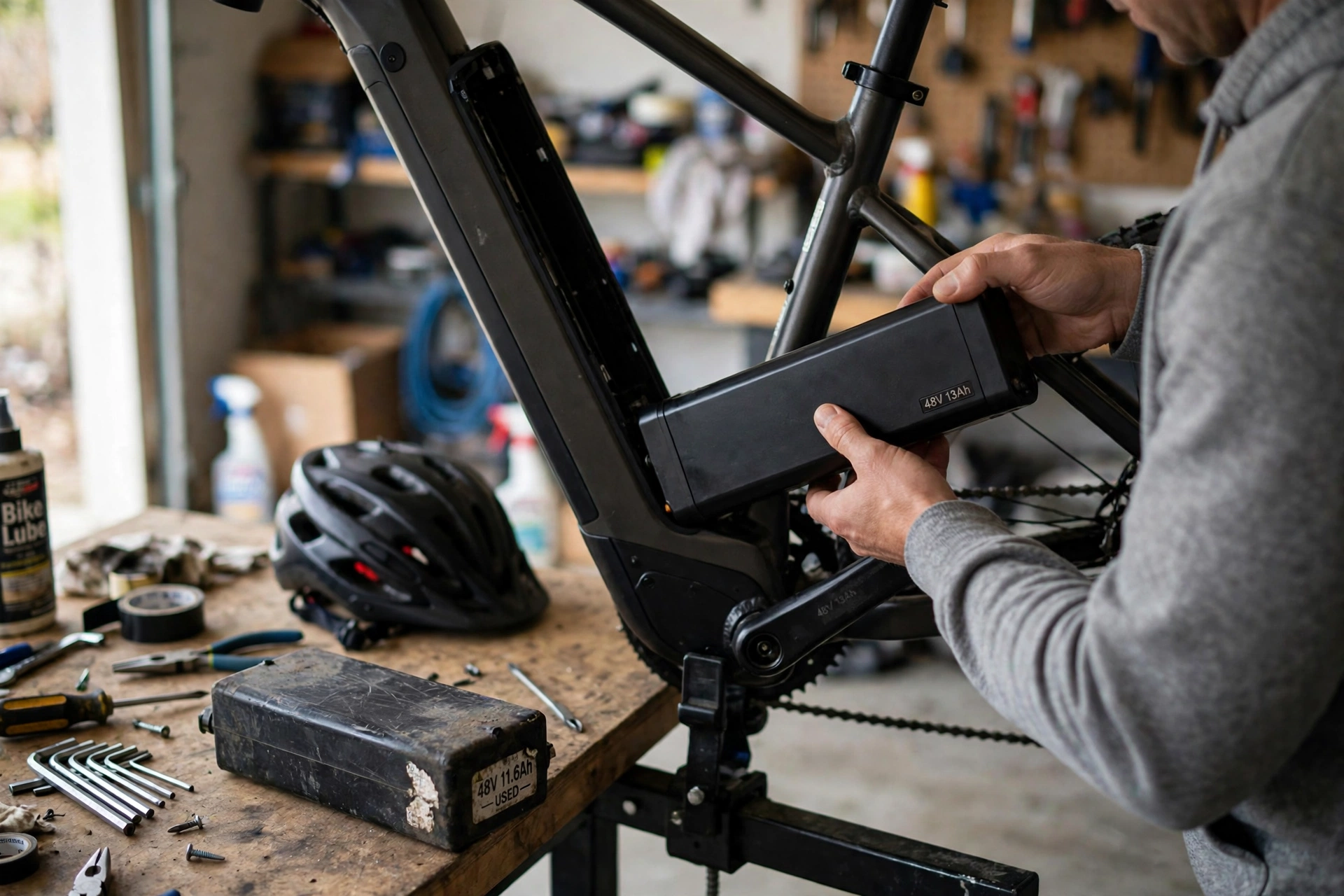
Fitting an electric bicycle replacement battery is the easy part; the care is in the order of operations. Power the bike off and support it properly — an in-tube pack is a 7-pound weight that drops straight onto your foot if you fumble the release. Inspect the connector pins on the bike side before the new pack goes anywhere near them: corrosion, a bent pin or grit in the mount causes more “faulty new battery” returns than faulty batteries do. Slide the pack home until the latch clicks, then do the tug test — a firm pull, no movement. Power up and read the display like a checklist: no error codes, and the reported capacity matching what you bought.
The first charge deserves respect. Do it to 100%, on a hard, clear surface, while you are home and awake. That full charge is not about the miles; it lets the management system balance the cells and learn the pack. Take the app’s health and cycle reading afterwards and note it in the manual: that baseline is the number every future spring gets compared against. First ride: keep it short and local. A pack that is wrong usually says so in the first three miles.
A year of care for your electric bicycle replacement battery
A replacement pack should outlast the one it replaced, and the difference is almost never luck — it is four seasonal habits.
Spring: wake it up properly
Bring the pack indoors to room temperature, charge it fully once so the management system can rebalance the cells, and take the health reading. If spring shows you a pack already under 80% and falling, make the replacement decision now, in the season of good stock and long evenings — not in November. Spring is also mount-and-contacts time: check for winter corrosion, wipe dry.
Summer: heat is the silent bill
Heat ages lithium faster than riding does. Never charge in a car boot or a metal shed baking past 104°F; charge in the cool of early morning or evening instead, and park the bike in shade. The worst summer habit is a full pack left sitting: at 100% in a hot garage, a battery ages at its fastest possible rate. Charge to full for a big ride, then ride it that day.
Autumn: decision season
Falling temperatures expose a weak pack weeks before they expose a strong one, so autumn is when honest assessments happen. If the loop test is borderline in October, order the replacement while your exact model is still in stock, before storage decisions tangle with a dying pack. If you ride less over winter, set your storage charge as the light fades — see below — rather than abandoning the bike at whatever charge the last ride ended on.
Winter: store it like you mean it
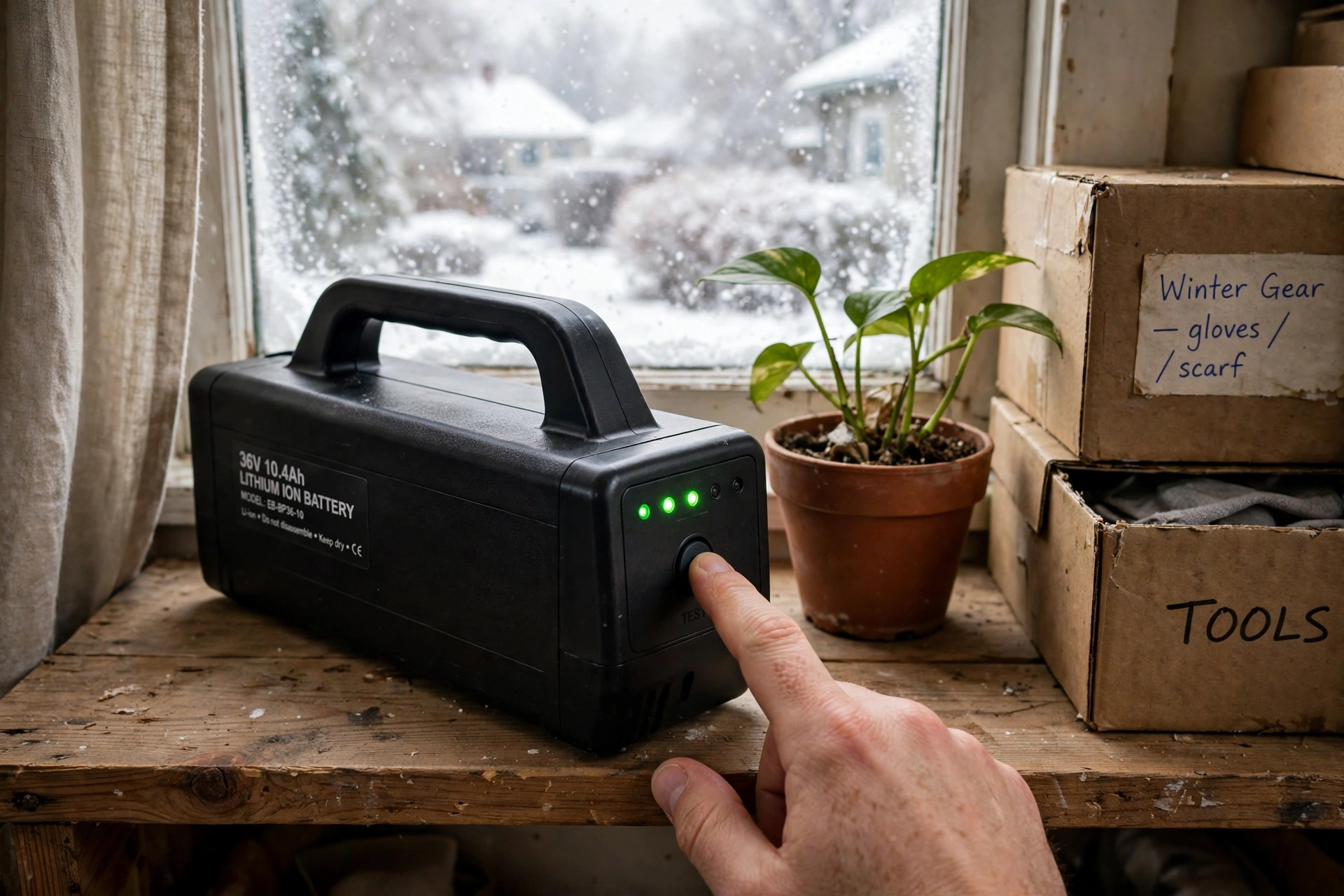
Off the bike, indoors, somewhere 50 to 68°F, at roughly half charge — 40 to 60%, with many makers settling near 60%. Not full, which stresses the cells; not empty, which risks the management system’s slow parasitic drain (a few percent a month, est.) pulling a cell below its safe floor. Check it monthly; thirty seconds with the indicator button, top it back toward 60% if it has sagged under 40%. And the rule that saves more packs than any other: never charge a frozen battery. Bring it inside for a few hours first. Charging below freezing plates metallic lithium onto the cells, and that capacity never comes back.
Slot a cold pack onto the bike only just before you ride, and expect 20–30% less range in the cold: that shortfall is weather, not wear. Day to day, live between 20% and 80% when your rides allow it — full charges are for long days and balance top-ups, not a nightly ritual.
The old pack: disposal done properly
A spent e-bike battery never goes in household rubbish and never in kerbside recycling — it is a fire risk in a collection truck and a landfill contaminant. Tape over the terminals and take it to a bike shop in the Call2Recycle e-mobility program, the industry-funded scheme run with PeopleForBikes, free at participating shops across the US and Canada. Ask when you order your electric bicycle replacement battery — most dealers will take the old pack off your hands on the spot. If the old pack is swollen, cracked or has been dropped hard, phone the shop or your local household-hazardous-waste facility first; damaged packs travel under stricter rules and never go in the post.
The short verdict
If your bike runs a smart system — Bosch, Shimano, Specialized, Yamaha — buy the OEM pack once; the integration is worth more than any saving elsewhere. If your bike is an open-system hub drive with a generic case, a certified third-party pack from a maker who names their cells is the value pick. Send a pack for recelling only when the original is discontinued or the quote beats new by a clear 25–30%, and only to a specialist you can name. An electric bicycle replacement battery bought in autumn and stored at 60% in a warm room will still be a good battery when the third spring comes. One left full in a freezing garage may not see the second.
Before you order, compare the total cost of an electric bicycle replacement battery across OEM, certified third-party and recell options, and check that the electric bicycle replacement battery you choose matches your voltage, mount and connector exactly. That final check is what keeps an electric bicycle replacement battery from becoming a return. In short, the right electric bicycle replacement battery is the one that fits your bike, your budget and your riding pattern.
Frequently asked questions
How long should an electric bicycle replacement battery last?
Expect 500 to 1,000 full charge cycles before capacity fades to 70–80% of new — roughly three to five years for a regular commuter, longer for a weekend rider. Calendar age counts too: heat and bad storage tire a lightly used pack faster than honest miles do.
Can I fit a bigger battery than the one my bike came with?
Sometimes, inside the same system family: many frames built for a Bosch PowerTube 500 also accept the 625, and DualBattery setups exist too. The voltage must stay identical and the mount must match exactly. A different voltage is never an upgrade; it is a hazard.
Is a cheap no-name replacement pack ever a sensible buy?
No. If the seller cannot tell you whose cells are inside and which laboratory certified the pack, close the tab. The gap between a certified pack and a no-name one is a couple of hundred dollars; the gap in fire risk is your home.
Why does my range collapse every winter, then recover?
Cold thickens the electrolyte and raises internal resistance, so the pack delivers less of its stored energy — around 80% of normal at freezing, nearer half at 0°F. It recovers as the pack warms. Test for real wear on a mild spring day, not a January morning.
Can a Bosch or Shimano pack be recelled?
Specialists do it, keeping the original case and electronics so the system still recognises its own battery. But it voids the manufacturer’s warranty, Bosch advises that an opened pack should never return to service, and the economics only work when the quote undercuts a new pack by at least 25–30%. For a current-model pack, new OEM is my default answer.