Last updated: October 24, 2026
Eleven and a half feet. That is how far the Kaabo King GTR electric scooter travels from 15 mph to a full stop in an independent test by Electric Scooter Guide. Eleven and a half feet, on a machine that weighs 137 pounds and can reach 65 mph. If you remember one number from this guide, remember that one. Top speed sells scooters. Braking distance decides whether you walk away from a mistake.
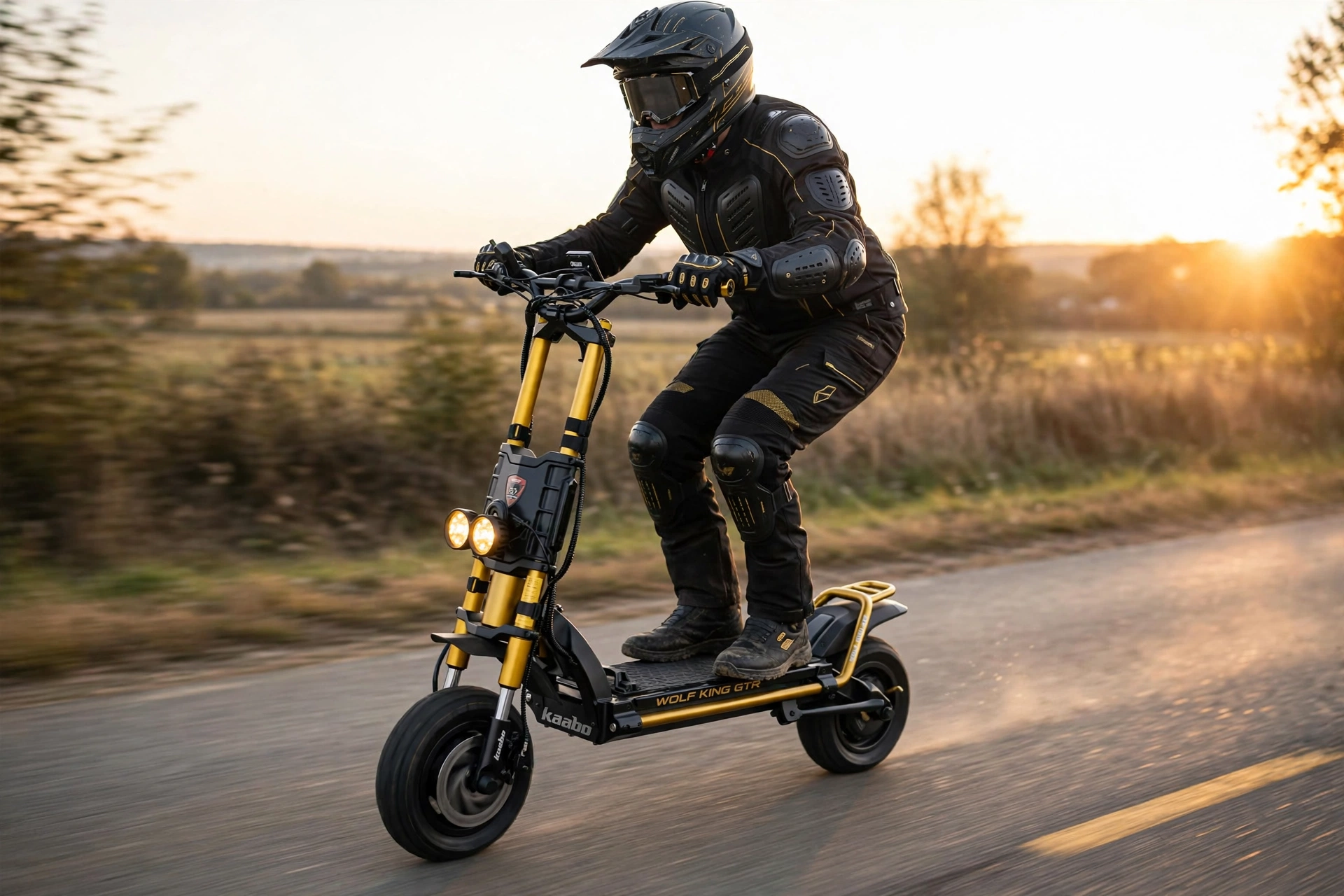
The Kaabo King GTR electric scooter — sold under Kaabo’s Wolf King line as the Wolf King GTR — is not a commuter scooter with a sporty paint job. It is a dual-motor hyper-scooter: two detachable 2,000 W motors, a 13,440 W peak output, a removable 72 V 35 Ah LG battery, and a claimed 112 miles of range. It costs $3,099 on sale at one US dealer at the time of writing, against a $4,199 list price. Everything about it is oversized, including the questions a buyer should ask before handing over that much money.
Here is my position, stated before the spec table so you can read the rest with it in mind. This scooter’s engineering is serious. Its brakes, its dual-stem front suspension, and its chassis are built for the speeds it claims. That does not make it a sensible purchase for most riders. At 65 mph on a standing platform with 12-inch tires, the margin for error is thin, the legal places to ride it at anything near full speed are few, and the weight makes it a garage machine, not a carry-it-upstairs machine. Buy it for private land, closed courses, or jurisdictions where it is genuinely legal to ride, with full gear, and it is a remarkable machine. Buy it expecting to commute on it at 65 mph through city traffic and you are buying trouble with a throttle attached.
Second opinion, equally plain. The headline range figure is a laboratory number. Kaabo claims 112 miles. Independent testers riding hard measured 43.2 miles and 42.8 miles. That gap is not a scandal — every scooter maker quotes range at low speed with a light rider — but it changes the buying math completely. Judge this scooter on 43 miles of hard riding or roughly 60 to 70 miles of gentle riding (est.), and decide whether that still justifies $3,099. For many buyers, it will. For a buyer who chose it specifically for 100-mile rides, it will not.
Kaabo King GTR Electric Scooter: The Short Answer
Think of the GTR as Kaabo’s answer to a simple question: how much scooter can you build before the platform itself becomes the limit? The answer is two motors you can detach for service, a battery you can lift out of the deck, motorcycle-style dual-stem front suspension, and a TFT display that shows you exactly how fast you are going while you decide whether that was wise.
Who is it for? An experienced rider with private land or track access, or a rider in an area where high-power scooters are legal on the road, who already owns full motorcycle gear and treats a pre-ride check as non-negotiable. Who should skip it? Every first-time scooter buyer. Every rider who needs to carry a scooter. Every rider whose daily route is a bike lane with a 15 mph limit. And anyone who plans to ride it without a full-face helmet, gloves, and armored jacket. On this machine, gear is not an accessory. It is part of the vehicle.
Kaabo King GTR Electric Scooter Specs: The Full Table
| Spec | Kaabo Wolf King GTR |
|---|---|
| Motors | Dual detachable 2,000 W nominal (4,000 W combined), 13,440 W peak |
| Top speed | 65 mph / 105 km/h claimed; 65.8 mph measured by one tester |
| Acceleration | 0 to 31 mph in 3.5 seconds (dealer figure); 0 to 50 km/h in 3.5 seconds (Kaabo closed-course figure) |
| Battery | Removable UL-certified LG 72 V 35 Ah, 2,419 Wh nominal per dealer spec sheet |
| Claimed range | 112 miles / 180 km (ideal conditions) |
| Tested range | 43.2 miles (Electric Scooter Guide, hilly course, max performance); 42.8 miles (Electric Scooter Insider, hard riding) |
| Controller | Two-in-one sine wave FOC controller, up to 160 A peak |
| Brakes | Front and rear Zoom hydraulic disc brakes, 160 mm rotors (50% thicker than standard), plus EABS |
| Braking distance | 11.5 feet from 15 mph (Electric Scooter Guide test) |
| Suspension | Front adjustable dual-arm motorcycle-style shock; rear 18-level adjustable spring-damping oil shock |
| Tires | 12-inch CST vacuum all-terrain tubeless tires, self-sealing type |
| Hill climbing | 50 degrees claimed; 200-foot 10% hill climbed in 6.4 seconds (Electric Scooter Guide test) |
| Weight | 137 to 139 lbs / 63 kg net |
| Max load | 330 lbs / 150 kg |
| Water resistance | IPX5 |
| Display | TFT display with Kaabo accelerator trigger |
| Charging | About 8.5 hours with two standard 84 V 2 A chargers; about 3.5 hours with two 5 A fast chargers |
| Extras | Turn signals, dual headlights, deck LEDs, motorcycle-grade horn |
| Price checked | $3,099 sale / $4,199 list at Wilson’s (US dealer) on October 24, 2026 |
Two spec-sheet conflicts deserve an honest note. First, the battery: 72 V times 35 Ah multiplies to 2,520 Wh, while one dealer spec sheet lists 2,419 Wh nominal. The difference is the gap between simple multiplication and the cell manufacturer’s nominal rating. I use 2,419 Wh for the charging-cost math below because it is the published nominal figure, and I flag it here rather than quietly picking the bigger number. Second, the weight: listings give 137 lbs and 139 lbs (63 kg) for the same machine. Treat 137 to 139 lbs as the honest range. Neither discrepancy changes the verdict. Both are worth knowing because they show how loosely scooter specs get copied between listings.
What Independent Tests Actually Measured
Kaabo’s numbers describe a light rider at low speed on flat ground. Independent tests describe what happens when a real rider opens the throttle. The gap between those two descriptions is the most useful thing in this guide.
Electric Scooter Guide took the GTR around a hilly range course in maximum performance mode with a 165 lb rider and measured 43.2 miles. That is 39 percent of the claimed 112 miles. Read that again before you plan a trip. On the same test program, the GTR stopped from 15 mph in 11.5 feet, and it climbed a 200-foot 10 percent hill in 6.4 seconds — quicker than the Inmotion RS and the older Wolf King GT Pro on the same hill, and a tenth of a second behind the NAMI. The reviewer’s summary line was blunt: the scooter has so much power it feels like riding with a finger on a trigger. That is a compliment about the motor and a warning about the throttle hand, in the same sentence.
Electric Scooter Insider’s tester, a 197 lb rider, measured 42.8 miles of real range and a 65.8 mph real top speed, with a 3.0-metre braking figure and a 1.6-second sprint to 15 mph. Two different testers, two different riders, two different courses — and the real-range answers land within half a mile of each other. When independent tests agree that closely, trust them over the brochure.
What about gentle riding? No independent tester has published a full eco-mode range loop for the GTR that I could verify at writing time, so I will not invent one. My working estimate, built from the tested 43.2 miles at full performance and the way scooter range typically scales with speed, is 60 to 70 miles of mixed gentle riding (est.). That is an estimate with its basis stated, not a measured figure. If your riding is mostly 20 to 25 mph on flat ground with modest throttle, expect the top half of that range. If your riding is mostly full-throttle bursts, expect the tested 43 miles, or less in cold weather or with a heavier rider.
An Australian long-range roundup gives a third data point in the same direction: it lists the GTR’s real-world range at roughly 140 to 150 km (87 to 93 miles) against the 180 km claim, presumably for gentler riding than the two hard-riding tests above. The spread across all three sources — 43 miles hard, 87 to 93 miles gentle per that roundup, 112 miles claimed — tells you everything about how much riding style matters on a machine with this much power. Speed is not free. On the GTR, speed is paid for in miles, at a steep exchange rate.
Braking and Suspension: Where This Scooter Earns Its Price
Most scooter reviews start with speed. This one starts with stopping, because stopping is where cheap fast scooters fail and where the GTR justifies its cost. Zoom hydraulic brakes on both wheels, 160 mm rotors that are 50 percent thicker than standard rotors, and electronic ABS assistance. Thicker rotors resist warping and overheating under repeated hard stops. On a 137 lb machine carrying a rider at highway speed, that is not a luxury feature. It is the difference between consistent braking on the tenth stop and fading brakes on the third.
Do the physics on that 11.5-foot figure, because it matters. Stopping distance grows roughly with the square of speed. Scale 11.5 feet at 15 mph up to 65 mph and you get roughly 216 feet before you count reaction time (est., physics scaling only). Add a second for the rider to react at 65 mph — about 95 feet — and a full emergency stop from top speed needs something like 300 feet of clear road (est.). That is a football field. It is also why I insist on full gear and clear sightlines for this machine. The brakes are excellent. They cannot repeal physics.
Suspension is the second place the money shows. The front end uses a dual-stem motorcycle-style setup — two fork stems instead of one — which resists the twisting forces that make single-stem scooters feel nervous at speed. The rear shock adjusts through 18 levels of spring damping. Set it soft for broken pavement, firm for fast smooth roads. Reviewers consistently rate the GTR’s suspension above the older GT’s, and the adjustable range means one scooter can be set up for a 150 lb rider on streets and a 250 lb rider on trails. Check the adjustment before your first fast ride. A hyper-scooter delivered on a middle setting is not set up for you.
One more hardware point that rarely gets the attention it deserves: the tires. Twelve-inch CST all-terrain tubeless tires with a self-sealing design. Bigger tires roll over road flaws that would deflect a 10-inch commuter tire, and the self-sealing construction buys you a ride home from a small puncture instead of a roadside stop. Check tire pressure weekly. Under-inflated tires on a machine this heavy wear fast, overheat, and lengthen stopping distances. A $15 gauge protects a $3,099 machine. That is the cheapest safety upgrade in this entire guide.
Our Own Math: What $3,099 Actually Buys
Here is the analysis only this site is publishing for the GTR, worked from the figures above. At $3,099 divided by the claimed 112 miles, you pay $27.67 per claimed mile of range. At $3,099 divided by the tested 43.2 miles, you pay $71.74 per real mile of hard-riding range. That $44.07 gap is the price of believing the brochure, and it is the single most useful comparison number in this guide. Use the tested-mile figure when comparing against any other scooter, or the comparison will flatter whichever maker exaggerates most.
Power per dollar tells the opposite story, and it is the GTR’s best value argument. Divide the 13,440 W peak output by $3,099 and you get 4.34 peak watts per dollar. Very few machines at any price beat that ratio. If your priority is acceleration per dollar, the GTR is genuinely strong value. If your priority is miles per dollar, it is not. Both statements are true at the same time, and which one matters depends entirely on what you will actually do with the machine.
Charging cost is small enough to ignore in a purchase decision, and I include it so the running-cost picture is complete. One full charge of the 2,419 Wh battery uses about 2.42 kWh. At an average US residential electricity price of about 17 cents per kWh (est.), a full charge costs about 41 cents. On the tested 43.2-mile range, that works out to roughly 0.95 cents per mile. Ride 3,000 miles a year — a heavy year for a recreational hyper-scooter — and you spend about $28.50 on electricity. Tires, brake pads, and the occasional suspension service will cost far more than the electricity, and any honest ownership budget should say so. For a fuller sense of how running costs compare across vehicle types, our EV total cost of ownership guide walks through the same kind of per-mile math for cars.
Weight per dollar is the number that kills the commuter fantasy. At 137 lbs, the GTR weighs more than three Segway commuter scooters combined in spirit, if not literally. It does not fold into a car trunk gracefully — reviewers call the folding mechanism clunky and the most difficult they have tested — and carrying it up stairs is a two-person job for most riders. The removable battery helps with charging: lift the pack out and charge it indoors instead of parking the whole machine by an outlet. Reviewers note the battery connector is fiddly in a tight space, so practice the removal at home before you need to do it in a parking garage.
Kaabo King GTR Electric Scooter Versus the GTR Max: Our Scores
The GTR Max is the same platform with a bigger battery and stronger brakes, and the comparison is the one most buyers actually face. Kaabo USA lists the GTR Max at $3,799 with a Samsung 72 V 40 Ah battery, a claimed 124 miles of range, four-piston brake calipers, and a 148 lb weight. Note the trade: 11 extra pounds for the bigger pack and stronger calipers, and $700 more. The GTR Max battery is described by Kaabo USA as non-removable, unlike the standard GTR’s removable pack — a real difference for a rider who charges indoors.
Our score: Kaabo King GTR electric scooter — 8.1/10. Range 7/10. The tested 43 miles is strong for a hyper-scooter and weak against the claim. Charging 7/10. Dual charging with fast chargers is genuinely quick at 3.5 hours. The standard 8.5-hour charge is a full overnight commitment. Value 9/10. At $3,099 on sale, the hardware per dollar is hard to beat.
Our score: Kaabo King GTR Max — 8.3/10. Range 8/10. The 40 Ah pack stretches both claimed and real range, though the same hard-riding discount applies. Charging 7/10. Same dual-charger setup, slightly longer at about 10 hours on standard chargers and 4 hours on fast chargers. Value 8/10. The extra $700 buys range and braking, not speed — top speed is the same 65 mph — so the Max only wins if range is your constraint.
My verdict between them is simple. Buy the standard GTR if you charge indoors and want the removable battery, or if the $700 difference matters. Buy the Max if you ride long distances between charges and never need to remove the pack. Neither is a beginner machine. Neither belongs in a bike lane at 15 mph with the throttle wide open, because neither was designed for that life.
Charging and Living With 137 Pounds
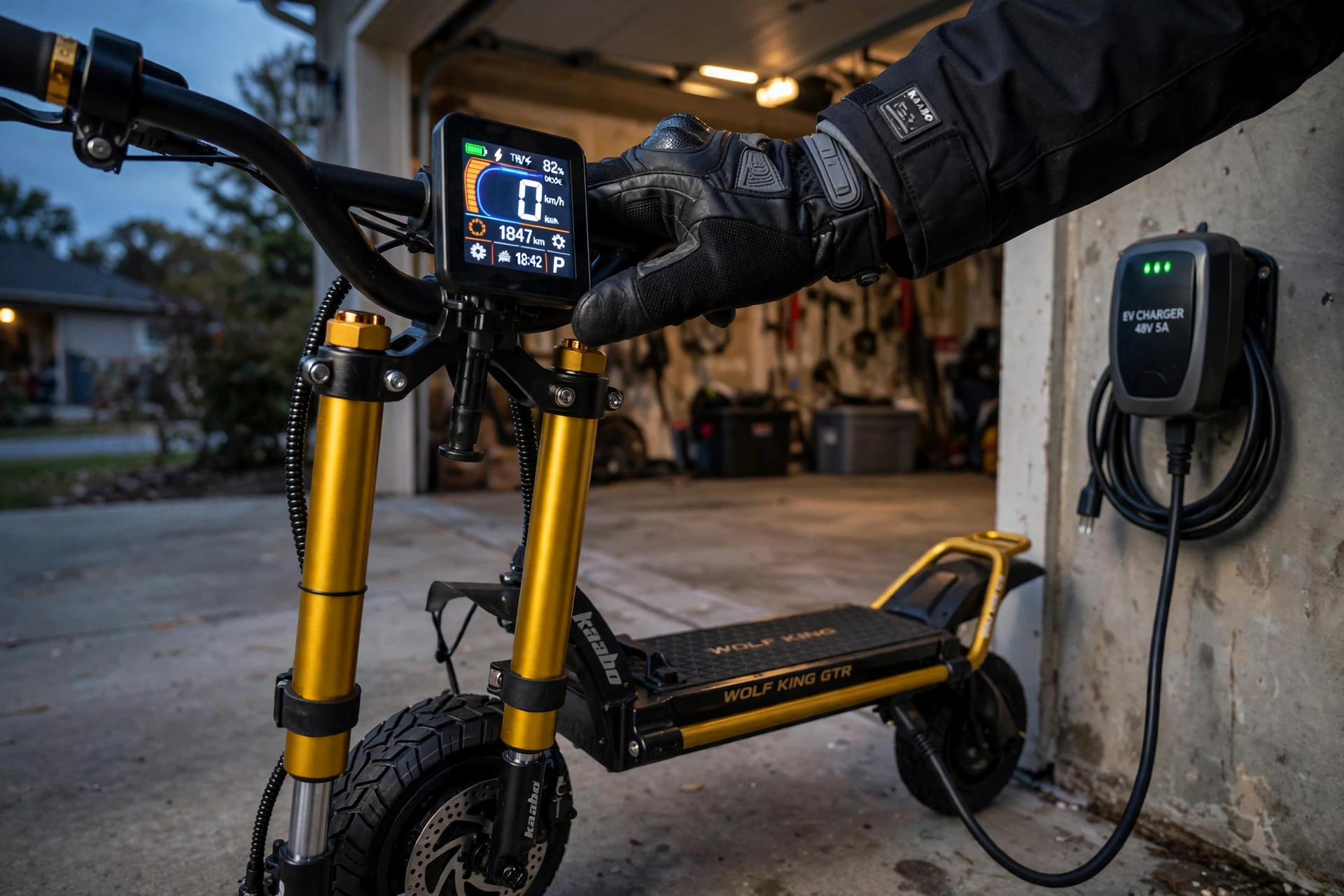
Daily life with the GTR starts with storage. This machine needs a garage, a ground-floor room, or a secure shed. It needs a ramp, not stairs. It needs a wall outlet and, ideally, a second charger. With two standard 2 A chargers, a full charge takes about 8.5 hours. With two 5 A fast chargers, about 3.5 hours. Buy the fast chargers if you ride more than once a day, and use only chargers approved for the 72 V pack. A wrong-voltage charger on a 2.4 kWh battery is a fire risk, not a shortcut.
Maintenance is heavier than commuter-scooter maintenance, in both senses. Check tire pressure weekly. Inspect brake pads monthly if you ride hard. Keep the suspension pivots clean and check the folding mechanism for play — a clunky folder that develops play at speed is a problem, not a quirk. Budget for tires and brake consumables as the real running costs, with electricity as a rounding error. And register the serial number and photograph the machine on delivery. A $3,099 scooter is a theft target, and a lock alone will not stop a determined thief with a van. Store it out of sight.
Where You Can Legally Ride It — Read This Before Buying
Here is the uncomfortable legal paragraph, and I would rather you read it here than learn it from a citation. Most US states and cities limit electric scooters to far less than this machine offers — commonly 20 mph and a motor cap, with rules varying by state, city, and path type. A 65 mph, 4,000 W nominal scooter exceeds those limits almost everywhere on public roads and bike paths. In practice, that means the GTR’s full performance is legally usable on private land, closed courses, and in the few jurisdictions that permit high-power scooters on the road — and everywhere else, you ride it limited, or you ride it illegally.
Kaabo’s own materials describe closed-course testing for the top-speed figures, which is a clue to how the maker itself frames this machine. Some dealers sell speed limiters and road-legal settings. If your area requires one, fit it before the first ride and keep the receipt. And check your local rules before ordering, not after delivery. A $3,099 machine you cannot legally ride where you live is an expensive garage ornament. Riders who want a fast but street-usable alternative should look at a lighter performance scooter in a legal power class — our Segway Xyber guide covers a very different kind of fast electric ride, and the contrast shows how much the legal class changes the ownership experience.
Who Should Buy It, and Who Should Walk Away
Buy the GTR if you are an experienced rider with private or track access, full gear, secure ground-floor storage, and a clear-eyed view of the tested 43-mile hard-riding range. Buy it if you value braking and suspension engineering over brochure numbers, and if the removable battery solves a real charging problem for you.
Walk away if you are new to scooters, if you need to carry the machine, if your riding is on public bike paths with speed limits, or if the purchase depends on the 112-mile claim being true. A gentler, cheaper scooter will serve those riders better, cost less to insure and maintain, and keep them on the right side of local law. If a seated, low-speed machine sounds more like your daily reality, our A3 Aero guide sits at the opposite end of the scooter world, and reading the two guides back to back is a good way to feel how wide that world is.
Final word from the braking-first corner. The GTR is one of the best-engineered fast scooters you can buy in 2026. It is also a machine that demands respect, gear, space, and legal homework. Give it all four and it rewards you with acceleration and stopping power that cheaper scooters cannot match. Skip any one of them and the same machine punishes you just as efficiently. That is not a contradiction. That is what a hyper-scooter is.
Frequently Asked Questions
How fast does the Kaabo King GTR electric scooter really go?
Kaabo claims 65 mph (105 km/h). One independent tester measured 65.8 mph, so the top-speed claim holds up in testing. Usable top speed on public roads depends on local law, which in most US areas is far below 65 mph.
What is the real range of the Kaabo King GTR?
Two independent hard-riding tests measured 43.2 miles and 42.8 miles, against a claimed 112 miles. Gentle riding stretches that figure substantially. My estimate is 60 to 70 miles of mixed gentle riding (est.). No verified full eco-mode test loop was available at writing time, so that estimate stands on its stated basis alone.
How long does the Kaabo King GTR take to charge?
About 8.5 hours with the two standard 84 V 2 A chargers, or about 3.5 hours with two 5 A fast chargers. The battery is removable on the standard GTR, so you can charge the pack indoors away from the machine.
How much does the Kaabo King GTR weigh?
Listings give 137 to 139 lbs (63 kg). It is not a portable scooter. Plan on ground-floor storage and a ramp, not stairs and car trunks.
Is the Kaabo King GTR street legal?
It depends entirely on where you ride. Most US states and cities cap scooter speed and motor power well below this machine’s capability, so its full performance is generally limited to private land, closed courses, and permissive jurisdictions. Check your local rules before buying.
Should I buy the GTR or the GTR Max?
Buy the standard GTR for the removable battery and the lower $3,099 sale price. Buy the GTR Max ($3,799) for the bigger 40 Ah battery, longer range, and four-piston brakes. Note its battery is non-removable and it weighs 148 lbs.