Last updated: October 27, 2026
Twenty-eight miles per hour. Drum brakes. Read that pairing twice before you read anything else, because it defines the turboant r9 all-terrain electric scooter dual suspension better than any marketing line. This is a $549.98 scooter (price checked October 27, 2026, on TurboAnt’s own store, marked down from a $699.98 list) that runs to a GPS-plausible 28 mph on knobby 10-inch tires, hangs its wheels on coil springs at both ends, and then asks two sealed drum brakes and an electronic brake to haul all of that back down to zero.
Speed is easy to sell. Stopping is where a scooter tells the truth about itself.
Start with the hard specification, because the R9 rewards precision. The motor is a rear brushless unit rated at 500 W with an 800 W peak. The battery is a 48 V, 12.5 Ah lithium pack — 600 Wh — fixed under the deck, charged through a 54.6 V, 2 A adapter in a quoted 6 to 8 hours. Three riding modes cap you at 10, 20 and 28 mph. TurboAnt claims 35 miles of range, a 20% climbing ability and a 275 lb maximum load. The frame is aluminum alloy, the deck is 6.7 inches wide and 19.7 inches long, ground clearance is 4.72 inches, and the whole machine weighs 55.12 lb. Water resistance is IP54.
Every figure in this paragraph comes from TurboAnt’s official R9 product page, and any number that page does not confirm gets labelled (est.) with its basis in this review.
Gear. Non-negotiable. A scooter that cruises at 28 mph puts you at bicycle-descending speed on 10-inch wheels, and small wheels lose arguments with potholes, wet leaves and loose gravel. Helmet, every ride, no exceptions carved out for “just down the street.” Gloves too — palms are the first thing a falling rider donates to the pavement. The R9’s knobby tires and suspension buy you margin. They do not buy you immunity, and they do not change the physics of a short wheelbase at speed.
Now the number that needs correcting before it costs somebody a long walk home. TurboAnt’s 35-mile range claim for the turboant r9 all-terrain electric scooter dual suspension is a best-case figure, achieved the way all manufacturer range figures are achieved: modest speed, modest rider, kind surfaces. Independent testing tells a plainer story. AmpedCycle’s published test of the R9 recorded 16 to 20 miles of real-world range depending on terrain and rider weight, and GPS-verified the top speed at 25 to 28 mph on flat pavement.
Credit where due: the speed claim holds up. The range claim does not, and you should plan your life around 18 miles, the middle of the tested band. A 9-mile ride out means a 9-mile ride back. That arithmetic has stranded more scooter owners than any dead battery ever has.
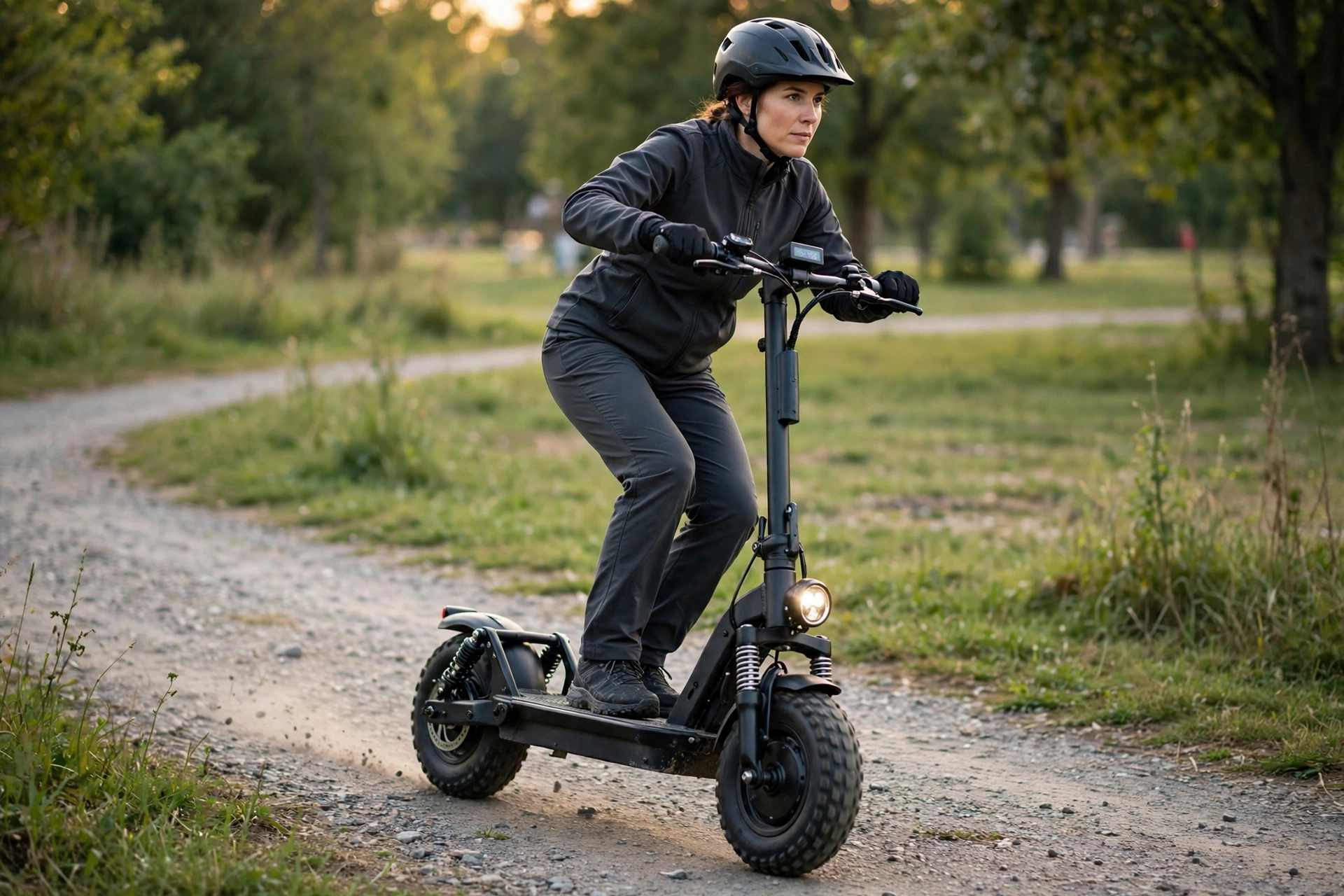
Hold those two facts side by side — honest speed, optimistic range — and the R9’s character comes into focus. It is a scooter for mixed-surface commuting and weekend gravel, priced like a commuter and built tougher than one. The rest of this review takes the machine apart in the order I judge any scooter: brakes first, suspension second, motor third, and the brochure claims last.
Braking, Taken Seriously
The braking system on the turboant r9 all-terrain electric scooter dual suspension is an electronic brake working with front and rear drum brakes. No discs. That sentence will make spec-sheet shoppers smirk, and the smirk is wrong. A drum brake is a sealed unit. The friction surfaces live inside a closed drum, away from the grit, dust and water that an all-terrain scooter spends its life throwing at its own running gear. A disc, by contrast, wears its rotor out in the weather with the pads a millimetre away, waiting for the first handful of trail grit to score it. On pavement-only machines I will argue for discs all evening.
On a scooter designed to leave the pavement, sealed drums are the correct engineering call, and it is not close.
TurboAnt publishes a braking distance, which already puts it ahead of rivals that publish none: 22 to 32 feet on a dry surface. Run the honest arithmetic on that. At 28 mph the scooter covers 41.1 feet every second. TurboAnt’s 22–32 ft figure is braking distance only — wheels already slowing, rider already squeezing.
Your reaction time comes first. Give yourself a realistic 0.75 seconds (est., a normal alert-rider figure) between seeing the hazard and the brakes biting, and the scooter travels another 30.8 feet before deceleration even starts. Total stopping distance from the moment your eyes register trouble: roughly 53 to 63 feet on dry ground. That is the number to hold in your head at full speed. Wet ground stretches it further, a drum’s one real concession, so ride the modes: 28 mph is for clear, dry, familiar ground, and Mode 2’s 20 mph cap exists for everything else.
Maintenance is the drums’ second argument, and it is a strong one. There are no exposed pads to inspect weekly, no rotors to warp, no hydraulic lines to bleed. The electronic brake adds regenerative drag the moment you roll off or touch a lever, which saves the drums work on long descents and returns a trickle of charge.
What you must do is keep the brake cables correctly adjusted — drums announce wear slowly, through a lengthening lever pull, and a rider who ignores that signal is volunteering for a longer stop than the brochure promised. Check lever feel every week. It takes ten seconds and it is the cheapest safety equipment you own.
Suspension and Tires: Where the “All-Terrain” Claim Earns Its Keep
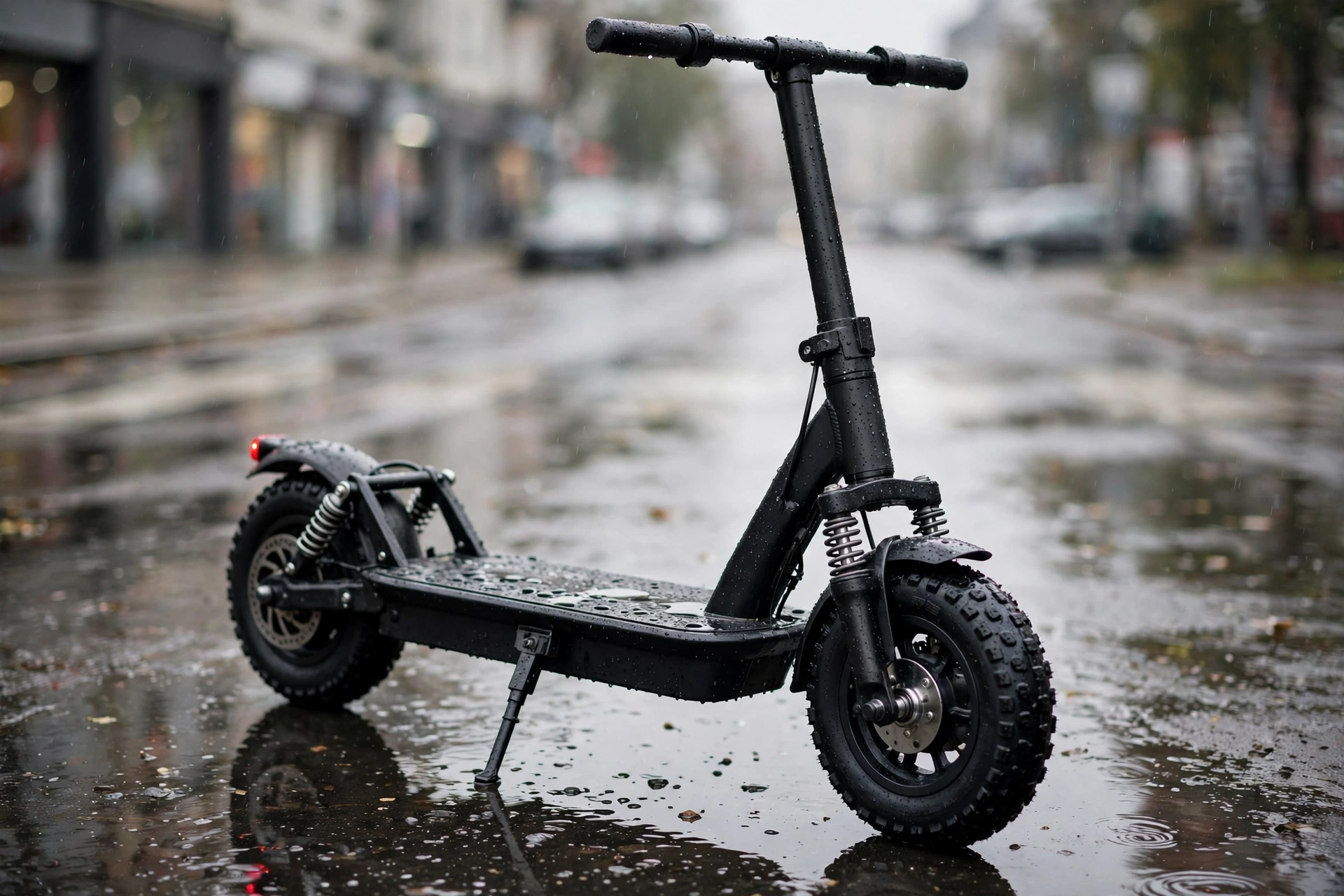
The dual suspension in the product’s full name — the turboant r9 all-terrain electric scooter dual suspension — means coil springs at the front fork and coil springs at the rear swingarm — TurboAnt describes them as front and rear suspension springs, and the design is conventional, proven and rebuildable. Paired with 4.72 inches of ground clearance, the system lets the wheels move over gravel, cracked concrete, grass and hard-packed dirt instead of deflecting off them.
Deflection is the enemy. A rigid scooter on a washboard surface spends part of every second airborne, and an airborne wheel cannot steer, cannot brake and cannot drive. Suspension keeps rubber on the ground, and rubber on the ground is the entire sport.
The tires are 10-inch pneumatics with an all-terrain tread, tubes inside, and they are doing more work than the springs. Air is the first suspension any small-wheel vehicle has. Run them at the pressure on the sidewall (check the fitted tire; do not guess), because a soft knobby tire squirms on pavement, overheats its sidewalls and drinks range, while a rock-hard one hands every pebble straight to the springs. Weekly pressure checks. Again: ten seconds, non-negotiable on a machine whose contact patches are the size of your palms.
Set expectations precisely, though. This is comfort suspension for broken surfaces, not a trail bike’s long-travel setup. Roots, ruts and washboard at walking-to-jogging pace: handled, genuinely well. Drops, jumps and technical singletrack: outside the design brief, and the 55 lb aluminum frame will file its complaint through your wrists first. Ride it as a mixed-surface commuter that refuses to fear a gravel shortcut, and the chassis makes complete sense.
The Motor and the 600 Wh Question
Five hundred watts rated, 800 watts peak, driving the rear wheel. Rear drive is the right layout for a scooter that climbs: weight transfers backward under acceleration, loading the driven wheel exactly when it needs grip. TurboAnt rates the climb at 20%, which in the real world means steep residential streets and parking-structure ramps, handled without the motor falling off its torque curve.
Independent testers noted the motor works hard and can trim power on long steep climbs to protect itself from heat. Believe them. A single 500 W motor is a commuter tool, and a rider who treats every hill as an insult will meet the thermal limit.
The battery deserves the same plain treatment. Six hundred watt-hours is a serious pack at this price — it is why the turboant r9 all-terrain electric scooter dual suspension can post a 35-mile claim at all. Working from the tested figure instead: 600 Wh over 18 real-world miles is 33 Wh per mile, a believable consumption rate for a heavy scooter on knobs at speed. Gentle riding in Mode 2 on smooth ground will beat it; full-throttle gravel will not.
The pack is fixed under the deck rather than removable, which keeps the structure stiff and the centre of gravity low — and means charging happens where the scooter sleeps, through that 2 A adapter, for 6 to 8 hours. Overnight, in other words. Fine for a daily rhythm, useless for a midday top-up strategy. If your charger ever needs replacing, match the 54.6 V output exactly; our EV charger compatibility checker walks through why voltage and connector matching matter before any money changes hands.
What the R9 Actually Costs to Run — Our Arithmetic
Now the computation we run on every machine, because purchase price per brochure mile is a rigged game. At $549.98 and the tested 18-mile midpoint, the R9 costs $549.98 ÷ 18 = $30.55 per mile of real range. Run the same division on TurboAnt’s claim and you get $549.98 ÷ 35 = $15.71 per mile — the flattering number, the one that assumes the brochure is a documentary.
For context, TurboAnt’s own X7 Max is $449.98 with a 30-mile claim, which is $15.00 per claimed mile, so the R9 is not selling cheaper miles. It is selling something else entirely: the springs, the brakes, the knobs and 8 mph more speed.
Running costs are almost absurdly small. A full charge pulls roughly 600 Wh ÷ 0.85 charging efficiency (est., a typical figure for a small switch-mode charger) = 706 Wh, call it 0.71 kWh from the wall. At $0.17 per kWh (est., US residential average territory), a full battery costs about $0.12. Spread over 18 tested miles, that is 0.7 cents per mile — the same order of magnitude we found when costing out what it costs to charge an electric bike, because physics charges by the watt-hour and does not care what the vehicle is called.
A year of 10-mile commuting days, 250 of them, totals roughly 139 full charges and about $17 of electricity. The tires will cost you more than the energy. Plan accordingly: budget for tubes and tread, not electrons.
Weight, Folding, and Living With 55 Pounds
The turboant r9 all-terrain electric scooter dual suspension folds, and the folded package measures 44.88 × 23.23 × 20.47 inches, which fits a car trunk or a hallway corner. It also weighs 55.12 lb, and here is a one-sided opinion you can hold me to: stop describing 55 lb as portable. Fifty-five pounds is a checked suitcase. It is a two-handed, plan-your-grip lift, and anyone who sells it as a train-friendly companion has never carried it up three flights of wet stairs. Fold it for the trunk, fold it for storage, fold it never for a daily multi-modal commute.
Riders who genuinely carry a scooter every day should be shopping a class down in weight and accepting the smaller battery that comes with it.
Daily details are otherwise well judged. The 23.2-inch handlebar is properly wide, which steadies a tall stem at speed. The deck takes both feet in a natural stagger. The LCD is readable, the 5 W LED headlight and rear turn signals are equipment many rivals at this price skip, and a bell is fitted because somebody at TurboAnt has ridden in a city. There is even a USB port (5 V, 1 A) for a phone, which will sip rather than gulp a charge.
IP54 means splashes and light rain — rinse-off weather, not storm weather — and the manual’s storage guidance caps a full charge’s storage at 30 days, so a scooter parked for winter wants a monthly charging appointment in the calendar.
R9 Against the Machines It Gets Cross-Shopped With
Two comparisons matter. The first is upward: our Kaabo King GTR scooter guide covers a dual-motor flagship that costs several times the R9’s price and plays a different sport altogether — sustained speed, huge range, serious mass. The R9 is not a cut-price GTR and should never be ridden as one; it is what a sensible rider buys when the GTR’s numbers are fantasy and the commute is real.
The second comparison is sideways: the Segway Ninebot Max G30P is the polished pavement commuter — refined, proven, and rigid. No suspension at either end. On smooth city asphalt that hardly matters; the first gravel cut-through or frost-heaved side street settles the argument in the R9’s favour, because that is precisely the terrain its springs and knobs were bought for.
So who should hand over the $549.98? The rider whose route mixes pavement with gravel paths, grass cut-throughs and broken back streets, and who is honest about an 18-mile working range. The rider who wants 28 mph with brakes engineered for the surfaces under the wheels, not just the spec sheet. Who should not: the apartment dweller with stairs, the 25-mile-each-way commuter, and anyone whose local law caps scooters at speeds the R9’s Mode 3 exceeds — check your jurisdiction before the first ride, and ride the mode your law and your surface agree on.
Our Verdict on the TurboAnt R9
Scores here follow the method on our how we research page: manufacturer figures are checked against published independent tests, estimates are labelled, and braking hardware is weighted like a rider’s life depends on it, because eventually one does.
Our score: 7.9/10
Range: 6.5/10 — the tested 16–20 miles is serviceable; the gap between that and the 35-mile claim is the deduction, and it is a large one.
Braking & suspension: 8.5/10 — dual sealed drums plus electronic brake, a published dry braking distance, and coil springs at both ends. The strongest part of the machine.
Value: 8.7/10 — $30.55 per tested mile of range with this chassis hardware at $549.98 is a hard combination to beat honestly.
The turboant r9 all-terrain electric scooter dual suspension is a properly engineered answer to a question most scooters dodge: what happens between the pavement’s end and your front door? It answers with springs, sealed brakes and tires with tread. Buy it for your surfaces, respect its range, wear the helmet.
TurboAnt R9 Questions, Answered Plainly
What range does the turboant r9 all-terrain electric scooter dual suspension really deliver?
Plan on 16 to 20 miles. That is the band independent testing published for the R9, against TurboAnt’s 35-mile maximum claim. Rider weight, hills, gravel and Mode 3 all pull you toward the bottom of the band; Mode 2 on smooth ground is how you reach the top of it.
Are drum brakes a downgrade at 28 mph?
No. Front and rear drums plus an electronic brake stop this scooter in a quoted 22–32 feet on dry ground, and the drums are sealed against the grit an all-terrain tire throws up. Add your own reaction distance — about 31 feet at 28 mph for a 0.75-second reaction (est.) — and ride with the true total, roughly 53–63 feet, in mind.
Can the R9 handle hills and heavier riders?
TurboAnt rates it for a 20% climb and a 275 lb load, and the 800 W peak output supports both claims for ordinary street grades. Long, steep climbs will heat the single motor and it may trim power to protect itself, so treat mountain grades as occasional efforts, not a daily route.
How long does charging take, and what does it cost?
Six to eight hours on the supplied 54.6 V, 2 A adapter — an overnight charge. The energy itself costs about 12 cents per full battery (est., from 0.71 kWh drawn at $0.17/kWh), which works out near 0.7 cents per tested mile.
Is the R9 waterproof enough for wet commuting?
It is rated IP54: splashes and light rain, yes; standing water, pressure washers and storms, no. Drum brakes tolerate wet weather better than open systems, and braking distances still grow on wet ground, so slow down, use a lower mode, and dry the scooter before charging.
In short, the turboant r9 all-terrain electric scooter dual suspension makes most sense for mixed-surface riders who value sealed braking and suspension over a headline range figure. For those riders, the turboant r9 all-terrain electric scooter dual suspension is a practical choice, provided the 18-mile real-world range fits the route.