Last updated: October 27, 2026
The short answer is no, with specific and narrow exceptions. If you are asking can you drive a golf cart on the road, the honest reply across most of the United States is that a standard golf cart, exactly as it leaves the showroom, is not a road vehicle. It is a course vehicle the law tolerates in defined places: designated streets in certain communities, cart paths in planned developments, private land.
Everywhere else, the machine that may legally do the job is a different legal object, the low-speed vehicle, or LSV, even when built on the same frame as the cart beside it.
The distinction surprises many buyers who ask can you drive a golf cart on the road, because the two vehicles often share a motor, a bench seat and a silhouette. The difference is not mechanical. It is documentary: a list of federally required equipment, a vehicle identification number, a title, a registration, an insurance policy and a licensed driver. European readers will recognise the pattern: neither the United States nor the European Union regulates vehicles by appearance, only by category, and the category decides where the wheels may turn.
The confusion is understandable. In the large retirement communities of Florida and Arizona, carts are simply how people move: to the shops, to the pool, to a neighbour’s porch. In The Villages in Florida, and on the hundred-plus miles of paths in Peachtree City, Georgia, the cart is ordinary transport, because locally it is. That everyday familiarity is why so many visitors ask can you drive a golf cart on the road beyond those boundaries.
From the statute book, each of those places is an exception drawn street by street. Step outside the boundary and the exception ends.
Federal law supplies the outer frame. NHTSA created the LSV class in 1998 through Federal Motor Vehicle Safety Standard No. 500, and the FMVSS 500 rule, published in the Federal Register, still defines what such a vehicle is and what it must carry.
The states decide the rest: titling, registration, insurance and the map of permitted roads. One level of government writes the equipment list; the other writes the geography. This article follows the same order: definition, designated places, the LSV checklist, the conversion arithmetic, owner-reported enforcement, and the European system. Our method is set out on our research page: statute first, brochure last.
Can you drive a golf cart on the road? Start with the definition
Florida law governs more golf carts than any other state’s, and it defines the vehicle with a number: under sections 320.01 and 316.212 of the Florida Statutes, a golf cart is a motor vehicle designed for operation on a golf course that is not capable of exceeding 20 mph. That figure, 20 mph (32 km/h), is the hinge of the subject. A vehicle that cannot pass it is a golf cart, exempt in Florida from title, registration and plates. One that can is a low-speed vehicle, with the full apparatus of motor-vehicle law attached. The badge on the bodywork is irrelevant. The speedometer decides.
That speed limit is therefore the first test when asking can you drive a golf cart on the road in Florida.
Most production carts sit below the line, at a governed 12 to 19 mph. That is why they are cheap and simple: no federal safety standard applies to a golf cart as such, so it needs no crash structure, no certified glazing, no seat belts and no regulated 17-character VIN, only a manufacturer’s serial number. The same speed-defined logic produced the Class 1, 2 and 3 system described in our guide to Class 1 e-bikes, and the same behaviour at the boundary: owners tempted to tune a vehicle across a line it was never certified to cross. That simplicity is why many buyers only later ask can you drive a golf cart on the road in legal terms, not just mechanical ones.
The question can you drive a golf cart on the road is therefore two questions, one about a cart and one about an LSV, wearing a single coat.
Definitions are not uniform, which is the first trap. Arizona defines a golf cart as a vehicle with at least three wheels, an unladen weight under 1,800 pounds (816 kg), designed for not more than 25 mph and not more than four people. A cart unremarkable in Phoenix may exceed the Florida definition of the same word. Read the definition in the state where the wheels will turn, not the state where the cheque was written.
Where a plain golf cart may legally travel
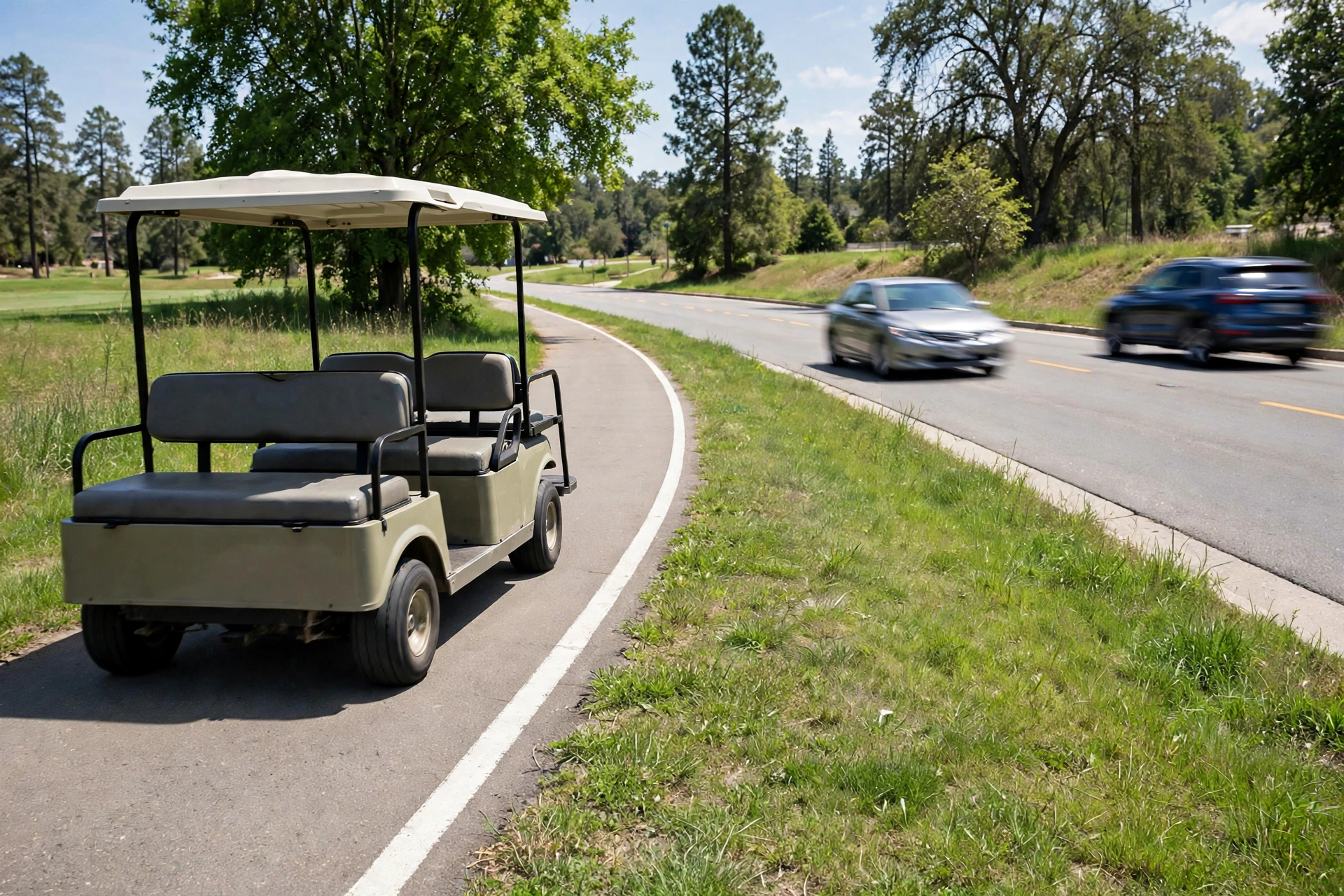
Asked as an address rather than a slogan, can you drive a golf cart on the road near your own house, the general rule is prohibition, followed by exceptions. Florida’s section 316.212 states the pattern plainly: a golf cart may not be operated on public roads or streets except where the responsible governmental entity, a county, a municipality or the Department of Transportation, has designated a specific road for carts and posted signs saying so. Designation is the whole mechanism: a quiet street is not thereby a legal cart street, and the sign is the evidence.
The statute then adds conditions owners frequently learn late. A cart may cross a street or highway at an approved crossing, and where a single mobile home park sits on both sides of the road. If authorised by the Division of Recreation and Parks, it may use State Park Road System roads posted at 35 mph or less. Operation is limited to sunrise-to-sunset hours, unless the authority has allowed night operation and the cart carries headlights, brake lights, turn signals and a windshield.
Every cart must have efficient brakes, reliable steering, safe tyres, a rearview mirror and red reflectorised warning devices front and rear. Drivers under 18 need at least a learner’s licence; drivers 18 and over need government photographic identification. Local ordinances may be stricter, and often are.
Arizona reaches a similar destination by a different road. Its operative road-use statute is the neighbourhood electric vehicle (NEV) law, section 28-966: an NEV must not exceed 25 mph, must not be driven on a highway posted above 35 mph, though it may cross one at an intersection, and must carry a notice of those restrictions in view of the driver. A separate provision lets carts and NEVs in age-restricted communities in unincorporated large counties use a paved shoulder or the roadway’s right-hand edge.
Sun City and Sun City West operate inside that framework, not outside the law. That framework is the local answer to can you drive a golf cart on the road in those communities.
Private and community roads are the third territory: streets owned by an association, resort or campus follow the owner’s rules layered over state law, which is why one community waves carts through and the next, across an identical-looking road, does not. Sidewalks are not cart territory under Florida or Arizona law, whatever local custom suggests.
Can you drive a golf cart on the road as an LSV? The federal checklist
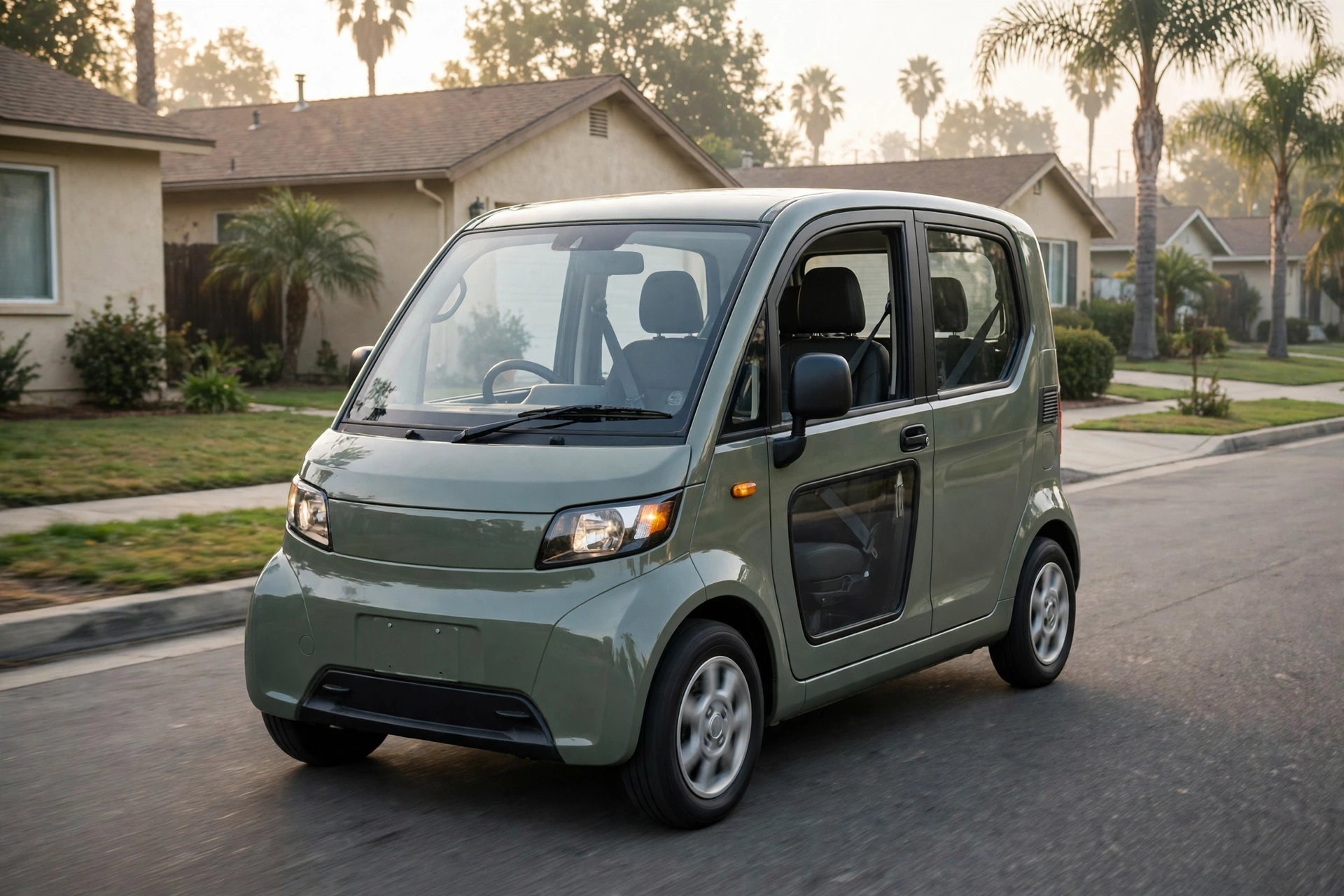
The lawful route onto ordinary public roads runs through the LSV category. Can you drive a golf cart on the road as a general-purpose vehicle? Only once it has stopped being, in law, a golf cart. FMVSS 500 defines a low-speed vehicle as a four-wheeled motor vehicle whose speed attainable in one mile is more than 20 mph but not more than 25 mph on a paved level surface, with a gross vehicle weight rating under 3,000 pounds (1,361 kg). The window is narrow by design: fast enough for a residential street, slow enough to stay outside the full passenger-car safety regime.
Every vehicle sold as an LSV must be equipped with all of the following: headlamps; front and rear turn signals; tail lamps; stop lamps; reflex reflectors, red at the rear and red on each side as far rearward as practicable; mirrors, an exterior mirror on the driver’s side plus either a passenger-side exterior mirror or an interior mirror; a parking brake; a windshield of safety glazing; seat belts for every designated seating position; and a VIN that conforms to the federal numbering standard.
LSVs built in recent years also fall under the federal rear-visibility and pedestrian-alert sound rules. What the standard does not require is equally instructive: no crashworthiness testing, no airbags, no bumpers rated for car-speed impacts. An LSV is a regulated vehicle, but it is not a small car, and it should never be driven as if it were one: the 25 mph ceiling exists because the structure behind the seat belts was never tested for more.
So can you drive a golf cart on the road in an LSV? Yes, within that ceiling and only on roads where LSVs are permitted.
Federal equipment is only half of the transaction. NHTSA does not title or register vehicles; states do.
The worked example is Florida’s section 316.2122: an LSV may be operated only on streets posted at 35 mph or less, though it may cross a faster road at an intersection; it must carry the federal equipment list; and it must be registered and insured under Florida law and titled, while the driver must hold a valid driving licence.
Counties and municipalities may still prohibit LSVs on particular roads for safety reasons. Most states follow the same pattern, 35 mph or less being the standard LSV territory, and most require the same four documents: title, registration, insurance, licence.
The factory LSV is the clean expression of the category. The GEM e2, e4 and e6, built by Polaris, and street-legal lines from Club Car and Tomberlin leave the factory inside the window: governed to 25 mph, the full equipment list fitted, a 17-character VIN and a manufacturer’s certificate of origin that a DMV can title without argument. They are not faster or stronger than a good converted cart. They are simply born documented, and in this subject documentation is destiny.
Factory LSV or converted cart: the arithmetic
Owners ask whether conversion is cheaper. The parts are not expensive; the paperwork risk is. Here is our computation: a sound used 48-volt cart converted to LSV specification in a state that permits conversions. Prices checked October 27, 2026; figures marked (est.) are typical US prices from dealer and parts listings of that date. The paperwork question behind can you drive a golf cart on the road matters more than the parts list, because an untitled conversion cannot use public roads.
- Used 48V cart in good mechanical order: $4,500 (est.)
- DOT lighting set (head, tail, brake, turn): $420 (est.)
- Safety-glass windshield with wiper: $380 (est.)
- Seat belts, four positions: $160 (est.)
- Mirrors, two exterior and one interior: $95 (est.)
- Horn, reflectors and slow-vehicle emblem: $60 (est.)
- Controller and speed work to reach a genuine 22 mph: $350 (est.)
- Labour, six hours at $95: $570 (est.)
The parts sub-total is $420 + $380 + $160 + $95 + $60 + $350 = $1,465; with labour, $1,465 + $570 = $2,035. The administrative layer follows: inspection, an assigned VIN where required, title and first registration at $210 (est.), and a first year of LSV insurance at $340 (est.). Total conversion cost: $2,035 + $210 + $340 = $2,585.
Beside the $4,500 cart, the converted, titled, insured machine has cost $7,085, against a new factory LSV that typically starts in the $8,000 to $12,000 band. The saving is real but narrower than the parts catalogue suggests, and it buys no manufacturer certification. Published conversion guides put a full conversion, titled and insured, at $2,000 to $4,500, which brackets our figure. You can test the ownership side year by year in our total cost of ownership calculator. That comparison is the financial side of can you drive a golf cart on the road, because the factory LSV price includes the paperwork.
Running costs are where the small vehicle wins honestly, if modestly. A 6-mile (9.7 km) daily round trip on 300 days a year is 6 × 300 = 1,800 miles. An LSV at 0.30 kWh per mile (est.) uses 1,800 × 0.30 = 540 kWh, costing 540 × $0.17 = $91.80 a year. A petrol car at 30 mpg burns 1,800 ÷ 30 = 60 gallons, costing 60 × $3.40 = $204, before higher insurance and servicing.
The saving, roughly $112 a year, is real and small; nobody should convert a cart to win it. Our verdict on conversion is firm: convert only a cart you already own, in a state with a documented conversion path. Where titling a conversion is slow or untested, the factory LSV is cheaper at any sticker price, because a conversion that cannot be titled is $2,585 of decoration.
What owners say: enforcement on the ground
The owner material here is reported as owners report it, in forums and community boards; it is owner-reported experience, not measured fact, as no agency publishes usable enforcement statistics. The pattern is consistent.
Inside designated communities, enforcement is light and usually begins with a warning; carts are part of the furniture. The stops owners describe happen at the boundary: the arterial outside the community, the stretch between designated areas, the highway crossed away from an approved crossing. The geography of the ticket is the geography of the statute.
The second pattern is financial rather than penal. Owners report that the expensive event is not the citation but the crash: an unregistered, uninsured cart in a collision on a public road leaves its driver carrying liability personally, and insurers have denied claims where a vehicle was operated outside its legal category.
A quieter complaint concerns associations stricter than the state, with fines for night driving the state itself would permit. Can you drive a golf cart on the road in front of your own house? Three authorities can write the answer, state, city and association, and the strictest collects the fine.
The third pattern is seasonal. In resort towns, visitors assume the local cart culture is a general permission, drive rental carts onto roads the designation never covered, and meet enforcement residents describe as far less patient with visitors. The lesson owners draw is boring and correct: the designation map, not local custom, is the document that matters. Before setting out, the safe check is to ask can you drive a golf cart on the road on that specific route, not whether carts are common in town.
Can you drive a golf cart on the road in Europe? Two categories, no grey zone
Europe solved this problem by refusing to have it. A European golf cart, as such, has no road category at all; what Europe registers instead is the quadricycle. Category L6e, the light quadricycle, is limited to an unladen mass of 425 kg excluding batteries, a maximum design speed of 45 km/h (28 mph) and, for an electric drive, a maximum continuous rated power of 6 kW.
Category L7e, the heavy quadricycle, allows 450 kg for passengers or 600 kg for goods, again excluding batteries, up to 15 kW and 90 km/h (56 mph) by design.
Both are type-approved, registered and insured, and both require a licence: typically the AM moped licence for L6e, available at 14 to 16 depending on the member state, and a B1 or full B licence for L7e.
The Citroën Ami, now common in French and Italian cities, is an L6e vehicle: what a golf cart becomes after a continent decides to regulate it properly.
The comparison exposes the American grey zone. The US low-speed vehicle sits at L6e speed with something closer to L7e paperwork, while the plain American golf cart occupies a legal space Europe does not offer: an unregistered motor vehicle tolerated by local designation.
Neither vehicle crosses the Atlantic legally: an Ami cannot be registered as a car in the United States, and an American cart has no category to register into in France. European buyers, used to the gap between WLTP-rated range and real range, will recognise the cart market’s range claims for what they are: a rating convention, not a measurement. In Europe the answer is a quadricycle, the same in Lisbon and in Lille. The Atlantic gap is another reason can you drive a golf cart on the road cannot be answered by looking at the vehicle alone.
Our verdict
Our score: 6/10 for the golf cart as road transport, assessed on the three measures that decide the question in practice. Legal clarity: 4/10. Conversion sense: 5/10. Everyday usability: 8/10.
The low clarity score is not an accusation against any statute; sections 316.212 and 316.2122 are models of plain drafting, and FMVSS 500 fits on a page. It reflects rules spread across federal standards, state statutes, county designations and association rulebooks, which most owners meet in the wrong order: vehicle first, law second. That spread of rules is why can you drive a golf cart on the road can feel confusing even when each individual rule is clear.
Conversion sense earns its middling mark from the arithmetic above. Usability is the genuine strength: inside its legal map, on 25 and 35 mph streets, for trips of two to six miles, an LSV is cheap to run, trivial to park and sufficient in a way a two-tonne car is not. The recommendation follows: if road use is the point of the purchase, buy the factory LSV and its paperwork. If the cart is in the garage, read the designation map before a parts catalogue. That advice is the practical answer for anyone asking can you drive a golf cart on the road for everyday trips.
Frequently asked questions
Can you drive a golf cart on the road at night?
In Florida, only where the responsible authority has permitted night operation and the cart carries headlights, brake lights, turn signals and a windshield; the default under section 316.212 is sunrise to sunset. An LSV, being a registered motor vehicle with full lighting, is not subject to the daylight restriction. Local rules elsewhere follow the same logic: lighting first, darkness second.
Do I need a driving licence to drive a golf cart?
For a plain cart on designated Florida roads, a full licence is not required: drivers under 18 need a learner’s licence or driving licence, and drivers 18 and over need government-issued photographic identification. For an LSV the answer is stricter everywhere we have checked, Florida included: a valid driving licence is required, because the LSV is a motor vehicle in the full sense.
Can a golf cart cross a main road?
Yes; crossing is the widely permitted exception. Florida allows carts to cross at approved crossings and where a mobile home park is divided by the road; LSVs may cross a road posted above 35 mph at an intersection, as Arizona’s NEV law also allows. Crossing is a moment, not a route: travelling along the faster road is what the law forbids.
Will insurance pay if an unregistered cart crashes on a public road?
Treat the honest answer as no, and plan accordingly. Owners report claims denied where a vehicle was operated outside its legal category, and a cart used on public roads without registration or a policy leaves the driver’s liability personal and uninsured. An LSV, titled and insured as a motor vehicle, removes that exposure: among the strongest practical arguments for the category.
Is a GEM just an expensive golf cart?
No. A GEM is a factory low-speed vehicle: it meets FMVSS 500, carries the full equipment list and a federal VIN, and is titled, registered and insured like any motor vehicle. It resembles a cart because the LSV category grew out of cart-shaped vehicles in planned communities; legally it is a different species, and the price is largely the price of that difference.
Can I register a European quadricycle, such as a Citroën Ami, in the United States?
Not through any normal route. The Ami is approved as an EU L6e quadricycle, a category American law does not contain; it meets neither US passenger-car standards nor the LSV definition, and arrives without the certification a state needs to title it. The two systems regulate the same idea in incompatible paperwork, and the Atlantic remains wider than 25 mph.
The summary is short. Can you drive a golf cart on the road? On designated roads, in defined communities, under conditions your state and city have written down, yes. As general transport on ordinary roads, no: the vehicle that can is called an LSV, carries a VIN, a plate and an insurance policy, and costs what that paperwork costs. Buy the category that matches the roads you intend to use, and the question answers itself.
So, can you drive a golf cart on the road? Check your local designation map first, and remember that can you drive a golf cart on the road depends on whether the vehicle is a plain cart or a titled LSV.